Zennaxx

Author: Zennaxx Team

  • HIPAA-Compliant App Development: Complete Guide to Cost, Requirements & Process

    HIPAA-Compliant App Development: Complete Guide to Cost, Requirements & Process

    What is HIPAA-Compliant App Development?

    HIPAA-compliant app development means developing mobile or web applications that comply with the security, privacy, and data protection regulations set by the Health Insurance Portability and Accountability Act (HIPAA). In short, if your app collects, stores, processes, or transmits any kind of patient health information referred to as Protected Health Information (PHI), then it must be built in a way to keep that information safe, private and handled correctly at every single step.

    This is not a checkbox exercise. HIPAA compliance covers everything from how data is encrypted to who is allowed access to it, to how long records are kept, to what happens if there is a breach. If you are building a telehealth software, a patient portal, a remote monitoring app or a clinic management tool, hipaa compliant app development has to be baked into the architecture from day 1 and not added as an after thought once the app is already built.Getting this right is a non-negotiable for healthcare businesses everywhere in Canada, including Toronto and Ontario and the US. It is the basis for everything else.

    Why HIPAA Compliance is More Important Now Than Ever

    Healthcare data is among the most valuable, and most confidential, information in the digital world. And the numbers explain why compliance isn’t optional any longer.Healthcare data breaches are now considered the most expensive of any industry, with the average breach costing millions of dollars per incident and taking months to fully identify and contain. The legal fallout is just as bad as the financial fallout.

    Violating HIPAA can cost you between a few hundred dollars per violation and over $2 million. If someone intentionally misuses patient data, they can face criminal penalties that include hefty fines and even jail time.

    But it is not just about fear of punishment. In the healthcare industry, HIPAA compliance has become a real trust signal. It’s not a compliant product so hospitals, insurance companies and enterprise healthcare buyers just won’t look at it. Patients are also much more aware of data privacy today, and they’re much less likely to use or trust an app that doesn’t take their information seriously.

    As digital health accelerates from telemedicine to AI-driven diagnostics to remote patient monitoring, the need for secure, compliant infrastructure is only growing. This is precisely the reason many healthcare organizations are reaching out to a trusted mobile app development company that understands the technology along with the regulatory landscape.

    HIPAA Mobile App Requirements: What Your App Needs

    The first step in any development project is to understand the core requirements of the HIPAA mobile app. HIPAA is made up of four core rules but the Security Rule and Privacy Rule are the most applicable to app developers.

    The Privacy Rule specifies when PHI may be used or shared, gives patients access to their own health data and the right to correct it, and requires that apps collect only the minimum amount of information necessary for their operation.

    The Security Rule requires certain protections that are divided into three groups:

    • Technical Safeguards- encryption, access controls, audit logs, and authentication, these are mostly owned by app developers
    • Administrative Safeguards- policies, training, and risk assessments managed by the healthcare organization
    • Physical Safeguards- controls over the physical devices and locations where PHI is accessed or stored

    Basic technical requirements for all HIPAA-compliant apps:

    • Encryption at rest using AES-256 for all stored PHI never saved in plaintext
    • Encryption in transit with TLS 1.2+ (TLS 1.3 is the new preferred standard)
    • Unique user identification with role-based access control (RBAC)
    • Multi-factor authentication (MFA) for any account accessing PHI
    • Audit controls and immutable logs that record every instance of PHI access
    • Integrity controls to prevent the unauthorized alteration or deletion of data

    Equally important is understanding the distinction between transient PHI access (data processed on a temporary basis and not stored) and persistent PHI access (data stored long term in the system).

    Each requires a different level of protection, and your app’s architecture should clearly separate the two from the very beginning.A technically perfect app can still lead to a violation if the organization employing it doesn’t adhere to proper administrative processes, making compliance a shared responsibility between the development team and the healthcare provider.

    Step-by-Step Process of HIPAA Compliant App Development
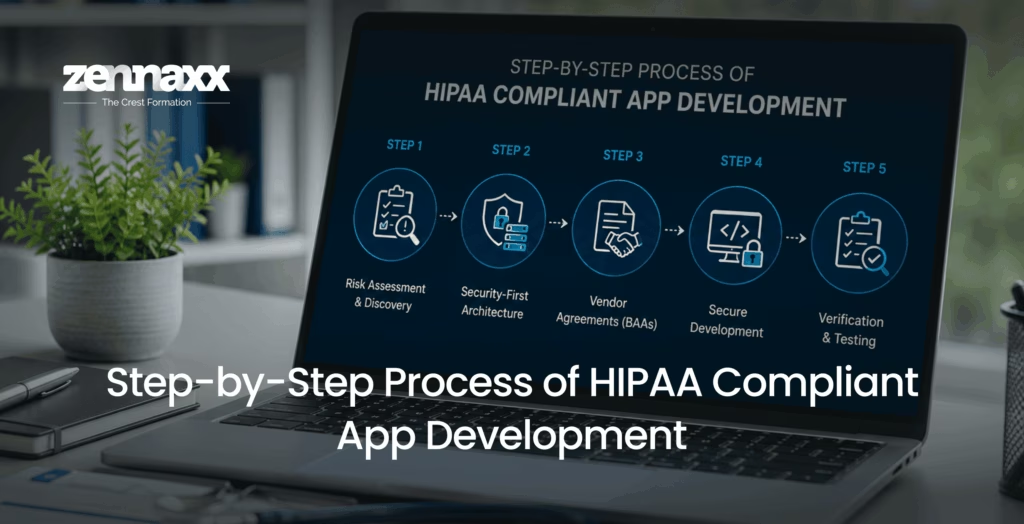
    Step by Step Process of HIPAA Compliant App Development

    Developing a healthcare app that meets compliance is a methodical, security-first process. Here’s how a seasoned development team does it:

    Step-1: Risk Assessment & Discovery

    The team conducts a gap analysis to understand exactly what PHI the app will handle, how it will flow through the system, and what risks exist at each touchpoint.

    Step-2: Security-First Architecture

    Instead of designing the app first and then bolting on security, the whole technical architecture, database structure, API design and cloud infrastructure is planned with compliance requirements in mind from the beginning.

    Step-3: Vendor Agreements (BAAs)

    Business Associate Agreement (BAA), Third-party vendors who interact with PHI include: cloud hosting providers, analytics tools, or customer support platforms. That means ensuring your cloud provider (AWS, Azure or Google Cloud) is configured within HIPAA-eligible boundaries, as default settings are often not compliant out of the box.

    Step-4: Secure Development

    Developers develop the application with encryption, access controls, and audit logging built in as architectural decisions, not as bolt-on features. Mobile-specific protections like certificate pinning, secure local storage (iOS Keychain or Android Keystore) and jailbreak / root detection are implemented to prevent data leaks on compromised devices.

    Step-5: Verification & Testing

    This phase includes rigorous QA, professional penetration testing and a compliance audit designed to identify encryption gaps, missing access controls or weak authentication before launch.

    Step-6: Pre-Launch Checklist & Continuous Compliance

    The team conducts breach notification processes, final security checks and documentation before going live. Compliance doesn’t end at launch. It must be monitored on an ongoing basis, risks must be assessed on a regular basis and HIPAA mobile app requirements must be updated as regulations change.In principle, this is how other regulated or security-sensitive apps are built. If you’re curious about how it compares across industries, take a look at our guides on mobile banking app development and stock trading app development that also need bank-grade security architecture.

    HIPAA App Development Cost: A Realistic Breakdown

    One of the most common questions healthcare businesses ask is: how much does HIPAA-compliant app development actually cost? The honest answer is that hipaa app development cost heavily depends on scope, but here’s a realistic framework based on current industry benchmarks:General Cost RangesThe simple overhead of compliance adds, on average, 15-25% to the normal development costs for additional encryption layers, audit-logging systems, access-control infrastructure, and compliance documentation.Other expenses to consider are:

    • HIPAA-compliant hosting- typically $200 to $2,000+ per month depending on data volume and log retention requirements
    • Third-party security audits- Independent HIPAA audits typically cost $5,000 to $50,000 depending on the depth.
    • Legal & BAA fees- drafting and reviewing Business Associate Agreements with a healthcare attorney usually ranges from $2,000 to $10,000
    • Continuous maintenance- Set aside 15-25% of your initial development cost each year for patches, updates and ongoing compliance monitoring

    To get a broader sense of how development pricing works across project types in the Canadian market, check out our guide on app development cost in Canada that breaks this down further.It’s worth repeating: retrofitting compliance into an app built without security from the ground up can cost three to five times more than building it right the first time. Investing in proper hipaa compliant app development from day one is not only safer but is also a lot more cost effective in the long run.

    Key Features of a HIPAA-Compliant App
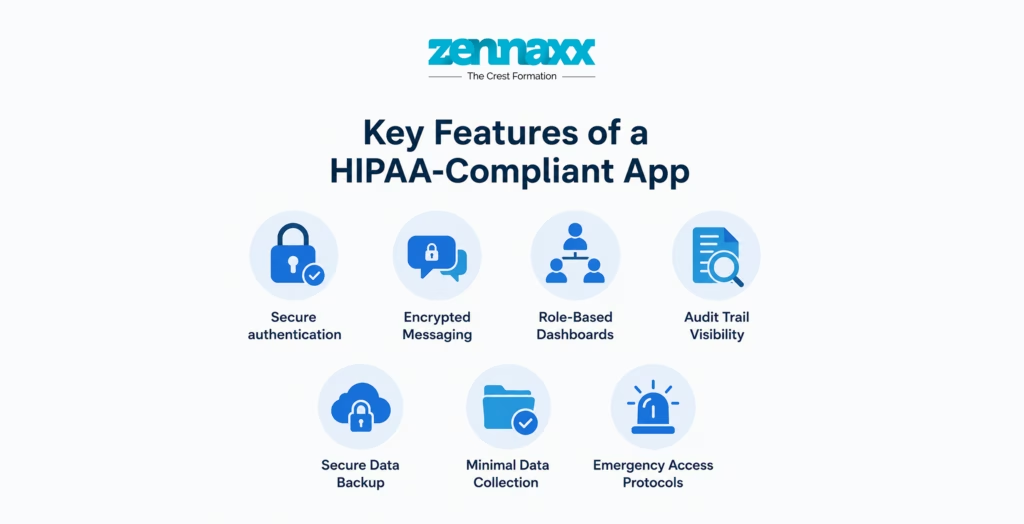
    Key Features of a HIPAA Complaint App

    Besides the technical safeguards that we have already discussed, here are the functional features that make a HIPAA compliant healthcare app truly useful and trustworthy:

    Secure authentication-Multi-factor authentication, biometric login options and strong password policies should be standard, not optional extras.

    Encrypted Messaging-In-app communication between patients and providers needs end-to-end encryption, not just standard SSL.

    Role-Based Dashboards-Only the information relevant to the role of doctors, nurses, administrative staff, and patients should be displayed.

    Audit Trail Visibility-A detailed, tamper-proof log of who accessed what data and when, which is critical for both compliance and internal accountability.

    Secure Data Backup- Backups should be automated and encrypted so that data is not lost and backups themselves must be encrypted as an unprotected backup is as risky as an unprotected live database.

    Minimal Data Collection- The best HIPAA compliant apps only collect the data they need to. That means that if something does go wrong, less data is collected to put at risk.

    Emergency Access Protocols- A secure way to gain authorized access during outages or emergencies, while still fully logging every attempt at emergency access.And if your healthcare app will be incorporating broader functionality, it’s worth checking out our full healthcare app development guide for a comprehensive view of what a modern, patient-centric platform should contain.

    Common Mistakes That Lead to HIPAA Violations

    Mistakes happen. Even the best-intentioned teams make mistakes that put their app and their business at risk. Most common ones are here:

    Compliance should not be an afterthought-Trying to bolt on security once development has been completed almost always leads to gaps, rework and much higher costs.

    No BAAs with vendors-Any vendor that has any contact with PHI, even momentary, needs a signed Business Associate Agreement . This step is one of the most common and most costly oversights.

    Storing PHI in device caches or in plain text-Mobile apps that cache data locally without encryption are a serious vulnerability, especially if the device is lost or stolen.

    Weak or missing audit logs- Without a clear, immutable record of who accessed what data and when, it is nearly impossible to properly investigate or respond to a potential breach.

    Default cloud configurations-Although cloud platforms like AWS and Azure have HIPAA-eligible services, they are configured by default in non-compliant ways that require explicit, correct configuration.

    Continuous maintenance-HIPAA compliance isn’t a one-and-done. Security threats change, regulations change and apps that aren’t continually patched become non-compliant over time.

    Benefits and Drawbacks of HIPAA Compliant App Development

    Advantages

    Builds Patient and Partner Trust-A HIPAA-compliant app lets patients, hospitals and insurance companies know you care about data privacy making partnerships and patient adoption much easier.

    Avoids Costly Penalties- Solid compliance from the beginning protects your business from crippling fines, legal fees and damage to your reputation.

    Long-Term Scalability-Apps built with a good security architecture tend to scale better as you add features, users and integrations down the road.

    Competitive Advantage-Compliance can be a true differentiator in a crowded digital health market especially when working with enterprise healthcare clients.

    Disadvantages

    Higher Upfront Investment-Development with compliance in mind will usually be more expensive than a standard app, due to the extra security layers, audits and documentation.

    Longer Development Timelines-Building in proper safeguards, testing and validation takes more time than a typical consumer app build.

    Ongoing Maintenance Burden-Compliance is not a one and done task. It requires ongoing monitoring, updates and periodic re-audits. There are ongoing costs associated with that.

    Complexity of Vendor Management- As more third-party tools and APIs get integrated, managing BAAs and vendor compliance becomes complex.

    How to Choose the Best Mobile App Development Company

    How to Choose the Best Mobile App Development Company

    Choosing the right development partner can make or break your HIPAA compliant app project. What to watch for:

    Proven healthcare experience-Ask for case studies or examples of past compliant builds, not just generic app development work

    Compliance first mindset-The team should discuss security architecture from the first conversation, not as an afterthought.

    Transparent process and pricing-Milestone-based delivery and clear documentation throughout the project reduce risk on both sides.

    Post-launch support-Compliance is not a one-time thing so your development partner should offer ongoing maintenance, monitoring and updates after you go live.

    Cross-industry security expertise-Teams with experience in other regulated industries, such as finance, often provide valuable security discipline to healthcare projects as well.A reliable mobile app development company with experience in the healthcare domain will guide you through each step, from the initial risk assessment to post-launch compliance monitoring. Zennaxx provides end-to-end mobile app development services for regulated industries. We help healthcare companies in Canada including Toronto and Ontario to develop secure, scalable and fully compliant apps.

    Final Thoughts

    Building a HIPAA-compliant app isn’t just about avoiding fines, it’s about building trust, protecting patients and creating a healthcare product that can scale safely for years to come. Healthcare organizations that buy into compliance-first architecture from the beginning are always more cost-effective, free of legal headaches, and more quickly trusted by patients and partners than those who try to retrofit security after the fact.

    Whether you’re a healthcare startup in Toronto, a growing clinic network across Ontario or an established provider anywhere in Canada, the right development partner makes all the difference.Zennaxx is a trusted mobile app development company with proven experience in building secure and compliant healthcare applications. We merge security expertise, regulatory knowledge, and considerate design to provide app development services that healthcare companies can truly rely on.

    FAQs

    Q1. How Much Does It Cost to Build a HIPAA-Compliant App?

    The cost will depend a lot on how complex it is. A basic MVP will typically cost $50,000 to $100,000, whereas a mid-range app for iOS, Android and web can cost $100,000 to $300,000. Enterprise-level platforms with advanced integrations can cost anywhere from $300,000 to millions of dollars. Then add the cost of compliance . You’re going to add 15-25 % to the base development costs for encryption, audit systems, security audits, and legal fees for Business Associate Agreements on top of the base development costs . Also, you can check out our detailed breakdown of the app development cost in Canada to get more insights.

    Q2. What Are the HIPAA Requirements for Healthcare Apps?

    HIPAA requirements for healthcare apps are derived from the Security Rule and Privacy Rule. This translates into AES-256 encryption for data at rest, TLS 1.2 or higher for data in transit, multi-factor authentication, role-based access control, automatic session timeouts, and detailed audit logs that track every instance of PHI access. “On the privacy side, apps should collect minimal patient data and should allow users to access and manage their health information. Administrative requirements such as staff training and signed BAAs with all vendors are just as important and need to be handled in parallel to the technical build.

    Q3. Can I Build a HIPAA Compliant App Without a Developer?

    Technically, no-code and low-code platforms are out there, but the risk of building a genuinely HIPAA compliant app without experienced developers is extraordinarily high. Compliance requires solid technical implementation, a sound encryption architecture, a secure authentication system, immutable audit logging, and properly configured cloud infrastructure that is far beyond what most no-code tools are able to reliably provide. Even small gaps in security architecture can cause serious breaches and penalties. For a healthcare product that handles real patient data, partnering with an experienced mobile app development company is the safer and more reliable path by far.

    Q4. How Long Does HIPAA-Compliant App Development Take?

    Timelines depend on the scope. A simple MVP with core compliance features can often be delivered in 4-6 months. A mid-range platform with EHR integrations, advanced security layers and multi-platform support typically takes anywhere from 6 to 10 months. Enterprise-grade builds with AI capabilities, multi-region compliance and deep system integrations can take 12+ months. Building compliance in from the start rather than retrofitting it later helps to keep timelines more predictable and avoid costly delays.

    Q5. Do All Healthcare Apps Need to Be HIPAA Compliant?

    Not all health apps need to be HIPAA compliant. An app needs to be HIPAA compliant if the app handles Protected Health Information (PHI) on behalf of a covered entity or business associate. General wellness apps, which don’t collect identifiable health data related to medical care, may not be covered by HIPAA. Any app used by a health care provider, insurer or their vendor to store, process or transmit patient health information must comply, though. If you are unsure, you probably want to speak with both a healthcare compliance attorney and an experienced development team before you launch.

  • How to Build a Telehealth Software: Complete Guide to Cost, Features & Development

    How to Build a Telehealth Software: Complete Guide to Cost, Features & Development

    What Is Telehealth Software?

    Telehealth software is a digital platform that allows healthcare providers to deliver clinical services, consultations, monitoring, and administrative tasks remotely without the patient ever needing to step inside a clinic or hospital.

    Whether it’s a video call with your family doctor in Toronto, a mental health session with a therapist in Ontario, or remote monitoring of a chronic condition anywhere in Canada, telehealth software makes it possible. And in 2025, it has become less of a “nice to have” and more of a core part of modern healthcare delivery.

    From hospitals and private clinics to independent practitioners and healthcare startups, organizations of all sizes are turning to telehealth software development to build scalable, patient-first digital health experiences. If you’re exploring this space whether you’re a healthcare business, a startup, or simply trying to understand how it all works this guide covers everything you need to know.

    Why Telehealth Software Is Booming in 2026

    The global telehealth market is projected to surpass $500 billion by the end of this decade. That’s not just a trend, that’s a transformation. And the drivers behind it are stronger than ever.

    Access to healthcare in remote or rural areas has always been a challenge, particularly across provinces like Ontario and British Columbia in Canada. Telehealth software bridges that gap efficiently. Patients no longer need to travel hours for a 15-minute consultation. Doctors can manage more patients in less time. Clinics can cut overhead costs significantly.

    The COVID-19 pandemic accelerated adoption, but what’s kept telehealth growing is the genuine value it delivers for patients, providers, and healthcare systems. Regulatory bodies in Canada, the US, the UK, and beyond have also updated frameworks to accommodate and encourage telehealth, making this an ideal time to invest in telehealth app development.

    Beyond convenience, telehealth software is now powering chronic disease management, behavioral health, post-surgical follow-ups, elderly care, and even pediatric consultations. It’s redefining what “going to the doctor” looks like and it’s not slowing down.

    You can also explore types of healthcare software to understand where telehealth fits in the broader digital health ecosystem.

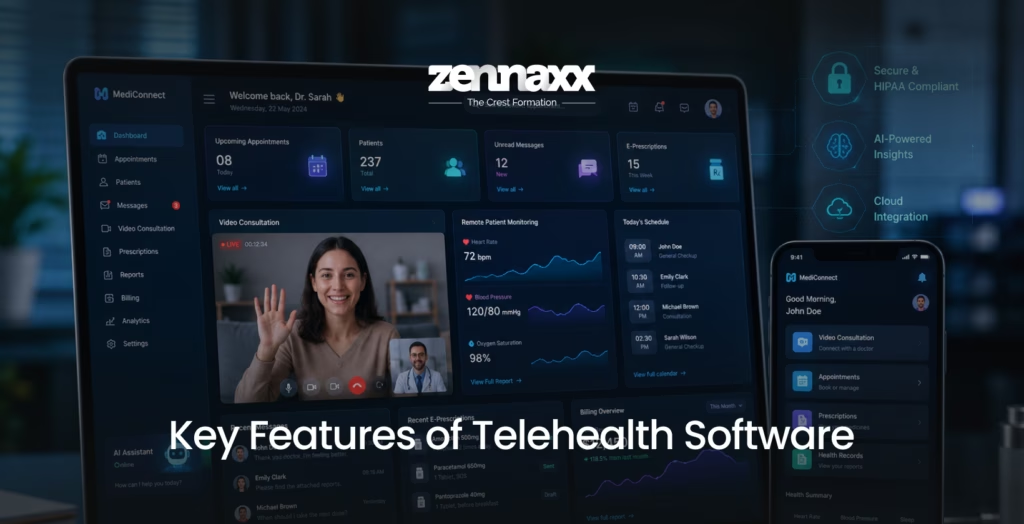
    Key Features of Telehealth Software

    Key Features of Telehealth Software

    Not all telehealth platforms are built equal. If you’re evaluating existing solutions or planning a custom telehealth app development project, here are the features that matter most:

    Video & Audio Consultation

    High-definition, low-latency video calling is the backbone of any telemedicine platform. The system must be reliable on both desktop and mobile, with fallback to audio-only when connectivity is poor.

    Appointment Scheduling & Management

    Patients should be able to book, reschedule, or cancel appointments without calling the front desk. Providers need an intuitive calendar view with real-time availability.

    Electronic Health Records (EHR) Integration

    Connecting telehealth software with EHR/EMR systems ensures continuity of care. Physicians can view patient history, prescriptions, and diagnostics all in one place, without duplicating data entry.

    Secure Messaging & Chat

    HIPAA-compliant (or PIPEDA-compliant in Canada) encrypted messaging lets patients ask follow-up questions and receive non-urgent guidance between appointments.

    E-Prescriptions

    Doctors can send prescriptions digitally to a patient’s preferred pharmacy saving time and reducing the risk of errors.

    Remote Patient Monitoring (RPM)

    With wearables and IoT devices, telehealth platforms can collect real-time vitals like heart rate, blood pressure, and glucose levels especially valuable for chronic disease management.

    Billing & Insurance Integration

    Telehealth billing is complex, especially across provinces or states. Integrated billing modules and insurance claim processing streamline the administrative side.

    Multi-Platform Support

    A strong telehealth solution works flawlessly on iOS, Android, and web ensuring accessibility for all patient demographics.

    AI-Powered Features

    From symptom checkers and triage bots to predictive analytics, AI is becoming a standard feature in next-generation telehealth software solutions.

    For a deeper look at how cloud infrastructure supports these features, read our guide on cloud computing in healthcare.

    Telehealth Software Solutions: Types You Should Know

    Telehealth isn’t a one-size-fits-all solution. Depending on the use case and patient population, different types of platforms serve different needs:

    Store-and-Forward (Asynchronous Telehealth)

    Patients submit health data, images, or medical history, which physicians review at a later time. Commonly used in dermatology and radiology.

    Real-Time (Synchronous) Telehealth

    Live video or audio consultations between patient and provider. The most common and widely recognized form of telehealth.

    Remote Patient Monitoring (RPM)

    Continuous collection of health data from patients at home using connected devices. Ideal for chronic conditions like diabetes, hypertension, and COPD.

    mHealth Apps

    Mobile health apps that deliver wellness programs, medication reminders, fitness tracking, and mental health support directly on a smartphone.

    Behavioral & Mental Health Platforms

    Specialized telehealth platforms for therapy, counseling, and psychiatric care a category that has seen explosive growth post-pandemic.

    Understanding which type of telehealth software solutions fits your business model is the first step before development begins.

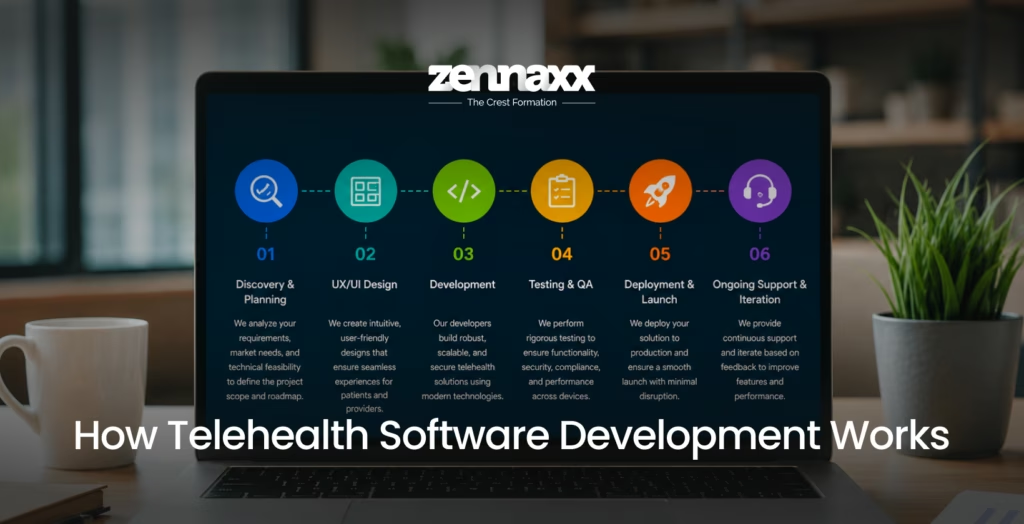
    How Telehealth Software Development Works

    How telhealth software development works

    Building a telehealth platform from scratch requires careful planning, technical expertise, and a deep understanding of healthcare regulations. Here’s a simplified view of the telehealth software development process:

    Discovery & Planning

    Define the product goals, target users, compliance requirements, and feature scope. This phase includes competitor analysis, user research, and technology stack selection.

    UX/UI Design

    Healthcare users both patients and providers, need intuitive, accessible interfaces. Design must factor in accessibility standards, multilingual support, and mobile-first experiences.

    Development

    The engineering team builds the front end (patient and doctor apps), back end (APIs, databases, cloud infrastructure), and integrates third-party services like EHR systems, payment gateways, and video SDKs.

    Testing & QA

    Rigorous testing covers functionality, security, load performance, and compliance validation. HIPAA penetration testing and data encryption verification are non-negotiable.

    Deployment & Launch

    The platform is deployed to cloud infrastructure (AWS, Azure, or Google Cloud), submitted to app stores if mobile, and launched with user onboarding flows.

    Ongoing Support & Iteration

    Post-launch, the platform requires monitoring, security updates, feature enhancements, and compliance audits.Working with an experienced software development company that understands both technology and healthcare is critical to getting this right. Whether it’s a startup or an enterprise, the right development partner can significantly shorten your path from idea to launch.For a comprehensive overview of the full process, explore our healthcare app development guide.

    What Cost is Expected for Telemedicine App Development?

    What Cost is Expected for Telemedicine App Development

    One of the most common questions organizations ask is:

    “How Much Does It Cost to Build a Telehealth App?”

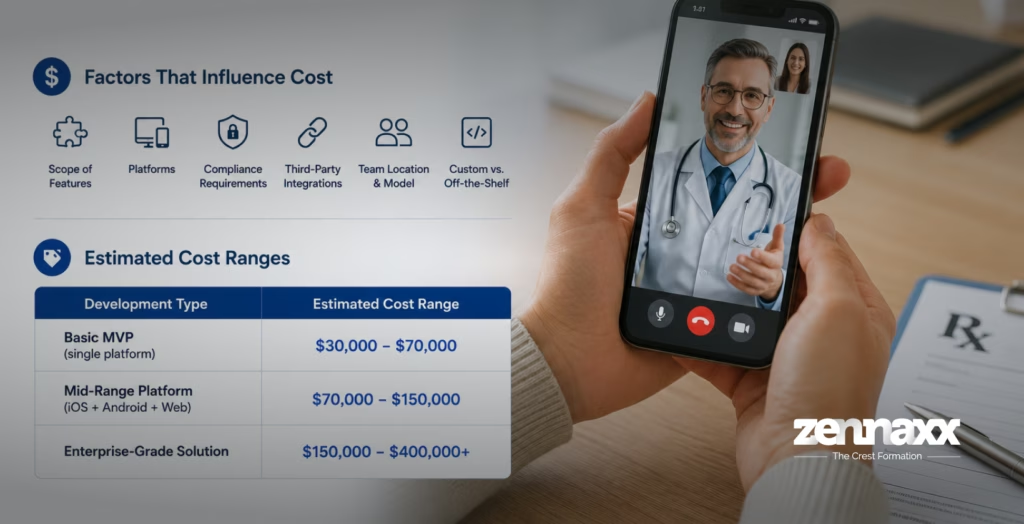
    The honest answer is – it depends. But here’s a framework to understand the major cost drivers:

    Factors That Influence Telehealth Software Cost

    • Scope of Features: A basic MVP with video calling and appointment scheduling costs far less than a full-featured platform with RPM, AI diagnostics, and EHR integration.
    • Platforms: Developing for iOS, Android, and web simultaneously increases cost compared to starting with a single platform.
    • Compliance Requirements: HIPAA, PIPEDA, PHIPA (Ontario), or GDPR compliance requires specialized development and security architecture.
    • Third-Party Integrations: EHR/EMR systems, insurance platforms, pharmacy networks, and IoT devices each add complexity.
    • Development Team Location & Model: Onshore vs. nearshore vs. offshore teams have significantly different rate structures.
    • Custom vs. Off-the-Shelf: Custom builds are more expensive upfront but offer far greater flexibility and long-term scalability.

    Estimated Cost Ranges

    These are industry estimates. The actual telehealth software cost for your project will vary based on your specific requirements and the development partner you choose.Investing in custom software development services from a specialized healthcare app development company can actually be more cost-effective in the long run because you avoid the licensing fees, limitations, and costly migrations that come with generic off-the-shelf platforms.

    Compliance & Security in Telehealth Software

    Compliance is not optional in healthcare, it’s foundational. Any telehealth software operating in Canada, the US, or internationally must adhere to strict regulatory standards:

    Key Compliance Frameworks

    • HIPAA (USA): The Health Insurance Portability and Accountability Act governs the privacy and security of patient health information in the United States.
    • PIPEDA / PHIPA (Canada): Canada’s federal privacy law (PIPEDA) and Ontario’s provincial health privacy law (PHIPA) regulate how healthcare organizations collect, use, and disclose personal health information.
    • GDPR (Europe): For telehealth platforms serving European patients, GDPR compliance is mandatory.
    • HL7 & FHIR Standards: Interoperability standards that govern how health data is formatted and exchanged between systems.

    Security Best Practices in Telehealth Development

    • End-to-end encryption for all video, audio, and messaging
    • Role-based access control (RBAC) to restrict data access by user role
    • Audit trails and activity logs for all data access
    • Two-factor authentication (2FA) for provider logins
    • Regular security audits and penetration testing
    • Secure cloud hosting with HIPAA/PHIPA-compliant infrastructure

    A reliable telehealth software development company will have documented processes for compliance architecture from day one not as an afterthought.

    Pros and Cons of Telehealth Software

    Like any technology, telehealth software has real strengths and real limitations. Here’s an honest look at both:

    Pros of Telehealth Software

    • Increased Access to Care: Patients in rural or underserved areas particularly in large provinces like Ontario or Alberta can access specialist care without lengthy travel.
    • Reduced Healthcare Costs: Both providers and patients benefit from reduced overhead. No physical space needed for every consultation. Fewer no-shows with automated reminders.
    • Improved Patient Engagement: Patients who can communicate easily with their care team are more likely to follow through on treatment plans and preventive care.
    • Scalability: A well-built telehealth platform can handle thousands of concurrent consultations with the right cloud infrastructure something a physical clinic cannot replicate.
    • Better Data Management: Digital-first platforms generate rich data that can be used to improve care protocols, population health management, and operational efficiency.

    Cons of Telehealth Software

    • Technology Barriers: Elderly patients or those with limited digital literacy may struggle with video-based consultations. Onboarding and support are essential.
    • Internet Connectivity Limitations: In remote areas, poor internet bandwidth can make video consultations unreliable, reducing the quality of care.
    • Regulatory Complexity: Operating across provinces or countries means navigating multiple regulatory frameworks simultaneously which requires ongoing legal and compliance attention.
    • Physical Examination Limitations: Telehealth cannot fully replace in-person care for conditions requiring physical examination, diagnostics, or procedures.
    • Data Privacy Risks: Without proper security architecture, telehealth platforms become targets for breaches. A data leak in a healthcare context carries severe legal and reputational consequences.

    How to Choose the Right Telehealth Software Vendors or Development Partner

    How to choose the right telehealth

    Whether you’re evaluating

    telehealth software vendors who offer ready-made platforms, or looking for a telemedicine app development company to build a custom solution, the selection process matters enormously.

    Key Questions to Ask

    • Do they have proven experience in healthcare software development specifically?
    • Can they demonstrate compliance expertise (HIPAA, PHIPA, PIPEDA)?
    • Do they offer post-launch support and ongoing maintenance?
    • What is their approach to data security and disaster recovery?
    • Can they integrate with your existing EHR, billing, or hospital management systems?
    • Do they offer transparent pricing and milestone-based delivery?

    When to Choose a Custom Build Over an Off-the-Shelf Platform

    Off-the-shelf telehealth software providers work well for standard use cases with limited customization needs. But if your organization has unique workflows, specialized patient populations, complex integrations, or strong branding requirements, a custom build is almost always the better long-term investment.

    A trusted software development company with healthcare domain expertise will help you define the right approach from the start whether that’s building from scratch, integrating with existing systems, or customizing a white-label solution.

    Zennaxx is a healthcare app development company that has helped healthcare organizations, clinics, and digital health startups across Canada and globally build compliant, scalable telehealth solutions. From initial discovery through launch and beyond, the team provides end-to-end custom software development services tailored specifically to the healthcare sector.

    Final Thoughts

    Telehealth software is no longer a niche solution; it is the future of healthcare delivery. As patient expectations evolve, regulatory support strengthens, and technology continues to advance, the organizations that invest in well-built, compliant, and user-centered telehealth platforms will be the ones leading healthcare forward.

    Whether you’re a hospital system in Ontario, a digital health startup in Toronto, a growing clinic network across Canada, or a healthcare entrepreneur with a bold vision, the time to build is now.

    Zennaxx is a dedicated software development company with deep expertise in telehealth software development. Our team of engineers, designers, and healthcare compliance specialists work with you from concept through launch, delivering custom software development services that are built to scale, built to comply, and built to make a real difference in people’s lives.

    FAQs

    Q1.Can I Hire Someone to Build Me a Telehealth App?

    Absolutely. You can hire a specialized telemedicine app development company or a healthcare app development company to build a custom telehealth platform tailored to your specific requirements. The key is to choose a team with proven healthcare experience, compliance knowledge, and a transparent development process. Companies like Zennaxx specialize in exactly this, delivering compliant, scalable telehealth solutions for businesses across Canada and beyond. You can explore our custom software development services for more details.

    Q2.How Long Does It Take to Develop a Telehealth App?

    The timeline depends heavily on the scope of features and the complexity of integrations. A basic MVP with video calling, appointment booking, and secure messaging can typically be delivered in 3 to 5 months. A mid-range platform with EHR integration, RPM, and multi-platform support usually takes 6 to 9 months. Enterprise-grade solutions with advanced AI, multi-region compliance, and deep system integrations can take 12 months or more. Working with an experienced telemedicine app development company that follows an agile process will help reduce time-to-market without compromising quality.

    Q3.What Are the Benefits of Telemedicine App Development Solutions for Doctors?

    Telemedicine app development delivers significant benefits for healthcare providers: reduced administrative burden through automated scheduling and digital documentation, the ability to see more patients per day with less physical overhead, access to patient history and health records during every consultation, secure digital prescribing, and the flexibility to consult from any location. Beyond convenience, telehealth platforms also help doctors improve patient retention and engagement leading to better health outcomes overall.

    Q4.How Does Telemedicine App Development Help Businesses in the Healthcare Industry?

    For healthcare businesses, telemedicine app development opens new revenue streams, expands geographic reach, reduces facility overhead, and improves patient acquisition and retention. Clinics, hospitals, insurance companies, and health tech startups are all using telehealth platforms to differentiate their services in a competitive market. Custom telehealth software solutions also enable better data collection, which supports more informed clinical and operational decisions. Partnering with a proven software development company ensures the platform is built to grow with the business.

    Q5.What Are Online Health Apps?

    Online health apps often referred to as mHealth (mobile health) apps are digital tools that help users manage their health and wellness through smartphones or tablets. They range from general wellness and fitness apps to specialized platforms for chronic disease management, mental health, telehealth consultations, medication reminders, and diet tracking. Telehealth apps are a subset of online health apps specifically designed for remote clinical care. As the demand for digital health solutions grows, more organizations are partnering with a healthcare app development company to build custom applications that serve their specific patient population.

  • Guide on How to Hire Dedicated Developers in Canada

    Guide on How to Hire Dedicated Developers in Canada

    The Canadian tech market is growing faster than ever. Startups, enterprises, and digital-first businesses are all racing to build smarter software, more intuitive apps, and scalable digital platforms. But there’s one challenge that keeps coming up at every stage finding the right development talent.

    If you’re looking to hire dedicated developers in Canada, you’re already thinking in the right direction. The dedicated hiring model gives businesses access to skilled professionals who work exclusively on your project, no context switching, no shared attention, just focused development.

    But knowing how to hire the right team makes all the difference.This guide walks you through everything why Canada is a smart choice for tech talent, what hiring models work best, how much it costs, and how to avoid the most common mistakes.

    Why Businesses Choose Canada for Dedicated Tech Talent

    Canada has become one of the top destinations for sourcing high-quality development talent. Cities like Toronto, Vancouver, Montreal, and Waterloo have thriving tech ecosystems with deep talent pools in software engineering, mobile app development, cloud computing, and AI.Here’s why businesses actively choose to hire from Canada:

    Strong Technical Education System

    Canadian universities and colleges consistently produce graduates with solid engineering and computer science foundations. Institutions like the University of Waterloo and University of Toronto are globally recognized for producing developer talent that’s ready for real-world, complex projects.

    Favourable Time Zones for North American Businesses

    If your company is based in the US or Canada, working with a Canadian development team means you share the same (or very similar) working hours. This makes real-time collaboration, daily stand-ups, and quick feedback loops effortless, something that’s not always possible when outsourcing overseas.

    Cultural and Communication Alignment

    Canadian developers are known for clear communication, professional work ethic, and a collaborative mindset. When you hire dedicated software developers in Canada, you’re working with professionals who understand North American business culture, product expectations, and user experience standards.

    What Is the Dedicated Developer Hiring Model?

    Before you start evaluating candidates or agencies, it helps to understand exactly what “dedicated developers” means in practice.When you hire dedicated developers, you’re bringing on one or more developers who are fully committed to your project for a set period. Unlike freelancers who juggle multiple clients or agencies that run project-based contracts, dedicated developers work as an extension of your own in-house team.This model works especially well for:

    • Long-term product development with evolving requirements
    • Startups building their MVP and scaling post-launch
    • Businesses that need specialized skills without the overhead of full-time employment
    • Companies running complex mobile app development projects that need ongoing iteration

    With Zennaxx, you can hire app developers who integrate directly into your workflows using your preferred tools, communication channels, and sprint processes. It feels like having an in-house team, without the heavy HR and infrastructure costs.

    Top Hiring Models to Consider

    Top Hiring Models to Consider

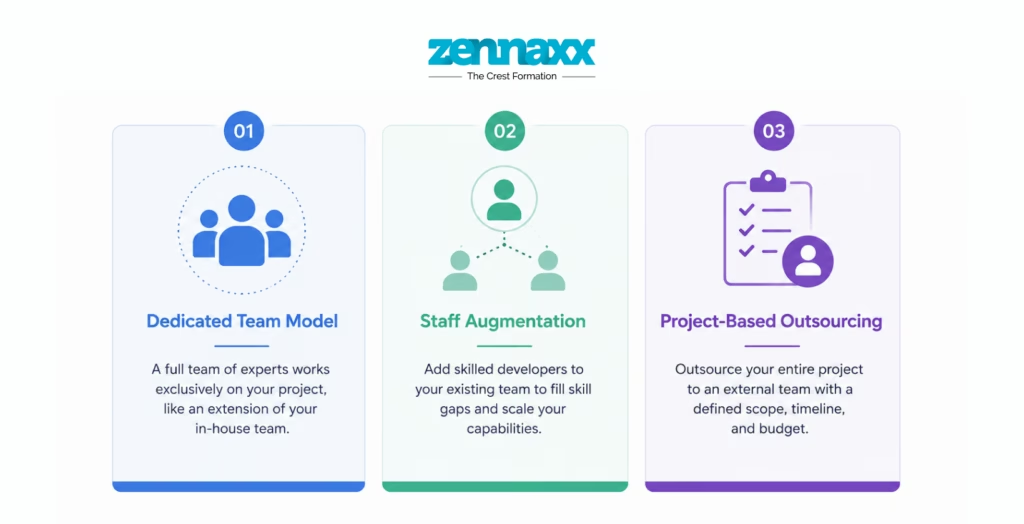
    Not every business has the same needs. Before you decide to hire dedicated developers, it’s worth understanding the different engagement models available to you.

    Dedicated Team Model

    A full team of developers, QA engineers, project managers, and designers works exclusively on your product. This is ideal for large-scale builds or when you need multiple skill sets working in parallel. As a leading mobile app development company, Zennaxx offers fully managed dedicated teams tailored to your project scope.

    Staff Augmentation

    You add one or two developers to your existing in-house team to fill skill gaps or increase capacity during peak phases. Your team stays in control, but you get the extra firepower you need.

    Project-Based Outsourcing

    You hand over a well-defined project to an external partner who handles it end-to-end. This works for shorter, tightly scoped deliverables but gives you less ongoing control compared to a dedicated model.For most growing businesses building digital products, the dedicated team model or staff augmentation model tends to deliver the best combination of control, quality, and cost-effectiveness.

    How to Hire Dedicated Developers in Canada – Step by Step

    Define What You Actually Need

    Start with clarity. What technology stack does your project require? Do you need a front-end developer, a full-stack engineer, or a mobile specialist? What’s the expected project duration? What’s your budget range? The clearer your requirements, the easier it is to find developers who genuinely fit.

    Choose Between In-House, Freelance, or a Dedicated Partner

    Hiring in-house gives you full control but comes with high costs, salaries, benefits, office infrastructure, and long onboarding timelines. Freelancers are flexible but often unreliable for complex or long-running projects. A dedicated development partner like Zennaxx gives you the best of both worlds: experienced talent, accountability, and scalability without the overhead.

    Evaluate Technical Skills Thoroughly

    Don’t rely on a CV alone. Arrange technical assessments, review past project portfolios, and conduct practical code reviews. If you’re building an iOS app, make sure the developer has hands-on experience with Swift or Objective-C and understands Apple’s design guidelines and App Store requirements.

    Assess Communication and Collaboration Style

    Technical ability is only part of the equation. A great developer who communicates poorly can slow your entire project down. Look for developers who ask smart questions, give structured updates, and can explain technical decisions in plain language.

    Finalise Engagement Terms and Onboard

    Once you’ve selected your developer or team, finalize the contract, set up access to your tools, and run a proper onboarding session. The faster they understand your product vision and development standards, the sooner they’ll be contributing at full capacity.

    Why Zennaxx Is the Right Choice When You Want to Hire Dedicated Software Developers in Canada

    Hire Dedicated Software Developers

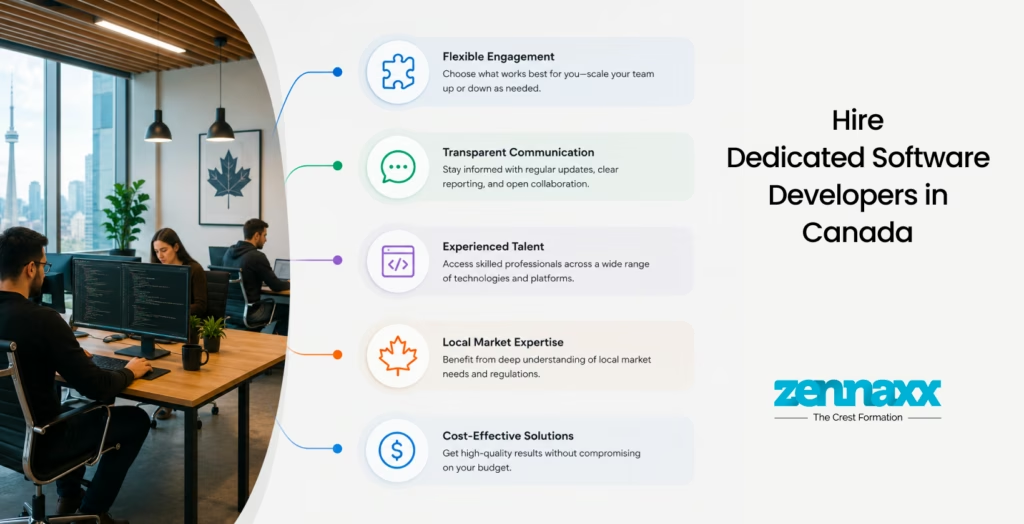
    Zennaxx is a trusted mobile app development company in Canada with a proven track record across industries from healthcare and fintech to retail and on-demand platforms. When you work with Zennaxx, you’re not just getting developers. You’re getting a committed team that takes ownership of your product.Here’s what sets Zennaxx apart:

    • Flexible engagement models – hire a single developer or an entire dedicated team
    • Transparent communication – weekly reports, sprint reviews, and always-on availability
    • Experienced talent across stacks – iOS, Android, React Native, Flutter, Node.js, and more
    • Canadian market expertise – deep understanding of Canadian user expectations and compliance requirements
    • Competitive pricing – enterprise-quality output without enterprise-level costs

    Whether you want tohire app developersfor a quick prototype or need a full team to take your product to market, Zennaxx has the people and the process to make it happen.

    Final Thoughts

    The decision to hire dedicated developers in Canada is one of the smartest investments a business can make when building digital products. You get focused talent, faster development cycles, lower overhead compared to in-house hiring, and a team that genuinely cares about your product’s success.What matters most is choosing the right partner, one with the technical depth, communication standards, and flexibility to grow with your vision. Zennaxx brings all of that to the table.Ready to build something great? Connect with Zennaxx today and let’s put the right development team behind your next big idea.

    FAQs

    How Much Does It Cost to Hire a Developer in Canada?

    The cost depends on factors like the developer’s experience level, the technology stack, and the engagement model. On average, hiring dedicated developers in Canada through a professional agency can range from CAD $50 to $150 per hour. However, partnering with a development company like Zennaxx can offer significantly more competitive rates without compromising on quality, especially compared to the cost of hiring and maintaining in-house staff.

    Should I Hire Developers Locally or Overseas?

    Both options have merit, but the right answer depends on your priorities. Hiring locally in Canada ensures time zone alignment, cultural fit, and easier legal compliance. Hiring overseas (especially through a trusted partner) can reduce costs. With Zennaxx, you get the advantage of a Canada-based company backed by a world-class development team giving you local accountability with global-standard expertise. It’s genuinely the best of both worlds.

    What Is the Difference Between a Dedicated Developer and a Freelancer?

    A freelancer typically works on multiple projects simultaneously and may not be fully invested in your product’s long-term success. A dedicated developer, on the other hand, works exclusively on your project, functions as part of your team, and is accountable for ongoing deliverables. For any project that requires consistency, quality, and clear communication over time, dedicated developers are the far better choice.

    How Long Does It Take to Hire a Dedicated Developer Through Zennaxx?

    Zennaxx has a streamlined hiring process designed to get you started quickly. Depending on your requirements, you can have a developer or team ready to begin within 3 to 7 business days. This is significantly faster than running an in-house hiring process, which can take weeks or even months.

    What Engagement Models Does Zennaxx Offer?

    Zennaxx offers flexible engagement models to suit different project needs including dedicated team hiring, staff augmentation, and project-based development. Whether you need one specialist developer or a complete cross-functional team for your mobile app development project, Zennaxx can structure an engagement that aligns with your goals, timeline, and budget.

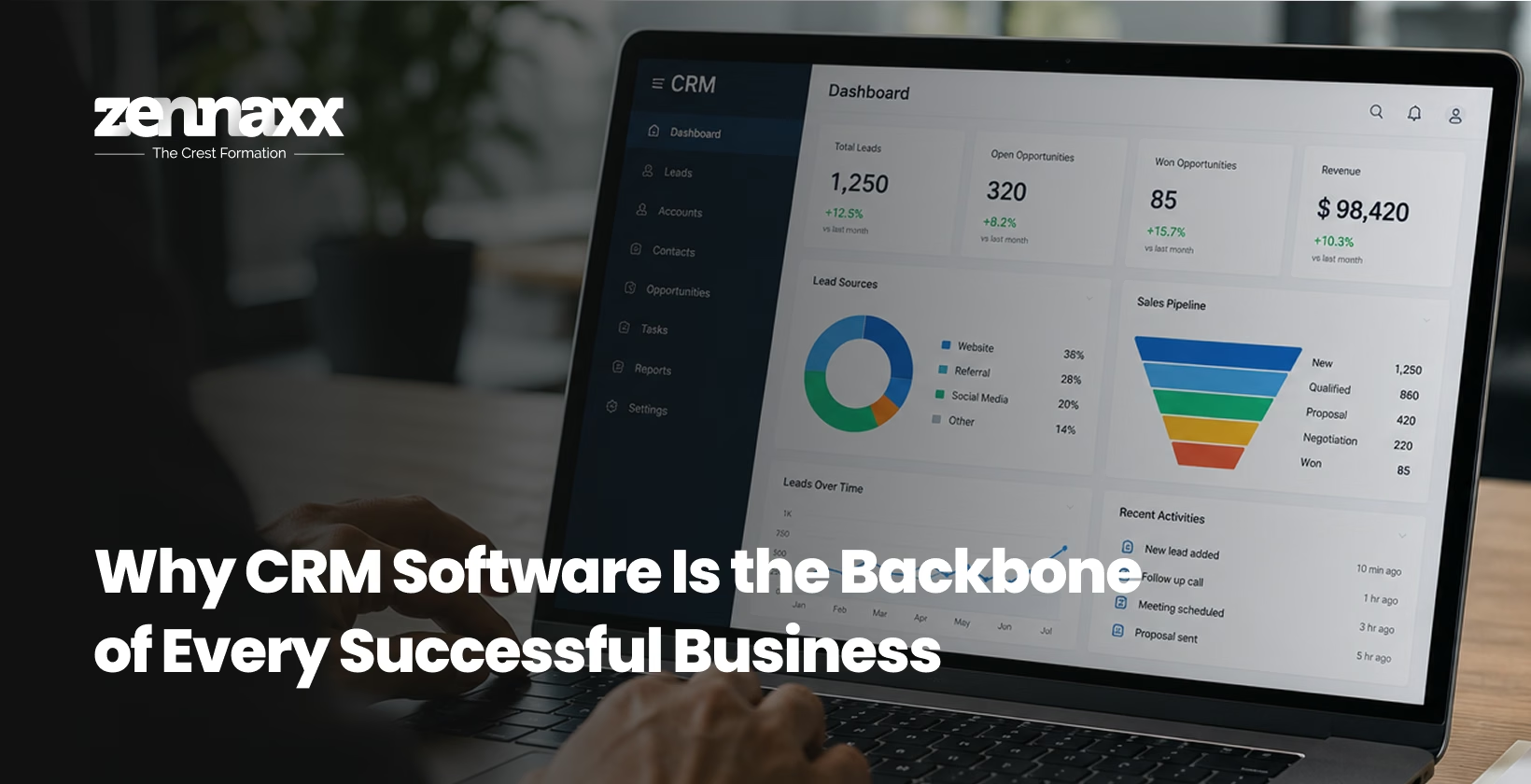
  • Why CRM Software Is the Backbone of Every Successful Business

    Why CRM Software Is the Backbone of Every Successful Business

    In a world where customers expect fast responses, personalized experiences, and seamless interactions, businesses that rely on spreadsheets and disconnected tools are quietly falling behind. The solution? A robust, well-built CRM software system – one that doesn’t just store contacts, but drives sales, strengthens relationships, and scales with your business.

    Whether you are a growing startup or an established enterprise, the right CRM platform can be the turning point that separates average performance from extraordinary results. And when it comes to building that platform the right way, choosing an expert CRM Development Company in Canada makes all the difference.

    What Is CRM Software and Why Does It Matter?

    CRM stands for Customer Relationship Management. At its core, CRM software is a centralized system that helps businesses manage all interactions with current and potential customers from the very first touchpoint to post-sale support.

    Think of it as the nervous system of your business operations. It connects your sales team, marketing department, and customer support under one roof, giving everyone real-time visibility into customer data, communication history, and pipeline progress.

    Key Benefits of CRM Software

    • Improved Customer Retention: When your team knows exactly where each customer stands in their journey, they can engage at the right time with the right message.
    • Higher Sales Productivity: Automated follow-ups, lead scoring, and task reminders eliminate the manual work that slows down your sales reps.
    • Data-Driven Decision Making: Built-in analytics and reporting help leadership make smarter, faster decisions based on real customer behavior.
    • Seamless Team Collaboration: A shared platform ensures no lead falls through the cracks and everyone is on the same page.

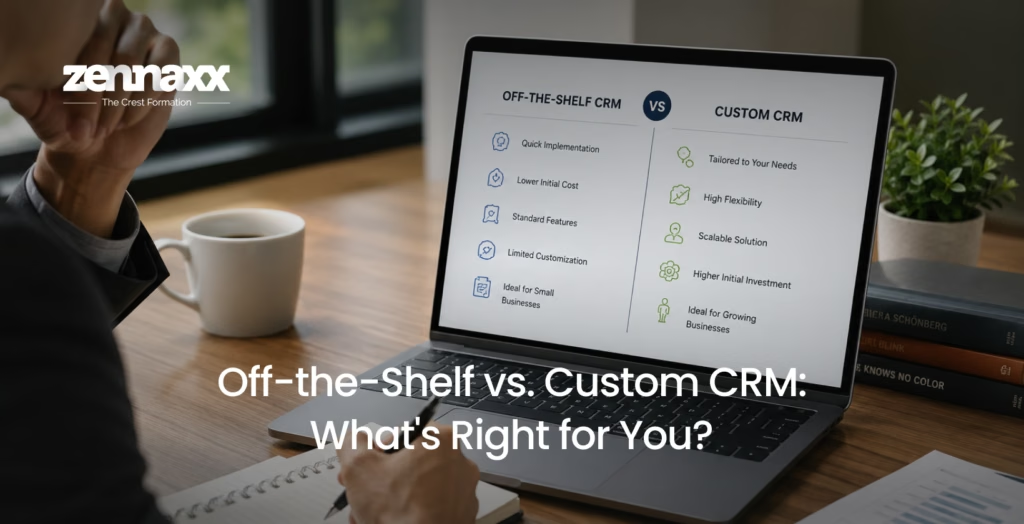
    Off-the-Shelf vs. Custom CRM: What’s Right for You?

    Custom CRM

    Many businesses start with out-of-the-box CRM tools like Salesforce or HubSpot. These are great entry points, but they come with limitations: rigid workflows, bloated features you never use, and ongoing subscription costs that pile up over time.

    Custom CRM Software Development offers a completely different experience. When your CRM is built specifically for your business processes, it works the way you work, not the other way around.

    Why Custom CRM Development Wins

    Tailored to Your Workflow: Every business has unique sales cycles, customer touchpoints, and reporting needs. A custom-built CRM adapts to your processes, not generic templates.

    Scalability from Day One: As your business grows, your CRM grows with it. Custom solutions are designed with future expansion in mind, so you are never locked into a system that cannot keep up.

    Seamless Integration: Whether it is your ERP, e-commerce platform, accounting software, or third-party APIs, custom CRM Software Development Services ensure everything talks to everything with no duct-tape workarounds.

    True Data Ownership: With a custom CRM, your customer data lives where you want it, with the security protocols you define. This is especially critical for industries handling sensitive information like healthcare, finance, and legal services.

    Lower Long-Term Cost: While the upfront investment in custom development may seem higher, businesses typically save significantly over time by eliminating expensive licensing fees and paying only for what they actually need.

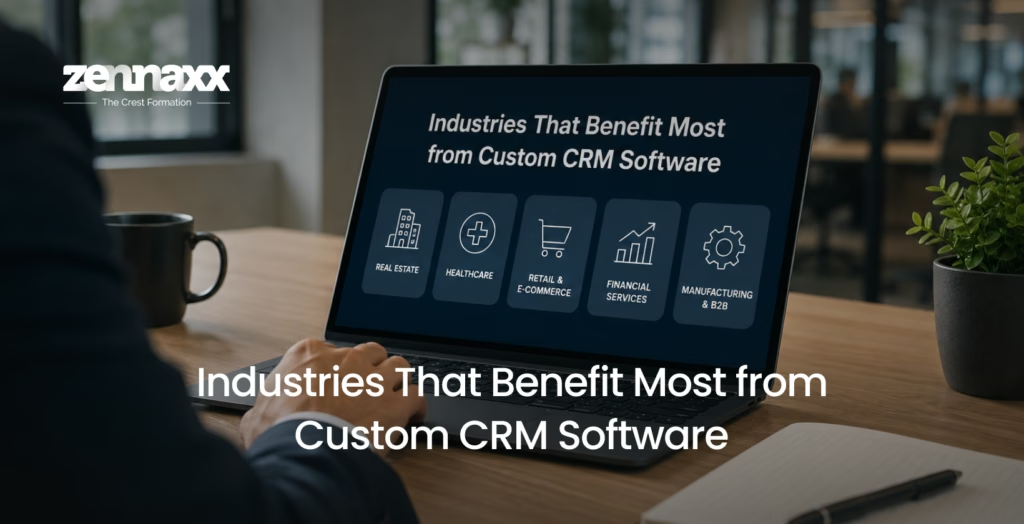
    Industries That Benefit Most from Custom CRM Software

    Benefit Most from Custom CRM Software

    The beauty of CRM software is that it is industry-agnostic. However, some sectors see especially transformative results from custom CRM solutions:

    Real Estate: Track leads, manage listings, schedule viewings, and automate follow-ups all in one place.

    Healthcare: Maintain patient records, appointment scheduling, and communication history while remaining fully compliant with privacy regulations.

    Retail & E-Commerce: Understand buying patterns, manage loyalty programs, and run personalized marketing campaigns backed by real data.

    Financial Services: Manage client portfolios, automate compliance tasks, and deliver timely, personalized financial guidance.

    Manufacturing & B2B: Track complex sales cycles, manage distributor relationships, and streamline quote-to-order processes.

    What to Look for in a CRM Development Company

    Not every development team is equipped to deliver enterprise-grade CRM software. When evaluating your options, here is what you should look for:

    Proven Industry Experience

    The right CRM Development Company has a portfolio that spans industries and project sizes. They understand both the technical architecture required and the business logic that drives CRM success.

    End-to-End Development Capabilities

    From UI/UX design and backend development to third-party integrations and post-launch support look for a team that handles the full product lifecycle so you are not juggling multiple vendors.

    Agile Development Process

    Businesses evolve quickly. An agile development approach ensures your CRM can adapt during the build phase, incorporating feedback and new requirements without derailing the entire project.

    Strong Post-Launch Support

    Your CRM needs ongoing maintenance, feature updates, and troubleshooting. A reliable development partner stays with you long after the launch date.

    Transparent Communication

    Clear timelines, regular progress updates, and a dedicated point of contact are non-negotiables when investing in custom software development.

    Why Choose a CRM Development Company in Canada?

    CRM development company in canada

    Canada has emerged as a top destination for high-quality software development, and for good reason. Canadian development firms combine global technical standards with a deep understanding of North American business environments, regulatory requirements, and customer behavior.

    Partnering with a trusted CRM Development Company in Canada means you get access to world-class engineering talent, rigorous quality assurance processes, and a team that understands the nuances of building software for competitive markets.

    For businesses across North America, working with a Canadian CRM development partner also simplifies time zones, communication, and project alignment making the entire collaboration smoother from kickoff to delivery.

    The CRM Development Process: What to Expect

    When you engage a professional team for CRM Software Development Services, the process typically follows a structured path:

    Discovery & Requirement Analysis: The team dives deep into your business processes, pain points, and goals to define the exact scope of your CRM solution.

    UX/UI Design: Wireframes and prototypes are created to ensure the interface is intuitive, user-friendly, and aligned with your brand.

    Development & Integration: The core CRM platform is built module by module contact management, pipeline tracking, automation, reporting, and all necessary third-party integrations.

    Testing & QA: Rigorous testing across devices, user roles, and edge cases ensures the platform is stable, secure, and ready for real-world use.

    Deployment & Training: The CRM is launched in your environment, and your team is trained to use it effectively from day one.

    Ongoing Support & Iteration: As your business evolves, features are added, refined, and optimized to keep your CRM performing at its best.

    Final Thoughts

    The right CRM software is not just a tool, it is a competitive advantage. It empowers your team to work smarter, keeps your customers happier, and gives your leadership the clarity needed to drive growth with confidence.

    If you are ready to move beyond generic, one-size-fits-all solutions and invest in a CRM platform built specifically for your business, now is the time to act.

    Partner with a leading CRM Development Company in Canada that brings the expertise, process, and commitment to turn your vision into a powerful, scalable CRM system built to grow as fast as you do.

  • Mobile Banking App Development: A Complete Guide for 2026

    Mobile Banking App Development: A Complete Guide for 2026

    The way people manage money has changed dramatically. Standing in a bank queue to transfer funds or check a balance feels almost outdated today. Consumers now expect instant, secure, and intuitive financial experiences right from their smartphones. Mobile banking app development has moved from a “nice to have” to a core business strategy for banks, credit unions, and fintech startups alike.

    According to Market Research Future, the global mobile banking market is on a steep growth trajectory, fueled by rising smartphone penetration, digital-first consumer expectations, and rapid advances in AI and cloud computing. If you’re considering building a banking app or upgrading an existing one, this guide walks you through everything: types of apps, must-have features, the development process, tech stack, security requirements, costs, and the trends shaping 2026.

    What Is a Mobile Banking App?

    A mobile banking app is a software application that allows users to perform financial transactions and manage their bank accounts through a smartphone or tablet. Beyond basic balance checks, modern banking apps support fund transfers, bill payments, loan applications, investment tracking, customer support, and much more all within a few taps.

    For businesses, a well-built banking app is not just a customer convenience tool. It is a revenue channel, a data asset, and a brand differentiator rolled into one. That is why more financial institutions are partnering with a dedicated Mobile App Development Company Canada to bring these products to life.

    Types of Mobile Banking Apps

    Before diving into development, it is important to know which type of app aligns with your business model:

    Basic Banking Apps- These handle the essentials account balance, transaction history, and simple fund transfers. They are typically offered by traditional banks as their first digital step.

    Full-Service Banking Apps- A step above, these include loan management, credit card controls, investment tracking, and customer support, the type of apps offered by major Canadian and North American banks today.

    Digital-Only Banking Apps (Neobanks)- Neobanks operate without physical branches. Built entirely for mobile-first experiences, they offer everything from instant account opening to advanced budgeting tools. This is one of the fastest-growing segments globally.

    Payment-Focused Banking Apps- These focus on peer-to-peer payments, bill splitting, and merchant transactions. They often integrate with existing bank accounts through open banking APIs.

    Business Banking Apps- Tailored for SMEs and enterprises, these include payroll, invoicing, multi-user account access, and treasury management features.

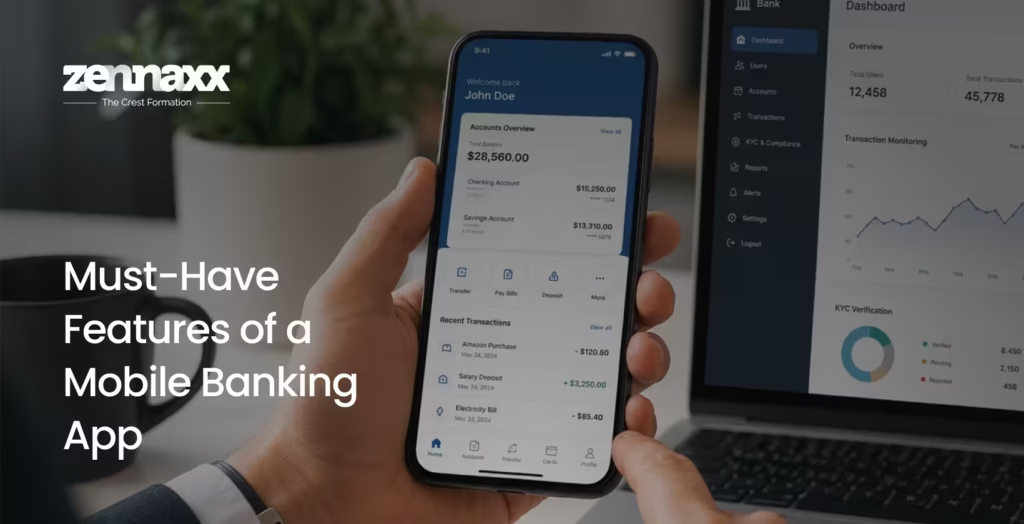
    Must-Have Features of a Mobile Banking App

    Must-Have Features of a Mobile Banking App Feature decisions will make or break your app. Here is what users expect and what admins need:
    User-Facing Features

    • Secure Login & Biometric Authentication – Fingerprint, Face ID, or PIN-based login for instant, frictionless, secure access.
    • Account Dashboard – Real-time view of balances, recent transactions, and account summaries at a glance.
    • Fund Transfers & Payments – Domestic and international transfers, scheduled payments, and bill pay built for speed and reliability.
    • Mobile Check Deposit – Camera-based cheque scanning and instant deposit confirmation.
    • Push Notifications & Alerts – Instant alerts for transactions, low balances, or suspicious activity to keep users informed.
    • Customer Support (Chat / Call) – In-app support with live agents or AI chatbot integration for 24/7 coverage.
    • Card Controls – Freeze or unfreeze cards, set spending limits, and manage virtual card numbers.
    • Financial Insights – Spending analytics, budget trackers, and savings goals to encourage healthy financial habits.

    Admin Panel Features

    • User Management – View, verify, and manage customer accounts with role-based access.
    • KYC & Compliance Dashboard – Monitor identity verifications and maintain regulatory filing records.
    • Transaction Monitoring – Flag, review, or block suspicious transactions in real time.
    • Reporting & Analytics – Business intelligence dashboards for product, compliance, and risk teams.

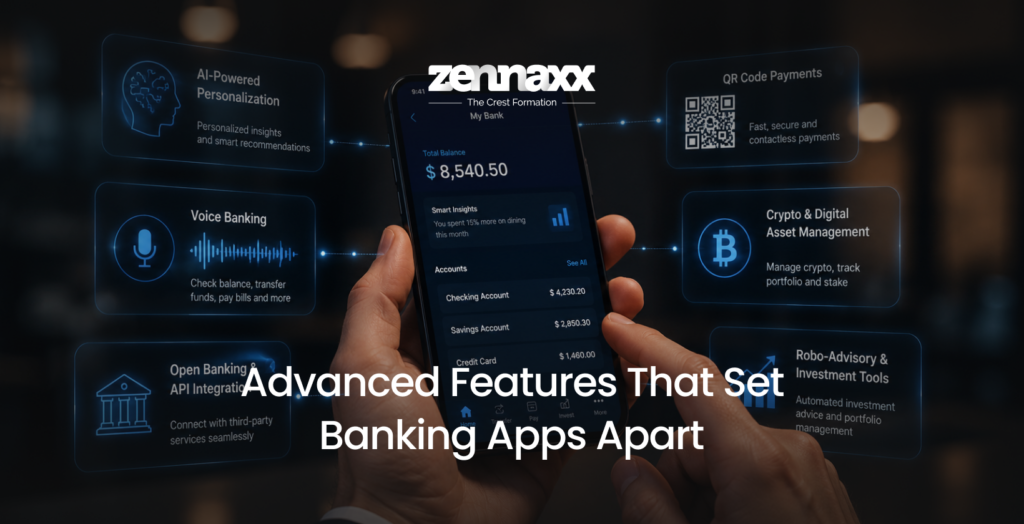
    Advanced Features That Set Banking Apps Apart

    Advanced Features That Set Banking Apps Apart Once core features are covered, advanced capabilities can position your app as a market leader. AI in fintech is already reshaping how banks interact with customers from hyper-personalized spending insights to real-time fraud prevention engines.
    • AI-Powered Personalization – Recommend financial products, predict spending patterns, and offer proactive savings tips based on individual user behavior. With AI in app development advancing rapidly, this capability is now accessible even for mid-sized financial institutions.
    • Voice Banking – Enable users to check balances, transfer funds, or pay bills using voice commands, powered by natural language processing (NLP).
    • Open Banking & API Integration – Connect with third-party financial services, insurance platforms, or investment tools to create a unified financial hub experience.
    • QR Code Payments – Fast, contactless payment experiences for retail and peer-to-peer transactions increasingly expected in urban markets.
    • Crypto & Digital Asset Management – Support for crypto wallets, staking, and portfolio tracking, especially popular with younger, tech-savvy users.
    • Robo-Advisory & Investment Tools – Automated, algorithm-driven investment recommendations for users who want passive wealth management without a human advisor.

    How to Develop a Mobile Banking App: Step-by-Step

    Market Research & Requirement Analysis (2–4 Weeks)

    Understand your target users, the competitive landscape, and the regulatory environment. Define business objectives and key success metrics before writing a single line of code. Skipping this step is the fastest way to build the wrong product.

    Define Your App Development Strategy (2–3 Weeks)

    Decide on the platform – iOS, Android, or both. Will you go native or cross-platform? Frameworks like flutter app development are increasingly popular for banking apps because they deliver near-native performance with a single codebase, cutting development time and cost significantly. For more on making this decision, read our detailed guide on native vs cross platform app development.

    UX/UI Design (3–5 Weeks)

    Banking apps must be intuitive and trust-inspiring. A cluttered or confusing UI can directly harm adoption and retention. Focus on clean, distraction-free interfaces with accessible design principles and conduct user testing early to validate flows before development begins.

    Backend Development & API Integration (8–14 Weeks)

    This is the engine of your app. Set up servers, databases, and APIs that connect your app to core banking systems, payment gateways (Stripe, Plaid, Interac), and any third-party services in your ecosystem.

    Frontend Development (8–12 Weeks)

    Build the screens and user flows based on finalized designs. Ensure smooth performance, responsive layouts across device sizes, and offline capabilities where relevant.

    Security Implementation (Ongoing, 4–6 Weeks Dedicated)

    Security is non-negotiable in banking. Implement encryption, multi-factor authentication, biometrics, fraud detection layers, and session management in parallel with the rest of development not as an afterthought.

    Quality Assurance & Testing (4–6 Weeks)

    Run functional, security, performance, and penetration testing. Simulate high-load scenarios and edge cases before any public-facing release. This phase often catches the issues that would otherwise become expensive emergencies in production.

    Deployment & Launch (1–2 Weeks)

    Submit to App Store and Google Play, configure production environments, and coordinate a phased rollout to catch any unforeseen issues with real users before a full public launch.

    Post-Launch Maintenance & Updates (Ongoing)

    Banking apps require continuous monitoring, bug fixes, compliance updates, and feature enhancements. Plan for this as an ongoing operational cost from day one not something to budget for later.

    Tech Stack for Mobile Banking App Development

    Flutter app development deserves special mention here. Its hot reload capabilities, rich widget library, and single codebase for both iOS and Android make it a strong choice for fintech teams that want quality and speed without doubling their development budget. It is fast becoming the go-to framework for banking apps built by forward-thinking companies.

    Security & Compliance in Mobile Banking Apps

    Security is not a feature in a banking app, it is the foundation every other feature sits on. Here is what a responsible, market-ready banking app must include:

    End-to-End Encryption – All data in transit and at rest must be encrypted using AES-256 or equivalent standards. No exceptions.

    Multi-Factor Authentication (MFA) with Biometrics – Combine passwords with one-time passcodes and biometric verification (fingerprint, Face ID) to minimize unauthorized access risk significantly.

    Real-Time Fraud Detection – Machine learning models that flag unusual transaction patterns and either alert users automatically or block suspicious activity outright before damage occurs.

    Certificate Pinning & Secure APIs – Prevent man-in-the-middle attacks by validating server certificates directly within the app itself, not relying solely on device-level trust.

    Regulatory Compliance – Depending on your market, your app must meet:

    • PIPEDA (Canada) – Personal Information Protection and Electronic Documents Act
    • PCI-DSS – Payment Card Industry Data Security Standard
    • OSFI Guidelines (Canada) – Office of the Superintendent of Financial Institutions
    • GDPR (if operating in Europe)

    Session Management – Auto-logout after inactivity, device binding, and remote session termination capabilities are expected as standard by both regulators and users.A trusted Mobile App Development Company Canada will have security compliance expertise integrated into their development process from the start not bolted on after the build is complete.

    How Much Does It Cost to Develop a Mobile Banking App?

    Development costs vary based on complexity, team location, and the features you need. Here is a general industry benchmark:

    Key cost drivers include:

    • Number of target platforms (iOS, Android, or both)
    • Native vs. cross-platform approach (Flutter can reduce overall costs by 30-40%)
    • Depth of security and compliance requirements
    • Number and complexity of third-party API integrations
    • UI/UX design complexity and number of custom interactions
    • Ongoing post-launch support model

    For a more granular breakdown of what goes into app development pricing, read our detailed guide on mobile app development cost.

    Challenges in Mobile Banking App Development (And How to Solve Them)

    Security Threats – Invest in penetration testing, threat modeling, and regular third-party security audits throughout the development lifecycle. Do not treat security as a final-phase checkbox.

    Regulatory Complexity – Work with a development partner who understands PIPEDA, PCI-DSS, and OSFI guidelines from the discovery phase. Retrofitting compliance after launch is costly and often unreliable.

    Legacy System Integration – Use middleware layers and well-documented APIs to bridge your modern mobile app with older core banking infrastructure. In most cases, a full rebuild is neither necessary nor practical.

    Scalability Under Peak Load – Design for cloud-native architecture with auto-scaling from day one. Load testing before launch is not optional, it is the difference between a smooth go-live and a headline-making outage.

    Cross-Platform Consistency – Frameworks like Flutter deliver consistent UI and logic across platforms. Pair them with rigorous device-specific QA testing to catch edge cases early.

    User Adoption & Retention – Invest in onboarding UX, personalized in-app nudges, and regular feature updates. Combining AI in mobile app development with behavioral analytics helps identify and remove friction points that silently kill retention metrics after launch.

    Latest Mobile Banking App Trends Shaping 2026

    AI & Machine Learning at the Core AI is no longer supplementary in banking apps; it powers fraud detection, credit decisioning, personalized product recommendations, and always-on customer support chatbots. AI in fintech is transforming not just internal bank operations, but what users actively expect from their day-to-day banking experience.

    Embedded Finance Non-financial brands are embedding banking capabilities accounts, lending, payments directly into their own apps and platforms. This means banking infrastructure needs to be API-first and built for third-party partnerships from the architecture level.

    Blockchain & DeFi Integration Tokenized assets, smart contracts, and decentralized finance tools are moving into mainstream banking apps, particularly for high-net-worth individuals and tech-forward user segments.

    Open Banking Expansion In Canada and globally, open banking frameworks are enabling third-party developers to build on top of consented banking data creating new revenue models, marketplace partnerships, and hyper-personalized financial products.

    Biometric Evolution Beyond fingerprint and Face ID, behavioral biometrics analyzing how a user types, swipes, and holds their device are being deployed as invisible, continuous authentication layers that flag anomalies without disrupting the user experience.

    Super App Convergence Banking apps are expanding well beyond finance embedding insurance, investment, shopping rewards, travel, and lifestyle services into unified platforms, modeled on the super app model that has dominated Asian markets for years.

    How to Choose a Mobile Banking App Development Partner

    How to Choose a Mobile Banking App Development Partner Choosing the right development partner is arguably more important than any technology decision you make. Here is what to evaluate:
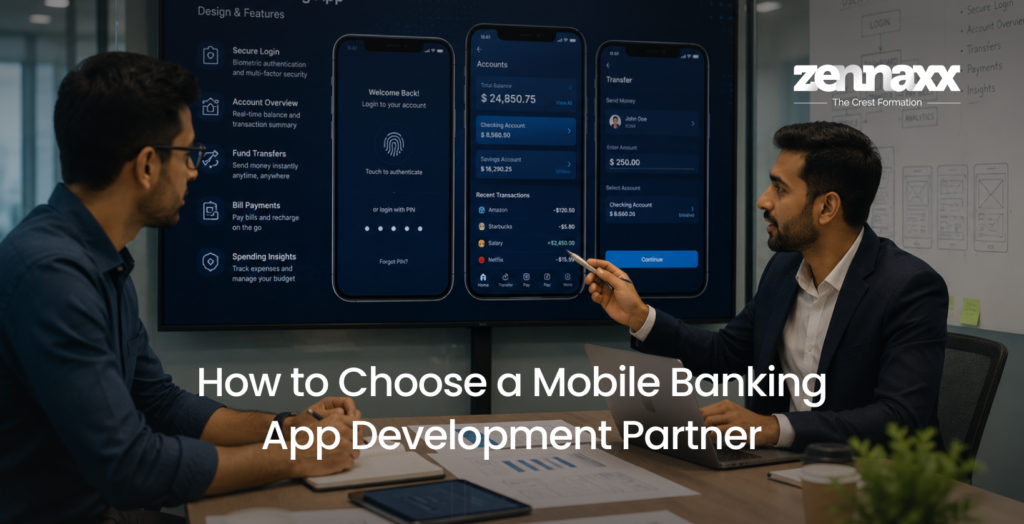
    Fintech Domain Expertise – Has the team actually built financial applications before? Do they understand the regulatory landscape, security requirements, and nuances of banking UX? Ask for case studies.

    Security-First Development Approach – Is security designed into every phase of the software development lifecycle (SDLC), or treated as a final-mile concern? The answer to this question alone can tell you a great deal about the quality of what you will receive.

    Scalable Architecture Design – Will the app comfortably handle 10x your current user base without a rebuild in two years? Ask for architecture documentation and scalability planning before you commit.

    Post-Launch Support Capabilities – Banking apps require continuous maintenance, compliance updates, and feature releases. Ensure your partner offers SLA-backed support agreements with clear response times.

    Transparent Communication – Look for teams that give you genuine visibility into sprint progress, timelines, technical decisions, and blockers not just polished status updates.Whether you also need CRM software in Canada to manage your banking customers alongside your mobile app, or a complete end-to-end fintech product build, partnering with a team that understands the Canadian regulatory and market context is a meaningful competitive advantage.

    Build Your Mobile Banking App with Zennaxx

    If you are ready to bring your mobile banking vision to life, Zennaxx is here to help. As a leading App Development Company in Canada, we specialize in building secure, scalable, and compliance-ready financial applications for banks, credit unions, and fintech startups across North America.

    Our team brings deep expertise in Flutter app development, AI-powered feature integration, open banking API connections, and end-to-end security implementation — so you get a product that performs reliably from day one and grows with your business over time.Whether you are building a mobile banking app entirely from scratch or modernizing a legacy platform that has held your business back, we partner with you at every stage from strategy and UX design through launch, compliance audits, and beyond. Let’s build the future of banking together.

    FAQs

    Q1.How long does it take to develop a mobile banking app?A basic banking app typically takes 4–6 months. A full-service or neobank-grade application usually takes 9–18 months, depending on feature complexity, third-party integrations, and security requirements.

    Q2.What platform should I build on first – iOS or Android?In Canada, both platforms hold substantial user bases. A cross-platform framework like Flutter allows you to launch on both simultaneously from a single codebase, often the most cost-effective approach for startups and mid-market institutions alike.

    Q3.How do I ensure my banking app is compliant with Canadian regulations? Work with a development partner experienced in PIPEDA, OSFI guidelines, and PCI-DSS standards. Compliance must be scoped, designed, and tested from the discovery phase not addressed retroactively before launch.

    Q4.What is the biggest challenge in mobile banking app development?Security and regulatory compliance are consistently the top challenges. They require dedicated expertise, ongoing testing cycles, and a development team that treats them as foundational requirements not optional layers added at the end.

    Q5.Can I use Flutter for a banking app?Absolutely. Flutter is increasingly used for production-grade financial applications. Its performance, security plugin ecosystem, and ability to target both iOS and Android simultaneously make it a smart and economical choice for mobile banking app development projects.

  • Native vs Cross Platform: Which Is the Right Choice for Your App in 2026?

    Native vs Cross Platform: Which Is the Right Choice for Your App in 2026?

    Every business that decides to build a mobile app faces one fundamental question early on Native vs Cross Platform. It sounds technical, but the answer shapes your app’s performance, user experience, development timeline, and total investment. Get it right, and your app thrives. Get it wrong, and you’re rewriting code months down the line.

    This guide explains everything you need to know about native vs. cross-platform mobile development in simple, easy-to-understand language. It is helpful for both startups making their first product and businesses that want to grow their online presence.

    What is Native App Development?

    When you develop a native app, you make a different app for each platform, like iOS and Android, using the tools and programming language that come with that platform. Swift or Objective-C is what you need for iOS. It is Kotlin or Java for Android.

    When you pay for Native Mobile App Development Services, you are really making two separate apps that are made to work on their own platforms. You can use the camera, GPS, Bluetooth, and sensors on the device without any loss of speed or responsiveness.

    Key characteristics of native app development:

    • Made for iOS and Android separately
    • Uses languages that are native to the platform (Swift, Kotlin)
    • Best performance and access to hardware
    • Best-in-class user experience that follows platform rules
    • The cost of development goes up because the codebases are separate.

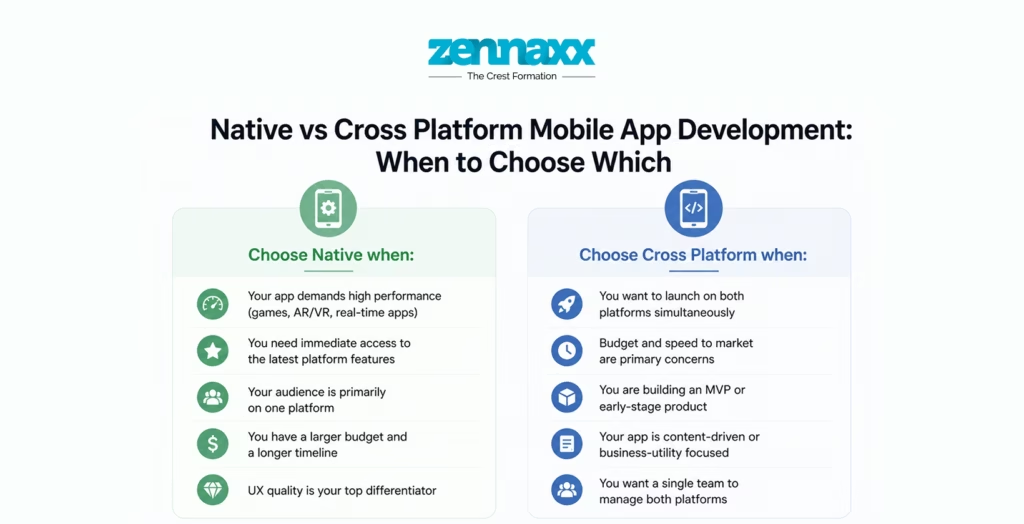
    Native app development is best for apps where performance is a must, like real-time games, video streaming, fintech apps, or health monitoring tools.

    What is Cross Platform App Development?

    With cross-platform app development, you can write one codebase that works on both iOS and Android. Frameworks like Flutter, React Native, and Xamarin make this possible by letting developers use most of the same code on different platforms.

    Cross Platform Mobile App Development lets businesses launch on more than one platform at the same time without having to do twice as much work. It is especially good for new businesses, MVPs, and companies that want to reach more people quickly and without spending too much money.

    Key characteristics of cross platform app development:

    • Single codebase for both iOS and Android
    • Built with frameworks like Flutter, React Native
    • Faster time to market
    • Development that doesn’t cost too much
    • Some native device features are hard to get to (but they’re getting better quickly)

    Cross platform app development is great for content-driven apps, e-commerce sites, productivity tools, and early-stage products where speed and cost-effectiveness are the most important things.

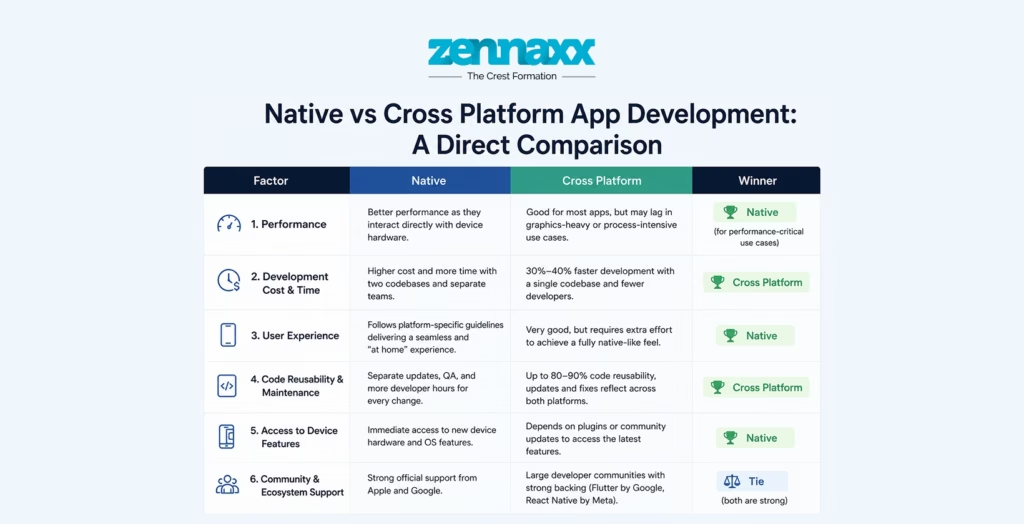
    Native vs Cross Platform App Development: A Direct Comparison

    Native vs Cross Platform App Development: A Direct Comparison

    When you look at native and cross platform app development side by side and compare them on the things that matter most to businesses, it becomes easier to understand the difference.

    Performance

    Native apps are clearly better in this case. Because they are made for a specific platform, they talk directly to the device’s hardware without requiring a translation layer. This makes things load faster, animations run more smoothly, and the whole experience feels better.Cross platform apps, while significantly improved in recent years (especially Flutter), still go through a bridge or intermediate layer. For most standard apps, the performance difference is barely noticeable. But for graphics-heavy apps or those requiring heavy background processing, native still leads.Winner: Native (for performance-critical use cases)

    Development Cost & Time

    This is where cross-platform apps really shine. Development time has been removed by 30% to 40% when there is only one codebase for both platforms. You also need fewer developers, and you can update both platforms at the same time.

    Native development essentially doubles the effort with two separate teams, two codebases, and two maintenance cycles. If you are also thinking about MVP development cost, cross platform is almost always the more practical starting point.

    Winner: Cross Platform

    User Experience

    Native apps follow platform-specific design guidelines with Material Design for Android, Human Interface Guidelines for iOS. This means users on each platform get an experience that feels truly “at home.” Gestures, animations, and UI components all behave exactly as users expect.

    Cross platform apps have improved dramatically, but achieving that fully polished, platform-authentic feel still requires extra effort from the development team.

    Winner: Native

    Code Reusability & Maintenance

    Cross platform apps allow developers to reuse up to 80–90% of the codebase. Bug fixes, feature updates, and UI changes made once are reflected across both platforms. This significantly lowers long-term maintenance overhead.

    Native apps require separate updates, separate QA cycles, and more developer hours for every change.

    Winner: Cross Platform

    Access to Device Features

    Native apps have unrestricted, immediate access to new device hardware and OS features as soon as they are released. Cross platform frameworks often need to wait for plugin support or community updates to access the latest features.

    Winner: Native

    Community & Ecosystem Support

    Both approaches have robust ecosystems. Native development benefits from official support from Apple and Google. Cross platform frameworks like Flutter (backed by Google) and React Native (backed by Meta) have enormous global developer communities.

    Winner: Tie (both are strong)

    Native vs Cross Platform Mobile App Development: When to Choose Which

    Native vs Cross Platform Mobile App Development: When to Choose Which Choose Native when:

    • Your app demands high performance (games, AR/VR, real-time apps)
    • You need immediate access to the latest platform features
    • Your audience is primarily on one platform
    • You have a larger budget and a longer timeline
    • UX quality is your top differentiator

    Choose Cross Platform when:

    • You want to launch on both platforms simultaneously
    • Budget and speed to market are primary concerns
    • You are building an MVP or early-stage product
    • Your app is content-driven or business-utility focused
    • You want a single team to manage both platforms

    If you are still unsure, it helps to explore a deeper technical comparison. We recommend reading our guide on Flutter vs Native Development: Better ROI for Apps to understand the performance and cost trade-offs with one of today’s most popular cross platform frameworks.

    How a Mobile App Development Company Can Help You Decide

    How a Mobile App Development Company Can Help You Decide

    Choosing between native vs cross platform apps is rarely black and white. It depends on your app’s features, your target users, your release timeline, and your growth roadmap. This is where working with an experienced Mobile App Development Company Canada makes a significant difference.

    A seasoned development partner does not just code, they consult. They analyze your business model, competition, platform audience, and technical requirements to recommend the right approach from day one. This prevents expensive pivots mid-development and ensures your app is built on the right foundation.

    At Zennaxx, we help businesses of all sizes navigate the native vs cross platform mobile development decision with clarity. From strategy and architecture to development and post-launch support, our team brings deep expertise across both approaches.

    The Real Cost Behind the Decision

    One thing businesses often underestimate is the long-term cost, not just the initial build. Native apps may cost more upfront, but if your app gains massive traction and needs to scale, the investment pays off. Cross platform apps may be cheaper to build but could require re-architecture later if your performance needs outgrow the framework’s capabilities.

    This is why understanding the full native vs cross platform mobile app development picture including maintenance, scalability, and update cycles is so important before you commit.

    Conclusion

    The debate around native vs cross platform does not have a universal winner. The right choice is always the one that aligns with your specific goals, budget, timeline, and user expectations.

    If you need the highest performance, deep platform integration, and a premium user experience, go Native. If you want speed, cost efficiency, and a unified codebase for both platforms, Cross Platform is your answer.

    What matters most is making an informed decision backed by the right expertise. Whether you choose to go with dedicated Native Mobile App Development Services or a Cross Platform Mobile App Development approach, the key is to align your technical strategy with your business vision and build with a team that knows both paths well.

    Ready to start? Let the experts at Zennaxx help you make the right call.

    FAQs

    Q1. Native vs cross platform – which is better for a startup? For most startups, cross platform is the smarter starting point. It allows you to launch on both iOS and Android faster, at a lower cost, and with a single development team. Once your product is validated and scaling, you can always migrate to native for specific performance-critical features.

    Q2. Do native apps perform better than cross platform apps?In general, yes – native apps offer slightly better performance because they run directly on the platform without an intermediate layer. However, modern cross platform frameworks like Flutter have closed this gap considerably, and for the vast majority of app types, the performance difference is negligible to end users.

    Q3. Is Flutter native or cross platform?Flutter is a cross platform framework developed by Google. It compiles to native ARM code, which gives it performance closer to native than most other cross platform solutions. It is one of the most popular choices today for native vs cross platform mobile development decisions.

    Q4. Which is more expensive – native or cross platform app development? Native app development is typically more expensive because it requires building and maintaining two separate codebases, one for iOS and one for Android. Cross platform development can reduce costs by 30-40% since a single codebase serves both platforms.

    Q5. Can cross platform apps access all native device features?Most native device features like camera, GPS, push notifications, Bluetooth are accessible in cross platform frameworks through plugins and APIs. However, access to bleeding-edge hardware features may be delayed compared to native development, which gets immediate support from Apple and Google.

  • Vibe Coding Vs Traditional Coding: Myths, Facts & Limits

    Vibe Coding Vs Traditional Coding: Myths, Facts & Limits

    The software world is buzzing with a new phrase – vibe coding. And with it comes a wave of opinions, strong claims, and a lot of confusion. Some say it’s the future of development. Others say it’s a shortcut that breaks things at scale. The truth? It’s somewhere in the middle and it’s more nuanced than most blog posts give it credit for.

    This blog clears up any confusion you might have experienced about Vibe Coding vs Traditional Coding. We’ll clear up the most common myths, give you the facts, and be honest about the real limits of both methods so you can make better choices for your project.

    What is vibe coding, exactly?

    Let’s ensure we have the definitions right before we compare both of them.

    Vibe coding is a way to develop software with the help of AI. You write down what you want in simple words, and tools like Cursor or GitHub Copilot make the code for you. You don’t have to write every line by hand. You give the AI prompts, look over what it comes up with, and then quickly repeat the process.It’s fast.

    It’s accessible. And it’s changed how many teams – especially startups and solo developers build software.

    Writing software manually is what traditional coding is all about. From design to deployment, developers plan the architecture, write every function, deal with logic edge cases, and follow structured processes. It takes a lot of technical know-how, but the end result is code that is well-documented, easy to understand, and built to last.

    Both are good ways to do things, but you can’t use them both. And that’s where most myths start: a lack of understanding.

    Debunking Common Myths About Vibe Coding and Traditional Coding

    Debunking Common Myths About Vibe Coding and Traditional Coding

    Vibe Coding Is Only for Beginners or People Who Don’t Code

    Fact: Many experienced developers use vibe coding to speed up tasks that they have to do over and over again, come up with new ideas, and cut down on boilerplate work. It’s not about how good you are; it’s about how quickly you can do things. Professionals use it as a productivity layer, not a replacement for thinking.

    That said, when non-developers use vibe coding without any engineering oversight, the risks go up significantly. The tool is powerful, but understanding what it produces still matters.

    Traditional Coding Is Slow and Outdated

    Fact: Traditional coding isn’t slow; unplanned traditional coding is slow. When done right with a well-organized Software Development Life Cycle, traditional development is organized, easy to predict, and very scalable. In the long run, teams that follow best practices like clear architecture, code reviews, and automated testing move faster because they don’t have to keep fixing broken code.

    “It’s slow” myth comes from comparing early-stage vibe coding (fast prototypes) to full-scale traditional production builds (complex systems). That’s not a fair comparison.

    Vibe-Coded Apps Are Good Enough for Production

    Fact: For MVPs, internal tools, or testing ideas, vibe coding can help you make a working product quickly. But “working” doesn’t mean “ready for production.

    “Production systems need to be checked for security, planned for scalability, handle errors correctly, follow rules, and have code that can be maintained. AI-generated code often skips all of this unless the developer asks for it and checks it carefully. A report from 2026 said that AI-generated code is responsible for 1 in 5 security incidents in businesses. This is a serious number that should not be ignored.

    You Can’t Use AI Tools with Traditional Coding

    Fact: AI tools are a big part of modern traditional development. The way they are used is what makes them different. AI works as an assistant in traditional workflows, helping with tasks like auto-completion, suggesting refactors, and finding bugs. The developer still owns every line, knows how it works, and makes decisions about how to build it.

    The AI controls the output in vibe coding. In traditional coding, the developer drives — and sometimes uses AI to accelerate.

    Vibe Coding Is Always Cheaper

    The truth is that vibe coding costs less up front. The total cost of ownership (TCO), on the other hand, is a different story. When AI-generated code builds up technical debt, like inconsistent patterns, duplicate logic, and missing documentation, it becomes much more expensive to maintain, debug, and scale over time.

    This is especially important for businesses that work with a Custom Software Development Company in Canada or any other mature market where the quality of software over time has a direct effect on business continuity.

    Differences That Really Matter : Vibe Coding Vs Traditional Coding

    Differences That Really Matter : Vibe Coding Vs Traditional Coding


    The truth becomes clear once you get past the myths. Here is how Vibe Coding and Traditional Coding compare in terms of important factors in real projects:

    Speed: Vibe coding wins at first. You can have a working prototype in a few hours. Traditional development is more structured, but it makes steady, reviewable progress.

    Code Quality: When there are good reviews in place, traditional coding makes code that is cleaner and better organized. The output of vibe coding can be neat or messy, depending on how well the prompts are written and checked.

    Security: This is where traditional coding is clearly better. Threat modeling, input validation, access control, and compliance checks are all built into the development process. When something breaks or an audit flags it, security is often added after the fact with vibe coding.

    Scalability: Systems made with traditional coding are meant to grow. When traffic increases, vibe-coded systems often run into performance problems because the original design didn’t take load into account. This is a hard limit, not just a choice.

    Maintainability: A developer knows what their code does when they write it. The developer might or might not write it when AI does. It gets harder to debug, add to, or hand off to new team members over time when codebases are made entirely from prompts.

    Compliance: Must in fields like healthcare and finance, like AI in Fintech. GDPR, HIPAA, SOC2, and PCI-DSS all require that processes be documented, data be traceable, and audits be possible. This is naturally supported by traditional development, but not by vibe coding.

    Where Vibe Coding Works (and Where It Doesn’t)

    There isn’t one way to do every project. It’s more useful to know when to use each than to say one is “better.”When vibe coding works well:

    • You’re checking to see if an idea works or making a minimum viable product (MVP).
    • The project is low-risk and only for the company.
    • You need a quick proof of concept for a demo or pitch.
    • The team is small and working quickly on the early stages of exploration.
    • The feature is still in the testing phase and won’t affect sensitive data.

    When vibe coding stops working:

    • The system has to be able to handle thousands of real users.
    • Data privacy and security are not up for negotiation.
    • You work in an industry that is regulated
    • A team will keep the codebase up to date and add to it over the years.
    • It is necessary to connect to complicated old systems or APIs.

    When traditional coding works best:

    • You’re making a system for production that customers can see.
    • Your product is subject to compliance frameworks.
    • Several developers need to work together on a codebase that they all use.
    • Decisions about architecture have effects on business in the long term.
    • The system needs to be checked, written down, or given to someone else.

    Real Limits of Each Technique

    Let’s be honest: neither method is perfect.

    Limits of Vibe Coding:The biggest problem is who owns it. A lot of the time, the developer doesn’t fully understand the code that the AI writes. When something breaks in production at 2 AM, that becomes a big problem. AI tools also have a hard time with undocumented APIs, legacy systems, and multi-service orchestration, which are all things that enterprise software runs into all the time.There are also security holes that aren’t obvious. AI models learn from a lot of code, even code that isn’t safe. If you don’t check carefully, vulnerabilities can get into production without anyone noticing.

    Limits of Traditional Coding:There are also problems with traditional coding. Slow onboarding, high upfront costs, longer time-to-market in the early stages, and over-engineering are all real risks, especially for startups where speed is most important.Also, the quality of the team is very important for traditional coding. A traditional project that isn’t well-structured can be just as bad as a vibe-coded one that hasn’t been looked over.

    Smarter Path: Choose Vibe or Traditional Coding Wisely

    Smarter Path: Choose Vibe or Traditional Coding Wisely

    The best development teams today don’t pick one over the other; they use both on purpose.

    When you want to explore an idea or make a prototype, start coding quickly with a vibe. Once the idea has been shown to be useful, switch to structured development methods. Before the system goes live on a large scale, break up the AI-generated code into clean layers, add proper testing, set service boundaries, and add security controls.

    A good Software Consulting Agency will help you make this change at the right time, before technical debt becomes a major issue and before security holes become a problem.

    This mixed method takes into account both the speed of vibe coding and the dependability of traditional development. It’s not about your beliefs; it’s about what your project needs at each stage.

    When to Bring in Expert Developers

    When to Bring in Expert Developers

    There’s a point in every product’s growth where the pace of vibe coding starts working against you. Features take longer to add. Bugs are harder to trace. The codebase feels brittle. That’s the signal.

    At that stage, bringing in skilled engineers makes more sense than continuing to prompt your way through. Whether you’re looking to Hire Dedicated Developers for a specific module or need a full team to take over the architecture, having professionals who understand both AI-assisted and traditional development is invaluable.They can audit what’s been built, identify where technical debt is accumulating, and create a roadmap to bring the system up to production standards — without throwing everything away and starting over.

    Conclusion

    The debate around Vibe Coding vs Traditional Coding isn’t really a debate at all — it’s a spectrum. Both have a place in modern software development. Both come with real myths that cloud good decision-making. And both have hard limits that you’ll run into if you rely on either one exclusively.

    The myth that vibe coding replaces engineering judgment is false. The myth that traditional coding can’t benefit from AI is equally false. The facts point to a more pragmatic truth: use the right tool for the right moment, and know when to shift.Build fast when you need to.

    Build right when it matters. And when you’re not sure which moment you’re in — that’s when talking to experienced developers makes all the difference.

    FAQs

    Q1. Is it possible that vibe coding will completely take over traditional coding in the future?Not likely, at least not for complicated systems that are ready for production. Vibe coding is great for speed and early-stage exploration, but it doesn’t have the architectural depth, security rigor, or code ownership that traditional development does. Even though AI tools are getting better, developers will still need to use their judgment, be accountable, and know a lot about their field. A more realistic future is one where both are more mixed together. AI does more of the boring tasks, and developers only make decisions that really need human thought.

    Q2. Is vibe coding safe to use for projects that deal with confidential user information?If you don’t watch it carefully, it can be very dangerous. AI-generated code can have small security holes, like not checking inputs, weak access control, or not handling data properly, that don’t show up until something goes wrong. If your project will be using personal information, financial records, or health information, any vibe-coded module should be thoroughly checked for security before it touches any real data. It’s best to think of AI output as a first draft that needs to be checked by a professional.

    Q3. How can I tell when it’s time to stop coding by feel and start using more traditional methods?There are a few clear signs that something is wrong: your codebase is getting harder to debug, adding new features breaks old ones, team members have trouble understanding what was built, or your product is getting closer to real users and real data. When compliance, scaling, or long-term maintenance become a priority, that’s another strong sign. At that point, continuing to build only with prompts makes things worse instead of better. Bringing in structured development practices becomes a business decision, not just a technical one.

    Q4. If I use vibe coding tools like Cursor or GitHub Copilot, am I not “really” coding?No, using AI tools doesn’t make software development any less of a skill. AI coding assistants don’t take the place of developers, just like calculators didn’t take the place of mathematicians. The way things get done changes. You still need to know what the code does, look at it carefully, make decisions about the architecture, and take responsibility for what gets shipped. Using tools like Cursor or GitHub Copilot well doesn’t mean that developers are skipping the thought that goes into making good software. They’re just working more efficiently.

    Q5. Which way is better for a new business to make its first product?Vibe coding is a good choice for the very first steps, like validation, MVP, or a proof of concept. It lets you move quickly, test your idea for a low cost, and learn quickly. But as soon as your product starts getting real users or you’re ready to grow, it’s worth putting money into good software architecture and development methods. A lot of startups that take shortcuts early on have to rewrite a lot of their code later on. Getting even the most basic structural choices right from the start, with help from a Software Consulting Agency, can save a lot of time and money in the long run.

  • Best Web Development Stack 2026: Choose Right for Business

    Best Web Development Stack 2026: Choose Right for Business

    You spend six months and a significant budget building your business website. It launches. And then it crashes under traffic, loads slowly, or becomes a nightmare to update. This is not a rare story. It happens when businesses skip the most important early decision: picking the right best web development stack 2026.

    Your tech stack is the collection of tools, frameworks, and languages that power your website or web app. It decides how fast your site loads, how secure it is, how easy it is to grow, and how much it costs to maintain long-term. Get it right from the start and everything else becomes easier.

    With any unnecessary complexity or term overload, this guide breaks through the noise and provides you with a straightforward, useful analysis.

    First, What Does “Full-Stack” Actually Mean?

    Every website or web app has three layers working together behind the scenes.

    The Frontend is what your users see – buttons, menus, pages, animations. It is built with HTML, CSS, and JavaScript, often powered by frameworks like React, Angular, or Vue.

    The Backend is the engine room. It handles your data, processes requests, manages logins, and connects everything together. Technologies like Node.js, Laravel, and PHP live here.

    The Database is where all your information is stored – customer records, orders, content. MySQL, PostgreSQL, and MongoDB are common choices depending on the type of application.

    The combination of these three layers is your tech stack. Choosing well means your business has a strong foundation. Choosing poorly means expensive rebuilds down the road.

    Frontend Frameworks: React, Angular, or Vue?

    Frontend Frameworks: React, Angular, or Vue

    This is where most businesses get confused. These three frameworks are all excellent but they serve different purposes. For a deeper breakdown, check out this guide on React vs Angular vs Vue.

    React JS is the most popular choice worldwide, and for good reason. It is fast, flexible, and backed by Meta. If you are building an e-commerce frontend, SaaS dashboard, or any app where user experience matters, React is a strong starting point. Pair it with Next.js and you also get great SEO performance.

    Angular is Google’s full-framework solution. It comes loaded with everything built in – routing, validation, security tools. It is the go-to for large enterprise applications where teams are big and code needs to stay consistent over years.

    Vue JS sits in the middle – easier to learn than Angular, more structured than React. It works particularly well with Laravel backends and is a favourite among startups that need to move fast without cutting corners.

    Backend Technologies: What Powers Your App

    PHP & Laravel remain extremely popular and for good reason. Laravel in particular is one of the cleanest, most developer-friendly frameworks available. It is ideal for custom web apps, SaaS platforms, and REST APIs. Fast to build with, easy to maintain, and widely supported.

    Node.js & Express.js bring JavaScript to the server side. One language across your entire stack means faster development and less complexity. Node.js handles real-time features brilliantly with live chat, notifications, and streaming. Thanks to its event-driven architecture.

    Java Spring Boot is built for enterprises operating at serious scale. Banks, healthcare systems, and logistics platforms rely on it for its security, reliability, and performance under heavy load.

    CodeIgniter is a lighter PHP framework that works well for smaller projects, MVPs, or businesses that need a fast, no-fuss deployment without extra overhead.

    E-Commerce: Shopify, Magento, or WordPress?

    E-Commerce: Shopify, Magento, or WordPress?

    Choosing an e-commerce platform is one of the biggest tech decisions a product business can make. The wrong platform will cost you in time, money, and missed sales.

    Shopify is the fastest way to get an online store live. It handles hosting, security, and updates for you. As a trusted Shopify Development Company in Canada, Zennaxx regularly recommends Shopify for brands that want a polished, manageable store without technical headaches. It is especially strong for D2C brands, fashion, and lifestyle businesses wanting a quick, professional launch.

    Magento (Adobe Commerce) is built for complexity. Multi-store setups, large product catalogs, B2B pricing rules, advanced inventory – Magento handles it all. It requires skilled developers to implement and maintain properly, but the payoff in flexibility is unmatched. If you are a growing retailer with complex needs, Magento Development Toronto expertise can make a real difference to your store’s performance and scalability.

    WordPress + WooCommerce is the most content-friendly combination in e-commerce. WordPress has the best SEO ecosystem of any platform. If organic traffic and content marketing are central to how you grow, working with a proven WordPress Development Company will give you a meaningful long-term advantage. It is also the most cost-effective option for small to mid-size stores just getting started.

    How Your Best Web Development Stack 2026 Affects SEO

    This is something businesses often discover too late. Your stack choice directly impacts your Google rankings.

    Google measures page speed, layout stability, and load times through Core Web Vitals and these are ranking factors. A poorly optimized stack can hurt your SEO even if your content is excellent.

    For JavaScript-heavy apps like React or Angular, server-side rendering (SSR) is important. Without it, search engines may struggle to crawl your content fully. Next.js (for React) and Nuxt.js (for Vue) solve this cleanly.

    WordPress remains the gold standard for SEO. Its structure, combined with plugins like Yoast or Rank Math, gives businesses an inherent advantage in organic search. If content drives your growth, it is hard to argue against WordPress.

    If you are investing in paid traffic or organic search, bringing in a Hire SEO Expert early before development, not after that ensures your stack supports your marketing strategy from day one, not as an afterthought.

    Best Stack For Your Business Type

    Best Stack For Your Business Type

    Here is a short practical guide inspired by your scenario:

    Startup / MVP – React + Node. js or Laravel. Be fast, be clean, iterate off actual user contact before you scale infrastructure.

    Choose Your E-Commerce Platform: Shopify for simplicity and speed; Magento for complex / high volume stores; WordPress + WooCommerce May be ideal if content will drive growth.

    Enterprise Application – Angular + Java Spring Boot or Laravel Ideal for larger teams, longer-lived projects and serious security requirements.

    SaaS Platform – React + Node. js + PostgreSQL. Re-usability of components, Real-time features & rock-solid scalability path.

    Content / Media website – WordPress, all the time Easiest CMS, highest SEO & lowest long term costs.

    React or Vue + Node: Real-Time App js + Socket. io + MongoDB. Specifically designed for live communication, collaboration, and working at scale.

    Five Questions to Ask Before You Decide

    • How big do you expect to grow in three years? Scale requirements should drive your architecture choices from the start.
    • What is your total budget – build cost and ongoing maintenance? Some stacks are cheaper to build but expensive to run. Factor in both.
    • What does your development team know well? The best stack is useless if nobody can build it properly. Depth matters more than trendiness.
    • Is SEO a core part of how you acquire customers? If yes, server-side rendering and WordPress need to be part of the conversation.
    • What systems do you need to connect to? CRMs, payment gateways, ERPs – know your integration requirements before you commit to a stack.

    Common Mistakes to Avoid

    Choosing based on what is popular rather than what fits. React is excellent but it is not the right tool for a simple business website.

    Over-engineering the first version. Start simple. Micro-services and complex architecture are problems to solve when you actually have scale, not before.

    Ignoring SEO until after launch. Retrofitting server-side rendering into a client-side app is painful and expensive. Plan for it upfront.Skipping mobile optimization. Over 60% of web traffic is mobile. Your frontend must be mobile-first, not just mobile-friendly.

    Final Thoughts

    The best web development stack 2026 is not the most hype one but it comes with a match to your business goals, user base, strength and budget of a team. There is no absolute right answer, but there is always a right answer for you.

    Shopify store, a Laravel-based SaaS with all enterprise required features, an enterprise Angular app, or even organic growth built WordPress site that the choice is clear and intentional with strongly valued experience of previous development teams delivering production grade apps in those technologies / tools.

    Zennaxx is a full-service Website Development Company in Canada that works with all major web technologies such as React, Angular, Vue, Node. js and Laravel PHP WordPress Shopify Magento, etc. Our recommendations are never based on either favoring internal players or not; they are focused purely on what is best for your business.

    Ready to get started? Book a free consultation with our technical experts who can help you select the right stack based on your objectives, timelines and budget.

  • AI in Fintech: How It’s Transforming the Financial World

    AI in Fintech: How It’s Transforming the Financial World

    The financial world is changing fast – and AI in Fintech is right at the center of it. From the way we transfer money to how banks catch fraud in real time, artificial intelligence has quietly become one of the most powerful forces reshaping the fintech space. If you’re a business owner, a startup founder, or someone working in financial services, understanding what AI brings to the table is no longer optional. It’s pretty much essential.So let’s break it all down in a way that actually makes sense.

    What Is AI in Fintech, Exactly?

    Fintech, short for financial technology – refers to the use of software and digital tools to deliver financial services. Think mobile banking, digital wallets, online lending, and investment platforms. Now, layer AI on top of that, and you get smarter, faster, and more secure systems that can adapt, predict, and automate in ways traditional software simply cannot.AI in fintech uses technologies like machine learning, natural language processing, predictive analytics, and automation to improve how financial products are built and delivered. The result? Better user experiences, reduced operational costs, and sharper decision-making across the board.

    Why AI Matters So Much in Finance Right Now

    The financial industry handles billions of transactions every single day. That level of volume creates a massive need for speed, accuracy, and security – three things AI is genuinely good at.Here’s the thing: human analysts can only process so much data at once. AI doesn’t have that limitation. It can scan thousands of data points in milliseconds, catch unusual activity before it becomes a real problem, and even predict customer behavior based on past patterns. For fintech companies, that’s a serious game-changer.Customer expectations have shifted too. People want instant responses, personalized experiences, and seamless digital interfaces. AI makes all of that possible – and at scale.

    Key Areas Where AI Is Making a Big Impact

    Key Areas Where AI Is Making a Big Impact

    Banking Software

    Modern banking software powered by AI goes far beyond managing accounts and processing payments. AI enables smart features like real-time fraud detection, automated customer support through chatbots, personalized product recommendations, and intelligent risk assessment. Banks can now offer a tailored experience to each customer without needing to scale up their headcount.

    Trading Platforms

    AI-driven trading platforms can process market data at speeds no human trader could ever match. Algorithmic systems powered by machine learning identify patterns, execute trades, and manage portfolios with a level of precision that minimizes human error. For investors and financial institutions, this translates to smarter, faster, and more confident decisions.

    Lending Software

    Traditional loan approvals can take days – sometimes weeks. AI-based lending software assesses creditworthiness in minutes by analyzing a much wider set of data points, not just credit scores but behavioral and transactional data too. This makes lending faster, fairer, and more accessible, especially for small businesses and individuals who might otherwise be underserved.

    E-Wallet Apps

    E-wallet apps have exploded in popularity, and AI is a big reason they’ve become so reliable and secure. From biometric authentication to smart spending insights and proactive fraud prevention, AI enhances both the functionality and trustworthiness of digital wallets. Users get a safer, smarter way to manage money – all from their phone.

    Crowdfunding Platforms

    AI helps crowdfunding platforms match the right investors with the right projects by analyzing risk profiles, project viability, and funding history. It also helps detect fraudulent campaigns and improves recommendation engines so backers can discover opportunities that genuinely align with their interests.

    Billing Solutions

    Automated billing solutions driven by AI reduce manual errors, handle complex billing cycles, and send smart payment reminders at exactly the right time. They can even predict payment delays and flag accounts that may need attention — incredibly useful for subscription-based businesses and growing SaaS companies.

    Payment Gateway Software

    AI-enhanced payment gateway software brings faster transaction processing together with real-time fraud screening. It analyzes transaction patterns on the fly and blocks suspicious activity without creating unnecessary friction for legitimate users. That balance between tight security and a smooth user experience is something AI handles particularly well.

    How AI Improves the Bigger Picture

    Beyond specific tools and products, AI in fintech also strengthens regulatory compliance – commonly called RegTech. Financial institutions deal with a mountain of compliance requirements. AI can automate monitoring, flag potential violations, and generate compliance reports automatically, saving enormous time and reducing regulatory risk in the process.AI is also transforming customer service through intelligent virtual assistants. These systems handle FAQs, guide users through complex processes, and escalate issues to human agents only when genuinely needed – without making customers wait around.And then there’s personalization. Just like how AI-Powered Food Delivery Apps use behavioral data to serve up smarter, more relevant recommendations, fintech apps are doing the exact same thing – offering customers tailored financial advice, spending insights, and product suggestions based on their real habits and goals.

    What This Means for Businesses Building Fintech Products

    What This Means for Businesses Building Fintech Products If you’re planning to build or upgrade a fintech product, the question isn’t really “should we use AI?” – it’s “how do we build it right?”That’s where having the right development partner makes all the difference. Building AI-powered financial software requires deep technical expertise, a solid understanding of compliance and security, and hands-on experience across different fintech verticals.For businesses in Canada, working with a team that understands both the technology and the local market is a genuine advantage. Whether you need Custom Software Development in Canada for a new lending platform, or you’re looking to modernize your payment infrastructure, getting the architecture right from day one saves enormous time and cost down the road.At Zennaxx, we offer end-to-end Software Development Services that cover the full fintech spectrum – from ideation all the way through to deployment. We’ve worked with clients across industries to build scalable, secure, and AI-ready on-demand solutions that solve real business problems, not just ones that look good on paper.If you’re based in Ontario or anywhere across Canada, our team as a trusted Software Development Company in Ontario is well-positioned to help you build fintech solutions that are ready for today’s market and tomorrow’s demands.

    Challenges Worth Keeping in Mind

    It’s not all smooth sailing, of course. Implementing AI in fintech comes with real challenges. Data privacy is a significant one – financial data is highly sensitive and subject to strict regulations. Any AI system needs to handle that data responsibly and transparently from the very start.There’s also the issue of bias in AI models. If the training data contains biases, the AI can replicate and even amplify them – for example, unfairly disadvantageing certain groups in lending decisions. Building responsible AI means regularly auditing models and using diverse, representative datasets.And then there’s the cost and complexity of integration, especially for legacy financial institutions running older systems. Replacing or upgrading those systems takes careful planning, phased execution, and a development partner that genuinely knows what they’re doing.These challenges are absolutely manageable but they’re also exactly why working with experienced developers matters so much.

    Road Ahead for AI in Fintech

    Road Ahead for AI in Fintech AI in fintech is not a passing trend, it’s a fundamental shift in how financial services are built and delivered. We’ll continue to see deeper integration of AI across every layer of the financial stack: smarter underwriting, more predictive risk models, hyper-personalized customer journeys, and real-time financial coaching built directly into everyday banking apps.For businesses that embrace this shift now, the competitive advantage is enormous. For those that wait, catching up will only get harder.Whether you’re building a new fintech product from scratch or looking to modernize an existing one, the opportunity is real and the technology is ready. The only question left is – are you?
  • Flutter vs. Native Development: Performance & Better ROI for Apps?

    Flutter vs. Native Development: Performance & Better ROI for Apps?

    Selecting the best approach for mobile app development in today’s competitive digital ecosystem is vital for performance, scalability, user experience and a long-term return on investment. Flutter vs native development is a hot debate that has continuously impacted strategic decisions of startups, enterprises and growth companies. Being a leading Flutter App Development Company, we assist organizations to decide which option brings them higher value in terms of ROI along with quicker go-to-market strategy execution and the sustainable expansion of their business.

    Mobile apps are no longer just value-added products, they now form catalysts for each business. Whether you are investing in android app development, iOS App Development, or cross-platform frameworks the objective remains the same – to maximize performance at optimized cost efficiency.

    Understanding Flutter vs Native Development

    The flutter vs native development difference comes mainly alive inside the technical structure, improvement procedure and assets deployment.

    What is Flutter Development?

    what is flutter development Flutter is an open-source UI toolkit created by Google that allows you to develop applications for multiple platforms from a single codebase. The businesses opting for Flutter App Development Services Canada, get fast deployment cycles and uniform UI across platforms.
    Flutter- It uses Dart programming language and renders components using its own engine instead of a native component to their platform. This naturally maintains design consistency and animates smoothly between the devices.

    What is Native App Development?

    What is Native App Development Native development means writing two independent applications targeting Android and iOS that use platform-specific languages – Android uses Kotlin/Java whereas iOS uses Swift/Objective-C. When it comes to Android App Development and iOS app development, companies investing separately usually cater deep hardware integration along with platform optimized performance.
    Performance Comparison: Flutter vs Native

    Performance is still the key metric for application success.

    UI Rendering & Speed

    Flutter has a high-performance engine (Skia) to render the UI components directly on the screen. That reduces dependencies on OEM widgets, reducing inconsistency. For most business applications, the differences in performance are not significant.

    Native apps, for their part, interact directly with device APIs: That makes them a little more optimized for computational intensive actions like AR, gaming or rich animations.

    Flutter offers more than adequate performance with smooth user experience for eCommerce, healthcare apps, fintech solutions, logistics platforms and enterprise dashboards.

    App Startup Time

    Native apps have always had slightly faster cold start times because they compile to a platform native binary. But Flutter has come a long way, and most commercial use cases see the same user experience.

    Hardware Integration

    Native applications have direct access to hardware-level features which are such as Bluetooth, GPS, sensors and camera APIs. Flutter bridges these through plugins. And now that the ecosystem supports almost all required integrations, it is a tool you can rely on for mainstream business applications.

    Development Speed & Cost Efficiency

    Time-to-market determines competitive advantage.

    Single Codebase Advantage

    Flutter – We maintain a single codebase for Android and iOS platforms. This reduces:

    • Development hours
    • Testing efforts
    • Maintenance complexity
    • Resource dependency

    Flutter reduces development costs by 30–40% for businesses hiring a professional Flutter App Development Company instead of having separate native teams.

    Native Development Cost Structure

    Native apps require:

    • Two separate development teams
    • Dual QA processes
    • Platform-specific UI implementation
    • Separate maintenance cycles

    Native apps provide the greatest level of control, however they represent a substantial increase in not only budget optimisation but day to day operational costs too.

    User Experience & Design Flexibility

    User Experience & Design Flexibility

    App retention relies heavily on user interface.

    Flutter UI Capabilities

    Flutter offers a great deal of flexibility in the design aspect as it allows creating high-quality custom widgets that reuse native UI elements. For high-performance and visually consistent applications, companies hire flutter developers as it is great for businesses that are looking forward to developing a high-end visual interface.All in all, this framework provides pixel-perfect designs and smooth animations across platforms without sacrificing performance.

    Native UI Approach

    Native apps are built according to platform-specific design guidelines (Material Design for Android & Human Interface Guidelines for iOS). Although this secures platform authenticity, it doubles your UI design efforts.For the ones that aim for uniformity in branding on multiple platforms, Flutter presents a valuable streamlined benefit.

    Maintenance & Scalability

    Maintainability is a prerequisite for long-term ROI.

    Flutter Maintenance Benefits

    • Unified updates
    • Faster feature rollouts
    • Lower technical debt
    • Simplified version control

    It becomes straightforward for businesses structured Mobile app development strategies over Flutter to maintain scalability.

    Native Maintenance Challenges

    Native applications require:

    • Separate bug fixes
    • Dual platform updates
    • Higher regression testing cycles

    Maintenance costs accumulate substantially over a period of time.

    ROI Comparison: Where Do Businesses Gain More?

    ROI Comparison: Where Do Businesses Gain More? Return on investment is not only about development cost; it can also be measured by speed, scalability, performance and flexibility to future changes.
    Flutter ROI Factors

    • Faster deployment
    • Reduced development resources
    • Lower maintenance cost
    • Easier scalability
    • Unified team structure

    For startups and SMEs, Flutter almost always results in a better ROI since the budgets are optimised and products can be launched faster.

    Native ROI Factors

    When Native development may create a much higher ROI:

    • The app also needs a lot of computing steps
    • Advanced hardware interaction is mandatory
    • Platform-exclusive features drive business value

    Native investment may be justified with enterprises that have big budgets and performance-intensive applications.

    When to Choose Flutter

    We recommend Flutter when:

    • You want faster go-to-market strategy
    • Budget optimization is essential
    • You aren’t dealing with prototyping or design handover
    • Long-term operations and management costs need to be contained
    • You intend to quickly scale features

    When businesses are comparing frameworks it’s also helpful to consider internal factors like flutter vs react native before finalizing a technology stack.

    When to Choose Native Development

    Native development becomes ideal when:

    • Your app is graphics-intensive
    • Real-time performance is mission-critical
    • Deep system-level integration is required
    • It is a strategic focus area for the user experience platform

    Security Considerations

    When implemented properly, both are equally secure. With native apps you also have access to platform-level encryption APIs. Flutter can overpass the listening in through native layers for secure storage and an encrypted communication channel.Most web security is based on the backend architecture and development patterns, rather than what frameworks you are using.

    Business Decision Framework

    To decide if it is profitable, companies need to check:

    • Project complexity
    • Budget constraints
    • Timeline expectations
    • Long-term maintenance capability
    • Scalability requirements

    Flutter and Native Development is not a trend-based decision, but rather investment based decision.

    Conclusion

    Conclusion Ultimately, choosing between flutter vs native development boils down to finding the right balance between performance needs and budgetary constraints with scalability aspirations. This means that, for most modern business applications, Flutter offers a compelling combination of performance, visual consistency, faster development time and maximized ROI. Native development is still the best solution for performance-oriented, hardware-dependent applications when you need access to the maximum platform resources.


    For organizations looking to grow sustainably, launch rapidly and scale cost-effectively, Flutter-backed solutions led by seasoned dev teams are a growing preference.

  • Why Choose AI-Powered Food Delivery Apps in Canada?

    Why Choose AI-Powered Food Delivery Apps in Canada?

    The food delivery sector has experience an enormous revolution in the last ten years, which is fueled by technology and evolving consumer standards. Food Delivery Apps in Canada are not the companies where you simply place an order and wait until it arrives at your door-step. Today, they are smart digital platforms that operate based on Artificial Intelligence (AI). AI is transforming customer behavior in ordering and the business in real-time tracking of deliveries and predictive analytics, among other personalized food recommendations.

    The ever-increasing competition and the more sophisticated customer demands require smarter, faster, and more scalable solutions in restaurants, cloud kitchens, and startups. That is why investing in AI-based food delivery systems has become one of the strategic business decisions made by companies to develop and grow, streamline their operations, and maximize customer satisfaction.

    Within this step-by-step guide, we discuss the reasons why the use of AI-driven food delivery applications is becoming crucial, the advantages of their application, and how a selection of a development partner can define your business success.

    Emergence of Food Delivery Apps in Canada

    Canadian food delivery market has been growing exponentially due to busy lifestyle, urbanization and increased use of smartphone. The consumers have now become demanding of great streamlining of ordering processes, prompt delivery, choice of payment systems, and custom service. The old fashioned food order websites are not sufficient to live up to these expectations.

    The gap can be filled by Food Delivery Apps in Canada that are driven by AI and provide:

    • Smart order predictions
    • Individualized menu suggestions
    • Efficient route optimization
    • Automated customer support
    • Real-time analytics

    These features are not only increasing customer satisfaction but also have a great impact on the efficiency of operations in restaurants and delivery businesses.

    Differences Between those AI-powered Food Delivery Apps

    AI-powered food delivery applications beyond mere order taking. They use the data on customer behavior, preferences, location, and ordering history to provide a highly customized and efficient experience.

    Key Capabilities of AI in Food Delivery Apps

    Individual User Interaction

    AI algorithms process customer data and propose dishes according to the preferences, past orders, time of the day and even weather conditions. This customization enhances value of order and loyalty of customers.

    Smart Order Prediction

    AI is able to find out the most frequent times, the most commonly ordered food, and the amount of food to be delivered, thereby enabling restaurants to stock up on inventory and staffing levels.

    Optimized Delivery Routes

    Routine optimization AI will decrease the time of delivery, fuel consumption, and unnecessary deliveries, enhancing customer satisfaction and effectiveness in operations.

    Customer Support AI Chatbots

    24/7 passive customer service will answer the customer queries immediately, eliminating human dependence and enhancing the response time.

    Data-Driven Business Insights

    AI dashboards help to give actionable information on sales patterns, customer behavior, inventory, and marketing effectiveness.

    Reason Why Businesses Choose AI-Driven Food Delivery Apps in Canada

    Reason Why Businesses Choose AI-Driven Food Delivery Apps in Canada Canadian market is very competitive. Businesses which survive and develop require technological innovation. The following is the reason why AI-based solutions are becoming popular:

    Improved Customer Preoccupation

    With the help of AI, interaction is highly customized, and retention and brand loyalty are enhanced.

    Increased Operational Effectiveness

    Automation saves on human error, streamlines the work process, and lowers operational expenses.

    Faster Deliveries

    Logistics with the use of AI provide fast and precise delivery, which is a key aspect of customer satisfaction.

    Better Scalability

    AI systems can easily be adjusted to meet the increasing business requirements and can assist in the expansion of the business in various cities.

    Role of a Professional Food Delivery App Development Company

    The development of an AI-driven application demands a complex technical and industry knowledge and a user-friendly philosophy. The collaboration with the reputable Food Delivery App Development Company will guarantee the scalability, security, and the future-readiness of your app.

    With an expert development partner, you get:

    • Design intuitive user interfaces
    • Integrate AI and machine learning features
    • Assure data safety and confidentiality
    • Provide high performance applications

    It is possible to effectively exploit the local market knowledge, regulatory compliance, and customer expectations by selecting credible Food Delivery App Development Services Canada.

    Why Choose an Online Food Delivery App Development Company?

    An Online Food Delivery App Development Company is a professional firm that focuses on the development of platforms that will help match customers, restaurants, and delivery agents in terms of smooth operation processes. Such platforms are developed in order to be fast, scalable and reliable.Key benefits include:

    • Cloud-based architecture
    • Advanced AI integration
    • Multi-payment gateway support
    • Live order and delivery tracking

    This guarantees a fully digital ecosystem that makes work easier and improves customer experience.

    Advantages of Working with a Food Ordering & Delivery App Development Company

    Advantages of Working with a Food Ordering & Delivery App Development Company A specialized Food Ordering & Delivery App Development Company understands the unique challenges of the food delivery ecosystem. Their solutions lie in the construction of scalable, secure and intelligent platforms which are able to process high traffic, real-time data and dynamic logistics.Such companies offer:

    • Custom feature development
    • Robust backend systems
    • Smart analytics dashboards
    • Scalable architecture

    These attributes assist companies to expand without compromising service quality and efficiency.

    Importance of Mobile App Development Canada for Food Delivery Solutions

    The modern food delivery services depend on mobile applications. When you collaborate with a trusted Mobile App Development Canada provider, you can be sure that your platform will be of quality, performance, and security that are acceptable and favored by Canada.Mobile-first development ensures:

    • Smooth user experiences
    • Fast loading speeds
    • Secure payment processing
    • Cross-platform compatibility

    This increases the user interaction and brand visibility.

    Why iOS App Development Company Expertise Matters

    The portion of users of iOS is a substantial market in Canada. When one is dealing with an experienced iOS App Development Company, he or she is guaranteed high-quality performance, extra design, and security compliance.

    An optimized iOS app delivers:

    • Faster performance
    • High-end security features
    • Seamless user interfaces
    • Better integration with Apple ecosystem

    This increases brand perceptions and retention.

    How AI Transforms Business Growth in Food Delivery Apps

    How AI Transforms Business Growth in Food Delivery Apps AI is not automation only, but a strong engine of growth. This is the contribution of AI to the long-term success:

    Smarter Marketing Campaigns

    AI processes customer data to generate tailored promotions and custom discounts and enhances the ROI of marketing.

    Demand Forecasting

    Predictive analytics assist companies to be ready in peak times, optimize stock use, and minimize wastage of food.

    Retention Strategies to the Customer

    AI-based loyalty programs and personalized offers improve repeat orders and long-term engagement.

    Operational Cost Reduction

    Robotic processes and streamlined logistics minimize time loss in delivery and workforce expenses.

    Key Features of AI-Powered Food Delivery Apps

    In order to achieve success in the Canadian market, AI-powered apps must have:

    • Recommendation engine based on AI
    • Intelligent order and delivery tracking
    • Forecasting analytics dashboard
    • Voice and chatbot support
    • Secure payment gateways
    • Multi-language support

    Such capabilities form an overall digital ecosystem which makes the customer and business experience more effective.

    Steps to Start Your Food Delivery Business Online

    If you’re planning to start food delivery business online, AI-powered apps offer a future-ready foundation. From market analysis to app deployment, AI-driven platforms streamline every stage of your business journey.

    When you are trying to launch food delivery business online, you can use AI-powered applications as a platform of the future. AI based platforms automate all the steps in your business starting with market analysis up to the deployment of the app.Planned development plan consists of:

    • Business requirement analysis
    • UI/UX design
    • AI feature integration
    • App development and testing
    • Launch and ongoing support

    This will guarantee a good entry into the market and quicker expansion of business.

    Reasons Why Zennaxx is the Ideal Development Partner

    Reasons Why Zennaxx is the Ideal Development Partner Zennaxx provides innovative AI-based products specific to the Canadian food delivery sector. Being one of the top Food Delivery App Development Company, Zennaxx applies technical skills, industry experience, and user-oriented design to create scalable and secure applications.Their comprehensive Food Delivery App Development Services Canada ensure:
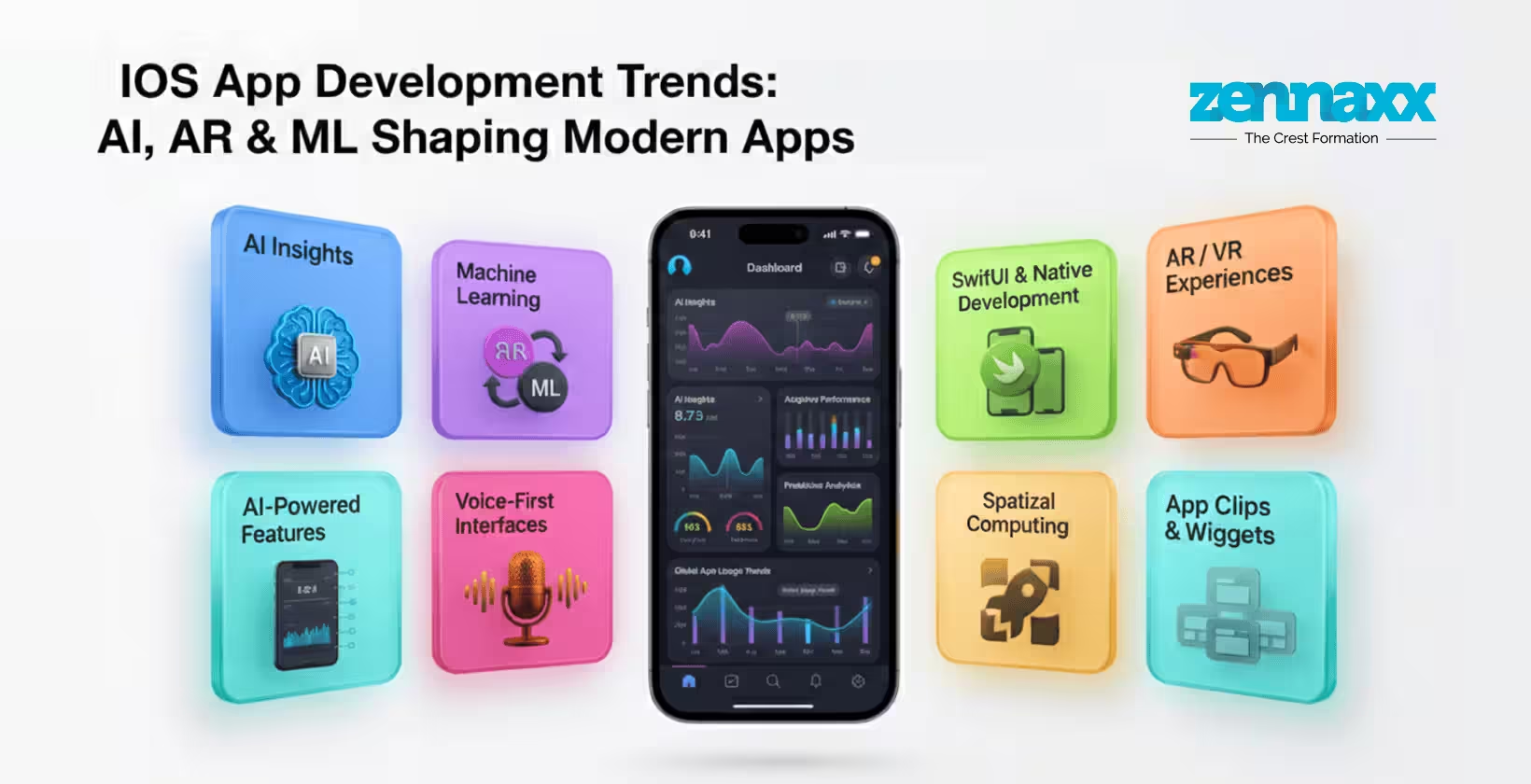
    • Custom AI integrations
    • Scalable architecture
    • Robust security
    • Seamless performance

    Whether you need a startup MVP or a full-scale enterprise platform, Zennaxx delivers reliable and future-ready solutions.

    Future of Food Delivery Apps in Canada

    Automation, customization and predictive intelligence are the future of food delivery. In the near future AI-driven platforms will embrace:

    • Autonomous delivery systems
    • Voice-enabled ordering
    • Hyper-personalized meal planning
    • Smart kitchen integrations

    Early adopters of AI in businesses will achieve a competitive advantage and sustainability.

    Conclusion

    The demand for Food Delivery Apps in Canada is growing rapidly, and AI is at the heart of this transformation. From enhancing customer experiences to optimizing business operations, AI-powered food delivery apps offer unmatched advantages.

    By partnering with a reliable Food Delivery App Development Company, businesses can build scalable, intelligent, and secure platforms that meet evolving customer expectations. Whether you’re planning to expand your restaurant operations or launch a new food delivery startup, AI-powered solutions provide the technological foundation for success.

    Now is the perfect time to invest in smart food delivery technology and position your brand for long-term growth in Canada’s dynamic digital marketplace.

  • iOS App Development Trends: AI, AR and ML Shaping Modern Apps

    iOS App Development Trends: AI, AR and ML Shaping Modern Apps

    In the fast-paced digital world of today, mobile apps are more than just instruments; they’re experiences. From hailing rides and handling money to gaining new skills and staying entertained, apps have reinvented the way people interact with technology on a daily basis. Apple’s universe is, arguably, the best performing and most user-friendly in any setting. And that’s also why iOS app development still draws businesses looking specifically at creating premium mobile products that are not only ready for the next day, but the next decade.

    But that’s not what iOS apps look like today. AI, AR & ML are redefining the way apps work and interact with users. These technologies are more than trends – they’re translating into expectations. Now, more than ever users want recommendations that are smart, experiences that they can dive deep into and interactions that feel extremely customized to them.

    So let’s unravel the ways AI, AR and ML are influencing new age iOS apps and why it is important to get associated with a fearless iOS App Development Company in Canada for your business strategies.

    Understanding the Modern iOS Ecosystem

    How Apple’s Ecosystem Drives Innovation

    Apple’s environment is creatively enabling, yet with rigid performance and security requirement now included. Developers can build apps that are fast, aesthetically rich and super snappy thanks to tools such as Xcode, Swift, SwiftUI and ARKit.

    But the real thing that makes iOS special is its consistency. The devices play well together – their iPhones, iPads, Apple Watches and Macs work in synergy to provide a seamless user experience. And this connected ecosystem paves the way for new inventive opportunities, particularly when partnered with newly developed tech such as AI and AR.

    The Role of Swift, SwiftUI, and Apple Frameworks

    Swift, Apple’s programming language, is built for speed and efficiency, in addition to safety and simplicity. Technology like SwiftUI allows developers to write less when it comes to building stunning interfaces, and integrated support for machine learning in the form of Core ML or augmented reality with ARKit.

    As a whole, these tools help developers innovate and create applications that feel intuitive and advanced.

    AI in iOS App Development – The Smart Shift

    AI in iOS App Development - The Smart Shift

    How Artificial Intelligence Enhances User Experience

    AI is turning iOS apps from still tools to proactive AI assistants. AI enables apps to learn about user behaviour, anticipate preferences, and tailor interfaces accordingly. Or think of this as having a digital mind within your app that learns and grows over time.

    The AI features, including voice recognition and natural language processing as well as smart recommendation, are improving interactions and making them more humanlike. From Siri and chatbots to predictive search, AI is how apps feel more alive, responding to us as individuals rather than dishing out the same rote experience.

    Practical AI Applications in iOS Apps

    AI is already behind many of the most popular features we use every day. Workout apps employ A.I. to study exercise routines. Finance apps detect suspicious transactions. E-commerce apps suggest products based on browsing behaviour. Social media applications curate your content feeds with intelligent algorithms.

    By incorporating AI, companies can deliver journeys that are personalized to users and will help them continue to be engaged and stick around.

    Voice Commerce, Chatbots and Predictive Analytics

    Chatbots, based on AI, deliver instant customer assistance that lowers response time and raises satisfaction. Voice assistants and navigational ease have made it easy to find your next weather forecast, while predictive analytics helps apps anticipate user wants. Nowadays it’s navigation has been added by quite a few businesses working with a Mobile App Development Company Canada that targets wise options.

    Machine Learning for Data-Driven Apple Apps

    Apple: Core ML and ML Frameworks

    Apple Core ML allows developers to add machine learning models into their iOS apps. This enables apps to work with data on the device, speeding app operation and keeping user data private.

    From facial recognition and text analysis to image categorization and recommendation engines, machine learning allows apps to “learn” from data and get better over time.

    Advantages of Machine Learning App Development Solutions

    Unleash the true power of data by teaming with specialists providing Machine Learning App Development Services. With ML-powered apps, you can spot trends, automate workflows and provide deeply personalized experiences that drive higher engagement and conversion.

    Augmented Reality (AR) Driven Engagement Experience

    Augmented Reality (AR) Driven Engagement Experience

    How Augmented Reality Can Transform iOS Apps

    AR = Augmented Reality Taking digital to real life and bringing the “wow” effect. It’s easier than ever now to add AR capabilities to your apps in iOS, thanks to Apple’s ARKit.From trying products on virtually to just being very cool, gaming and education app experiences are all reimagined with AR. No longer tapping screens – stepping into experiences.

    Industries Benefiting from AR Apps

    Retail, real estate, healthcare, education and gaming are some of the industries that have adopted AR in a big way. Customers can preview furniture in their homes, students can dissect a 3D model and gamers and fans get a unique and up-close experience of the action.

    Role of AR App Development Services

    Professional AR App Development Services & Augmented Reality AR App Development helps companies design irresistible apps that engage users.

    Wearable Devices Integration – Next Big Leap

    Apple Watch and Wearable Ecosystem

    Users’ engagement with the app has been changed by wearable technology. Apple Watch apps provide quick updates, health insights and instantaneous notifications that are wonderful.

    Wearable Device App Development Trends

    Wearable app development focuses on health tracking, fitness monitoring, productivity tools and smart notifications. Businesses taking a wild leap Wearable Device App Development will enable seamless app experiences between devices to enhance customer Interactions.

    Emergence of Hyper-Personalized Mobile Experiences

    Role of AI and ML in Personalization

    People in the modern-hour feel that their apps should be intelligent about what they are interested on. AI and ML use user behavior to deliver personalized content, product recommendations, and custom interfaces. Personalisation to this extent promotes retention and nurtures long-term relationships.

    Now try it again, only this time the app feels like it knows you – your preferences, habits and goals. Now that’s smart personalization.

    Principles of Privacy, Security & Ethical AI in iOS Apps

    Principles of Privacy, Security & Ethical AI in iOS Apps

    Apple’s Privacy Guidelines and the Business of Apps

    Apple is famous for its private policies. iOS apps should maintain clear and transparent data practices so that users are in control of their information.

    Developers have shifted their attention to creating ‘ethical’ AI solutions that honour user permission, keep fragile data out the hands of the untrustworthy, and live up to legal standards globally. It’s called a layer because security isn’t a feature – it’s part of the foundation.

    Performance Optimization and Battery Efficiency

    How Modern Tools Enhance the Performance of Your App

    High quality apps are crucial for user satisfaction. Apple’s dev tools assist to make the memory consumption better as well as power usage and Cross-Device performance smoother.

    Efficient coding practices, AI-based optimization, and regular testing also enable apps to remain fast, stable and battery-efficient.

    Cross-Platform and Cloud-Based Development

    Hybrid & Cloud Options in iOS Applications

    Use cloud integration so iOS apps can store, process and sync data on any device. Framework Hybrid and API allows a business to develop scalable solutions that grow with their user base.

    Apps that support the cloud deliver flexibility, reliability and rapid updates – perfect for today’s digital businesses.

    Why Businesses are Spending More on iOS Apps

    iOS Fanboys have shown to be more engaged and willing to spend. Businesses regard it as a high-end platform used to provide you with great experiences, high levels of trust in the brand, and real value to them.

    Collaborating with an experienced iOS App Development Company in Canada allows businesses to develop scalable, secure, and feature-rich apps that are tailored as per their needs.

    Choosing the Best iOS App Development Partner

    Choosing the Best iOS App Development Partner

    Why Experience and Expertise Matter

    A trusted development partner will have the technical skills, strategic vision and understanding of (the) market. These projects can help ideas turn into useful and user-friendly applications.

    If you’re looking to create or enhance your app version, consider exploring this: guide on iOS Application Development for an in-depth explanation of how it works and best practices.

    Future Trends in iOS App Development

    The present and future of iOS app development is so exciting to see. Look for deeper AI integration, more immersive AR experiences, enhanced health monitoring via wearables and smarter automation. Apps will only become more intuitive, anticipatory and engaging as technology continues to evolve.

    Conclusion

    With iOS app development becoming more and more advanced, we can’t just write code for the fun of it anymore- We have to think about how we are building intelligent, immersive and personal experiences. Machine Learning, AI and AR is completely reinventing what users do with apps, effecting smarter, more compelling and profoundly intuitive applications.

    In pursuing these trends and finding the developments partner, companies can keep on top in a vastly competitive digital world. If you are building new apps or upgrading existing applications, now is the time to invest in innovation and deliver these game-changing experiences.

    FAQs

    Q1.How AI is boosting iOS app development?

    AI improves personalization, automation, predictive analytics and user engagement to make applications more intelligent and intuitive.

    Q2.Why is AR important in today’s IOS apps?

    AR leads to immersive experiences which drive engagement, particularly in sectors such as retail, education, gaming and health.

    Q3.How does machine learning relate to mobile apps?

    Machine learning can help apps learn from user data, provide better recommendations and automate decision-making.

    Q4.Is There a Trend Towards Wearable Apps?

    Yes, wearable apps are rising exponentially and thriving in the fields of fitness, healthcare, productivity and lifestyle management.

    Q5.How can I select the best iOS app development company?

    Seek out experience, technical expertise and knowledge of your industry, as well as a record for building better apps.