Zennaxx

Author: Zennaxx Team

  • Software Outsourcing Models Demystified: Complete Guide

    Software Outsourcing Models Demystified: Complete Guide

    Did you know the IT outsourcing industry is expected to make over US$460 billion by 2023? A large number of businesses have chosen to outsource for valid reasons.

    After the global pandemic outsourcing work, industries are taking a considerable curve to work from different locations and combine different sharp skills. Also, businesses can benefit hugely from this. In fact, 45% of companies plan to outsource more.

    But if you are thinking about outsourcing, you must know the different ways to work on it. Other options are divided by place and distance between working teams.

    You can understand what is best for you and what the limits of each one are by reading this blog. It helps you find a suitable outsourcing model for your business.

    As experts in software development outsourcing, we can guide you through the process and find the best fit for your business needs and budget.

    We’ll break down the different outsourcing models, explain their benefits, and help you understand how they can work for your business.

    Whether new to outsourcing or looking to improve your current strategy, we’ve covered you with clear, straightforward advice.

    Nowadays, three types of software development outsourcing models are used in industries:

    • 1. Location-based software development outsourcing models
    • 2. Relationship-Based Software Development Outsourcing Models
    • 3. Contract-Based Software Development Outsourcing Models

    Let’s understand the model one by one.

    • Projected growth rates for the next few years can indicate the increasing demand for outsourcing services.
    • According to a Grand View Research report (2023), the global IT Services Outsourcing Market was valued at USD 639.59 billion in 2022 and is expected to reach USD 1,149.24 billion by 2032, with a CAGR (Compound Annual Growth Rate) of 8.2%.
    • A report by Precedence Research (2023) might discuss staff augmentation as a significant part of IT strategies, with a projected market size of USD 147.2 billion by 2028.
    • A survey by an outsourcing company might reveal that 60% of clients prefer dedicated teams for complex projects, while 40% opt for staff augmentation for short-term needs.

    Location-based software development outsourcing models

    Software development outsourcing models work based on the geographical distance between the client and server. Industries choose this outsourcing model because of the cost difference and the developer’s expertise in development.

    Outsourcing sometimes gives the best results and finds the best team with good expertise to manage the project rather than locally.

    Onsite Outsourcing

    Onsite outsourcing brings an outsourced team to your office. They work like in-house staff but are employed by a third-party company.

    It saves on-boarding costs and allows quick adaptation to your systems. However, it may need to be more cost-effective in high-labor-cost regions. Suitable for projects needing close collaboration and fast turnaround.

    Advantage

    • Provide direct and immediate communication between development teams.
    • Being physically present encourages strong collaboration and problem-solving.
    • You can directly supervise the project and keep it on track.

    When it is based

    It is based in different locations worldwide but works in any physical location.

    Onshore Outsourcing

    Onshore outsourcing means partnering with a team in your own country. It’s convenient with no language or time zone barriers. However, it may cost more due to limited talent options.

    This is the right option for companies looking for more flexible outsourcing. Onshore outsourcing is frequently preferred by businesses seeking to maintain greater control over their projects while benefiting from external expertise and cost savings.

    Advantage

    • Help to find skilled developers at a lower cost and reduce operational costs.
    • You can tap into diverse skills worldwide, fostering innovation and problem-solving.
    • Delegating non-core office tasks can boost productivity and competitiveness.

    When it is based

    It is based in your own country but in a different city.

    Planning software development?

    Ready to elevate your software projects? Partner with us for seamless software solutions.

    Offshore Outsourcing

    Offshore development is a business strategy where a company contracts tasks or services to a third-party provider in a different country. This option is best for companies looking for lower labor costs.

    Businesses can use offshore development methods to leverage specialized skills and reduce operational costs while maintaining high-quality standards. Offshore development commonly involves services like software development, customer support, and manufacturing.

    Outsourcing may present challenges related to communication, time zone differences, and cultural nuances.

    Advantage

    • Lower labor costs without compromising quality.
    • Access specialized skills from all over the world to produce high-quality results.
    • Extend market reach while addressing communication challenges.

    When it is based

    It could be in another country or halfway across the world.

    Nearshore Outsourcing

    Nearshore outsourcing is a model in which a client hires a development team in a nearby country. The time zone difference between this country and your home country is less than three hours.

    Nearshore outsourcing saves developers money and provides a diverse talent pool while minimizing time zone differences.

    Choosing a country with a common language can help reduce language and communal barriers by combining the benefits of onshoring and offshoring.

    Advantage

    • Save money by tapping into nearby talent pools.
    • Reduce language barriers for more productive collaboration.
    • Minimize time zone differences for better coordination.

    When it is based

    This is based on the nearest country or location where you can meet them in less than 3 hours of traveling.
    advanced tools

    Multisource Outsourcing

    Multisource outsourcing provides the most excellent flexibility by allowing you to combine different outsourcing models for various phases of your project.

    For example, you could hire a financial consultant locally (onshoring), a UX design team from a nearby country (nearshoring), and a development team from a faraway country.

    This approach allows you to leverage specialized expertise where it is needed while also saving money. Outsourcing to multiple vendors will enable you to reduce project cost and put together the best teams for each task.

    Advantage

    • Combine outsourcing models to create unique solutions.
    • Reduce costs by assembling the best teams.
    • Spread the risk by diversifying outsourcing partners.

    When it is based

    In this condition, teams work with remote development teams based in different locations.

    Relationship-Based Software Development Outsourcing Models

    Relationship-based outsourcing models cater to your project’s changing requirements. Choosing how to outsource your work requires more than where to outsource it. It also includes selecting the appropriate outsourcing model.

    These models are staff augmentation, dedicated development teams, and project-based. These models provide control and engagement options tailored to your project’s scope and size.

    Each of these options represents a unique type of outsourcing relationship. Here are some relationship-based models for outsourcing software development. Let’s review each in detail.

    Staff augmentation model

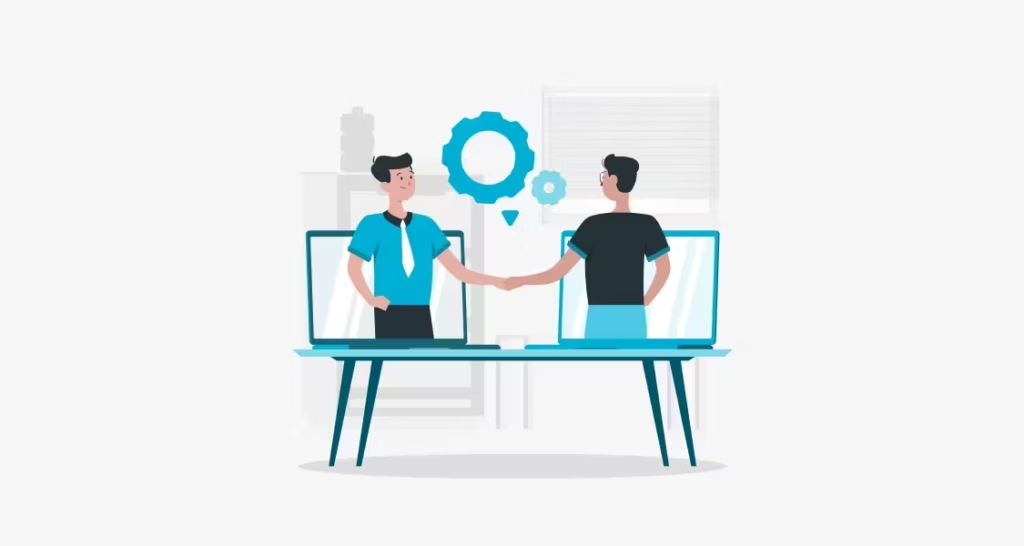
    The staff augmentation model, or extended team or outstaffing, means hiring a third-party provider to supplement your existing team.

    You can employ onsite or remotely, as you want. In short, you are hiring employees for your business with the help of other third-party services. You do not have to worry about typical employee costs such as onboarding, training, or benefits.

    You can hire skilled and working staff with better experience to help with your company projects.

    Staff augmentation is when you ask an agency to provide a freelance UX designer because you don’t have one on staff. It is a low-cost way to fill skill gaps in your in-house team or help you complete an app on time.

    It is ideal for short-term collaboration or when you suddenly find yourself with a limited time-frame.

    Sometimes, the most severe challenge is integrating the extended team with your in-house team, especially if they arrive mid-project.

    Aside from that, staff augmentation allows you to recruit developers when and where you need them. And if the project is finished, you can quickly terminate the contract.
    build mvp

    Dedicated team model

    This is when a company puts together a group of people specifically for your project. They work on it from the beginning to the end, just like a team you would have if they were your employees.

    Zennaxx is a company that follows this dedicated team model. They assemble a team of experts to work on your project.

    When you hire Zennaxx, they gather a team from their pool of over 70 skilled professionals. These people have different specialties in handling any problems during the project.

    The dedicated team can adjust to any changes in the project. They’re versatile and can handle different tasks. You can tackle projects requiring more experience With a dedicated team.

    For example, if you’re making a health app but need to learn more about health, you can have experts on your team who do.

    Managing and communicating with a team in a different office can be tricky. You have to make sure everyone understands what needs to be done.

    Sometimes, people from various backgrounds need help understanding each other perfectly, leading to misunderstandings.

    You can hire a team that speaks your language to avoid these challenges. This helps with communication and understanding each other better.

    In simple terms, a dedicated team model means hiring a group of experts to work exclusively on your project.

    It provides flexibility, but communication must be managed effectively, especially if team members come from different cultures. Hiring a team who speaks your language can help solve this problem.

    Project-based model

    A project-based model transfers the entire project to an external agency or company. This means they take on all project-related responsibilities, from initial planning to final release or delivery.

    This model is similar to the dedicated team model we discussed earlier. There is one notable difference. The service provider is responsible for project management and completing project tasks.

    Once you’ve defined your requirements and objectives, you hand over the reins to the agency. They are responsible for carrying out the necessary tasks, such as designing and programming the app and overseeing the project management.

    So, what does this imply in practice? Consider the following scenario: you have a project to develop a new app. Instead of managing the project internally within your organization, you outsource it to a professional agency.

    This includes developing timelines, assigning tasks to team members, meeting deadlines, and coordinating communication among all parties involved.

    They serve as the hub for all project-related activities, ensuring everything runs smoothly from beginning to end.

    Contract-Based Software Development Outsourcing Models

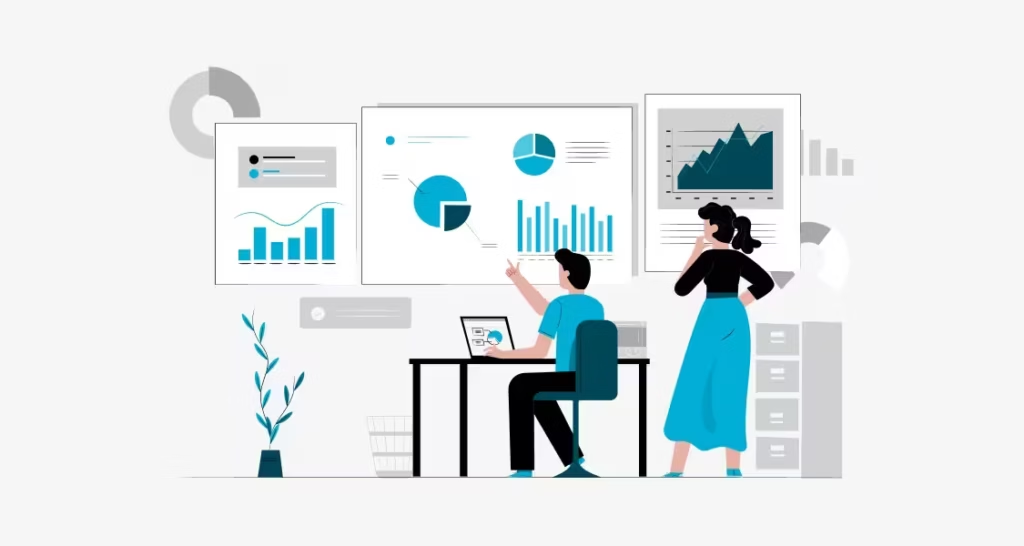
    When you’re looking to outsource software development, you have different options for setting up your contract with the outsourcing company.

    When deciding which outsourcing model to use, you must consider the specifics of your project and what works best for you.

    Depending on the complexity and requirements of your project, combining multiple outsourcing models may be the most effective approach.

    But this option makes you tension-free for your management and developing processes and errors.

    With the signing of the contract, you have to wait to complete your project at the right time and within budget. Here are two options available in this outsourcing method.
    Contract-Based Software Development Outsourcing Models

    Fixed-price model

    In a fixed-price model, the client and service provider agree on a set amount of money at the start of the project.

    This figure is based on how much time and resources they believe will be required to complete the job project. It’s a simple way to handle payments that helps clients avoid paying more than expected.

    Fixed-price models are unable to handle project changes effectively. And almost every project changes in some way.

    For example, suppose people are testing an app and discovering a disliked feature. It will require additional changes; we need more time and money to fix them. But if the price is fixed, the client either has to stick with the problem or pay more to get it fixed.

    So, you can be involved in a difficult situation if you choose this option for your project. Fixed-price models are better suited for more straightforward projects with well-defined requirements.

    Time and materials model

    In a time-and-materials model, the service provider charges the client for the time spent on the project. As a result, the time and materials model benefits both parties.

    Developers are fairly compensated for their work, and the client receives a high-quality product in proportion to the money spent.

    It also reduces stress and friction, allowing everyone to focus on the outcome. The time and materials model is the best approach for most app projects.

    It would help to have a flexible payment plan because changing requirements and scope are standard.

    Of course, when using the time and materials approach, you must remember that you may exceed your budget. An inexperienced development team will also spend more time on the project, resulting in unnecessary costs.

    Our opinion on the best outsourcing model

    The best outsourcing model for your project depends on your situation, budget, and what you need for your project. However, a committed team employing the time and materials model is the best approach for most app projects.

    This means you get a high-quality app and a smooth development process without worrying too much about costs.

    So, if you want these benefits for your project.

    Contact us right now to get started on your business project!

    We provide every single solution for your project.

    FAQs about software development outsourcing models

    Q1.HOW DO YOU DEVELOP YOUR OUTSOURCING STRATEGY?

    To create a successful outsourcing strategy, define business goals, identify suitable tasks, research various destinations, maintain clear communication, and monitor performance closely. Adjust the plan as needed to make it a success.

    Q2.WHAT CRUCIAL PARAMETERS ARE USED TO CREATE THE LIST OF BEST SOFTWARE OUTSOURCING COMPANIES?

    To select the best software outsourcing companies, consider their reputation, technical expertise, communication skills, cost-effectiveness, value proposition, cultural compatibility, and ability to work within budget and timezone.

    Q3.WHAT ARE THE SUCCESSFUL OUTSOURCING MODELS?

    Outsourcing models vary based on project requirements and organizational needs. Depending on project scope and organizational needs, project-based, dedicated teams, managed services, and hybrid models offer flexibility, continuity, expertise, and efficiency.

    Q4.WHAT ARE THE DIFFERENT SOFTWARE DEVELOPMENT SERVICES THAT CAN BE OUTSOURCED?

    Outsourcing models vary based on project requirements and organizational needs. Depending on project scope and organizational needs, project-based, dedicated teams, managed services, and hybrid models offer flexibility, continuity, expertise, and efficiency. You can contact Zennaxx Software Development Services for more queries.

    Read Also: 
  • Top 7 Augmented Reality Frameworks for AR App development

    Top 7 Augmented Reality Frameworks for AR App development

    An AR framework is a development platform that provides essential tools, libraries, and APIs for creating Augmented Reality applications. AR frameworks simplify the integration of 3D models, object tracking, scene recognition, and real-time rendering into mobile applications.

    The difference between AR frameworks and SDKs depends on their scope and functionalities. AR frameworks provide a complete development environment with built-in libraries, rendering engines, and object tracking, making them ideal for full-scale AR app development. AR SDKs (Software Development Kits) offer specific tools and APIs that enhance AR capabilities within an existing application but do not function as standalone development platforms.

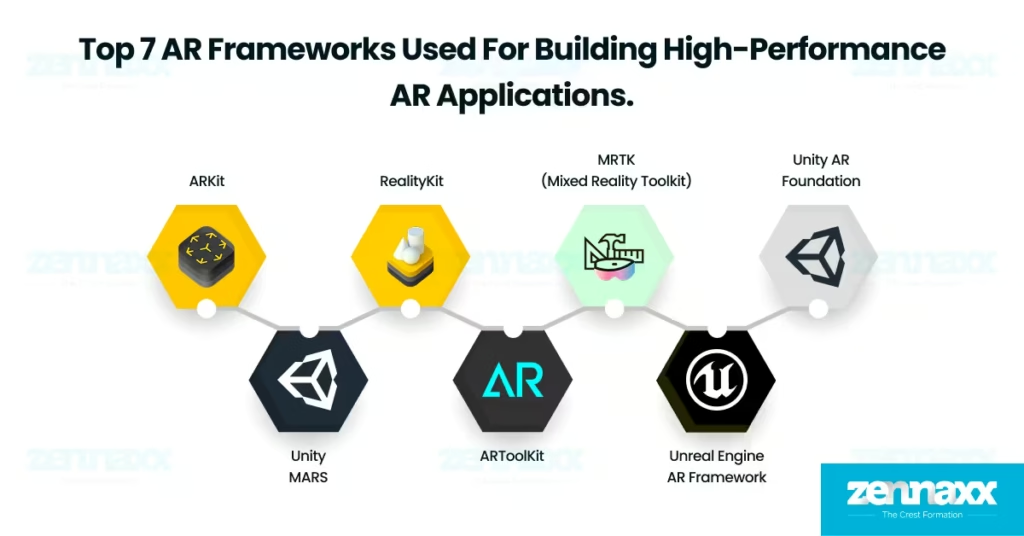
    Listed below are the top 7 AR frameworks used for building high-performance AR applications.

    best augmented reality development frameworks

    • ARKit: ARKit is a frontend AR framework for iOS that enables developers to create high-quality AR experiences using Apple’s advanced tracking and rendering technologies.
    • Unity MARS: Unity MARS is a backend AR app development framework that extends Unity’s capabilities for AR content creation.
    • RealityKit: RealityKit is a frontend AR framework for iOS designed by Apple to work seamlessly with ARKit for real-time rendering and physics-based animations.
    • ARToolKit: ARToolKit is an open-source AR framework for Android and iOS that enables marker-based tracking and augmented reality rendering.
    • MRTK (Mixed Reality Toolkit): MRTK is a backend AR app development framework developed by Microsoft, designed for mixed reality applications on HoloLens, Windows Mixed Reality, and cross-platform AR devices.
    • Unity AR Foundation: Unity AR Foundation is a backend AR app development framework that unifies ARKit (iOS) and ARCore (Android) under a single development environment.
    • Unreal Engine AR Framework: Unreal Engine AR Framework is a backend AR development framework designed for photo-realistic AR experiences.

    ARKit

    ARKit is Apple’s augmented reality (AR) development framework designed specifically for iOS and iPadOS devices to enable developers to build interactive and immersive AR applications. ARKit was first introduced in September 2017 as part of iOS 11 to significantly enhance the capability of Apple devices to process AR experiences.

    Unique features of ARKit include accurate motion tracking, scene understanding, image recognition, and LiDAR-powered depth sensing. Major pros of ARKit are its ease of integration, high accuracy in real-time AR experiences, and strong performance optimized for Apple’s ecosystem. ARKit is best suited for scenarios such as gaming, interactive product demonstrations, navigation apps, educational experiences, and retail applications.

    Unity MARS

    Unity MARS (Mixed and Augmented Reality Studio) is an advanced AR development framework built on top of the Unity game engine. Unity MARS aimed was simplify the creation of AR applications across multiple platforms including iOS, Android, and mixed-reality devices. Unity MARS was launched by Unity Technologies in June 2020 to streamline complex AR development through intuitive workflows and enhanced environmental understanding. Unique features of Unity MARS include real-world object anchoring, intelligent scene recognition using AI, and adaptive AR content placement.

    Unity MARS features include efficient cross-platform compatibility, powerful simulation capabilities, and simplified workflows. Unity MARS is ideal for enterprise AR solutions, industrial training, interactive product visualizations, and complex simulations requiring adaptive and realistic AR interactions.

    RealityKit

    RealityKit is Apple’s high-performance AR framework specifically designed for developing realistic and interactive AR experiences on iOS and iPadOS. RealityKit is integrated seamlessly with ARKit and provides developers with advanced tools for building detailed 3D animations, realistic physics interactions, and spatial audio. RealityKit was first released on June 3, 2019, alongside iOS 13, complementing ARKit by enhancing the visual realism and interactivity of AR content. Unique features of RealityKit include realistic rendering, physics-based animations, spatial audio integration, and real-time reflections.

    RealityKit framework features include ease of use, native integration with Apple’s ecosystem, and optimized rendering performance. RealityKit is best for developers and scenarios focused on creating immersive and lifelike AR experiences such as gaming, product showcases, virtual try-ons, and educational simulations.

    ARToolKit

    ARToolKit is an open-source AR framework designed for building marker-based augmented reality experiences on multiple platforms including iOS, Android, Windows, and Linux. ARToolKit was released in 1999 and ARToolKit became one of the first frameworks enabling developers to easily track and display virtual objects over physical markers. Unique features of ARToolKit include real-time marker tracking, natural feature detection, camera calibration, and strong cross-platform support.

    The key pros of ARToolKit include its open-source flexibility, straightforward implementation, and effective performance on a wide range of devices. ARToolKit is best suited for academic research, experimental AR applications, educational purposes, and simpler AR projects where marker-based tracking is preferred.

    MRTK

    MRTK (Mixed Reality Toolkit) is a backend AR development framework developed by Microsoft and designed for mixed reality applications on platforms. MRTK was launched in December 2017 and provides advanced tools for developers creating complex AR and MR experiences. Unique features of MRTK include spatial awareness, intuitive hand-tracking, gesture interactions, and pre-built UI components tailored for mixed reality.

    MRTK framework benefits include robust interaction models, powerful integration with Microsoft services, and comprehensive documentation. MRTK is best for enterprise-level mixed-reality applications, interactive training scenarios, remote assistance solutions, and complex simulations.

    Unity AR Foundation

    Unity AR Foundation is a cross-platform AR development framework by Unity Technologies and helps to build applications that smoothly operate on Android and iOS devices. Unity AR was launched in 2019 and provides a unified abstraction layer to simplify AR development across multiple platforms. Unique features of Unity AR Foundation include plane detection, image and object tracking, face tracking, environment probes, and robust integration with Unity’s real-time 3D engine.

    Unity AR Foundation has cross-platform compatibility, streamlined workflow, and an efficient development pipeline. Unity AR Foundation is best suited for developers needing consistent AR experiences across Android and iOS, especially in gaming, education, social AR apps, and large-scale commercial projects.

    Unreal Engine AR Framework

    Unreal Engine AR Framework is a high-performance augmented reality solution provided by Epic Games and built on the powerful Unreal Engine for creating visually realistic AR applications. Unreal Engine AR was introduced by Epic Games in 2017 and empowers developers to build AR apps capable of photorealistic graphics and seamless AR-VR transitions. Unique features of Unreal Engine AR Framework include advanced rendering capabilities, real-time lighting, visual scripting via Blueprints, and realistic physics interactions.

    The key advantages of the Unreal Engine AR Framework include exceptional graphics quality, versatility in content creation, and strong integration with VR platforms. Unreal Engine AR is best suited for high-end gaming applications, cinematic AR experiences, architecture visualization, and scenarios requiring AAA-quality graphics and immersive visual experiences.

    What Are the Best AR Frameworks for Android?

    The best AR frameworks for Android are ARCore, Unity AR Foundation, and Vuforia, as they provide advanced AR capabilities, cross-platform support, and strong development tools. ARCore is Google’s native AR framework and offers motion tracking, environmental understanding, and light estimation.

    Unity AR Foundation enables developers to create AR experiences that run on both Android and iOS without separate implementations. Vuforia is used for marker-based AR experiences and features advanced object recognition and cloud-based AR tracking.

    What Are the Best AR Frameworks for iOS?

    The best AR frameworks for iOS are ARKit, RealityKit, and Unity AR Foundation, as they provide high-performance AR capabilities optimized for Apple’s hardware and ecosystem. ARKit is Apple’s proprietary AR framework and offers high-precision tracking, LiDAR support, and seamless integration with iOS devices.

    RealityKit enhances ARKit’s functionality by providing realistic rendering, spatial audio, and physics-based interactions. Unity AR Foundation allows developers to build AR applications for both iOS and Android while maintaining native performance and compatibility with ARKit.

    What are the best Augmented Reality application SDKs?

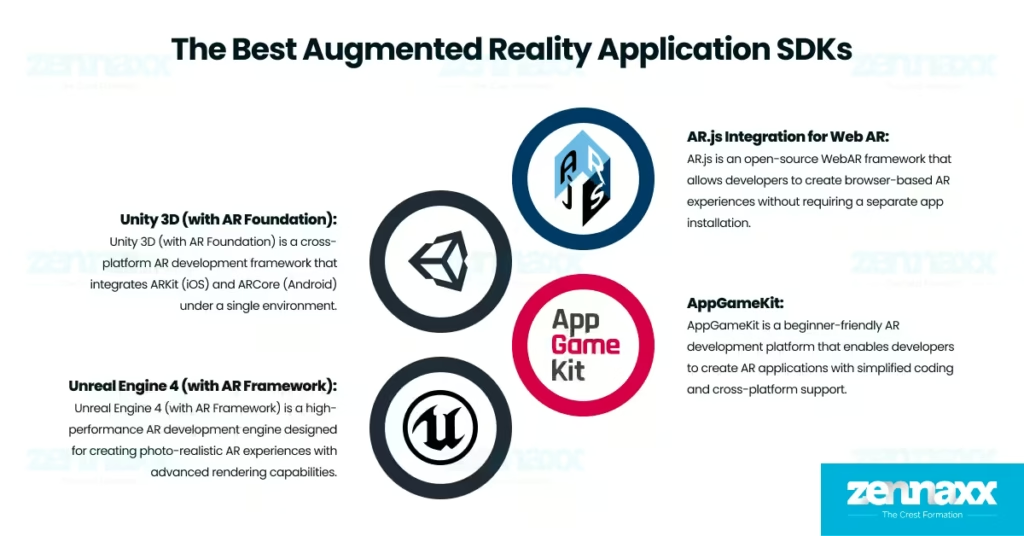
    best augmented reality sdks The best Augmented Reality application SDKs provide developers with essential tools, libraries, and APIs to create immersive AR experiences. These SDKs facilitate object tracking, scene mapping, motion detection, and 3D rendering.
    Listed below are the best Augmented Reality application SDKs.

    • Unity 3D (with AR Foundation): Unity 3D (with AR Foundation) is a cross-platform AR development framework that integrates ARKit (iOS) and ARCore (Android) under a single environment. Unity 3D provides developers with a powerful real-time 3D engine, physics-based interactions, and cross-platform AR support. Unique features of Unity 3D include plane detection, object tracking, light estimation, and seamless AR/VR compatibility.
    • Unreal Engine 4 (with AR Framework): Unreal Engine 4 (with AR Framework) is a high-performance AR development engine designed for creating photo-realistic AR experiences with advanced rendering capabilities. Unreal Engine 4 provides developers with real-time lighting, physics-based simulations, and cinematic-quality visuals. Unique features of Unreal Engine 4 include Blueprint visual scripting, high-fidelity graphics, and AR/VR cross-integration.
    • AppGameKit: AppGameKit is a beginner-friendly AR development platform that enables developers to create AR applications with simplified coding and cross-platform support. AppGameKit provides built-in 2D/3D rendering, physics engines, and easy integration with mobile devices. Unique features of AppGameKit include its BASIC-like scripting language, rapid prototyping tools, and multi-platform deployment.
    • AR.js Integration for Web AR: AR.js is an open-source WebAR framework that allows developers to create browser-based AR experiences without requiring a separate app installation. AR.js provides efficient marker-based tracking, lightweight JavaScript implementation, and seamless integration with HTML and WebGL. Unique features of AR.js include fast performance, cross-browser compatibility, and mobile-first optimization.

    How AR Frameworks and SDKs Are Used in AR App Development?

    AR frameworks and SDKs are essential in Augmented reality app development as they provide the necessary tools, libraries, and APIs to create immersive and interactive experiences. AR frameworks enable structured augmented reality application development by handling 3D rendering, object tracking, motion detection, and real-world interaction mapping.

    AR SDKs enhance these capabilities by offering marker tracking, SLAM (Simultaneous Localization and Mapping), and AR cloud integration. The importance of AR frameworks and SDKs in augmented reality application development depends on their ability to streamline development, ensure cross-platform compatibility, and optimize performance.

  • 40+ Best Web App Ideas for entrepreneur in 2024

    40+ Best Web App Ideas for entrepreneur in 2024

    How can you make money online or start any business online in 2024? The best ideas for making money online and starting your business are web applications. The best way to start generating good revenue and expanding all types of business can be done by building a web app and IoT things.

    In the future, web applications will be necessary for any big or small business. The only way to make your name in the market is to build a robust web application to battle with your marketing competitor.

    Now you are thinking about firing the market, how to get out of this race of online business, and which field gives you more revenue from the market? Worry not. Here, we provide you with 40+ of the best web app ideas to expand your business in 2024.

    What are Web Apps?

    Web app is an online program that can be run on any internet device without software installation. So it is easy for your user to access anytime without any other software. It is easy to access and use the functionality on every device without any problem.

    Nowadays, unlike traditional market apps, web apps are in the most demand because of their flexibility. Web apps are safer and more secure because all users operate on the same version, which reduces the chances of compatibility problems.

    Some examples of web applications include emails, online retail sales, spreadsheets, instant messaging, and photo and video editing apps. Many new no-code platforms have made web app development more accessible. Using this whole book of full-stack web application ideas, you can quickly get innovative ideas that raise your business online.

    Best Web App Ideas for Projects

    After so much industrial and marketing demand study and research, we selected 40+ web app ideas to quickly grow your business in the market without so much effort. We choose every marketing demand across industries to help you make the right decision.

    This comprehensive guide provides many web development ideas for starting your online business quickly.

    Wellness and Fitness Apps

    Wellness and fitness app development is a great way to enter this growing market. After the COVID-19 pandemic, the wellness and fitness areas are expanding rapidly. People highly care about their health and body fitness with online information and tutorials.

    Create a web-based app where people can get full health-related support.

    Travel Accommodation Selection Service Provider Apps

    The travel sector is growing through internet booking and sightseeing, which are necessary for travelers before reaching their destination. Create a web-based app that gives customers flexible options for managing travel. This web app creation business gives you more opportunities to stabilize your business in a hot field.

    Online Classroom Web App Idea

    Online learning classes and tuition are some of the excellent web app ideas. Students and teachers both get total flexibility and peace from outside. Developing a web app for an online classroom is also more demanding in this digital world. Several education systems are also creating web applications for online classes.

    Online Pharmacy Web Application Idea

    It was no surprise that online pharmacies would be on trend in 2020. Still and all, these web apps will continue to thrive in the post-pandemic age as well. You can order medications from the comfort of your home and have them delivered, bypassing the long lines and busy markets.

    Dating Web App Project Idea

    Create a dating app and target Gen Z since it is easy to expand a business. A dating web app is the most trending business idea in the market right now. People love exploring online with Strangers on online platforms. It is the correct full stack web application idea for covering your lots of customers with this web application.

    Automated Chat-bots Web App Ideas

    Develop AI and ML-powered chatbots to respond to your customer queries and don’t make them feel bored. Live chats change perspectives on customer service by providing continuous support, with businesses incorporating automated chat boxes on their websites to give 24/7 accessibility.

    Payments Apps Idea to Make Money

    If you want a higher chance in the web application market, develop a UPI payment app and launch it with attractive offers and a user-friendly design. Because digital transactions are the most popular option for people worldwide, creating a secure UPI payment appcan help you tap into a growing market.

    Workflow Management Apps

    Developing a web app for managing the workflow of the daily regular tasks of office workers’ attendance and chats. Because of the remote working culture, thedemand for management apps is increasing, and everyone is finding flexible web applications to manage and save tasks.

    On-demand Grocery App for Beginners

    Many grocery web apps are available online, but more popularity is needed because of user-friendly interfaces and features. Develop a web application for grocery delivery with a smooth and flexible interface to get more users.

    AI-Powered Personal Assistant

    Consider developing AI-powered assistants to manage your daily tasks and schedule based on your routine work. Easily schedule and remind your day-to-day tasks and make reminders before you forget to attend. This web application makes more business revenue nowadays.

    Eco-Friendly Product Marketplace

    Finding eco-friendly and sustainable products on a web app with a curated selection of eco-conscious goods. From organic skincare to recycled fashion, an eco-friendly web application promoting eco-friendly products dramatically impacts your business idea.

    Language Learning Platform

    Create a new language learning platform where users can access interactive language lessons, live tutoring sessions, and educational resources on a web app catering to diverse learning needs and skill levels. From vocabulary drills to immersive conversations, everything is provided on one Platform.

    Simple Web Application Ideas for Beginners

    If you are new in the web application business, here are some full-stack ideas

    That can quickly enter the market without facing high requirements and demands.

    Such a web app now has many business and customer options in the market. Create unique services that fulfill the basic needs of industries at a low cost and provide top-notch solutions to the users.

    Planning web development?

    Ready to elevate your web projects? Partner with us for seamless web app solutions.

    Website Building Apps

    Simple web development apps like customers can develop online websites using templates. Creating and reducing some challenges is easy, like designing a name, hosting, and running a website. This innovative web application idea is easy to buy and use for small businesses by direct purchasing.

    CRM Tools Web Application Project idea

    CRM softwareis now the most demanding tool for handling the whole business, but small startups need help to afford the high cost of CRM software. You can create such tools as CRM web applications for small investors, which is the best idea for web development in 2024.

    Youtube Radio App

    YouTube is a vast content source; finding the gems in it takes work for some. So many masterpiece audios are still hidden behind this Platform. Consider developing a radio application that includes the top content and sells it to the audience.

    Crypto Exchange Platforms

    Cryptocurrency is a hot trend in the mind of every business person. Building a simple cryptocurrency exchange app can give you a lot of revenue from the market quickly. It is not only for demand, but this web application can brighten your business features, too.

    Platforms for Hobbyist

    Using multimedia and the internet, people most love to share different arts and hobbies and create interest in various hobbies. Develop a web app platform where people can engage, connect, share ideas, and build a community. Start making a web-based app that covers every social media user and provides an upgraded interface to attract their mind.

    Child Tube Web App Idea

    Many parents are always searching for accessible platforms for children to access and get colorful and funny content to make their children calm and engaged. The Child Tube web application idea is one of the best ideas for starting a business on a low budget.

    Home Renovation designer

    From design inspiration to project management, the Platform streamlines the renovation process by creating a web application that helps engineers draw a proper visual design of the new structure and share it with the customers. New technological and estate innovative web application ideas help to create your business online.

    Stock Trading Web Apps

    Traders and new beginners always look for new apps to help them invest in stocks and track their portfolios. Create a web-based app for stock investment that is quick, simple to use, has a smooth interface, and provides trading updates to help you grow in industries.

    Gift Delivery App

    Sending a personal gift from far away is not accessible to some online stores, but develop a perfect innovative web application app that gives various gifts and toys and shows pic with gift wrapping options.

    People can directly donate the gift using your application, a creative web application idea for new business startups.

    Web App For Auction

    Create a trustable and secure auction web app with accessible functions. Being able to connect people globally and help in business is one of the right ideas for creating customers. Develop a functional web auction app that gives more flexibility in auction options and a smooth user experience.

    Web App for Pet Care

    Many people start adopting pets in their homes, but caring for them requires many rules and guidelines in their schedule, as well as food care and treatment at home. Developing a web app for pet care parents that helps pet parents guide them in parenting and care.

    Online Gaming Apps

    Online server gaming is not a hot trending topic to jump on. Take expert support and develop a customized video gaming web app with the right technology. Online games easily reach the right players and are played by several users worldwide simultaneously.

    Memes and GIFs Making Apps

    Memes dominate these days, as do social media and social groups. People like to share memes and love to create personal memes for fun. Also, it is an excellent platform for earning money. Building memes and GIFs and developing an app is also a good idea.

    Docket Management Web App

    Organizations prefer secure, interactive, and user-friendly applications because the documents are private and require advanced security. Many organizations are responsible for managing a large number of sensitive documents. Gdrive, Dropbox, and similar services must help them develop a customized docket management web app that solves their issues.

    Web Application Project Ideas

    Know more business project-related innovative web application ideas when you can start a business and quickly build your business web application online. Here are some advisable full-stack web application ideas that give you new startup-related ideas when you think about establishing your business. If you have any queries or new ideas, share them with us and contact us for development-related queries.

    Music streaming Web Apps

    People crave to listen to music online whenever they can do their daily tasks or travel somewhere. Develop a music library app full of popular charts and different playlists, including some trending shows.

    Online Personal Styling and Fashion Advice Service

    Receive personalized fashion recommendations, style tips, and outfit suggestions from professional stylists via a web app. Whatever fashion-related new tricks and how to prepare for the latest fashion, expert advice and curated looks tailored to their taste, body type, and lifestyle elevate their fashion sense and confidence.

    Motor Services and Wash App

    In many countries, providing door-to-door services is the priority option for people. For the same, these days, cars are used or serviced in their place, and people want to use services like that. Develop web-based applications like a car wash or bike service, create a chain between vehicle owners and garages, and build your business worldwide.

    Medical Consultation Web App

    Medical consulting apps are also the most increasing opportunity, reducing the mundane tasks that reach more people with the help of the internet. You can create a web-based app that connects patients and doctors, offers 24-hour consultations, and delivers medications online, among other features. For more information, visit our blog on.

    Ride-sharing Web Apps

    Increasing the traffic in megacities and burning uncalculated fuels are unsuitable for the global market. Think in a new way when people can switch to on-demand cab and carpooling services. This brand new idea of designing full-stack web application ideas to provide cab service facilities and ride-sharing facilities to people in a city or country can quickly boost your business.

    Collaborative Study Space

    Build a student community web application where students share study-related information and guide other students. Where students can collaborate on group projects, share study materials, and organize study sessions, fostering a supportive and productive learning environment.

    E-commerce Applications

    Online e-commerce application building with the right ideas and public demanding needs. Try to provide a feature-rich e-commerce application for things that are needed daily. Developing a web app for Ecommerce idea with flexible designs and more discountable dealing options has become more popular.

    Student Entrepreneurship Hub

    Design is a platform where aspiring student entrepreneurs can access resources, mentorship, and networking opportunities to launch and grow their startups, fostering innovation and entrepreneurship on campus. These Innovative web application ideas help to push new businesses fast, and new ideas come into the market marketplace.

    Online Therapy and Mental Health Support

    Create an application where people can connect and talk with licensed therapists for emotional support and mental health resources via a web app. Develop a personal space for customers who struggle with any mental illness and can quickly heal themselves through your web application.

    Legal Document Preparation Service

    Simplify the process of drafting legal documents such as contracts, agreements, and wills with a web-based app that provides templates, guidance, and document review services. From business contracts to personal legal matters, the Platform offers accuracy and compliance, saving time and resources for individuals and businesses navigating legal issues.

    Astrology Apps for New Projects

    Business and new project dealers believe in astrology and time-related future prediction talks. Many people use mobile phones and Google to predict the time to invest or develop. Create a web-based app that allows people to search for question-related success, relation, education, and investment.

    Crime Alert Web Application Ideas

    Crimes and fraud rates are increasing, and people don’t know what is happening around them. So, developing a web app where people update and know the details about any crimes happening around them and make strong communication is an essential idea for new businesses.

    Professional Services Web App

    Many people need professional support but can’t fit in because riPlatformsform is available. Suppose you have a good community of services like cleaning, helping, or house-related professional services. In that case, you can build a web app and connect many businesses and services with one Platform.

    E-commerce Stores

    Build an e-commerce store with the right niche and unique product that people find only in your store. Make your brand and product and create an online e-commerce store that attracts multiple people and grows your business revenue in a short time.

    Unique Web App Project Ideas for Students

    Student project ideas for the college and its students are easy to develop, code, and manage. College students can create projects like this in college submission and final year project ideas. We have many web development ideas to work on to make your submission project demanding future marketing applications.

    Food Delivery Apps for New Business

    Online food delivery apps are the right topic for students to improve and provide to people. Do some research on how to make it more flexible, make some needed improvements, and develop a food delivery web app that showcases hotels, restaurants, and cloud kitchens; everything merged into one Platform and provides flexible delivery.

    Job Portal Web App Ideas

    Job portal web apps still need to be more precise and more time-consuming online applications. Build a job portal web app that can easily direct seekers to the right place and directly connect them with job providers. It saves people from providing money to job-searching agencies every time.

    Fitness Challenge App

    Develop a fitness app that encourages people to participate in wellness challenges. People can use this web application to set fitness goals and track their progress, promoting physical activity and healthy habits in the community. Because of challenges and new people connections, this helps encourage people to use this web application.

    Career Guide Web App

    Guide the students to suitable careers and introduce them to every future career option in one application. It is a good idea to create a new web application. You can guide several students who need clarification about the career-choice phase. You can also introduce the importance of AI and ML in future careers.

    Flower and Gift Delivery App

    Any memorable moments are incomplete without cake, flowers, and gifts. Finding everything on one Platform is one cup of tea. Make a flexible platform to celebrate a special day in one order. Customers can discover every need on one Platform, which makes your business more popular. Like this new innovative web application idea, create a full stack web application to start new services.

    Table Booking App Idea for New Project

    Who likes to wait out of restaurants and cafes with family and full hunger? A perfect table booking app provides every restaurant and cafe table data and allows booking from anywhere at the right time. People use it to schedule meetings, occasional dinners, and hangout parties by giving a vast crowd of customers details and revenue.

    Personal Finance Management Tool

    Develop a web application to track customer financial data, such as spending and earnings. With this data, it can manage how to track expenses, set budgets, and monitor investments for better savings. People use your web application to make secure savings and create future goals.

    Book Review Web Application

    Authors and book readers also read everyone’s opinion before reading any book. Develop a book review web application when they find a massive database of every book review and comment. Also, they can share reviews on it and guide new readers and writers in a right-leaning way.

    Car Rental Platform

    From compact cars to luxury SUVs, the flexibility and affordability of the offer for travelers and commuters alike are available only on one Platform. Customers can book transparent pricing and find the perfect vehicle through your web application. A car rental web app lets Customers conveniently explore vehicles and book peer-to-peer car rentals.

    Photo and Video Editing App

    People give more importance to posting videos and photos on social media. This is not only the internment but is also a good source of generating income from it. Developing a web application that can easily edit and download photos and videos in high-quality resolution. This will provide video features and editing tools to make it more user-popular.

    Second-hand goods Buying and Selling Platform

    Selling and buying second-hand goods, furniture, and electronic tools is now the most helpful tool for working couples and busy customers in the office. People look for easy, reliable options without fraud and hassle-free payment. Developing web-based applications where customers can easily buy and find things of good quality and with money options.

    Language Translation Web Apps

    Create a smooth and flexible language translation web application that can easily be used by travelers, reporters, and elders to translate anything with a click. Try to make the experience smooth with this AI and machine learning technology. Build an all-in-one language translator web application to help people immediately, anywhere.

    Interior Designing Apps

    Designing applications that help to boost artists’ creativity to another level, artists use your application to make their minds sharp and taste their ideas. Interior designing web apps allow people to make raw designs of homes and cut the extra cost of designing.

    Travel Experience Platform

    Build a travel community app where people share every travel experience on your web application, from iconic landmarks to hidden gems. This Platform offers immersive storytelling, interactive maps, and virtual tours that transport users to distant lands and inspire wanderlust, fostering a deeper connection to the world and its diverse cultures.

    Volunteer Matching Service

    Create a platform where people can find volunteer opportunities and connect with local organizations needing volunteers based on their required skills. It helps travelers find accommodation by providing them with skills and services. This is also one of our innovative web application ideas that is currently in demand.

    Task Management Apps

    Businesses now use digital assistant apps that handle all tasks. Create a web-based app that performs various functions, including calendar management, daily reminders, note-taking, etc. This is one of the most popular innovative web application ideas, and it can boost your business growth.

    Conclusion: Ideas for Web Application Projects

    Every web application idea is unique, as per marketing demands. I hope some of these innovative web application ideas help you start your business and ignite your sharp mind.

    Using Internet services, many companies make more than seven figures in revenue by using ideas like this and establishing their businesses worldwide. Stay focused on providing value to your users and adapting to their changing needs to ensure long-term success for your web application project.

    Getting the right idea and working with the proper planning gives you more opportunities to create a successful business. Start working on starting your business online by quickly creating your personal business idea.

    Zennaxx is a software development consultancy that helps companies with cutting-edge technology and solutions achieve their goals and grow their online presence. Our team of experts is dedicated to supporting your business as it reaches its full potential in the digital world. Contact us for your estimate and any web application development-related queries.

    FAQs

    Q1.WHAT ARE SOME GOOD IDEAS FOR WEB APP PROJECTS?

    For a college student or a Technological field student who can build a project app, We suggest projects like Build a Task Management App, Creating a platform where users can access interactive language lessons and educational resources to enhance their language skills.

    Q2.WHICH WEB APP IS BEST?

    The best web app depends on various factors, such as target audience, market demand, and personal interests. Some of the best web app examples are Online Classroom Web Apps, Education and Learning Apps, Productivity and Task Management Apps, and Financial Management Apps.

    Q3.WHAT ARE SOME COOL APP IDEAS?

    As per marketing demand, some excellent web applications are created where people can build a community and share their personal experiences and three skills; in short, people can earn by using their skills. Examples are Astrology Apps for New Projects, Eco-Friendly Product Marketplace, and Travel Experience Platforms.

    Q4.WHAT KIND OF WEB APPS ARE IN DEMAND?

    New marketing demands for web applications, such as crypto, share market-related, and traveling marketing applications, are rising. You can also build applications based on photo and video editing apps.

    Read Also: 

  • 6 Best Software Development Methodologies with Pros & Cons

    6 Best Software Development Methodologies with Pros & Cons

    Over the decades, software developers have developed numerous methodologies. They all aim to improve the quality of software development projects.

    However, finding the perfect fit for every development team remains a challenge. There is no one-size-fits-all approach.

    We have over 10 years of experience in the software development industry. We have witnessed the benefits and challenges of various methodologies.

    This gave us valuable insights into project management.

    Over the decades, software developers have developed numerous methodologies. They all aim to improve the quality of software development projects.

    We discuss the six primary successful software development methodologies. We also show how they can be tailored to meet the specific needs of different development teams.

    By the end of this article, you will have a deeper understanding of the available software development methodologies.

    You will also gain the knowledge to make informed decisions. This will help you select the best software development methodology that aligns with your team and project.

    Whether you are a first-time founder or looking to expand your knowledge, grasping these methodologies will undoubtedly contribute to the success of your business.

    Continue reading to discover which software development methodology suits your needs best.

    What Is Software Development Methodology?

    Software development methodologies refers to structured processes applied in project work. It combines design principles and pragmatic reality rooted in the early days of computing.

    The objective is to create a systematic approach to software development.

    Over the years, various Software development methodologies have been established. They aim to leverage evolving technologies and resources. These methodologies provide a foundation for developers.

    They can collaborate more efficiently as a team. They formalize communication and define how information is shared within the team.

    Many IT companiesrecognize the importance of adopting a software development methodology.

    However, the debate persists about which method is superior. The development is that there is no one-size-fits-all solution.

    Each methodology comes with its own advantages and disadvantages. Success depends on team structure, project requirements, and goals. It’s not uncommon to use different methods for various projects.

    Why follow the software development methodologies?

    It’s essential to understand the need for choosing and following a software development methodology throughout a project.

    Taking this process for granted introduces numerous risks. It exposes developers to ever-changing customer requests and potential miscommunications.

    Without structured guidance, revisions to the software may become frequent. Often, they don’t consider the overall project implications.

    This can waste time, money, and effort. It can produce a subpar application that falls short of expectations.

    Development teams and customers both benefit from the design of software development methodologies.

    Ensuring that discussions are conducted through proper channels involves choosing the correct method. It also provides that we make decisions after thoroughly evaluating all relevant factors.

    Using a software development methodologies helps teams minimize inefficiencies. It also helps them provide more accurate delivery timelines.

    Let’s discuss software development methodology one by one in detail.

    Waterfall Model

    Waterfall Model

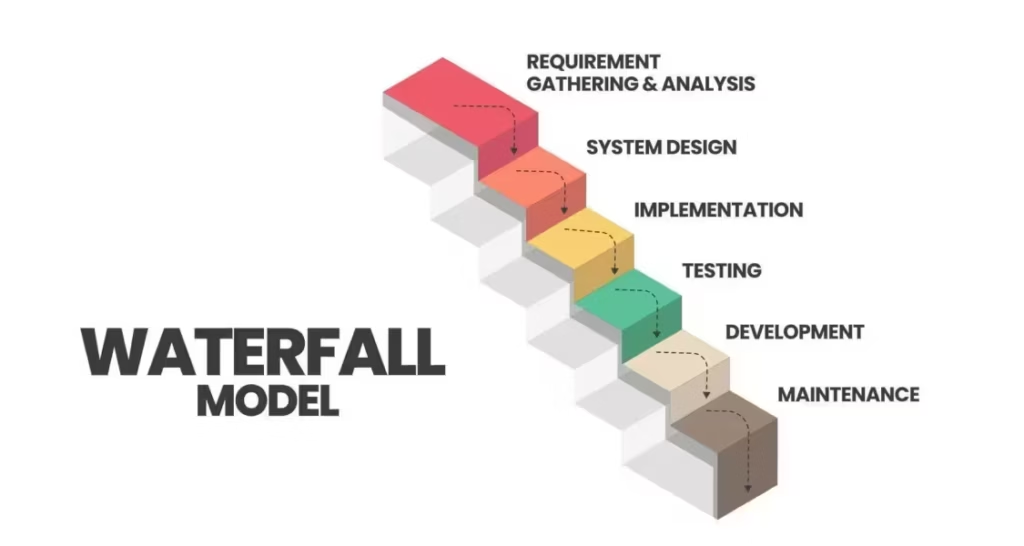
    The Waterfall Model is a popular method of developing software. It can be compared to building a structure with Lego bricks. It involves progressing through distinct steps or phases. It’s similar to assembling one piece of the Lego set before moving on to the next.

    This process unfolds linearly and sequentially. It’s much like a waterfall cascading down levels. Each phase in the Waterfall Model is like a building block. It must be completed thoroughly before advancing to the next one.

    This approach ensures a systematic and disciplined way of handling software development. It helps to provide a clear road map for the project. Developers follow a rigid structure. They emphasize the importance of completing each phase before proceeding further.

    This simplicity and orderliness contribute to the reliability and predictability of the Waterfall Model. This makes it a foundational methodology in software development.

    Sequential Phases

    The Evolution of PHP and Why it is Still Relevant?

    1. Requirements: The project begins with a thorough understanding of customer requirements, aiming to document all specifications comprehensively.

    2. Design: The design phase involves creating detailed plans, architecture, and system specifications based on the gathered requirements.

    3. Implementation: Developers execute the design plans, translate them into actual code, and build the software system.

    4. Testing: The software undergoes rigorous testing to identify and rectify defects, ensuring it meets the specified requirements.

    5. Deployment: Once successfully tested, the software is deployed and delivered to the end-users.

    Advantage and disadvantage

    Advantage Disadvantage
    Easy to understand and straightforward. Inefficient for complex and evolving projects.
    Ideal for small teams or businesses with clearly defined requirements. Higher risk of customer dissatisfaction if requirements change.
    Simple to manage with a structured development process. Limited adaptability to changing business or project needs.
    Provides fixed deadlines and well-defined project milestones. User feedback is typically received late in the development cycle.

    Use Cases

    1. Small to Medium-sized Projects: Waterfall is suitable for projects with well-understood requirements and limited complexities.

    2. Stable Environments: When the project environment is stable, and changes are unlikely, the Waterfall Model can be effective.

    3. Regulated Industries: Industries with strict regulatory compliance may benefit from the Waterfall Model’s systematic documentation and clear phases.

    Agile Methodology

    Agile model

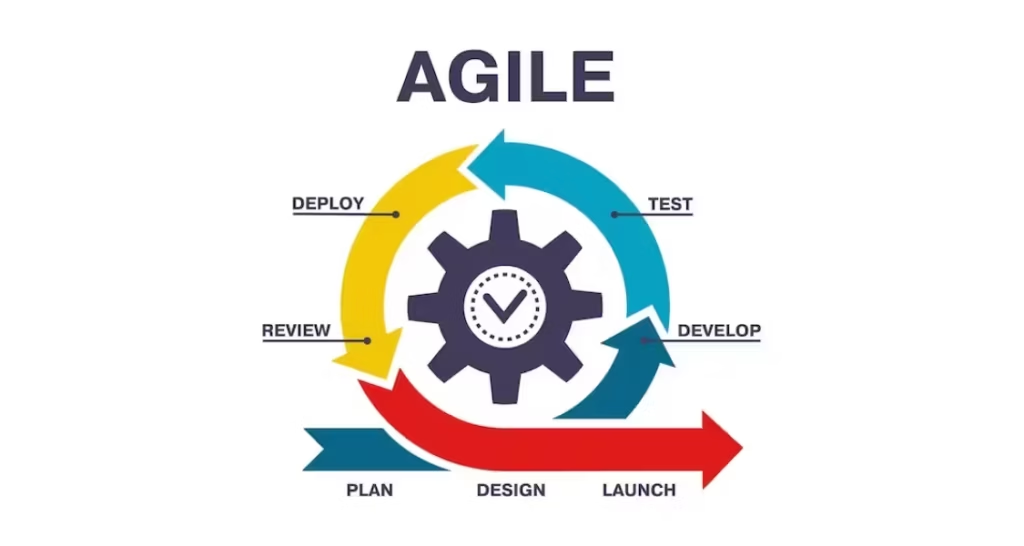
    Agile is a dynamic software development method. It emphasizes flexibility and collaboration to enhance adaptability and customer satisfaction.

    It prioritizes individual contributions, effective communication, and practical solutions. It values customer involvement and responsiveness to change over strict processes and tools.

    You will also gain the knowledge to make informed decisions. This will help you select the best software development methodology that aligns with your team and project.

    In Agile, we divide projects into small, manageable parts called iterations. These iterations follow an iterative and incremental development approach.

    People do work in repeated cycles. Each cycle builds on the previous one. At the end of each iteration, we deliver a potentially usable part of the product.

    This enables continuous feedback and refinement. This iterative process allows ongoing improvements and adjustments based on real-time insights. It ensures that the final product aligns closely withcustomer needs and expectations.

    Scrum, Kanban, and Extreme Programming (XP) within Agile:

    1. Scrum: A popular Agile framework emphasizing teamwork, accountability, and iterative progress through time-boxed intervals called sprints.

    2. Kanban: A visual system that manages workflow, emphasizing continuous delivery and efficiency by limiting work in progress.

    3. Extreme Programming (XP): Emphasizes customer satisfaction and flexibility through practices like pair programming, continuous integration, and frequent releases.

    Advantage and disadvantage

    Advantage Disadvantage
    Supports iterative and incremental development, enabling continuous improvements. Lack of predictability in project scope, timeline, and final outcomes.
    Leverages proven frameworks such as Scrum, Kanban, and Extreme Programming (XP). Documentation may receive less attention compared to traditional methodologies.
    Prioritizes delivering working software and business value over excessive documentation. Can place too much emphasis on short-term goals instead of long-term planning.
    Accelerates time-to-market through continuous releases and rapid iterations. Requires a learning curve for teams unfamiliar with Agile practices and collaboration.

    Success Stories (Check Board for Additions)

    1. Spotify: Embraced Agile and Scrum, allowing for rapid innovation and adaptation to changing market demands.

    2. Amazon: Utilizes Agile practices to enhance development speed and customer responsiveness.

    3. Microsoft: Adopted Agile methodologies, particularly Scrum, leading to more efficient development processes.

    DevOps

    Dev Ops
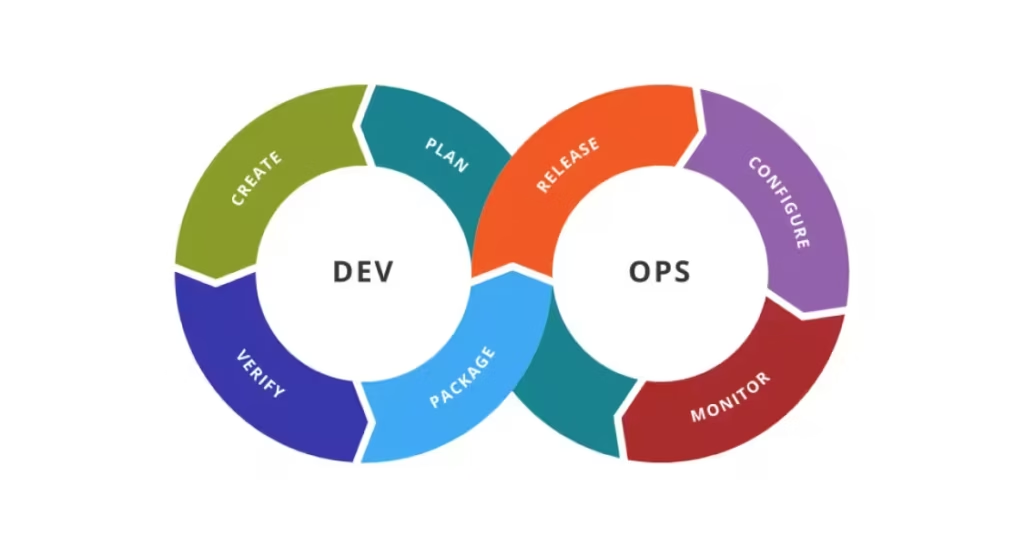
    DevOps is a fusion of Development and Operations. It represents a collaborative strategy. It unifies development and IT operations teams across the entire software development lifecycle.

    The primary goal is to enhance communication, collaboration, and efficiency between these traditionally separate functions.

    DevOps ensures a seamless and integrated workflow by breaking down the project between development and operations.

    This collaborative approach emphasizes continuous communication and cooperation.

    It fosters a shared responsibility for the success of the software delivery process. With DevOps, teams can streamline processes.

    They can automate repetitive tasks and deliver software more rapidly and reliably. This ultimately improves the overall quality and performance of the final product.

    Continuous Integration and Continuous Deployment (CI/CD)

    1. Continuous Integration (CI): involves regularly merging code changes into a shared repository to detect and address integration issues early in the development process.

    2. Continuous Deployment (CD): The automated process of deploying code changes to production environments after passing through the CI pipeline.

    We have over 10 years of experience in the software development industry. We have witnessed the benefits and challenges of various methodologies.

    Collaboration and Communication: DevOps emphasizes strong collaboration and communication among development, operations, and other stakeholders to streamline processes and improve the overall efficiency of software development.

    Automation in DevOps: Automation performs a major role in DevOps, featuring the automation of repetitive tasks, testing, and deployment processes. This automation contributes to faster development cycles and reduced human error.

    Advantage and disadvantage

    Advantage Disadvantage
    Continuous Integration and Continuous Deployment (CI/CD) streamline software delivery. Implementation can be complex and requires significant planning and expertise.
    Improves scalability by enabling applications to handle growth efficiently. Organizations may face resistance to adopting new workflows and cultural changes.
    Automation increases efficiency by reducing manual tasks and minimizing human errors. Automation and cloud infrastructure can introduce security and compliance concerns if not managed properly.
    Accelerates time-to-market through faster releases and continuous delivery. Requires ongoing monitoring and maintenance to ensure pipeline reliability.

    Real-world Examples

    1. Amazon Web Services (AWS): Utilizes DevOps practices to enhance scalability, reliability, and agility in their cloud services.

    2. Netflix: Implements DevOps to achieve rapid innovation, continuous delivery, and efficient incident response in their streaming platform.

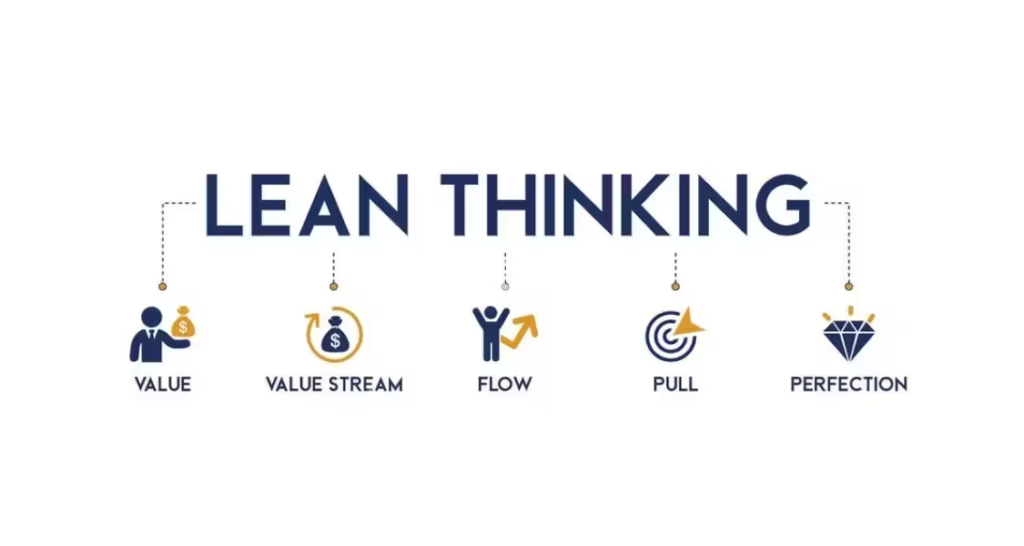
    Lean Development

    Lean Thinking

    Lean Development in software engineering adopts principles from Lean Manufacturing to streamline processes and maximize efficiency. It focuses on eliminating waste, optimizing workflows, and delivering customer value effectively.

    Key principles include:

    Reducing Waste, Amplifying Learning, and Creating Teams:

    Reducing Waste: Lean Development targets the elimination of unnecessary processes, steps, or resources that do not contribute directly to delivering value to the customer.

    This includes minimizing delays, unnecessary documentation, and inefficient practices.

    Amplifying Learning: Continuous learning is pivotal in Lean Development. Teams are encouraged to gather feedback, learn from experiences, and adapt quickly to changes.

    This iterative learning process contributes to ongoing improvement and ensures the software meets evolving customer needs.

    This empowerment enables faster decision-making and problem-solving, leading to more responsive and efficientdevelopment processes.

    Continuous Improvement: Lean Development strongly emphasizes continuous improvement, encouraging teams to regularly evaluate and refine their processes to enhance efficiency and eliminate inefficiencies.

    Creating Powerful Teams: Lean Development emphasizes empowering cross-functional teams. Giving teams autonomy and encouraging collaboration fosters a sense of ownership and accountability.

    Application in Software Development

    1. Value Stream Mapping: Identifying and optimizing the entire development process to enhance value delivery.

    2. Kanban: Visualizing work and limiting work in progress to maintain a smooth and efficient workflow.

    3. Just-In-Time (JIT): Delivering work just in time to meet demand, minimizing unnecessary waiting times and resources.

    Advantage and disadvantage

    Advantage Disadvantage
    Strong focus on delivering maximum customer value. Implementation can be complex, especially for organizations new to Lean practices.
    Empowers teams to make decisions and continuously improve processes. Overemphasis on efficiency may sometimes overlook innovation or long-term planning.
    Uses value stream mapping to identify waste and optimize workflows. Resistance to change may slow down Lean adoption across teams.
    Visualizes workflows using Kanban boards for better transparency and task management. Requires a cultural shift toward continuous improvement and collaboration.
    Supports Just-In-Time (JIT) delivery to reduce waste and improve operational efficiency. Heavy dependence on accurate planning and timely resource availability can increase operational risk.

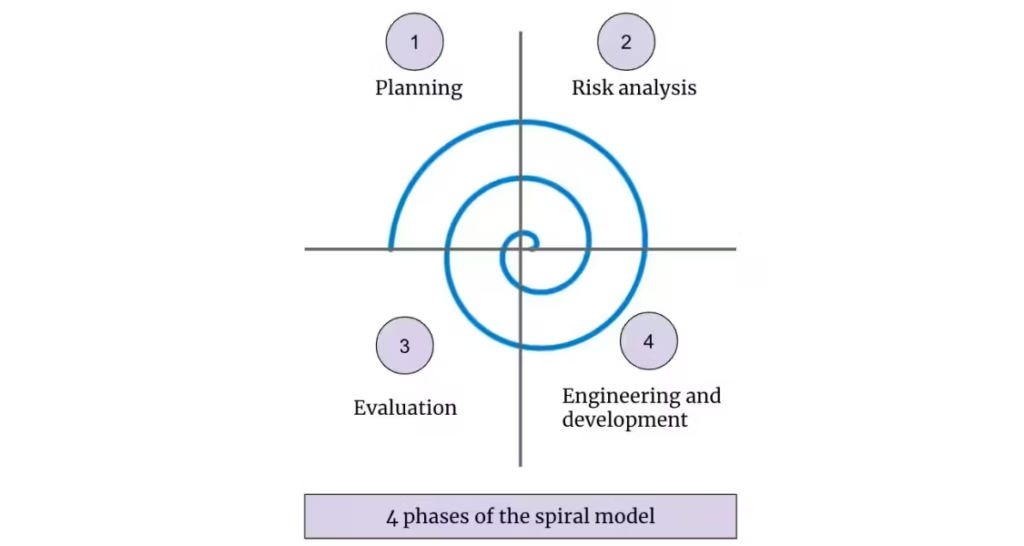
    Spiral Model

    Spiral Model

    The Spiral Model is a software development approach that blends features from both the waterfall and prototyping methodologies.

    It emphasizes iteration and risk analysis. This model guides the development process through a series of iterative cycles. Each cycle represents a phase in the project’s evolution.

    The primary key feature of the Spiral Model is its focus on risk management. It encourages developers to assess and address potential risks at every stage.

    This ensures that issues are identified and mitigated early in the development process. This iterative approach allows for flexibility and adaptation as the project progresses.

    The model involves four main phases: determination of objectives, risk assessment, and mitigation. It also includes development and testing, and an evaluation of the current iteration.

    This continuous spiral-like cycle repeats until the final product is ready. The Spiral Model is especially good for large, complex projects. When managing uncertainty and risks throughout the project’s development, we use it.

    Iterative Development with Risk Analysis

    1. Iterative Development: The Spiral Model follows a cyclical approach where the project evolves through repeated iterations, allowing for the incorporation of new features and improvements.

    2. Risk Analysis: Each spiral iteration includes a risk analysis phase, where potential risks are identified, assessed, and strategies are developed to manage or mitigate these risks.

    Phases in Spiral Model

    1. Planning: Define the project objectives, risks, and constraints.

    2. Risk Analysis: Evaluate potential risks and develop strategies to address them.

    3. Engineering: Develop, test, and integrate the product based on the planning and risk analysis.

    4. Evaluation: Review the results of each iteration to decide whether to proceed to the next spiral.

    Advantage and disadvantage

    Advantage Disadvantage
    Supports gradual and incremental development, reducing project risks over time. Can become complex to plan and manage, especially for large-scale projects.
    Follows a systematic and well-structured development approach. Generally more expensive due to extended planning, testing, and iterative development.
    Enables early identification and mitigation of project risks. Development can be time-consuming because of multiple iterative phases.
    Adapts well to changing requirements throughout the project lifecycle. Not ideal for small projects with simple or fixed requirements.

    Applicability and Comparison with Other Models

    1. Applicability: Suitable for large, complex projects with changing requirements and a need for frequent risk assessment.

    2. Comparison: Contrasted with the waterfall model, the Spiral Model accommodates changes more flexibly. It also provides a systematic approach similar to the waterfall model.

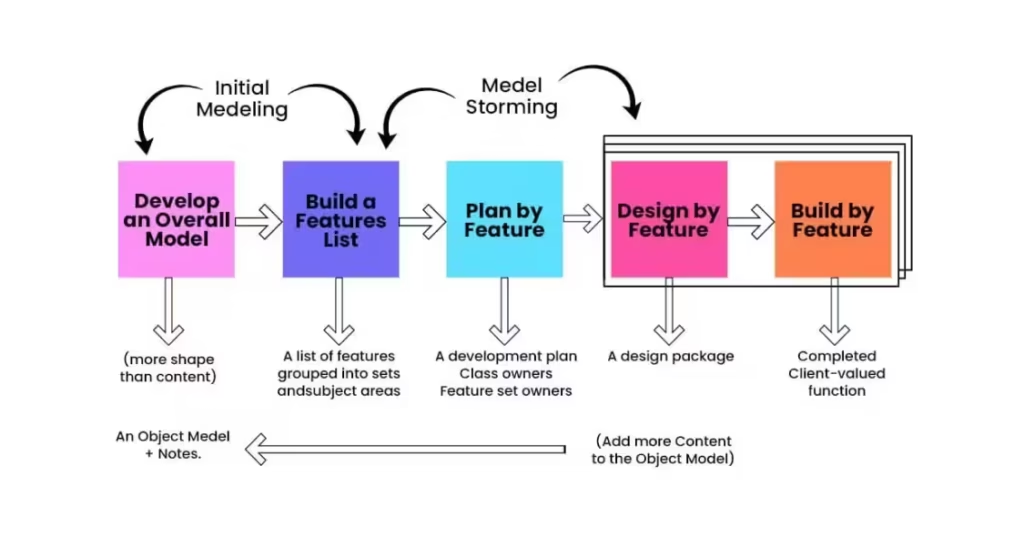
    Feature-Driven Development (FDD)

    Model Streaming

    1. Domain Object Modeling: FDD places significant importance on creating a clear and comprehensive model of the problem domain. This involves identifying and modelling the key elements (objects) in the system’s domain and their relationships. This model serves as a foundation for understanding and designing the features.

    Feature-Driven Development (FDD) is a methodical and iterative approach to software development that revolves around constructing features as its central focus. This methodology incorporates several key concepts to guide its process:

    2. Developing by Feature: FDD organizes development around individual features, which are distinct functionalities or capabilities that provide value to the end-users. Teams work on these features in a structured manner, breaking down the overall project into manageable, incremental pieces.

    3. Individual Class Ownership: FDD encourages a sense of ownership and responsibility among developers. Each class in the system is assigned to a specific developer who becomes the primary owner of that class. This ownership model enhances accountability and promotes efficient collaboration.

    4. Iterative and Incremental Development: FDD follows an iterative and incremental approach where features are developed in short iterations. A potentially shippable product increment is produced at each iteration.

    Roles and Responsibilities

    1. Chief Architect: Responsible for overall design and architecture.

    2. Class Owners: Developers responsible for specific classes or features.

    3. Domain Experts: Provide insights into the application domain.

    4. Chief Programmer: Oversees the development team and ensures quality.

    Advantage and disadvantage

    Advantage Disadvantage
    Provides clear ownership and accountability for each feature. Not well-suited for small projects with limited scope.
    Enables focused development by allowing teams to work independently on specific features. Limited flexibility when accommodating major requirement changes.
    Supports an iterative and incremental development approach for continuous improvement. May lead to feature overlap or duplicated efforts without proper coordination.
    Improves project visibility through better tracking of feature progress and priorities. Formalizing processes and maintaining consistency across teams can be challenging.

    Examples of Successful Implementation

    1. United Overseas Bank (UOB): Successfully implemented FDD to enhance the efficiency and quality of their software development projects.

    2. Singapore Land Transport Authority (LTA): Applied FDD to improve the development process for their transportation management systems.

    Ready to optimize your software development process?

    Let’s explore the perfect methodology for your project’s success. Let’s streamline together

    Choosing the Right Methodology in Project

    Choosing the right methodology in project management is a critical decision that can significantly impact the success of a software development project.

    Various factors must be carefully considered to ensure that the selected methodology aligns with the project’s characteristics and requirements.

    Here, we delve into the key factors to consider when making this crucial decision.

    Project Size

    Project size refers to the scale and scope of the development effort. It can be measured in terms of lines of code, functionality, or team size.

    Consideration: Larger projects often demand more structure and organization to manage complexities effectively.

    In such cases, methodologies like the waterfall model or the Rational Unified Process (RUP) may be more suitable due to their sequential and phased approach, providing clear milestones and planning.

    Complexity

    Project complexity involves the intricacy of the system being developed, considering factors such as technical challenges, inter-dependencies, and evolving requirements.

    Consideration: Highly complex projects may benefit from methodologies that embrace adaptability and flexibility.

    Agile methodologies, such as Scrum or Kanban, are known for their iterative and incremental nature, allowing teams to respond quickly to changes and uncertainties.

    Team Expertise

    The skill set, experience, and proficiency of the development team members are crucial in determining the methodology that best fits the project.

    Consideration: Teams with extensive experience in a specific methodology may prefer to continue with what they know best.

    For example, a team proficient in Agile practices might choose Scrum or XP (Extreme Programming) for their emphasis on collaboration and adaptability.

    Customer Involvement

    Customer involvement refers to the degree to which end-users or stakeholders participate in the development process, providing feedback and influencing decision-making.

    Consideration: Projects with a high level of customer involvement often benefit from Agile methodologies, where continuous feedback and collaboration are integral.

    On the other hand, projects with less direct customer interaction may find traditional methodologies like Waterfall more suitable.

    Hybrid Approaches

    Hybrid methodologies combine elements from different project management approaches to create a customized framework that suits the specific needs of a project.

    Consideration: Recognizing that a one-size-fits-all approach may not be ideal, hybrid methodologies allow teams to blend practices from Agile, Waterfall, or other frameworks.

    For instance, a team might use Agile principles for flexibility and customer collaboration while incorporating aspects of the Waterfall model for structured planning and documentation.

    There is no one-size-fits-all approach when it comes to selecting a software development methodology.

    Project managers and teams must carefully evaluate the project’s size, complexity, team expertise, and customer involvement and consider the benefits of hybrid approaches to select a methodology that aligns with the unique requirements of the project.

    Challenges and Solutions in Software Development Methodologies

    1. Changing Requirements: Fluid project requirements can pose challenges, especially in methodologies with a fixed planning phase.

    2. Communication Breakdown: Inadequate communication can lead to misunderstandings, delays, and errors.

    3. Team Collaboration: Ensuring effective collaboration, especially in distributed teams, can be challenging.

    4. Resistance to Change: Team members may resist adopting new methodologies due to unfamiliarity or established habits.

    5. Resource Allocation: Efficiently managing resources to meet project demands is a common challenge.

    6. Unforeseen Risks: Identifying and mitigating risks can be difficult, especially when they emerge unexpectedly.

    7. Quality Assurance: Maintaining consistent quality throughout the development process is a perpetual concern.

    Strategies for Overcoming Challenges

    1. Adaptive Planning: Embrace methodologies that allow for flexibility in response to changing requirements.

    2. Enhanced Communication: Foster open and transparent communication channels within the team and with stakeholders.

    3. Collaboration Tools: Utilize collaboration tools to facilitate communication and teamwork, especially in distributed environments.

    4. Change Management: Implement change management strategies to address resistance and facilitate a smooth transition to new methodologies.

    5. Resource Management: Employ effective resource allocation strategies, considering team skills and project requirements.

    6. Risk Management: Conduct thorough risk analysis at regular intervals and develop strategies to mitigate potential risks.

    7. Quality Assurance Processes: Implement robust quality assuranceprocesses, including testing and code reviews, to maintain high standards.

    Continuous Improvement and Adaptation

    1. Retrospectives: Regularly conduct retrospectives to reflect on project outcomes, identify areas for improvement, and implement changes.

    2. Feedback Loops: Establish feedback loops within the development process to gather insights and make informed adjustments.

    3. Training and Development: Invest in ongoing training and development to keep the team updated on the latest methodologies and practices.

    4. Adaptive Culture: Foster a culture of continuous improvement, encouraging the team to adapt and evolve in response to challenges and changing requirements.

    5. Benchmarking: Compare project outcomes against industry benchmarks and best practices to identify areas for enhancement.

    The software development landscape is dynamic, and challenges are inevitable. However, by implementing thoughtful strategies, fostering a culture of continuous improvement, and adapting to the evolving needs of projects, teams can overcome challenges and deliver successful outcomes.

    Conclusion

    We’ve explored six main software development methodologies, highlighting their strengths and weaknesses. Whether it’s the systematic Waterfall Model, the dynamic Agile Methodology, collaborative DevOps, efficiency-focused Lean Development, risk-aware Spiral Model, or feature-centric Feature-Driven Development (FDD), each serves specific project needs.

    Selecting the right methodology for a project requires considering factors like size, complexity, team expertise, and customer involvement.

    Addressing challenges through adaptive planning, improved communication, quality assurance, and continuous improvement is key.

    Zennaxx Software Development Company puts the right methodology into projects and keeps up with new trends and technology.

    Contact us to start the project from scratch and make it a success. Our experienced development team will guide you in choosing the most suitable methodology for your project.

    Read Also: 

  • Top Mobile App Development Company in Canada

    Top Mobile App Development Company in Canada

    Canada recorded a significant boost in mobile usage and custom app solutions. Approximately 33 million more users than the previous year. This boom in mobile usage was observed right from the beginning of January. It indicates a solid start to the year for the mobile app development company in Canada.Canada is widely known as an IT hub. Its strong tech industry continues to attract both domestic and international companies.

    The increasing number of mobile users has created a growing demand for innovative app development solutions for startups. This presents several opportunities for the mobile app development company to expand its reach and capitalize on this trend.

    To boost your marketing business’s reach and overcome competition, invest in mobile app deployment in Canada. Also, listen to the needs of the growing number of mobile users.But here is a question: How can you guarantee that your mobile app stands out from the competition?

    There are thousands of mobile app development companies in Canada. Also, the mobile app market is constantly evolving, and new apps are being released every day.

    Every mobile software development company provides innovative app development solutions. They use their expertise and knowledge in the field.So, for your solution, here we list down the top mobile app companies in Canada.

    Zennaxx

    Zennaxx is at the top of the list of the most successful mobile software development companies in Canada in the past 10 years, with a strong background in delivering high-quality mobile applications and solutions in Canada. 10+ years of experience in the technological field provides you with assured and top-quality support and management.Zennaxx has a 50+ members team of skilled developers and designers. Your projects are maintained under their experienced manager for better results.

    They consistently stay ahead of the latest industry trends and technologies. Zennaxx software services provide not only mobile app development services but also web development, software development, and IT-related solutions.

    Their expertise extends to web development, UI/UX design, and software testing. They prioritize client satisfaction and strive to deliver innovative solutions that meet their specific business needs.

    Zennaxx is most known for being the best mobile app development company in Canada, with 92% satisfied client reviews all over the world and completed 700+ high revenue generating successful projects.

    Services offered: Android & iOS app development, Cross-platform app development, Web designing, UI/UX design

    Expertise and technologies used: PHP, Node JS, java, HTML5, Angular, ReactPortfolio and client references: Mitsubishi, Hitachi, Nike

    Mindsea

    Mindsea Software Services is another reputable company in the industry. It offers a wide range of mobile app development services in Canada.

    They specialize in creating user-friendly and visually appealing applications for both the Android and iOS platforms. Mindsea ensures that its clients receive top-notch solutions that align with their business goals. They do this through their expertise in UI/UX design and software testing.

    Mindsea has an experienced team of developers. They provide high-quality code and efficient project management. As a result, Mindsea delivers projects on time and within budget.With the mobile app solution, Mindsea has completed health-related projects in history. Their commitment to innovation and customer satisfaction has earned them a reputation as one of the leading mobile app development companies in Canada.Services offered: UX designs, App development and technology, Digital Health SolutionExpertise and technologies used: JavaScript, React.JS, Laravel, React Native, HTML5Portfolio and client references: University Health Network, HUSO On the Go, 99 Walks

    Fullestop

    Fullestop is a leading web design and app development company in Canada. IT mainly works on digital product development projects. With their expertise in digital production, we chose this company on the list of the best mobile app development companies in Canada.Their team of skilled professionals has a proven track record. They deliver high-quality websites and mobile applications that meet the unique needs of their clients.Fullestop’s commitment to innovation and customer satisfaction sets them apart from other companies in the industry.

    Their experienced team not only provides a service but also wins many awards. They receive recognition for their best performance, creativity, and expertise. They also provide various services related to development and web solutions.

    Fullestop stays up-to-date with the latest technology. This dedication ensures their clients get cutting-edge solutions. It gives them a competitive edge in the market.Services offered: e-commerce development, software development, AI developmentExpertise and technologies used: WordPress, JavaScript, Python, SQLPortfolio and client references: Walkswagon, Adidas, and Scoda

    Techware Hut

    Techware Hut is a premier digital agency. It has been providing services worldwide for over 22 years and have extensive experience in mobile app development, custom web development, and application development.

    It also has experience in staff augmentation, SEO, SMO marketing, and cloud application development. In the journey of 22 years, the company has completed over 7,500 projects in the development industry.

    My broad experience in the development industry ensures the best practices and top-notch skills in all kinds of technology to complete projects. Full stop has a team of highly skilled professionals.

    The team has earned a reputation for delivering innovative and cutting-edge solutions to clients across various industries.

    They stay updated with the latest technological advancements. This commitment allows them to exceed client expectations and deliver exceptional results.

    Services offered: mobile application development, web development, and IT consultingExpertise and technologies used: B2B apps, AngularJS, WordPressPortfolio and client references: Fair and Handsome, Scoda, Adidas, Sony

    Bytes Technolabs

    Bite Technolabs provides mobile app development services for all kinds of small and large industries and entrepreneurs. They also offer Google app engine development services. During this development, Bite Technolabs provides UI/UX design.

    They also offer web app development, eCommerce development, CMS development, emerging technologies, quality assurance, software testing, infrastructure, and DevOps.

    Company developers are skilled in creating efficient and scalable custom mobile app solutions. They use the Golang and Lavarel frameworks and have extensive experience in building robust applications.

    They cover all the unique requirements of each client. The company has a team of over 150 developers. With this skilled team, the company has around 425 global clients. They provide top-notch mobile app development solutions in Canada and around the globe.

    Services offered: Mobile App Development, Shopify, Web Development

    Expertise and technologies used: Python Django, .Net, Drupal, Golang

    Portfolio and client references: Alliance consumer group, Ragnar, Healthy Planet

    Master Of Code Global

    Master of Code Global is known for Android mobile app development. They are a mobile app development company with the best practices. They also make conversational chat and voice solutions enabled by AI.

    It started in 2004 and has since grown to become a leading global software development company with 250+ masters in international. They are committed to delivering innovative and high-quality software solutions to clients worldwide.

    Master of Code Global can handle large-scale projects effectively because of its large team. Their team of experts guarantees that each project is delivered on time.

    The projects also meet the highest standards of quality. Additionally, their dedication to staying at the forefront of technology trends allows them to provide cutting-edge solutions to their clients.

    Services offered: eCommerce Development, Mobile App Development, AI Development

    Expertise and technologies used: Android, Cross-Platform, WordPress

    Portfolio and client references: Luxury Escape, Aveda, eBags, Burberry

    Multiverse Software

    Multiverse Software is an award-winning mobile app development company. With mobile app development, they also contribute to the growth of your business and applications. Multiverse software provides mobile app development services.

    They also offer website development, branding, marketing, and all kinds of IT services. They provide start-to-end support in all types of services.

    The Multiverse software team achieved the 2017 GMASA Awards and Google’s Made for Billions. They got these awards for their hard work and good development practices.

    Their expertise in mobile app development has not only earned them recognition and awards. It has also helped numerous businesses thrive in the digital market.

    Multiverse Software offers a comprehensive range of services. This ensures that clients receive holistic support for all their IT needs. They are a trusted partner for businesses who are seeking mobile app development.

    Services offered: Mobile app development, It services, Graphic designs

    Expertise and technologies used: Laravel, Flutter, React Native

    Portfolio and client references: Huawei, Gujarat Advocates, Healstation Foundation

    Build Me App Inc

    Build Me App Inc. is a 22-year-old mobile app development company in Canada. They specialize in creating innovative and user-friendly mobile applications for various industries.

    With a team of experienced developers and designers, Build Me App Inc. has successfully delivered numerous successful projects to satisfied clients worldwide.

    With the use of an AI-based estimator, this mobile app consultancy service provides a business estimate for team timing and the cost of developing a whole business.

    Buid Me App Inc. can provide you with superior development with its massive team of 500+ developers and support team to handle your projects easily.

    This team has over 200 products on the market, generating good revenue for their business. Build Me App Inc. They stay up-to-date with the latest technological advancements and industry trends. This allows them to deliver cutting-edge solutions that drive business growth and success.

    Services offered: Mobile App Development, Web Development

    Expertise and technologies used: JavaScript, Python, Django, Flutter

    Portfolio and client references: Colibri, gSwop, Swop Market

    Openxcell

    Openxcell is a CMMI Level 3 and ISO 9001:2008-certified company. It successfully developed over 3000+ mobile applications and customized 2000+ software. Companies are ready to sign a non-disclosure agreement for project confidentiality.

    This is because they have good expertise in mobile app development. Openxcell’s skilled developers and designers ensure the highest level of security and privacy for their client’s projects.

    Openxcell covers all development from simple business mobile app development to complex enterprise-level eCommerce solutions. The Openxcell team of certified SCRUM developers supports your development.

    They also provide top-notch technology solutions for your business. Openxcell has extensive experience in mobile app development. They are well-practiced in handling projects of any complexity.

    Services offered: Software Development, Product Engineering, AI & ML Machine Learning

    Expertise and technologies used: Next.js, Python, Android

    Portfolio and client references: Byju’s, Hubble, Pedigree

    Designli

    In the list of the top ten mobile app development companies in Canada, we finish this blog by adding Designli Mobile Development Company to this list.

    Design specializes in developing new technology for mobile applications. This mobile app development company provides new software concepts to the market.

    Designli is also an Agile Software Development Agency, which means the success rate of development increases by 150% with this method. This methodology helps you generate 60% more revenue and profit in your business.

    The 70% of Designli teams are experts in agile methodology. They have a proven track record of delivering high-quality mobile applications within tight deadlines. Designli ensures efficient collaboration.

    Their expertise in agile methodology enables quick adaptation to changes in project requirements. This company’s dedication to innovation and customer satisfaction sets it apart from other mobile app development companies in Canada.

    Services offered: Mobile App Development, Software Development, IoT

    Expertise and technologies used: Node.js, Android, Flutter

    Portfolio and client reference: Thingealogy, Secur. Space, Paidback

    Planning mobile development?

    Ready to elevate your app development projects? Partner with us for seamless app development solutions.

    Conclusion

    The list of the top 10 mobile app development companies in Canada is based on their previous projects and successful output. These development companies help you to build the best mobile app with a high-quality customer experience.

    They have a team of skilled professionals who specialize in variousaspects of app development, such as design, coding, and testing.

    These companies also stay updated with the latest trends and technologies in the mobile app industry to ensure that your app is innovative and competitive in the market.

  • Cross-Platform Application: Definition, Development, Frameworks, Languages, Pros and Cons

    Cross-Platform Application: Definition, Development, Frameworks, Languages, Pros and Cons

    A cross-platform application is software developed to operate on various operating systems like Android, iOS, and Windows using the same code. According to Statista, up to 40% of mobile apps use cross-platform frameworks. Flutter leads with 46% adoption.

    The Business of Apps claims that companies can launch apps 30–40% faster and save up to 50% on development costs. Cross-platform apps are effective because 80% of users demand a faultless experience across devices.

    Cross-platform app development is creating applications that function on multiple platforms with the same code. These apps are developed using frameworks that allow code reuse and optimize performance across various operating systems. Compared to native app development, this method assures faster development cycles and efficient maintenance.

    Cross-platform apps follow similar UI/UX principles as mobile apps. However, they differ in their use of shared codebases and platform-independent logic. Unlike mobile apps, cross-platform apps use a write-once, run-anywhere approach.Cross-platform apps rely on frameworks that enable multi-platform compatibility. Cross-platform apps use languages such as JavaScript, Dart, and C#. The cross-platform process includes UI/UX design, coding, testing, and deployment.

    The process ensures a seamless user experience across devices. The most recognizable cross-platform frameworks include Flutter, which uses Dart and offers a highly customizable UI. React Native, which is JavaScript-based and widely used for hybrid apps. Ionic which leverages HTML, CSS, and JavaScript for lightweight applications.Cross-platform apps stand out due to their single codebase. These apps eliminate redundancy and cost-effectiveness, which help reduce development expenses and faster deployment.

    The cross-platform apps speed up market entry and broader audience reach to ensure a smooth experience for users across different platforms.

    What Is A Cross-Platform Application?

    cross platform mobile app definition

    A cross-platform application refers to various computing platforms such as macOS, Linux, Android, iOS, and Windows and device types such as desktop and mobile. Cross-platform apps streamline development, reduce costs, and ensure consistency across devices. Primarily, mobile app development relies entirely on native coding, iOS apps using Objective-C, and Android apps using Java. This approach was time-consuming and expensive. The early 2010s saw the emergence of hybrid development tools like .NET MAUI and Ionic. React Native and Flutter revolutionized cross-platform development in the mid-2010s. Today, frameworks like Flutter, Kotlin, and Ionic continue to expand cross-platform capabilities.

    Cross-platform frameworks such as React Native, Flutter, and Xamarin create platform-specific differences. UI components ensure a consistent look and feel. Platform-specific APIs offer access to features like cameras, GPS, and sensors. To improve functionality, backend services handle data storage, authentication, and cloud integrations.Cross-platform apps follow a structured development process. The chosen framework compiles the code into a native-like format that works across different operating systems. The five major examples of cross-platform mobile app development include Instagram, Facebook, Google Ads, Microsoft Teams, and Spotify.

    What Are the Features of a Cross-Platform Application?

    cross platform mobile application features Cross-platform applications offer multiple features that make them highly functional for multi-platform development. Cross-platform apps enable developers to develop and manage apps for multiple operating systems with minimal effort. These apps provide benefits such as faster development cycles, cost savings, and the ability to provide a consistent user experience across platforms.
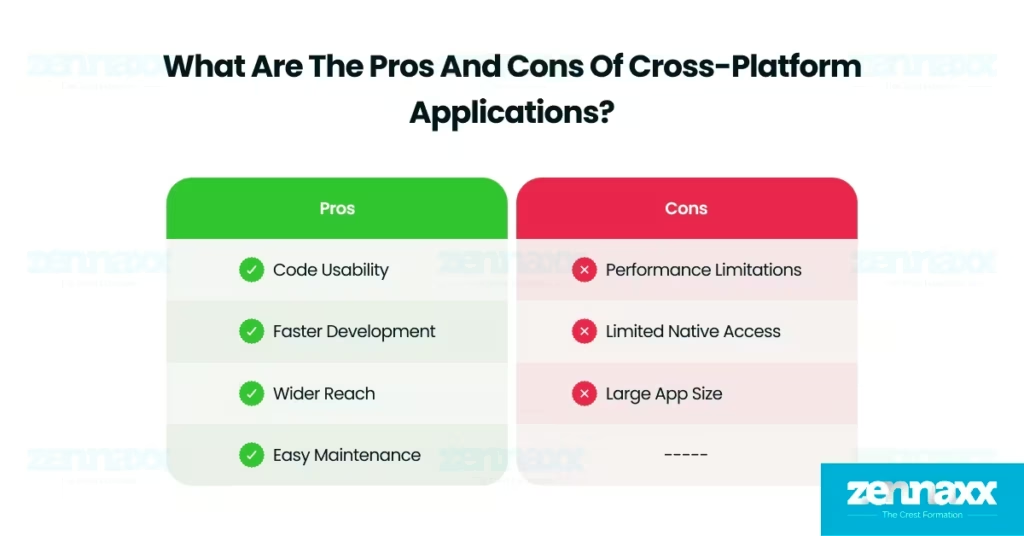
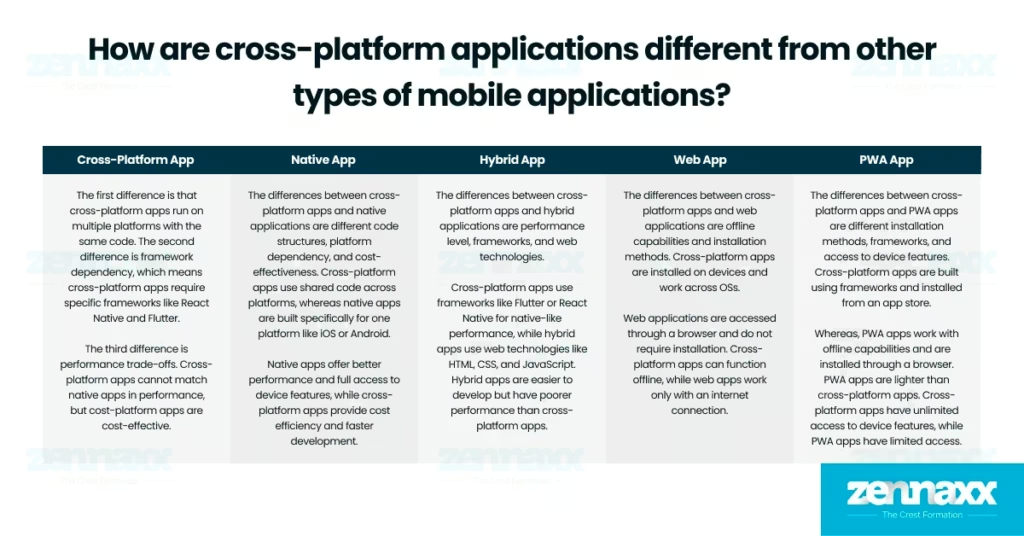
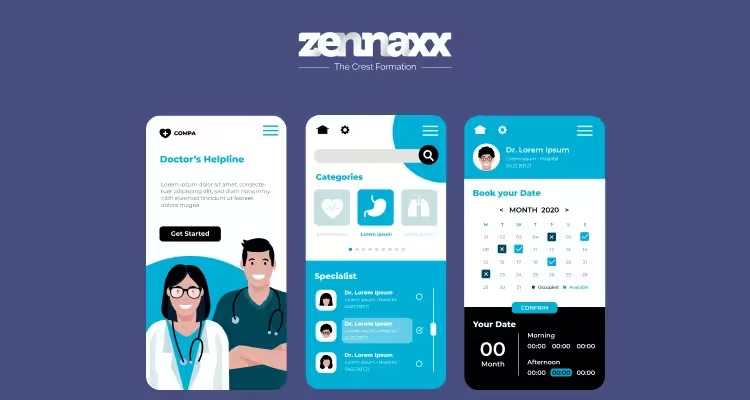
    Below are the key features of cross-platform applications.

    1. Single Codebase: A single codebase uses one code for all platforms in cross-platform apps, which reduces repetition and maintenance efforts.
    2. Platform Independence: Cross-platform apps work on different operating systems, such as macOS, Android, and Windows, with a single codebase.
    3. Reusable Components: Across different platforms, code and UI elements can be reused to save time and ensure consistency in cross-platform applications.
    4. Native-Like Performance: Modern frameworks offer native-like performance in cross-platform applications.
    5. Faster Development: Cross-platform apps avoid the need for platform-specific code with short development time.
    6. Cost Efficiency: Reduced development and maintenance costs eliminate separate codebases for each platform in cost-platform apps.
    7. Cloud Integration: Cross-platform apps offer easy integration with cloud services for flexible backend solutions.
    8. Consistent UI/UX: Cross-platform apps assure a unified design and user experience across devices.

    What Platforms Support Cross-Platform Applications?

    Cross-platform applications are designed to run on multiple operating systems, such as iOS and Android, to decrease development time and cost. Cross-platform apps are supported by multiple frameworks that include Flutter, Ionic, React Native, Unity, and Electron. Cross-platform applications offer compatibility across different devices to make them efficient and flexible.

    What Is Cross-Platform Application Development?

    Cross-platform application development is the development of mobile apps that run on multiple operating systems with a single code. Cross-platform apps do not require separate code for each platform, like native apps. Cross-platform development leverages frameworks like React Native, Flutter, and Xamarin to streamline the process.

    A cross-platform application development service is a service provided by app development agencies and freelance developers to create apps that run across various platforms. Cross-platform app services deliver efficient and expandable mobile or web apps using cross-platform tools.Cross-platform app development services include consultation and planning, UI/UX design, app development, testing, deployment, and post-launch support.

    The cross-platform app development services offer businesses fast delivery, reduced costs, a smooth user experience, expert guidance, and flexibility.Cross-platform application development is creating apps that run seamlessly on multiple operating systems like iOS, Android, and Windows using one code.

    The structured process begins with idea generation and research, where developers examine market needs, define features, and choose the right technology stack. Designing and prototyping, wireframes, and UI/UX designs are formed to ensure a smooth user experience. The development phase involves writing and integrating code. Testing and debugging identify and fix performance issues.

    Developing cross-platform applications involves multiple structured steps that are listed below.

    Generating Ideas and Researching

    Generating ideas and researching is the first stage where app ideas are conceptualized and researched for feasibility.

    • Market Research: The market research examines user needs, competitors, and industry trends. It conducts surveys, studies app store trends, and analyzes competitors’ strengths and weaknesses. The market research best practices are to focus on a target audience, identify main points, and ensure a unique value proposition.
    • Feature Planning: Future planning lists and prioritizes essential and additional app features such as platform-specific features, data synchronization, and push notifications. It is done by creating a feature roadmap using MoSCoW (Must-have, Should-have, Could-have, Won’t-have) prioritization. The feature planning best practices are to keep the core functionalities simple and avoid unnecessary complexity.
    • Technology Selection: Technology selection chooses the best frameworks, programming languages, and tools. It evaluates frameworks based on platform compatibility, performance, and community support. The technology selection best practices are to use technologies like Flutter or React Native for better maintenance and support.

    Designing and Prototyping

    Designing and prototyping create the app’s visual structure and an interactive prototype to define the seamless user experience.

    • Wireframing: Wireframing is a low-fidelity layout that highlights the app’s structure and navigation. It uses tools like Figma or Adobe XD to make blueprints of the app screens. The wireframing best practice is to keep it simple, focus on user flows, and ensure logical screen transitions.
    • UI/UX Design: UI/UX design the visual aesthetics and user interactions for a flawless experience. It uses design principles like consistency, minimalism, and accessibility to create intuitive interfaces. The UI/UX design best practices are to follow platform-specific guidelines like Material Design for Android and Human Interface Guidelines for iOS.
    • Prototyping: Prototyping creates a responsive and clickable model of the app before actual development. It uses tools like InVision or Figma to simulate app interactions. The prototyping best practice is to gather early feedback from users to refine the design before coding begins.

    Developing and Integrating

    The development and integration phases involve code writing, implementing features, and integrating third-party services such as developers through APIs to create an efficient application.

    • Frontend Development: The frontend development makes the app’s user interface and interactions. It uses frameworks like Flutter, React Native, or Ionic. The fronted development best practice is to ensure prompt layouts, smooth animations, and functional rendering.
    • Backend Development: Backend Development sets up databases, authentication, and business logic. It develops RESTful APIs or GraphQL using backend technologies like Node.js, Firebase, or Django. The backend development best practice is to ensure security, scalability, and efficient data management.
    • API Integration: API integration connects external services such as payments, maps, or authentication. It uses SDKs and APIs such as Stripe for payments or Firebase for authentication. The API integration best practice is to ensure seamless integration, low-latency API calls, and error handling.

    Testing and Deploying

    Testing and deploying ensure the app is free of bugs, performs well, and is ready to submit to app stores.

    • Unit Testing: Unit testing consists of individual components to ensure they function as required. It uses testing frameworks like Jest, Mocha, or Flutter Test. The unit testing best practice is to automate tests to find issues quickly and reduce manual errors.
    • Performance Testing: Testing checks app speed, promptness, and stability under many conditions. It uses tools like Firebase Test Lab or Xcode Instruments. The performance testing best practice is to optimize code, reduce load times, and test on multiple devices.
    • Deployment: Deployment circulates the app on platforms like the Google Play Store and Apple App Store. It obeys app store guidelines, signs the app with proper credentials, and turns it in for review. The deployment best practice is to monitor user feedback, release updates regularly, and fix reported issues promptly.

    What Are The Uses Of Cross-Platform Applications?

    Cross-platform apps run on multiple devices with one code and offer cost-friendly solutions for businesses and developers. These applications are best for social media platforms, e-commerce stores, financial services, gaming experiences, and business productivity tools.

    Below are the uses of cross-platform applications.

    1. Social Media Apps: Cross-platform apps help users interact with family, friends, and colleagues through social media apps such as Facebook, Instagram, and Twitter.
    2. E-Commerce Apps: Cross-platform apps offer platforms such as Amazon and eBay for a flawless shopping experience for users.
    3. Banking and Finance Apps: Cross-platform apps provide mobile banking apps that enable secure transactions and account management.
    4. Gaming Apps: Cross-platform apps offer games such as PUBG and Among Us to reach a wider audience.
    5. Business & Productivity Apps: Cross-platform apps offer Slack, Trello, and Microsoft Teams for efficient collaboration across different OSs, such as iOS, Android, and Windows.
    6. Healthcare Apps: Cross-platform apps offer telemedicine, and fitness tracking apps to operate on both Android and iOS.
    7. Education Apps: Cross-platform apps provide e-learning platforms such as Coursera and Duolingo for accessibility across devices.
    8. Entertainment & Streaming Apps: Cross-platform apps created Netflix, Spotify, and YouTube to ensure seamless media consumption across platforms.

    How Much Does It Cost To Develop A Cross-Platform Application?

    Cross-platform mobile app development costs range from $20,000 to over $150,000. Basic apps cost $20,000–$40,000, medium apps $40,000–$100,000, and complex apps over $150,000. Cross-platform mobile app development price depends on app complexity, developer rates ($30–$150/hour), and extra charges for licensing, third-party tools, cloud services, and maintenance.

    What is the average salary of a cross-platform application developer?

    The average salary of a cross-platform application developer is around $80,000 to $120,000 per year, which solely depends on developers’ experience and location. The average salary of a cross-platform app developer in the United States is around $102,000 per year. The beginner developers earn around $65,000 annually, while senior developers make more than $150,000 per year. In Europe, a cross-platform app developer makes around £50,000 to £70,000 per year.

    Are cross-platform applications developed in the same way as other types of mobile apps?

    No, cross-platform applications are not developed in the same way as other types of mobile apps. The mobile app development cycle of cross-platform apps includes research, design, development, testing, and deployment.

    The cross-platform apps differ in how the code is written and executed across platforms. Cross-platform apps differ in approach, tool selection, and performance optimizations compared to native or hybrid applications.

    What programming languages are used to develop cross-platform applications?

    JavaScript, Dart, Kotlin, and C# are programming languages that are used to develop cross-platform applications. JavaScript is used in React Native and Ionic. Dart is used in Flutter, which is Google’s cross-platform framework. C# is used in Xamarin for native-like cross-platform development.

    Kotlin allows sharing logic between Android and iOS.Cross-platform development based on languages that allow running code on multiple operating systems.

    What frameworks are used to develop cross-platform applications?

    Flutter, React Native, Ionic, and .NET MAUI are frameworks that are used to develop cross-platform applications. The cross-platform application development frameworks enable developers to write one codebase that runs on various operating systems. These frameworks use different programming languages and tools to guarantee compatibility, performance, and smooth user experiences.

    Popular cross-platform frameworks are listed below.

    1. Flutter: Flutter is made by Google, and Flutter uses Dart to create high-performance mobile, web, and desktop apps. This framework also uses a custom rendering engine for smooth animations and a native-like UI. Flutter supports hot reload, which allows developers to see real-time changes during development.
    2. React Native: The React Native framework is developed by Facebook. It uses JavaScript and React to build mobile apps. This framework facilitates code reuse between web and mobile apps. React Native offers a vast library of third-party plugins and has strong community support.
    3. Ionic: The Ionic framework uses HTML, CSS, and JavaScript to develop hybrid apps with a single codebase. This framework works well with Angular, React, and Vue frameworks. It offers UI components to make development faster.
    4. .NET MAUI: .NET MAUI is a framework used to develop cross-platform apps from a single codebase, such as C# for Android and iOS. This framework is open-source and is the extended version of Xamarin.

    What are the pros and cons of cross-platform applications?

    cross platform mobile application pros cons

    The pros and cons of cross-platform applications include code reusability, faster development, wider reach, easy maintenance, limited native access, performance limitations, and larger app size.

    The key benefits of cross-platform application development are listed below.

    • Code Usability: Cross-platform apps use a single codebase for multiple platforms.
    • Faster Development: Cross-platform apps reduce development time and cost.
    • Wider Reach: Cross-platform apps support multiple OSs, such as iOS and Android, without extra effort.
    • Easy Maintenance: Cross-platform apps update sync across all platforms.

    The disadvantages of cross-platform application development are listed below.

    • Performance Limitations: Cross-platform apps are slower than native apps in heavy processing because cross-platform apps need an extra layer to interact with platforms’ features.
    • Limited Native Access: Cross-platform apps have device-specific features such as GPS, cameras, and push notifications that require additional work.
    • Large App Size: Cross-platform apps are heavier when compared to native apps.

    What is the future of cross-platform applications?

    The future of cross-platform application development is based on growing with better frameworks, improved performance, and AI-driven optimizations, which makes it a dominant choice for businesses and users.

    The future of cross-platform applications looks promising. There will be improved efficiency, versatility, and client engagement. The major key point of cross-platform applications’ future includes wider adoption, development ease, and integration with emerging technologies.

    Are IoT apps going to die?

    No, IoT apps are not going to die because of advancements in AI, edge computing, and 5G. IoT apps will see a shift in prominence as replacements like cross-platform frameworks evolve. IoT apps will remain crucial for industries that need high performance, improved security, and deep hardware integration.

    How are cross-platform applications different from other types of mobile applications?

    cross platform apps vs other mobile apps

    Cross-platform applications are different from other types of mobile applications in 3 different ways such as platform compatibility, framework dependency and performance trade-offs.

    The first difference is that cross-platform apps run on multiple platforms with the same code. The second difference is framework dependency, which means cross-platform apps require specific frameworks like React Native and Flutter. The third difference is performance trade-offs. Cross-platform apps cannot match native apps in performance, but cost-platform apps are cost-effective.

    What are the differences between cross-platform apps and native applications?

    The differences between cross-platform apps and native applications are different code structures, platform dependency, and cost-effectiveness. Cross-platform apps use shared code across platforms, whereas native apps are built specifically for one platform like iOS or Android. Native apps offer better performance and full access to device features, while cross-platform apps provide cost efficiency and faster development.

    What are the differences between cross-platform apps and hybrid applications?

    The differences between cross-platform apps and hybrid applications are performance level, frameworks, and web technologies. Cross-platform apps use frameworks like Flutter or React Native for native-like performance, while hybrid apps use web technologies like HTML, CSS, and JavaScript. Hybrid apps are easier to develop but have poorer performance than cross-platform apps.

    What are the differences between cross-platform apps and web applications?

    The differences between cross-platform apps and web applications are offline capabilities and installation methods. Cross-platform apps are installed on devices and work across OSs. Web applications are accessed through a browser and do not require installation. Cross-platform apps can function offline, while web apps work only with an internet connection.

    What are the differences between cross-platform apps and PWA apps?

    The differences between cross-platform apps and PWA apps are different installation methods, frameworks, and access to device features. Cross-platform apps are built using frameworks and installed from an app store. Whereas, PWA apps work with offline capabilities and are installed through a browser. PWA apps are lighter than cross-platform apps. Cross-platform apps have unlimited access to device features, while PWA apps have limited access.

  • A Complete Guide on Healthcare App Development

    A Complete Guide on Healthcare App Development

    After COVID-19, the healthcare sector has exploded quickly. According to Statista, global sales in healthcare are expected to reach $57.86 billion by 2023 and $85.95 billion by 2027.Medical groups are using healthcare mobile apps more frequently to improve services, which is contributing to this growth. COVID-19 created opportunities for healthcare apps, prompting businesses to consider questions such as workforce health and safety, expense management, and social responsibility.
    These apps use AI insights and real-time data analytics to improve patient care and, in some cases, transform medicine.

    The global digital health market is expected to grow to nearly $190 billion by 2025. If you are thinking about developing a healthcare mobile app, this resource will inform you about everything you need to know whencreating healthcare apps.

    What is a Healthcare App?

    Developing a healthcare app means making a mobile app that helps people manage their health worries using their phones or tablets. This could be things like tracking medical appointments, accessing electronic health records, dealing with insurance claims, and many more.

    Software consulting in healthcare develops medical applications in every field. Medical fields are also starting to do many tasks online for patients and doctors.

    Benefits of developing a healthcare app

    For doctors: These apps help doctors keep track of patients, schedule appointments, and manage their staff.

    For Patients: People can use these apps to book appointments, talk to their doctors online, or get health advice.

    Lots of firms are developing healthcare apps. Here are some figures about them:

    • There are about 45,478 healthcare apps available on Apple’s App Store.
    • The Play Store has around 43,285 healthcare apps.
    • In 2022, the global mHealth industry made $ 56.26 billion and is expected to grow to $ 861.40 billion by 2030. exhibiting a CAGR of 40.2% during 2023–2030.
    • A survey by Accenture found that 75% of patients understand why health apps are essential.
    • The telemedicine software solutions are predicted to grow to $17.14 billion by 2026.

    Today, there are many different kinds of healthcare apps for various needs and functions.

    Professional Healthcare Apps

    Professional healthcare apps are specifically designed to connect doctors to the communication and treatment processes between patients and healthcare providers.

    These apps serve as mediators for facilitating interactions and managing medical information. Here are different types of professional healthcare apps:

    • 1. Doctor appointment apps:
    • 2. Electronic medical/health records apps:
    • 3. Medical reference apps:
    • 4. Database apps:
    • 5. Health tracking apps:
    • 6. Networking apps (for doctors):
    • 7. Telemedicine apps:

    Healthcare Apps for Patients

    These apps typically do not require direct support from doctors, but they provide valuable information and features to patients. Here are different types of healthcare apps for patients, each with its own set of features:

    • 1. Medical education apps
    • 2. Reminder apps
    • 3. Healthy lifestyle apps
    • 4. Dieting apps
    • 5. Diagnosis apps for preventive purposes
    • 6. Fitness apps

    You have a ton of options for your startup idea with this broad spectrum of possibilities.

    Different Types-of-Medical Apps inner image

    Different Types of Medical Apps

    We are now going to discuss the different types of apps developed by software consulting in healthcare. The utilization of applications and their priorities will vary depending on the department and personnel human uses.

    Here, we discuss a few different types of medical applications.

    Health Apps for Patients

    Patients should manage their routing and stay updated by using these apps. Patient’s health apps include keeping track of their regular checkups, scheduling appointments, or providing information about medical conditions and treatments.

    Health Apps for Providers

    Doctors and nurses use this health application to manage the routing schedule and time. They could help with things like managing patient records, accessing medical literature, or communicating with colleagues.

    Health Apps for Medical Administration Staff

    Workers in healthcare settings who perform administrative or office-related tasks can use these apps. They might help with tasks such as scheduling appointments, managing billing and insurance, or organizing patient information and records.

    Telehealth Apps

    In between busy schedules, telehealth apps provide online help to participants. Patients don’t need to physically visit a clinic when using telehealth apps to communicate with their healthcare providers via video calls or messages.

    Medical Networking Apps

    Medical apps connect healthcare professionals for collaboration, learning, and sharing information. it can be used to discuss cases, ask questions, or connect with colleagues in the field. This apps are used to build an extensive professional network.

    Medical prescription apps

    These apps help doctors and other healthcare providers manage prescriptions for their patients. They might include features like electronic prescribing, medication reminders, or drug interaction checks.

    Medical Record Apps

    These apps store and manage patients’ medical records digitally. This kind of application makes it possible for healthcare providers to quickly and easily access important information like previous treatments, test results, and allergies.

    Healthcare Apps for Patients and General Users

    Healthcare Apps for Patients and General Users

    General healthcare apps help with routing and provide general health information to their users. Helped manage physical and mental health and offered helpful data to users to take care of their regular health needs.

    Some apps also offer features such as medication reminders, symptom tracking, and virtual consultations with healthcare professionals.

    Mental health apps

    Mental health applications are focused on mental well-being. This app provides tools and techniques for managing stress, anxiety, depression, or other mental health concerns. Users can access resources like guided meditation, therapy sessions, or mood tracking to improve their mental wellness.

    Health monitoring apps

    These apps help users track their health metrics and progress over time. They may include features for monitoring health signs like blood pressure, heart rate, or glucose levels.

    Users can use these apps to keep track of their health and make informed decisions about their lifestyle and habits.

    Medical Education Apps

    Medical education apps are designed to make users aware of various medical topics, conditions, and treatments. They provide reliable information and resources to help users understand their health better.

    Users can access articles, videos, or interactive tools to learn about medical issues and make informed decisions about their health care.

    Health and Lifestyle Apps

    The Lifestyle app provides lifestyle-related information and encourages users to adopt healthy lifestyles.

    Built-in features like exercise routines, nutrition plans, and wellness challenges to help users improve their overall health. Users can keep track of their progress, set goals, and receive personalized recommendations for leading a healthier lifestyle.

    Software consulting in healthcare provides every type of solution related to medical industries.

    You can solve every development problem by contacting the right medical software consulting company for app development. You can directly share your project idea and get an estimate by visiting Zennaxx software consultancy.

    Planning mobile development?

    Ready to elevate your app development projects? Partner with us for seamless app development solutions.

    Why is Healthcare App Development Essential for Businesses?

    According to the reports, 6.5 billion smartphones are active in the world, and Current numbers show that the industry will experience a 14% growth year, so you can imagine how quickly this industry is growing.

    So, bringing up with software consulting in healthcare app building support, we provide you the step-by-step healthcare app building guide for the best application development in an easy, professional way to cover all the areas.

    Steps to Build a Healthcare App

    Healthcare IT consulting services have some differences from other app development. You have to understand many specific needs and be concerned about some differences. If you want to know about a clear development road map, see this guide on development to give you clear direction and avoid making mistakes.

    Do Market Analysis

    You have to do a deep market analysis before building a healthcare app, and you have to include user pain points and needs. Fins, the competitor’s strong and weak sides, help you focus on the healthcare app’s development goals. Do research on the apps on the market, understand their simple UI/UX designs, and try to make them simpler than competitor’s apps.

    Study Your Audience

    Do complete user research during this process. Good market research helps you cover every user’s points in your healthcare application. You have to handle all kinds of sensitive issues directly through the app. It can be challenging to understand users’ problems while maintaining social rules when conducting focus groups, surveys, or interviews.

    Know how people want to use your application by deep analysis with healthcare IT consulting services. What kind of hospital process can users wish to permeate the healthcare app? Know more about acute needs and their requirements before making a final list of your application. This study helps implement every helpful feature in your healthcare app.

    Choose App Type

    Now, it’s time to choose the application type. What kind of app will work more smoothly and help users? Read your functionality list and try to understand how these features get into your healthcare application. With a clear vision, you can create clarity between your needs and the development process. This choice is based on the problem in your application, your target audience, and the intended use case.

    Create Design

    The design and UI/UX parts are the main reasons behind your application’s goal, and the health app layout should be consistent and intuitive. You have to focus on your application layout and navigation process. With a simple design, users like to use most of your application, and for a better user experience, make it work smoothly on every device. We also recommend that you minimize the cognitive load of your application for a better user experience.

    Make it HIPAA-compliant

    We cannot adequately point out how sensitive the healthcare topic is, and developing healthcare applications takes work. If you want to create a healthcare app, you must follow specific regulations.

    The USA region will require your app to comply with all HIPAA regulations. HIPAA was created to protect personal healthcare information for both patients and healthcare providers. If you want to understand this in more detail, read this paragraph on HIPAA compliance in healthcare app development.

    Specific user roles have access to the health data of other users. Only the treating doctor has access to their patient’s profile, which includes analysis, progress, diagnosis, and other information.

    Developers must use trustworthy encryption protocols to protect all personal health information. The IT team must keep information in multiple copies on different servers in case of a crash or error and respond to any alerts as soon as possible.

    Every healthcare mobile app development service must be HIPAA compliant. When working on one of the projects, you must use secure chat, which is HIPAA compliant.

    Please keep in mind that this is a partial list of what to include in your app complaint. We primarily concentrated on technological concerns, but there are also administrative requirements, such as assigning specific responsibilities and developing policies.

    Check the official guidelines to make sure you’re not breaching any regulations. You can also work with companies that provide HIPAA audits to assist you in becoming or remaining compliant.

    build mvp

    Build MVP

    Now you have an idea about choosing the health application types and security guidelines. Before the launch of the actual product, you can buy the MVP because you will get an idea of market demand and user preferences. When developing a healthcare app MVP, please keep the following guidelines in mind: build it quickly and make it viable.

    Before starting to build an MVP, make sure you have covered every feature users have needed and are solving every single problem.

    MVP gives you a competitive advantage because you can enter the market faster and collect feedback from real users than if you built a full-fledged product right away.

    Solving any difficulties and making minor improvements as per user feedback will make your application strong for the market at every point.

    It saves your product’s market value while also informing customers about your new upcoming product.

    Zennaxx Software Consulting provides a valuable solution for your project. Share brief details about your idea and get support to make it accurate by reaching out to us now!

    develop an educational app.

    Healthcare App MVP: Features Checklist

    Here is a concise checklist of necessary features for a healthcare app by using every software consulting in healthcare development: Minimum Viable Product (MVP):

    User Authentication: Secure login and registration processes for patients, doctors, and other healthcare professionals.

    Profile Management: Application Users can create and manage their own profiles, like data of personal information, medical histories, and preferences.

    Appointment Scheduling: Functionality to schedule, reschedule, or cancel appointments with healthcare providers.

    Telemedicine/Video Consultations: Capability for remote consultations between patients and healthcare professionals via video calls.

    Electronic Health Records (EHR): Storage and access to digital health records, including diagnoses, medications, lab results, and treatment plans.

    Prescription Management: A feature for doctors to prescribe medications electronically and for patients to view and refill prescriptions.

    Health Monitoring: Tools for users to track vital signs, symptoms, medications, and other health-related data.

    Notifications and Reminders: Automated alerts for appointments, medication reminders, and essential health updates.

    Secure Messaging: Secure messaging functionality for communication between patients and healthcare providers.

    Integration with Wearable Devices: Compatibility with wearable devices for seamless data transfer and monitoring.

    Data Privacy and Security: Implementation of robust security measures to protect patient data in accordance with regulations such as HIPAA or GDPR.

    Feedback and Rating System: A mechanism for users to provide feedback and rate their experiences with healthcare IT consulting services.

    This 12-point checklist covers the core features necessary to create a functional healthcare app MVP. Additional features may be added in subsequent iterations based on specific requirements and the target audience.

    Custom Healthcare App Development Cost and Time

    The total cost of developing a wellness and health mobile application is defined by the number of features and capabilities.

    With the growth of new technologies and systems, we have to take advantage of the best software consulting in healthcare to develop the best healthcare development with low-cost and quality features.

    It depends on some essential roles and management; let us also take a look at the team requirements. To create a healthcare mobile app, you will need the team of:

    Require Team

    • Frontend Designer
    • Back End Developer
    • DevOps
    • Business Analyst
    • UI/UX Designer
    • Team Project Manager
    • Quality Assurance

    Our healthcare mobile apps for patients provide services that are specifically curated to help you get the best results from the product.

    The cost estimate will consequently be predicated on the inclusion of features from a single, viable product.

    Let’s get an idea about the development time of some essential application parts and solutions.

    Cost Of Development

    Function or Feature Development Time (Hours) Development Cost
    Profile 60 $2,400
    Social Sign-Ins 100 $4,000
    Push Notifications 120 $4,800
    Chat or Messenger 180 $7,200
    Video Conferencing 200 $8,000
    Geo-Location 240 $9,600
    File Storage 120 $4,800
    HIPAA Compliance 240 $9,600
    Total 1,260 $50,400

    We can calculate the cost based on the number of hours required to develop the health app. To create a mobile healthcare app, you can use one of three types of development services.

    • In-house team
    • Freelancers
    • Outsource

    Among one of these options, an in-house team will produce a high-quality product, which may be costly.

    When you’re just getting started, hiring and maintaining an in-house team is expensive. It may charge $100 to $200 per hour.

    The second option is to employ freelancers from all around the world. That’s another great way to save money.

    However, quality is not guaranteed when freelancers design your application. So, what is the ideal strategy for creating a medical application?

    It is possible to obtain the most competitive rates by hiring an outsourcing agency. When comparing service prices and developing a healthcare mobile app, we found that outsourcing has the lowest hourly rates and the highest quality development.

    For application development in the healthcare industry, the going rate is about $40 per hour.

    All The total costs of healthcare application development are in the table below.

    Functions Development Time (Hours) Development Cost
    Application Development 1,260 $50,400
    Quality Assurance 120 $4,800
    Project Management 160 $6,400
    Total 1,540 $61,600

    This table provides you with the lowest estimated cost for buying a simple healthcare application. Contact us anytime to discuss your queries and problems. We help create healthcare applications from scratch with our experienced team of developers.

    Challenges in Medical App Development

    Medical app development is a project that includes our security plus government regulations and rules. Healthcare applications are not like developing games; we have to develop health-related software, so it is essential to care about solving every development challenge. Also, care about some points as per below:

    • Regulatory Compliance
    • Smooth Integration
    • Clinical Validation
    • Scalability
    • Compatibility
    • Updates & Maintenance

    Several challenges come with the development of medical health applications. Some are that you have to be aware of, but software consulting in healthcare knows about every little rule and regulation and solves challenges.

    Lack of Detailed Focus in One Domain

    Medical software consulting focuses on medical areas or healthcare needs when making a medical app. If this wasn’t the case, the app might not be able to meet the particular needs of a specific medical profession or group of patients.

    Non-Compliance with the Law

    Medical apps have to follow strict rules and laws to protect patients, keep data private, and be correct. Not following these legal requirements can lead to harsh penalties, such as fines and legal action.

    Lack of Security

    Medical apps handle sensitive patient information, such as medical history and treatment records. If the security measures aren’t strong enough, people who shouldn’t be able to can get this info and steal your identity or breach your privacy.

    Presence of Multiple Channels and Devices

    To reach a wide connection and meet users’ needs, medical software needs to work smoothly on a number of different devices and platforms. Building and maintaining compatibility across various channels, on the other hand, can be challenging and takes more time and money.

    You have to be aware of every tiny change and challenge users have to face. Try to solve it covered by new features and technology, which gives you a chance to grow more in the market.

    Essence

    Software consulting in healthcare means helping healthcare organizations use technology by giving them skilled advice and support.

    One of the main goals of software advising is to help organizations choose the best software solutions that are best for them. Software consultants in healthcare work closely with healthcare workers to learn about their processes, problems, and goals.

    The population health management software experts are minimal and understand the health and the medical field deeply.

    Healthcare technology solutions carefully look over current systems and procedures to find ways to make them better and then suggest software solutions that fit the organization’s needs and budget.

    So, if you are thinking about developing a healthcare app, consult the software results for better guidance and support.

    FAQs

    Q1.HOW MUCH DOES IT COST TO DEVELOP A HEALTHCARE APP?

    According to an internet study report, A simple healthcare app might cost between $35,000 and $75,000, but more complicated apps might cost more than $100,000. The primary cost of developing a healthcare app depends on the features, how difficult they are, the location, and the development team’s expertise.

    Q2.HOW DO YOU MAKE AN EFFECTIVE MEDICAL MOBILE APP?

    First of all, focus on finding out your user’s needs, doing deep market research, designing an easy-to-use interface, following HIPAA compliance for data security, adding features like appointment scheduling and tele-medicine, and regularly updating and maintaining the app to make sure it works at its best.

    Q3.HOW LONG DOES IT TAKE TO DEVELOP A MEDICAL APP?

    Application building time depends on the features and complexity of the medical application. A fully working healthcare app can take anywhere from six months to more than a year to make. Rapid prototyping and MVP development can speed up the launch process.

    Q4.DO ALL THE HEALTHCARE APPS NEED TO BE HIPAA COMPLIANT?

    Yes, a healthcare app that works with protected health information (PHI) must follow the rules set by the Health Insurance Portability and Accountability Act (HIPAA) to protect patient data’s privacy and safety. If you don’t follow the rules, you could face legal consequences and fines.

    Q5.IF YOU COULD GIVE ME ONE PIECE OF ADVICE TO HELP ME CREATE AN EXCELLENT HEALTHCARE APP, WHAT WOULD IT BE?

    Put the safety of your users and their info ahead of everything else. Please focus on the user when making the app, and make sure it’s simple and easy to use. Also, HIPAA rules must be strictly followed to protect patients’ privacy and trust.

    Q6.HOW CAN WE USE BLOCKCHAIN TECHNOLOGY IN MEDICAL SOFTWARE?

    Blockchain technology can improve medical software by keeping patient records safe and open, promoting data integrity, letting healthcare providers share medical data safely, speeding up the claims process, and making it easier to track drugs and manage the supply chain.

    Q7.HOW CAN I MAKE SURE MY PATIENT APPLICATION REMAINS COMPETITIVE?

    To stay competitive, make sure you regularly add new features and improve existing ones based on what users say and how technology changes. Keep up with changes and trends in your business, work on making the user experience better, and spend money on marketing and advertising to stay visible and bring in new users.

    Read Also: 

  • How to Future-Proof Your Business with Modernized Legacy Systems

    How to Future-Proof Your Business with Modernized Legacy Systems

    Companies always take a walk towards competition in the market, and nothing is better than working out on your applications. This is where prioritizing Modernized Legacy systems comes into play.

    This approach allows businesses to safeguard their outdated applications. Without modernizing legacy applications, an organization cannot innovate and grow.

    Additionally, legacy applications are less agile and scalable, causing inefficiencies and delays.

    With an intelligent approach to legacy modernization, organizations can solve problems and improve user experience.

    This guide discusses these benefits and offers guidance on modernizing legacy applications.

    About Legacy Applications

    The term legacy application refers to computing systems used by organizations for a long time.

    These applications or systems were likely developed with outdated technologies, architectures, and programming languages, which may now be outdated and not compatible with current trends and technologies.

    Although crucial to enterprise operations, legacy applications can present challenges when technology advances.

    What are the Challenges of Legacy Applications?

    Increasingly outdated legacy systems pose many challenges to organizations, some of which are outlined below:

    • Outdated Technology : Legacy programs consist of older frameworks and programming languages. There are no advanced technologies and no innovations compatible with these systems.
    • Maintenance : As technology advances, developers skilled in outdated languages and frameworks are harder to find. This results in increasing development time and maintenance costs.
    • Scalability : Legacy applications may have trouble handling increased workloads, making them less responsive and performing worse.
    • Integration : Integrating an older application into a more modern API, system, and technology can be complex and error-prone.
    • Security : The vulnerability of outdated technologies enables cyberattacks against legacy applications.
    • User Experience : Inefficient features and poor user interfaces could reduce the satisfaction and efficiency of users.

    Why Do You Need to Modernize Your Legacy Systems?

    Your business needs to have a reliable system available all the time so you can respond to user needs at any time of the day. It’s impossible to predict when user spikes will occur on your system.

    A system or application that does not cater to the needs of its users will directly affect its return on investment.

    The goal of modernizing legacy applications is to stay relevant to your target users’ needs and stay ahead of your competitors. There are several advantages to leveraging legacy application modernization services:

    • Competitiveness : Businesses need to keep up with technological changes to remain competitive. Keeping legacy apps up to date allows them to use the latest technology and offer excellent functionality.
    • Achieving efficiency : Automating procedures and reducing manual workarounds make modern software more efficient.
    • Affordability : Maintenance and support costs for legacy applications can be high. Modernization can reduce costs over the long run by optimizing resources and reducing downtime.
    • Security : A modernized IT infrastructure can introduce new security features and address security flaws, ensuring the protection of sensitive data.
    • Agility and Flexibility : Modernized applications can respond to changing client requirements, corporate policies, and market conditions.
    • User Experience : Inefficient features and poor user interfaces could reduce the satisfaction and efficiency of users.

    Step-by-step strategy for modernizing legacy applications

    Planning and assessment

    The first step is to assess and plan. When you check your business requirements, determine legacy applications and identify critical legacy systems. This focuses on your modernization efforts and the foundation for future success.

    Achieving optimal results requires alignment with business goals and effective resource allocation. This is an essential step in reengineering legacy applications.

    Strategies for migration

    Migration strategies aim to transition legacy applications into modernized systems. Here are five standard methods for making informed decisions.

    • Re-hosting : Changing the application’s hosting infrastructure without significantly changing its code or architecture.
    • Replatforming : This strategy optimizes performance and leverages features specific to a platform.
    • Refactoring : Reorganizing a codebase to make it more scalable and designed to meet modern standards.
    • Rebuilding : Building from scratch with modern technology and maintaining functionality.
    • Retiring : Removing obsolete applications and simplifying IT infrastructure to reduce costs.

    Strategies differ in their benefits and considerations. If you carefully evaluate your needs and goals, you can decide which approach would be best for your modernized legacy systems.

    Technology Stack Selection

    Modernizing your applications requires the right technology stack. A chosen framework, language, and technology combination makes your application more scalable, maintainable, and compatible.

    Selecting your technology stack is integral to your modernization journey, so don’t overlook it.

    Design and Architecture

    Modernizing legacy applications requires careful consideration of architecture and design. A successful application depends on its structure, behavior, security, and effectiveness.

    Considerations such as data design, the architecture of a system, and the user experience of a system are all crucial. Modernized legacy systems must be scalable and maintainable, as well as architecture and design.

    Migration and transformation of data

    Data migration and transformation are crucial aspects of modernizing legacy applications. To fit the new application’s structure, the data must be transferred, validated, and transformed.

    The data transition must be planned, analyzed, and tested carefully to ensure its integrity. Additionally, you should establish data governance and involve all stakeholders to ensure effective data migration and transformation.

    Quality assurance and testing

    The testing and quality assurance phase begins after reengineering, migrating, selecting technologies, and constructing the architecture. Modernizing legacy apps to be reliable, standards-compliant, and user-friendly is critical.

    To conduct tests, you need to plan them, set up the environment, define the test cases, run performance and functional tests, secure those tests, and automate them whenever possible.

    The management of defects and their reporting are also essential. Identifying issues and minimizing risks are necessary for a successful modernization with adequate testing.

    End-users will be able to access the updated application through the production environment. Rollout and deployment involve several key elements, including:

    • Planned release
    • Setting up the production environment
    • Optimal configuration
    • Installing
    • Migration of data
    • Testing
    • Testing of user acceptance (UAT)
    • Plan for the rollout
    • Support & Training
    • Observation and monitoring
    • Evaluation after deployment

    The deployment and rollout of modernized legacy applications must be smooth and successful to maximize their impact and benefits.

    Post-Migration Maintenance and Support

    The final step in implementing a modernized application is creating an incident management process for resolving post-migration problems.

    Key elements include defining escalation and response procedures and establishing a dedicated support team. A ticketing system can also be implemented to track and focus on issues.

    Maintaining and supporting the modernized application is crucial to ensuring its long-term reliability and performance.

    future trends

    Future Trends in Application and Cloud Modernization

    As technology advances, so does the landscape of app and cloud modernization. The following are some of the latest trends in app modernization and cloud modernization:

    • Microservices and Serverless Architectures : With a microservices architecture, software applications are now separated into smaller, more manageable components that can be developed, scaled, and individually deployed. With serverless architecture, infrastructure administration is abstracted away, freeing developers to focus on code alone.
    • Containerization and Kubernetes : Containers provide consistent environments across many apps on many platforms. Kubernetes simplifies the deployment, scaling, and maintenance of containerized applications.
    • Hybrid Cloud and Multi-Cloud Strategy : Organizations adopt hybrid cloud platforms that combine on-premises resources with public and private clouds. Using services from different cloud providers prevents vendor lock-in and enhances reliability.
    • AI and Machine Learning Integration : AI and machine learning capabilities allow users to enjoy personalized and predictive apps and more automated processes.
    • Low-Code/No-Code Development : These platforms allow both non-developers and developers to create applications using little to no code.
    • Edge Computing : The rise of IoT devices has made edge computing more significant. The data processing can be done closer to its source, which reduces latency and improves real-time capabilities.
    • Cloud-Native Security : When data and applications migrate to the cloud, security becomes more critical. Cloud-native security solutions provide real-time threat detection and automated solutions.
    • Quantum Computing : While few people are aware of quantum computing, quantum computing can transform cloud computing by providing solutions to challenging problems beyond the scope of classical computing.

    Planning software development?

    Ready to elevate your software projects? Partner with us for seamless software solutions.

    Legacy Modernization Examples

    Legacy systems, once the backbones of operations, can become obstacles to progress and efficiency. The success stories of businesses that have successfully modernized legacy systems illustrate the power of legacy system modernization. Modernization can offer substantial opportunities and advantages to any company, no matter its size or industry.

    Carhartt

    An American apparel company partnered up with IBM to update its legacy applications. By streamlining processes and improving employee productivity, this modernization effort freed up staff for strategic initiatives.

    Claro

    Claro, a primary telecommunications provider in Latin America, chose Wovenware to replace paper-based legacy system workflows with automated ones. Besides improving customer experience, modernized Legacy systems increased productivity and decreased licensing costs.

    Equinix

    As one of the world’s top data center companies, Equinix decided to accelerate the development of new features. By modernizing its legacy system, Equinix’s development team became more agile, reliable, and faster.

    Goldman Sachs

    The legacy system of this global financial services company had a complex toolchain that impeded execution speed. Modernizing legacy systems simplified workflows, optimized developer efficiency, and improved customer satisfaction.

    Quantum Aviation Solutions

    An Atlanta-based company specializing in baggage handling systems for airlines has transformed its legacy Java application into a web application. As a result of the modernized software, the product is more mobile, scalable, and cross-platform compatible, thereby increasing productivity.

    Conclusion

    Business owners must adopt application modernization to remain agile, competitive, and effective. Success and future growth require adapting, evolving, and accepting changes. Investing in application modernization services can serve as a strategic business decision.

    An organization that doesn’t adapt to a technologically driven society risks being left behind. Modernization services help build a future-proof, efficient, and optimized technical ecosystem. Modernized Legacy systems put your organization on a path of innovation, success, and development. By updating your software, you’re making a difference!

    FAQs

    Q1.WHAT ARE THE 4 PILLARS OF MODERNISATION?

    Legacy application modernization revolves around the four crucial pillars: assessment, migration, modernization, and optimization. Assessment: Assessment includes checking through existing legacy systems for functionality, reliability, and limitations. Migration: Migration means transferring data and applications to modern architectures. Modernization: Modernization means enhancing the application codebase, user interface, and features that meet the standard. Optimization: It means eliminating mistakes, monitoring, and making improvements to ensure efficiency and effectiveness.

    Q2.WHAT ARE THE THREE ESSENTIALS OF MODERNIZATION THEORY?

    Three essential aspects of modernization theory begin with re-platforming, re-hosting, or reengineering. The theory behind the approach is focused on detailed analysis, strategic planning, and execution for successful transformation.

    Q3.WHAT IS NECESSARY FOR MODERNIZATION?

    Adapting to requirements, successful application migration, and technology are the core of modernization. These play an essential role in taking the legacy modernization application to success.

    Q4.WHAT ARE THE POSITIVE EFFECTS OF MODERNIZATION?

    Modernizing legacy applications offers a range of positive impacts to business, which include excellent performance, scalability, and security. It allows companies to integrate with modern technology and work on boosting user experience with fewer maintenance costs.

    Q5.WHAT ARE THE PROBLEMS OF MODERNIZATION?

    Challenges that businesses face through modernization are integrating new technologies and losing functionality and reliability on the codebase. Keeping the balance between the present functionality and integrating advanced features poses another significant challenge.

    Read Also: 

  • How to Make an App like Uber: Process, Cost And Tips

    How to Make an App like Uber: Process, Cost And Tips

    If you are reading this blog post, we know you are coming here with some questions and ideas. Your mind is thinking of creating something new in this digital world. You have a clear vision and plan to make something new to accelerate this digital era.

    Upon investigating the on-demand economy, one is presented with a picture of expansion in which companies utilizing this model have achieved great success and have gradually gained investor favour.

    Today, many distinct categories comprise an on-demand ecosystem: food delivery, ride booking, at-home services, and even job on-demand.

    When you look at the on-demand taxi booking app market, you’ll notice that apps like Uber and Lyft dominate a large portion. However, when it comes to Eastern nations such as the Middle East, Careem is the clear market leader.

    Creating an app like Uber typically ranges from $70,000 to $100,000 for just one iOS or Android platform. If you want to add more platforms or features, the development cost increases accordingly. In this blog, we cover everything from the start to discuss each factor of the cost of developing an app like Uber.

    How Does Uber App Work?

    The main thing that affects how much it costs to make an app like Uber is what it can do. Even though it seems like just one app to users, it has many different parts.

    Let’s look at what the app can do, for instance.

    Depending on where you are, people using Uber can choose from different kinds of rides:

    • UberX: This is the regular option for booking a ride for up to 4 people.
    • UberXL: This is for bigger groups, up to 6 passengers.
    • Uber Black: This is a fancy taxi service.
    • Uber Black SUV: These are premium rides for up to 5 passengers.
    • Car seats: These are cars with seats for kids.
    • WAS: These are rides in vehicles that are easy to get into for people in wheelchairs.

    But Uber isn’t just about rides. It’s significantly grown and now includes other services like Uber Eats and Uber Rent.

    So, how much it costs to make an app like Uber depends on all these different things, and we’ll look at all the critical factors.

    The Number of Apps Needed

    Did you know that creating an app like Uber actually involves making not just one, but three different apps?

    Here’s what we’re talking about:

    1. Driver app: This app is specifically for drivers. They use it to accept trips, see trip details, get paid, and keep track of their earnings.

    2. Passenger app: This one is for people looking for rides. Passengers use it to book drivers, find nearby drivers, pay for their rides, and rate their experience.

    3. Admin panel: This is like the control centre for your app. It lets you manage everything, from users to payments to reports and analytics.

    And remember, all these apps rely on a backend system to work properly. So, when you’re thinking about the cost of making an app like Uber, don’t forget to include the backend development too.

    Want to Explore All Aspects of Uber App Development?

    Uber app development includes different aspects. It includes technical aspects, business aspects, and marketing aspects. Each has various cost factors and requires a unique approach to calculating its value and determining the cost of Uber app development.

    So, these aspects clear your mind to choose the correct option in development.

    Type of the vendor

    When it comes to developing an app like Uber, you’ll need to choose the right type of vendor to help you. Here are the three options you can choose from:

    Freelancers:

    You can hire individual freelancers to work on your app. While this might seem cost-effective initially, there are challenges. You may have little control over the development process, and quality’s not guaranteed.

    Plus, if issues arise, you might have to start over. Freelancer costs vary widely, but you might expect to pay anywhere from $20 to $150 per hour, depending on their expertise and location.

    In-house team:

    Another option is hiring developers to work directly for your company. However, this comes with its own set of challenges. You’ll need to pay salaries regardless of whether there’s work for them, and there are additional costs like office space and dealing with HR matters. This might work well for larger companies but could be risky for startups with tight budgets and deadlines.

    Outsourcing to a app development company:

    This can often be the best choice. By outsourcing, you hand off the development work to a third-party company. They handle everything, including ensuring quality and meeting deadlines. Costs for outsourcing can range from $50,000 to $140,000 for one platform (iOS or Android), depending on the complexity of the app and the company you choose to work with.

    This option can be desirable to avoid the hassles and bureaucratic issues of managing development in-house.

    Outsourcing to a app development

    How to find the best software development vendor?

    Choosing an Uber app software development vendor not only affects your app development cost but also impacts the quality and success of your project.

    Researching vendors’ portfolios, client reviews, and communication styles can help you find the best fit for your needs and budget. Considerscheduling consultations with potential vendors to understand their expertise and software development approach better.

    Schedule 1:1 consultations with Zennaxx

    Number of supported platforms

    Choose the right operating system between Android and iOS. Everyone chooses both at the start of development, but then it becomes somewhat costly, and in the end, it increases more than the budget sometimes. We prefer the option to try MVP testing to find the right platform; this helps you so much with marketing and upgrading your app like Uber and is more helpful than it.

    Now, why not develop for both platforms? That’s an option if your users are evenly split between Android and iOS and if you’re ready to invest heavily in development without testing the waters first with a minimum viable product (MVP).

    Uber Application Features

    The app uses GPS technology to detect the user’s location, allowing for precise pick-up and drop-off points and a hassle-free experience. The Uber application offers diverse ride options, including UberX, UberXL, Uber Black, UberPool, and UberWAV, catering to various needs and preferences.

    You need to concentrate on the safety features for user and driver satisfaction. Must focus on features like real-time tracking, requiring users to share their trip details with trusted contacts, and driver background checks to verify their credentials.

    A critical factor in high security is the availability of multiple payment options in select regions, including credit and debit cards, digital wallets, and cash.

    Fare estimates and transparent pricing ensure that users know the cost before confirming their ride. Extra valuable features like the Uber app add feedback and rating features, allowing users to provide valuable insights and maintain service quality.

    Technology

    Choosing the right technology according to your budget and adding artificial intelligence (AI) and machine learning (ML) features to your app can make it super bright. Still, it can also cost more to develop.

    Developing and fine-tuning the unique algorithms your app needs, plus setting up the tech to make it all work, also adds to the cost. Testing and ensuring everything runs smoothly is also important, which adds to the bill.

    All the ins and outs of AI Development

    AI development includes problem definition, data collection, preprocessing, model selection, training, evaluation, fine-tuning, deployment, and ongoing support. All these cutting-edge features required professional development teams and new technology.

    This step became costly.

    For AI development, you must have sound data about customer development and your application requirements.

    Also, it needs to be cleaned, organized, and prepared for analysis. Developers must do deep research on AI worlds and learn about patterns and relationships within the data, adjusting its parameters to minimize errors and improve performance.

    UX/UI design

    Give full importance to the application UX/UI designs. Choose the proper layout that is more accessible and flexible with users. Only the right colors, layout designs, and good-looking interface are not measured in UX/UI. It combines good information structure, interface layout, page hierarchy, and user flow.

    You can only create an excellent UX and UI design if you understand your target audience. Like creating logos and other branded elements, audience analysis also drives up the cost to build apps like Uber.

    Quality assurance & testing

    Quality assurance (QA) is like giving the app a final check to ensure it’s good to go before it’s released. QA engineers test the app and all its parts in different situations to find any problems.

    Their goal is to catch bugs so that the app runs smoothly and doesn’t have any issues that could bother users. They check if everything looks good, works right, and doesn’t slow down.

    They also make sure the app works well on different devices and platforms. This process usually costs between $5,000 to $20,000, depending on the complexity of the app and the extent of testing required. By doing this, they ensure that people can use the app without any trouble when the app is out.

    Learn how to make an app like Uber: process, costs, and tips. Start your ride-hailing app development journey now!

    Cost to Build an App Uber – Like: Features for Passengers

    When you think about building an app like Uber, it is divided into three phases. Passenger App(user app), Driver app (Customer app), and Admin app (Main app). These three different applications combine to create a whole app that works as an Uber.

    Understanding each feature and the developing time and cost makes it straightforward to make changes and upgrade some features in your plan. Start with understanding passengers’ features one by one.

    Registration & login

    The main door for customers is registration and login in your app. It creates the first impression of your application. Ensure the registration process is simple and doesn’t take long for the customer.

    Connect with other accounts and social media to log in with one click to make it more straightforward, such as Google or Facebook. This will streamline the registration process and make it more convenient for users.

    This takes around 50 to 160 hours to build up, and as per the development rate, it costs you around $4000 per location and development team selection.

    User profile

    Users should be able to edit their data, including phone numbers, credit card information, profile pictures, and any other pertinent information, based on the final set of features. This functionality typically requires a development time of 50–60 hours, totaling $2500 to $3000.

    Geolocation, routing & direction

    Uber depends on GPS technology for tasks like tracking drivers, users, car movement, distance, and pickup location, ensuring efficient and accurate transportation.

    You can expedite the development process by integrating your app with the Google Maps SDK for Android and MapKit for iOS. The installation of these features typically takes 100–400 hours, ranging from $6000 to $25,000, depending on the complexity and final feature set.

    Payments

    You will need to put in some effort and figure out how your app will be paid for as you work on making it similar to Uber. Here are some facts you have to focus on.

    • Base fare: A flat fee is charged at the beginning of each trip.
    • Cost per minute: Charges incurred based on the duration of the trip.
    • Cost per mile: Charges based on the distance travelled.
    • Surge pricing: Additional charges during peak hours or high demand periods.
    • Sales ride fee: Additional fees or taxes that may apply depending on the region.

    If you want to integrate cashless payments into your app, you must concentrate on financial data protection. PCI compliance is required for securely storing and processing credit card data. Secure payment gateway takes under 100 hours with the best software development team and costs you around $5000 to $6000.

    Notifications

    Any mobile app must have push notifications to notify users of updates. To successfully implement this functionality, you will need to use platform-specific services.

    Apple Push Notification Service (APNs):

    This service helps send push notifications to iOS devices. By connecting with users on iOS devices, you can keep them interested in your app’s newest features and updates.

    Firebase Cloud Messaging (FCM):

    Firebase Cloud Messaging is the go-to solution for Android app development. Users can be informed about significant app-related events using its reliable and efficient push notification system to send messages to Android devices.

    Push notification functionality can be provided across both iOS and Android platforms using APNs for iOS and FCM for Android. Building this feature takes around 80–100 hours and around $4000.

    Rider-driver communication:

    Create a path where the rider or driver can communicate and share the location and any vital message if needed. It helps customers quickly find each other with straightforward navigation in any area. This feature costs around $3000.

    Scheduling rides in advance

    Ride scheduling is a more demanding feature in this fast-paced world. It is beneficial, and customers and riders also get more benefits from work and time management.

    The application offers advanced features, surpassing other driving apps, costing between $5000-$6,000 to boost popularity.

    Booking rides for others

    This feature is excellent and advanced to use in this application when someone can send a ride to another friend or family member to be picked up for some good reason, and without any problem, they get a good treat for the loved one.

    The feature, though time-consuming and costing over $6000, is highly recommended for integration into your application.

    Splitting a fare

    You also have to think about these features that cut the cost of customers and give reasonable trips to the user, the same as a local fair.

    This feature increases the risk of using your application for students and people who need help to afford the high-paying riding online app. This feature will cost about $7000.

    Penalty-free ride cancellation

    You can think about both types of customer rides, and users must follow ride cancellation rules to save on extra penalties and feature improvements. Uber allows riders to cancel a ride within two minutes without facing penalties or fees issues. This feature will cost around $2500.

    Here, we explain the features provided for passengers in apps like Uber.

    With the lump sum cost of developing each future for this application, you can add more features to make this application more flexible. Contact our team to explain your idea for making more implementations of these features and cost-related queries.

    Want to create app like uber?

    Ready to elevate your app development projects? Partner with us for seamless app development solutions.

    Uber App Features for Drivers:

    You’ll also need to design an app for drivers as part of your Uber-like app development. The cost of developing such an app can be substantial.

    Let’s review some of the fundamental and advanced features you’ll need to develop for drivers.

    Registration

    Just like for the passenger profile, the sign-up and sign-in options are required for drives. Also, you can integrate the driver app with social media and google for a fast sign. This is the same process we use in the passenger app. This costs around $4500 because of some extra details and security.

    Personal profile

    All driver data will be kept in a personal profile, allowing drivers to manage other pertinent details, upload and edit profile photos, and update personal information.

    This profile is a centralized repository for driver-related details, allowing for seamless updates and maintenance of accurate records. Building these features will cost around $4000 and 50-70 hours.

    Push notifications

    Like a passenger app, push notifications are also crucial in the driver app, or you can customize and provide eye-catching pop-up notifications. It takes around 40-60 hours and costs around $4000.

    Ride cost estimation

    Drivers can also be aware of the cost of the ride and route. This feature helps drivers decide the right path and choose the right one if they get more than one offer. The feature of the cost estimate takes only around $3000 and is easy to build up.

    Driver Reporting

    Passengers rate drivers based on their experience, identifying potential issues. Provide driver reports based on their previous work and build a strong profile to get many more rewards and customer trust.

    Administrators can ban low-rated drivers, promoting excellent service. High-rated drivers receive priority rides. The estimated cost of the feature is $3500, and it takes 20-30 hours to build.

    Route optimization

    A smooth and straightforward route optimization finds the short way for both driver and passenger. An app can help with the work by making route optimization recommendations based on traffic data collected in real-time. This is why an app should be linked to mapping services.

    Active/Inactive option

    We should provide the option to the driver to turn on/off the working time for any emergency work or lunchtime. This feature not only helps drivers but also helps the system to not make sure the other drivers have inactive their location. It will cost around $2000 with the right budget team.

    Driver-passengers communication

    Direct communication between drivers and passengers is most necessary for standing out among the market competition. Using this feature, the driver and passenger can communicate whenever needed. It cost around $3500.

    Heat maps

    Heat maps help find the location where drivers can get high demand for taxi services and great ride deals. The heat map feature is handy for riders to get more payments in cost depending on your recommendation and requirements.

    Driver-side features are most important and should be more accessible to users. Improving the driver side helps to get more business in the competitive market.

    Uber Features for Admins

    After creating passenger and driver apps, you need an admin application to control both. The application panel is where you oversee the entire app and its users. You can add features as needed for your business, but each new feature adds to the cost.

    Here are a few essential features that you may need to include:

    • Main admin profile (super admin that can manage other admins)
    • Adding and deleting admins for big business
    • Managing admin access
    • Drivers’ verification and selection
    • List of drivers based on filters
    • Updating drivers’ data
    • Managing price rules for rides
    • Passenger control (booking history, payment history, profiles)
    • Driver Control (booking history, payment history, profiles)

    Advanced features include a revenue dashboard, data filtering capabilities, advanced analytics, and any other functionality your company requires.

    Back-End Development to Create an App Like Uber

    Developing the back end of an application can be much more expensive than creating all its features together. Apps like Uber have a complicated back-end that links the driver app, passenger app, and the admin panel.

    The back end handles communication between different parts of the platform. It needs to be built with scalability in mind so you don’t have to overhaul the entire app architecture later due to scalability issues.

    Typically, the back end takes care of tasks such as:

    • Authentication and authorizing users
    • Running algorithms for ride pricing, driver recommendations, etc.
    • Storing data and files
    • Managing payments, subscriptions, premium features, etc.

    The development process for the back end usually takes between 2,500 and 3,500 hours and around $ 100,000.

    Overall Time to Design an App Like Uber

    The app development process doesn’t start with code creation. It starts a lot earlier with the creation of UX and UI design. You’ll also need to create designs for passenger and driver apps.

    Design for a passenger app:

    • Wireframes (UX) – 70 – 100 hours
    • Mockups (UI) – 50 – 70 hours (for one platform)

    Design for a driver app:

    • Wireframes (UX) – 40 – 60 hours
    • Mockups (UI) – 50 – 70 hours (for one platform)

    Costing Table for building an App like Uber

    The table below provides the time and cost of developing an app like Uber for a single feature.

    Driver App :

    Driver App Time Duration Costing
    User Registration 1–2 Weeks $5,000 – $7,000
    Booking Functionality 4–6 Weeks $15,000 – $20,000
    GPS Tracking 3–4 Weeks $10,000 – $15,000
    Payment Integration 2–3 Weeks $7,000 – $11,000
    Ratings & Reviews 2–3 Weeks $7,000 – $10,000
    Additional Features Variable Variable
    Total 4–6 Months $50,000 – $70,000

    Customer App :

    Customer App Time Duration Costing
    User Registration 1–2 Weeks $5,000 – $8,000
    Booking Functionality 4–6 Weeks $15,000 – $22,000
    GPS Tracking 3–4 Weeks $10,000 – $15,000
    Payment Integration 2–3 Weeks $7,000 – $12,000
    Ratings & Reviews 2–3 Weeks $7,000 – $11,000
    Additional Features Variable Variable
    Total 4–6 Months $50,000 – $80,000

    Admin Panel :

    Admin Panel Time Duration Costing
    User Management 2–3 Weeks $7,000 – $11,000
    Ride Management 3–4 Weeks $10,000 – $15,000
    Payment Management 2–3 Weeks $7,000 – $13,000
    Reporting & Analytics 3–4 Weeks $10,000 – $15,000
    Additional Features Variable Variable
    Total 3–5 Months $30,000 – $60,000

    This timing and costing estimate number is according to the overall world developing costing and rates, so remember you can get many different costing as per choosing development company and location base. Additionally, the location where you outsource the development determines costs.

    How Addevice Can Assist with Uber-Like App Development

    If you’re considering building your app like Uber, our team at Zennaxx is here to help you through the process. One crucial step is more than just focusing on Uber as the benchmark in the industry. Instead, it’s wise to brainstorm and develop a unique app idea that sets you apart.

    • Ensuring passenger safety
    • Tracking the journey
    • Checking rates before booking
    • Implementing an online payment system
    • Automatically registering drivers with licences
    • Incorporating a rating system

    Our team successfully developed the minimum viable product (MVP) for Taxi App in a few months. This allowed our client to test their idea in the real world and gather valuable feedback. If you’re interested in creating a unique app like others, we’re here to assist you every step of the way.

    Do you want to create an app like Uber?

    If you want to create an app similar to Uber, our team can help you develop a customized solution that meets your needs and requirements. Zennaxx is an experienced app development companywith the expertise and experience to bring your vision to life and create a successful app that stands out in the market. Contact us today to get started on your mobile app development journey.

    FAQs

    Q1.HOW MUCH DOES IT COST TO BUILD A TAXI APP?

    Our experienced talents have completed 700+ IT projects for clients in a wide range of industries. We have experience developing mobile apps, web apps, SaaS apps, or any other software product your business needs.

    Q2.WHAT FACTORS INFLUENCE UBER-LIKE APP DEVELOPMENT COSTS?

    Complexity of features, the number of platforms (iOS, Android), the choice of development team (freelancers, in-house team, or outsourcing to a development company), the technology stack used, the design requirements, and the need for backend development.

    Q3.WHERE SHOULD I OUTSOURCE UBER APP DEVELOPMENT?

    Look for companies with a proven track record, positive client reviews, expertise in relevant technologies, and good communication skills. Countries like India, Ukraine, and Eastern European countries are popular outsourcing destinations known for their skilled development teams and competitive pricing.

    Q4.HOW LONG DOES IT TAKE TO BUILD AN APP LIKE UBER?

    The time required to build an app like Uber can vary depending on factors such as the complexity of features, the number of platforms, the development approach, and the availability of resources. Generally, it can take anywhere from a few months to a year or more to develop a fully functional Uber-like app.

    Read Also: 

  • Software Testing Challenges: How to Handle Them

    Software Testing Challenges: How to Handle Them

    Difficulties in quality assurance processes are common in software development. Quality assurance testing is finding tiny mistakes and problems in the software. You must ensure that your software is working correctly from every side before people start using it.

    That way, you can be sure that what you’re putting out there is good and won’t cause trouble for those who use it.

    So many different kinds of testing hurdles occur in software development. Sometimes, testing can be more tricky and challenging for QA engineers. QAs deal with a lot of responsibility.

    Therefore, it stands to reason that they will face many challenges in their daily work. This article will help you understand the most common software testing challenges every QA faces and give you the best solution.

    Let’s begin by discussing each software testing challenge and their respective solutions.

    Lack of Communication

    Software testing is always tricky when communication between the development teams is unclear. Communication problems occur in every department because of poor description.

    Communication issues between the development and testing teams are not uncommon.

    There could be a misunderstanding of the requirements or the features that must be tested. Members of the testing team may need to be on the same page regarding the approach or process of software testing challenges.

    Solution

    The first thing the team must do to avoid these issues is to communicate clearly and concisely all the time. Organizations must choose the right communication platform for everyone to reach out to quickly.

    Lack of resources

    Limited resources are another reason to create difficulties in quality assurance processes. You have to be adequately prepared for both kinds of resources: human resources and software resources.

    Every piece of software needs an additional platform for quality testing and highly knowledgeable people to handle it. Having a plan to manage these kinds of resource limitations is essential.

    Insufficient financial resources can limit a project’s scope, leading to investments in essential tools, technologies, and expertise required for successful software development.

    Solution

    Hire a complete, experienced tester in the quality assurance team. Use premium and trustworthy software to tease your project. Consider outsourcing and strategic alliances to supplementin-house resources and expertise.

    Dealing with changes

    Trials in software testing challenges are often repeated because of new changes and updates. Also, there might need to be a proper time and schedule for changes and testing every time.

    The Quality Assurance Team must verify that the test cases are valid and cover all the new features. It can be challenging to assess the effects of changes on different aspects of software, such as functionality, architecture, and design.

    Solution

    After every new change, the development and quality assurance teams must follow proper procedures to fix and resolve the bugs. Implement agile methodologies such as Scrum or Kanban to support iterative development, frequent stakeholder collaboration, and adaptability to change.

    Planning software development?

    Ready to elevate your software projects? Partner with us for seamless software solutions.

    Missing Documentation

    Sometimes, it implements new changes after the documentation process is done. This increases the chance of missing important notes that need to be tested again.

    Outdated and missing changes are complex for developers to find and solve, making testing more confusing.

    Solution

    Constantly update the documentation with new changes in software made by any developer and inform the team. Always put the documentation on the right path so that whenever a developer or tester needs to read it, they can easily access it.

    Inadequate Testing

    Inadequate testing also increases software quality control challenges. The main reason behind it is responsive changes and testing when sometimes the software testing process is not completed correctly before launching.

    Insufficient testing can result in software bugs and defects that could be avoided.

    Solution

    Before the software is released, verifying that it has undergone enough testing is necessary. This can improve software quality and prevent defects. Always prioritize a citizen by noting every testing phase before passing it.

    Unstable Environment

    Unstable environments in development teams can lead to decreased productivity and increased turnover rates.

    The constant changes in project requirements, lack of clear direction, and frequent interruptions can hinder developers’ progress and make it easier for them to focus on their tasks.

    Solution

    The software may be installed on a constantly changing server. Alterations to the hardware may also occur regularly. Maintaining the stability of the test environment and keeping up with the changes may become challenging as a result.

    Compatibility Issues

    Compatibility issues are a significant challenge in software testing, as the software must function smoothly across various operating systems, browsers, and devices. The complexity of software verification in different environments can be time-consuming.

    Solution

    Using emulators and simulators to emulate various environments and devices reduces the complexity of software verification.

    Not Knowing When To Stop Testing

    Another significant challenge in software testing, particularly for inexperienced teams, is creating obstacles in software quality assurance regarding when to conclude testing.

    Your software requires testing across various scenarios, making determining when all relevant test cases have been adequately covered challenging.

    Solution

    Understand the proper working process of a project on different devices. Make an adequate sheet and note all the participants with every test completed.

    Non-Functional Testing Challenges

    Non-functional testing involves evaluating the complexity of software verification, such as scalability, security, and compatibility across various platforms and environments.

    Its requirements such as usability, performance, and reliability are often subjective and challenging to quantify objectively.

    Solution

    Non-functional requirements are explicitly defined, documented, and communicated to all stakeholders. Non-functional testing should be added to the software development process from the beginning.

    Which tests to execute first

    Some issues encountered during software testing are caused by unplanned software testing. Quality assurance has to know which test cases are the most important.

    Essential and unimportant tasks should be on one list, and giving proper priority to each test is the role of an experienced quality assurance manager.

    Solution

    Make a good plan to reduce the complexity of software verification. The quality assurance plan should include creating a priority list for all test cases.

    Regression Testing

    Regression Testing means “test again” for a specific reason. When a bug in the source code is fixed, or a particular test case needs to be rerun because it fails on the final execution, retesting is required.

    This is done to verify that the flaw has been fixed and is not causing any new bugs. Software systems rely on modules, components, and third-party integrations to work together.

    Solution

    It creates quality assurance dilemmas in software projects. You can implement automatization to reduce it repeatedly in software testing challenges.

    Defect Management

    The number of defects can be reduced by resolving or fixing them, but it is impossible to create error-free software.

    Defects are considered detrimental at all phases of software development. Any unexpected events throughout the software development process are defects in the software itself.

    Solution

    No such software is defect-free, but repeat trials in software testing are always necessary. Creating a defect management plan is the most appealing and effective way to raise and improve software quality.

    Test Environment Duplication

    One challenge with test environment duplication is maintaining the accuracy and consistency of duplicate environments.

    It can be challenging to precisely recreate all aspects of the production environment, including hardware configurations, software versions, network setups, and data sets.

    Differences between the duplicated environment and the actual production environment can cause many Testing Hurdles in Software Development.

    Solution

    Integrating test environment duplication into the CI/CD pipeline automates creating, updating, and removing duplicated environments. Regular validation and verification checks are necessary to verify that repeated test environments accurately reflect the production environment.

    Test Data Management

    Synchronizing data across various environments while maintaining consistency leads to complexity in the software verification process. Managing large volumes of test data and protecting scalability for diverse testing scenarios require secure solutions.

    Using compelling data masking and anonymization techniques to protect privacy while preserving data integrity adds another layer of complexity.

    Solution

    Create a data governance framework with policies and procedures for managing test data. Data virtualization techniques generate lightweight, on-demand copies of production data for testing purposes.

    Undefined Quality Standards

    Your software must be tested and passed in terms of undefined quality standards. Otherwise, it creates issues encountered during software testing that inexperienced quality assurance learners need help solving.

    Unclear quality standards make comparing the software to industry best practices or competitor products difficult.

    Solution

    Define clear and measurable quality metrics consistent with the organization’s goals and consumer expectations. Train and educate quality assurance team members on quality standards and quality assurance procedures.

    Lack of Traceability between requirements and test cases

    Always be sure your software is tested again to meet different requirements. Without a clear link between requirements and test cases, there’s a risk of issues encountered during software testing. It’s easier to be greasier when all requirements are adequately tested and when there’s no traceability between the two.

    Solution

    Develop a requirement traceability matrix to document the relationship between requirements and test cases. Review and update traceability matrices regularly to represent changes in requirements or test cases.

    Conclusion

    This software testing challenges most companies regularly face, or sometimes it creates significant hurdles for their development process. Zennaxx Software Development Company deals with these challenges by properly planning and implementing effective testing strategies.

    We are trying to share this solution to overcome these challenges. Our main suggestion is that regular communication and collaboration between the development and testing teams help identify issues early on and prevent them from becoming major testing roadblocks in software engineering.

    Frequently Asked Questions (FAQs)

    Q1.WHAT IS THE BIGGEST CHALLENGE IN MANAGING TESTING?

    The most significant challenges in testing management and communicating successfully are frequently keeping team members on the same page and setting priorities.

    Q2.WHAT IS THE BIGGEST CHALLENGE IN MANUAL TESTING?

    The most challenging aspect of manual testing is the time and effort required to correctly execute repetitive test cases. Which can be subject to errors and consume significant resources.

    Q3.WHAT IS THE SOFTWARE TESTING LIFE CYCLE?

    The software testing life cycle (STLC) is a systematic method describing the steps in testing a software product. Testing involves everything from designing and planning to carrying out, evaluating, and implementing fixes.

    Q4.WHY IS TESTING CHALLENGING?

    Testing can be challenging because of the complexity of modern software systems. Short project timelines, changing requirements, and the need to guarantee comprehensive coverage while balancing resources and constraints.

    Q5.HOW CAN A TESTER IMPROVE?

    Testers can improve by staying current on industry trends and following best practices. They are honing their technical skills, working effectively with developers and stakeholders, and soliciting feedback to improve their testing processes.

    Read Also: 

  • The Best Front-End Framework for 2024: Angular vs React

    The Best Front-End Framework for 2024: Angular vs React

    Web development is growing at the same scale as technology. The need for creative and productive solutions drives the ongoing rise in web development. It fulfills the demands of developers and web development technology.

    Angular.js and React.js are two of the most prominent front-end development frameworks in the extensive JavaScript framework.

    The question that comes up is: which option stands as the best choice?

    Should the selection be based on the project’s specific requirements? Should priorities like popularity take precedence in the initial stages? Or should ramp-up time be the priority?

    Choosing between Angular.js vs is like picking the right tool for a project. You need to think about what your project needs and then compare the features of each framework.

    Let’s discuss and determine the best option.

    What is React.js?

    React.js is a front-end JavaScript library designed for building user interfaces. It is mainly designed for creating dynamic and responsive single-page applications (SPAs).

    It allows developers to construct UIs using reusable components and makes the front-end development process efficient and modular.

    React.js supports server-side rendering, which improves performance by generating HTML on the server and sending it to the client, where the Virtual DOM (Document Object Model) is manipulated and updated.

    In React.js, UIs are built using components, which are modular, reusable units of code. Components can have their own states and are composed to create complex user interfaces.

    Pros and Cons of Using React.js in Project

    Pros

    Easy Debugging and Re-usabilityReact.js offers an easy debugging process. The code is modular and reusable, which improves sustainability.Migration Flexibility

    Developers can migrate applications to React.js with relative ease.

    React.js Native LibraryThe React.js Native library facilitates efficient cross-platform mobile app development.

    Cons

    JSX Learning Curve

    JSX, while powerful, may have a learning curve for developers unfamiliar with it.

    Rapid Changes

    Developers must stay up to date with any rapid changes that React.js’s framework and best practicesmay experience.

    Potential Overhead

    For more straightforward applications, using React.js might create unnecessary complexity.

    The Flexibility of React.js vs. Angular.js:

    JSX Advantage

    JSX, a syntax extension for JavaScript, allows mixing HTML with JavaScript libraries in React.js components, providing a concise and expressive syntax.

    Building Blocks Flexibility

    React.js provides more flexibility in terms of organizing and structuring the building blocks of an application.

    Isomorphic JavaScript

    React.js enables the development of isomorphic JavaScript applications, where the same code can run on both the server and the client.

    Single Data Binding

    React.js follows a unidirectional data flow, offering a more straightforward approach to handling data binding compared to Angular.js’s bidirectional data binding.

    What is Angular.js?

    Angular.js, an open-source front-end web application framework crafted and continually supported by Google’s Angular.js team, is extensively utilized for constructing scalable and high-performance mobile and web applications using HTML, CSS, and TypeScript.

    Embracing a modular and structured architecture, Angular.js employs the MVC (Model View Controller) technique, enriching the front-end development process.

    Distinguished by a robust two-way data binding technique, Angular.js establishes a seamless link between the user interface (UI) and the underlying data model. This reciprocal connection ensures that alterations in the UI automatically update the model and vice versa.

    Angular.js’ architectural prowess lies in its modular design, systematically breaking down applications into smaller, more manageable modules. Each module encapsulates specific functionality, facilitating the organization and maintenance of intricate applications.

    Furthermore, Angular.js integrates dependency injection, a design pattern streamlining the management and injection of dependencies into components. This enhancement promotes code reusability, testability, and overall maintainability.

    Pros and Cons of Using Angular.js

    Pros

    MVC Model

    Angular.js employs the MVC architecture, providing a structured approach to organizing and managing application code.

    Dependency Injection

    Dependency injection in Angular.js promotes modularity and code maintainability by injecting dependencies where needed.

    Two-way Data Binding

    Two-way data binding simplifies the synchronization of data between the model and the view, reducing boilerplate code.

    Cons

    Learning Curve

    Angular.js has a steeper learning curve compared to some other frameworks, especially for beginners.

    Size of Framework

    The framework’s size might be considered significant for smaller projects, impacting initial load times.

    Flexibility Trade-off

    The opinionated nature of Angular.js may limit flexibility compared to more lightweight libraries.

    Feeling torn between React and Angular?

    Let us shed light on your decision-making journey and direct you towards the best solution. Contact us today to start your journey!

    What Makes Angular.js Stronger than React.js:

    MVC Model

    Angular.js enforces a clear MVC architecture, making it easier to manage and understand the structure of the application.

    Dependency Injection

    Dependency injection in Angular.js promotes modular and reusable code.

    Out-of-the-Box Full Stack Framework

    Angular.js is a comprehensive full-stack framework that provides solutions for various aspects of web development.

    Two-way Data Binding

    Angular.js’s two-way data binding simplifies the synchronization of data between components and the view.

    Amazing App Structure

    Angular.js encourages a well-organized application structure, facilitating scalability.

    Key Differences of React.js vs. Angular.js

    After knowing the basic designs and work differences. We have just covered the essential weak points and strong points of eachJavaScript framework.

    Also, we have defined the point when each JavaScript framework is robust on its own. React.js and Angular.js have several critical web development comparisons in terms of their design principles and approach to building web applications.

    Let’s now discuss the main differences between React.js and Angular.js.

    Architecture and Design

    React.js’s Component-Based Structure

    React.js follows a component-based architecture, where the user interface is built using modular, reusable components. Components encapsulate their own state and behaviour, making the codebase more modular and easier to maintain. The Virtual DOM efficiently updates only the necessary parts of the actual DOM, improving React.js performance.

    Angular.js’s Modular MVC Architecture

    Angular.js contains a modular architecture and follows the MVC (Model View Controller) design pattern. Applications are divided into logical modules, each containing components, services, and other features. The MVC architecture separates concerns, promoting modularity, testability, and maintainability.

    Data Binding Process

    React.js’s Unidirectional Data Flow

    React.js follows a unidirectional data flow, where data flows in a single direction—from parent components to child components. Changes in the application state trigger updates, and the Virtual DOM efficiently manages the rendering process.

    Angular.js’s Two-Way Data Binding

    Angular.js features two-way data binding, allowing automatic synchronization between the model and the view. Changes in the UI update the underlying model, and vice versa, without the need for explicit event handling.

    Learning Curve

    React.js’s Simplicity and Gradual Learning Curve

    React.js is known for its simplicity and a relatively gradual learning curve. Developers can start building applications with a basic understanding of JavaScript libraries and gradually delve into more advanced concepts as needed.

    Angular.js’s Steeper Learning Curve Due to Comprehensive Features

    Angular.js has a steeper learning curve, mainly due to its comprehensive feature set and a more opinionated approach. Developers need to familiarize themselves with concepts like dependency injection, TypeScript, decorators, and the Angular.js CLI.

    React.js emphasizes a component-based structure with unidirectional data flow, providing simplicity and flexibility.

    On the other hand, Angular.js employs a modular MVC architecture with two-way data binding, offering a more comprehensive solution but requiring a steeper learning curve.

    The choice between React.js and Angular.js often depends on project requirements, developer preferences, and the complexity of the application being developed.

    Performance Difference Between React.js vs. Angular.js

    The web development comparison between React.js and Angular.js in terms of performance often depends on the specific requirements of the project, the development team’s familiarity with the JavaScript frameworks, and the desired balance between built-in features and bundle size optimization.

    Rendering Efficiency

    React.js’s Virtual DOM for Efficient Updates

    React.js employs a Virtual DOM that acts as a lightweight copy of the actual DOM. When changes occur, React.js calculates the most efficient way to update the Virtual DOM.

    Only the necessary parts of the real DOM are updated, reducing the computational load and enhancing rendering efficiency. This approach contributes to React.js’s ability to provide fast and responsive user interfaces.

    Angular.js’s Larger Bundle Size Due to Built-in Features

    Angular.js, being a full-stack framework, comes with a comprehensive set of built-in features, such as routing, HTTP requests, and dependency injection. While these features enhance developer productivity, they contribute to a larger bundle size. The inclusion of the Angular.js core and associated modules can result in a more significant initial download size for the application.

    React.js’s Virtual DOM contributes to efficient updates, minimizing the impact on rendering performance. Its minimalistic approach allows for smaller bundle sizes, giving developers more control over the dependencies they include.

    Angular.js’s two-way data binding, while powerful, may introduce some performance considerations, particularly in larger applications. Additionally, the built-in features contribute to a larger bundle size, requiring careful optimization strategies.

    Parameters Angular React
    Developed By Google Facebook (Meta)
    Release Year 2009 2013
    Written In TypeScript JavaScript
    Type Framework Library
    Performance High performance with built-in optimizations for enterprise applications. Very high performance, powered by the Virtual DOM for fast rendering and updates.
    Best Suited For Highly interactive, large-scale enterprise web applications. Dynamic applications with frequently changing user interfaces and reusable components.
    Data Binding Two-way data binding. One-way data binding.
    App Structure Component-based architecture with a complete framework structure. Component-based architecture using reusable UI components.
    DOM Type Real DOM Virtual DOM
    Dependency Injection Fully supported with a built-in dependency injection system. Not built-in; relies on third-party libraries or React Context.
    Community Support Large community backed by Google with extensive documentation. Strong open-source community backed by Meta.
    Flexibility Opinionated framework with a predefined project structure. Highly flexible and easy to integrate with third-party libraries.
    Mobile Development Ionic and NativeScript are commonly used for mobile app development. React Native enables cross-platform mobile app development.

    Community and Ecosystem of both Platforms

    The benefits of React.js are its large and active community, which fosters innovation, collaboration, and a wealth of resources. The advantage of Angular.js is its mature ecosystem, official Google support, and strong presence in enterprise-level applications.

    React.js’s Large and Active Community

    Community Size

    • React.js has a large and vibrant community of developers worldwide.
    • The community actively contributes to the framework’s growth and improvement.

    Active Development

    • React.js is continually evolving, with regular updates and new features being introduced.
    • The community-driven development model ensures a steady stream of innovations and improvements.

    Abundance of Resources

    • A vast array of tutorials, blogs, and online forums are available, making it easy for developers to find support and solutions to common issues.

    Third-Party Libraries

    • React.js benefits from a rich ecosystem of third-party libraries and components, allowing developers to extend functionality and build upon existing solutions.

    Angular.js’s Mature Ecosystem and Official Support from Google

    Mature Ecosystem

    • Angular.js has a mature and well-established ecosystem backed by official support from Google.
    • The ecosystem includes a wide range of tools, libraries, and extensions to enhance the development process.

    Official Support

    • Angular.js is developed and maintained by Google, providing a sense of stability and long-term support.
    • Enterprises often value the assurance of official backing when adopting a technology for critical projects.

    Endorsement in Enterprises

    • Angular.js is commonly adopted in enterprise-level applications, and its ecosystem includes features like Angular.js CLI (Command Line Interface) for streamlined development.

    Documentation and Learning Resources

    • Angular.js offers comprehensive documentation and learning resources, catering to both beginners and experienced developers.

    Availability of Third-Party Libraries and Resources for Both Frameworks

    React.js

    React.js’s extensive community has led to a vast collection of third-party libraries and resources. The NPM (Node Package Manager) registry is a crucial resource for React.js developers to discover and integrate libraries seamlessly.

    Angular.js

    Angular.js benefits from a variety of third-party libraries available via tools like NPM. The Angular.js Package Format ensures consistency in how libraries are created and consumed within the Angular.js ecosystem.

    Both React.js and Angular.js have robust communities, and the choice between them often depends on project requirements, team preferences, and the specific needs of the application being developed.

    Future Considerations – React.js vs. Angular.js

    React.js continues to be a preferred choice for single-page application development, known for high reusability, robustness, and scalability. As of November 2022, approximately 11.9 million websites use React.js, indicating its widespread adoption.

    Latest Version Analysis (React.js 18.2.0)

    • React.js 18.2.0, released in June 2022, introduces features like automatic batching, server components, and asynchronous rendering boundaries for performance optimization.
    • The JavaScript framework evolves with new features and updates, enhancing efficiency and practicality for developers.

    React.js Features and Usage in Web Development

    • React.js maintains attention due to optimized performance, advanced tooling, and continuous updates.
    • Impressive features like support for a virtual DOM, easy integration with other JavaScript libraries, and a shallow learning curve contribute to its popularity.
    • React.js powers large-scale applications, including Facebook, Netflix, and Instagram, showcasing its capabilities in complexweb development.

    Future of React.js

    • React.js’s increasing popularity and versatility point towards a promising future.
    • Demand for React.js developers is rising across various industries like healthcare, finance, e-commerce, and entertainment.
    • Technologies like React.js Native and React.js VR extend their applications to cross-platform mobile app developmentand virtual reality experiences.

    New Tools and Frameworks for React.js Development

    • React.js’s popularity has led to the development of toolsand frameworks, including Next.js, Gatsby, Storybook, and Redux Toolkit, enhancing the development experience.

    Latest Version Analysis (Angular.js 17)

    • Angular.js 17 introduces support for advanced browser features, improved build performance, and updates to the Material UI library.
    • The framework’s continual development and support from Google contribute to its relevance.

    Angular.js Features and Usage in Development

    • Angular.js’s comprehensive set of functionalities, including data binding, dependency injection, and pre-designed components, makes it suitable for various applications.
    • Robust data binding capabilities and a wide range of applications contribute to Angular.js’s efficiency and popularity.

    Future of Angular.js

    • Angular.js’s future holds promise with continued improvements and adaptations to new technological breakthroughs.
    • Its applications are expected to expand across various industries, including eCommerce, healthcare, education, finance, government, and gaming.

    Angular.js New Features and Enhancement

    • Angular.js introduces features like strict typing. It also reduces framework overhead, improves testing times, and enhances debugging capabilities.
    • The flexibility of using ngc outside the Angular.js CLI and optional NgModulars enhances development efficiency.

    Decision Factors for Choosing Between React.js and Angular.js

    Choosing between React.js and Angular.js for a project involves considering various factors that align with the project’s requirements and the team’s expertise.

    Here are critical decision factors:

    Project Requirements and Goals

    React.js:

    Best suited for projects where flexibility and speed of development are crucial. Ideal for single-page applications (SPAs) and projects requiring a high level of component reusability. Well-suited for projects with dynamic and interactive user interfaces.

    Angular.js: 

    Suitable for larger projects with complex structures and enterprise-level applications. Offers a comprehensive set of features out of the box, making it a good fit for projects with diverse requirements. Well-suited for projects where a more opinionated framework and consistent Angular.js architecture are preferred.

    Developer Team Expertise

    React.js:

    Has a shallower learning curve, making it easier for developers to get started. Ideal for teams with expertise in JavaScript and a preference for a more flexible and less opinionated framework.

    Angular.js:

    Requires a steeper learning curve due to its comprehensive features and a more opinionated structure. Suited for teams with experience in TypeScript and a preference for a full-fledged framework with built-in tools.

    Community Support and Long-Term Considerations

    React.js:

    Boasts a large and active community, contributing to its continuous growth and improvement. Widely adopted by various companies and industries, ensuring long-term support and updates. Abundance of third-party libraries and resources from the community.

    Angular.js:

    Supported by Google, providing a sense of stability and long-term backing. Popular in enterprise-level applications, with solid support and updates from the Angular.js team. Robust ecosystem with tools and libraries backed by official support.

    Scalability and Project Size

    React.js:

    Excels in scalability, particularly for projects where modular components can be efficiently managed. Well-suited for both small and large projects but particularly favoured for projects that may grow over time.

    Angular.js: 

    Designed with scalability in mind, making it suitable for large and complex applications. Offers a modular MVC Angular.js architecture and dependency injection, providing structure for extensive projects.

    Integration with Other Technologies

    React.js:

    React.js is Known for its flexibility and compatibility with various libraries and tools. It integrates well with tools like Redux for state management. It integrates Next.js too for server-rendered applications.

    Angular.js:

    Angular.js offers a complete solution with built-in features like Angular.js CLI. It makes it a comprehensive choice for end-to-end development. Smooth integration with other Google products and services.

    The choice between React.js and Angular.js depends on the project’s requirements. It also requires the development team’s expertise, long-term support, and scalability considerations.

    Both frameworks have proven successful in different scenarios. Selecting the right one requires a careful evaluation of these decision factors.

    Conclusion

    The decision to opt for React vs Angular in front-end development hinges on project requirements, team proficiency, and long-term objectives. Developers must assess scalability, integration capabilities, and team expertise when selecting between React.js and Angular.js. As both frameworks continually evolve to align withmodern web development standards, success pivots on choosing the most fitting tool for the task at hand.

    At Zennaxx, our suite of technology solutions leverages both front-end and back-end development to engineer streamlined user experiences.

    This commitment ensures the delivery of cutting-edge, future-proof solutions aligned with current trends. Connect with us to embark on a new project or enlist the expertise of our top-notch development team for your business.

    Read Also: 

  • Security in the Software Development Life Cycle

    Security in the Software Development Life Cycle

    Software development process has become more complex in the current predicament with several remote and on-site teams working together. So, you need to have a security mechanism in place to ensure data protection across the software development lifecycle.

    But why?

    It’s simple if you don’t invest in the security of the system development life cycle, the total cost of ownership will rise-

    HOW?

    The global data breach cost is $4.45 million, growing by 15% annually. So if you are not planning for secure software development, you may end up paying more than the budget. But, how to cope with the security requirements of the software development process.

    A simple answer is to have a software development life cycle (SDLC) security requirements checklist. Leveraging an SDLC security checklist you can ensure better data and system protection against cyberattacks throughout the lifecycle.

    This article will help you understand the software development life cycle and provide a comprehensive sdlc security requirements checklist. Let’s first understand SSDLC for your project.

    What is the Secure Software Development Life Cycle (SSDLC)?

    Secure Software Development Life Cycle(SSDLC) is a security framework that provides a structure for data protection across the software development process. Securing the SDLC includes adding a security testing process at each stage of the software development lifecycle.

    Right from the design stage to development and deployment, software development life cycle security ensures security for the entire process. It involves requirement gathering, need analysis, architecture design for secure operations, and implementing extensive software testing.

    SSLDC follows an iterative process of different phases, including security requirements, design, development, testing, deployment, and maintenance. It adopts security controls to protect the life cycle by creating secure software.

    The main purpose of using SSLDC methodology is to confirm the presence of essential components in the software environment is secure. It also helps reduce the costs caused by design flaws and vulnerabilities and offers long-term viability to the project

    But is SSDLC worth investing in?

    Here are some key reasons!

    Why Is SDLC Important: 6 Benefits of SDLC

    Software Development Life Cycle (SDLC) is an ongoing process. Your project activities do not end as you launch software, so it is also crucial to plan for security at each stage of SDLC.

    Some of the key reasons SDLC matters for any organization why and security integration is so important are:

    Structured Approach

    Software development is a complex process where multiple phases occur and if you don’t use a structured approach, it can lead to errors. Take an example of the software development process, which requires not just effective coding practices but effective testing and incremental improvements.

    While many organizations have a siloed approach to software development. A structured and collaborative SDLC can offer high-quality software delivery.

    Quality Assurance:

    Ensuring software quality does not mean focusing only on the design or development aspects. It’s a continuous process where you must keep testing your software and ensure better quality with each iteration.

    Continuously improving the software quality and ensuring better performance encapsulated different stages of software development life cycle security. Without effective quality assurance activities across SDLC, your software quality will take a hit.

    Risk Management

    SDLC helps you detect the errors early and reduce the risks of cyberattacks. Integrating the testing across SDLC stages helps in improving the performance and quality of your software. Take an example of the testing in production approach where you can test directly within the live production environment rather than in a separate testing environment.

    If you want to use the testing in-production approach SDLC methodology becomes crucial because the production environment is available for testing only after you launch the software. However with the conventional approach of focusing only upto the deployment of software does not allow you to test within a production environment, increasing the risks of errors that go unnoticed during the development phase.

    Cost-Effectiveness

    The software development life cycle approach helps reduce repeated errors, leading to lower operational costs. For example, if you test the software for failure, you can detect errors earlier, which can cause massive disruptions later on in the production environment.

    Using SDLC improves the development speeds and minimizes risks related to the project, reducing the cost of production. Further integrating security testing across the phases of software development, SDLC helps reduce the costs of error detection and resolution through early failure remediation.

    Customer Satisfaction

    SDLC helps improve the quality of software, which in turn improves customer satisfaction. Another important aspect of using software development life cycle is improved system security.

    Due to testing at each stage of software development, deployment, and production environments, risks are minimized, leading to higher security for user data.

    This allows businesses to better comply with leading data regulations like GDPR and PCI DSS. Better compliance with data regulations and security improves user trust and customer satisfaction.

    Scalability and Maintenance

    The software development life cycle approach allows you to improve scalability and maintenance differently.

    For example, SDLC offers a systematic management framework for increased visibility of the development process, efficient cost estimation, planning, and scheduling.

    SDLC also helps facilitate efficient maintenance by offering a systematic approach to delivering software that meets customer demands.

    Understanding the importance of SDLC, you now know why it is so popular among organizations. However, what’s crucial is to understand all the stages to prepare for security integrations.

    The 6 Stages Of A Software Development Life Cycle

    From gathering the project requirements to deploying and maintaining the software, there are six stages of SDLC encapsulating several important aspects.

    The 6 Stages Of A Software Development Life Cycle

    Requirement Gathering and Analysis

    During the first phase of SDLC, the main objective is to understand the software product’s requirements clearly.

    This involves conducting a thorough analysis of the business needs, consulting with all stakeholders, and gathering all necessary information to define a comprehensive specification.

    Plan the project by dividing work, setting milestones, creating timelines, getting cost estimates, conducting risk analysis, and devising a mitigation plan, using the “Software Requirements Specification” as a reference. Focus on delivering high-quality work on time and within budget.

    Designing the Software

    In the software development process, the second phase involves creating the software architecture with the SRS (Software Requirements Specification) as the reference.

    This phase focuses on two key aspects: High-Level Design (HLD) and Low-Level Design (LLD). In HLD, the software’s overall structure, components, modules, architecture, and relationships between them are outlined, while LLD provides the actual implementation details.

    The design phase ensures that the software meets the defined requirements and involves multiple stakeholders, including designers and architects. There are two key elements of the software design that you will create during this phase:

    ● Software architecture, which provides a process flow and structure for different elements in a code.

    ● Design prototype or wireframe developed by the UI/UX team providing an overview for the users or clients

    Implementation and Coding The Software

    In the Implementation and Coding stage of SDLC, the software is created based on approved design. Code is written, tested, and integrated. Collaboration is crucial to ensure the software meets specs. DevOps can improve software quality through better collaborations. The design prototype provides an overview for clients.

    Testing the Software

    Testing the software is a stage where you ensure that the digital product achieves the desired outcome, This includes testing it for functionality, usability, accessibility, and compatibility across platforms.

    You also need to test the software for backward compatibility ensuring access across older and newer devices.

    This is where regressive software testing becomes essential for your project. Apart from the regressive testing you also need to test the software for security purposes ensuring better data protection.

    Deploying The Software

    Deployment phase involves making the software live and functional in the production environment. Testing in the product environment is crucial for enhanced performance.

    Embrace DevOps culture for improved collaborations, reduced errors, and faster deployment. Continuous integration and delivery are key for improving software quality with each deployment iteration.

    Maintaining and Managing The Software

    This stage is an ongoing process that continues throughout the SDLC. It involves all activities necessary to keep the software running smoothly and efficiently, including:

    • Bug fixing: Resolving any errors or defects in the software.
    • Security patching: Updating the software to address security vulnerabilities.
    • Performance tuning: Optimizing the software to improve its speed and responsiveness.
    • Change management: Managing changes to the software, such as new features or enhancements.
    • Documentation updates: Keeping the software documentation up-to-date.
    • Support: Providing technical support to users who experience problems with the software.

    Now that you know how different stages of SDLC are, it’s time to understand the security integration requirements.

    Worried about security gaps in your software development lifecycle?

    Let’s fortify your processes from start to finish. Ready to strengthen your defenses?

    Overview of the SDLC Phases and Security Considerations in Each SDLC Phase

    Securing software development is crucial to protect applications and data from cyber threats. It involves implementing security measures throughout the development life cycle, adhering to secure coding guidelines, identifying and assessing potential threats to a software system, and implementing counter measures to mitigate risks through threat modeling.

    Requirements Gathering

    Security considerations are essential in requirements gathering because they help to ensure that the system being developed is protected from unauthorized data access. Identifying security requirements and conducting risk assessments, organizations can develop systems that are more secure.

    Identifying security requirements

    Security requirements are the specific measures that must be taken to protect a system from unauthorized access, use, disclosure, disruption, modification, or destruction. These requirements can be identified through a variety of methods, including

    • Interviews with stakeholders can provide valuable input on the security risks that are most relevant to the system being developed.
    • Risk assessments can help to identify the potential threats to the system and the likelihood and impact of each threat.
    • Review of existing security policies can provide guidance on the security requirements that should be implemented.

    Conducting risk assessments

    The goal of a risk assessment activity is to determine the impact of each risk and develop strategies to mitigate them. Risk assessments can be conducted using a variety of methods, including

    • Qualitative risk assessment helps estimate the likelihood and impact of each risk by using specific judgements
    • Quantitative risk assessment uses data and analysis to determine the impact of each risk.

    The output of a risk assessment is a risk register, which lists the identified risks, their likelihood and impact, and the strategies that will be used to mitigate those risks.

    Architecture and Design

    When developing a software system, it is essential to consider the security objectives of the system, including confidentiality, integrity, availability, and non-repudiation. Specific security requirements should be defined to mitigate these risks and protect the system.

    Identifying Security Requirements

    To ensure a secure software system, develop a security architecture with defined responsibilities, policies, and procedures. Integrate security controls like authentication, authorization, encryption, and logging.

    Implement security measures at various system levels and properly configure and test security controls for effective protection.

    Defining Security Controls

    To create secure software systems, architects and designers must identify threats, select and implement specific security controls, implement secure coding practices, conduct security testing and monitoring, and develop an incident response plan.

    By following these considerations, they can create software that meets the organization’s security requirements and protects against evolving threats and vulnerabilities.

    Implementation

    The SDLC implementation phase is where software is built. This phase involves converting the design specifications into an actual working system. It is crucial to integrate security measures during this phase to ensure integrity.

    Secure Coding Practices and Guidelines

    It is important to establish and enforce secure coding standards and guidelines that developers can follow to ensure the security of software applications.

    This includes using secure coding tools and techniques to prevent common vulnerabilities like buffer overflows, SQL injections, and cross-site scripting.

    Regular code reviews must also be conducted to recognize and address potential security issues before they become a problem.

    Input Validation and Data Sanitization

    Input validation ensures that whatever data the user provides conforms to the expected format and falls within acceptable ranges. It is crucial to sanitize user inputs to eliminate any malicious characters or code that could exploit vulnerabilities.

    One way to streamline the process and minimize errors is to use input validation libraries or frameworks. Further, you can leverage the following tips:

    • Establish clear rules and criteria for validating user input.
    • Implement validation checks in the application code to verify that user input meets the defined rules. Thoroughly test the input validation mechanisms to ensure they are working as intended
    • Periodically review and update the input validation rules
    • Determine which data fields contain sensitive information that needs to be sanitized.
    • Replace sensitive data with unique identifiers that can be used to retrieve the original data.
    • Encrypt sensitive data using a cryptographic algorithm to make it unreadable for hackers.
    • Apply the chosen sanitization method to the identified sensitive data.
    • Test the sanitized data to confirm that it has been effectively removed

    Access Control Mechanisms

    To ensure the security of your system resources and data, it’s essential to implement access control mechanisms. You can achieve this by defining data access permissions based on the principle of least privilege.

    Use authentication and authorization techniques to verify user identities and grant appropriate access. In addition to this, there are some other security considerations to keep in mind.

    • Conduct threat modeling to identify potential security risks and develop mitigation strategies.
    • Perform security testing to identify and address vulnerabilities before deployment.
    • Establish configuration management processes to apply security settings across the system.
    • Develop an incident response plan to outline procedures for responding to and recovering.

    Testing

    The Testing phase of SDLC is a continuous process as you will be conducting tests throughout the software development, deployment,and even after the release. So, you need to plan the entire testing phase and define key security integrations.

    Security testing methodologies

    Security testing is a process of conducting specific tests on your software to evaluate its resilience to cyberattacks. This includes doing manual code reviews and dynamic and static analysis.

    Manual Code Review

    Manual code review involves thoroughly examining the source code by reviewers to identify security vulnerabilities, coding errors, and best practices adherence.

    Reviewers analyze the code line by line, looking for potential security flaws such as validation issues, insecure data storage, or improper error handling.

    Manual code review can uncover complex security issues that automated tools may overlook and is essential for assessing the overall security posture of the codebase.

    Dynamic Analysis

    Dynamic analysis, also known as black-box testing, involves analyzing the software in operation. It assesses the code’s behavior regarding inputs, outputs, and overall performance under different conditions.

    Unlike static analysis, dynamic analysis does not examine the source code but focuses on identifying vulnerabilities and potential security issues while the software runs.

    This testing methodology assesses the software’s resilience to attacks, ability to withstand malicious inputs, and overall security properties during runtime.

    Static Analysis

    Static analysis, also known as white-box testing, involves the examination of the source code or binary code without executing the program. It aims to identify security vulnerabilities, coding errors, and adherence to coding standards.

    By leveraging specialized tools, static analysis can identify potential vulnerabilities such as buffer overflows, injection attacks, and other common security issues.

    This methodology is effective at detecting security flaws early in the development process and is crucial for ensuring the overall security robustness of the software.

    Vulnerability scanning and penetration testing

    Adding vulnerability scanning and penetration testing to your software testing phase in SDLC helps ensure the security of your systems. These vulnerabilities can attract cybercrimes, costing up to $10.5 trillion by 2025. Vulnerability scanning identifies and assesses weaknesses in a network.

    Vulnerability scanners typically compare configuration and versions of a software to a database of known vulnerabilities.d

    Penetration testing helps identify vulnerabilities that an attacker could exploit. Penetration testers simulate an attempt to gain access to the system or network and escalate privileges.

    Deployment

    The deployment phase of SDLC deals with the release of the software leveraging an iterative process. However ensuring secure software development needs security integrations in the deployment phase also. This is a crucial aspect of your SDLC security requirements checklist.

    Security testing methodologies

    There are various security testing methodologies, each with its own strengths and weaknesses. Some of the most common methodologies include:

    •  Static Application Security Testing (SAST) is a security testing where you analyze the source code of an application to identify potential vulnerabilities..
    • Dynamic Application Security Testing (DAST) is a testing approach where you analyze the behavior of an application while it is running.
    • Security Audits: Security audits are a type of security testing that involves a comprehensive review of a system’s security controls and procedures.

    Secure Deployment Practices

    Secure deployment practicesare the measures taken to ensure that software applications are deployed in a secure environment that can withstand unauthorized access, data breaches, and other security threats.

    Some common secure deployment practices include

    • Use a secure deployment pipeline to deploy software applications.
    • Use secure deployment tools to help you deploy software applications securely. These tools can automate security checks, scan for vulnerabilities, and enforce security policies.
    • Train your team on secure deployment practices so that they can help to ensure the security of your deployments.

    Maintenance and Support

    Maintenance and support stage of your SDLC project deals with the activities of monitoring the software, and fine-tuning performance with technical support functions.

    A key aspect of the maintenance stage that you need to incorporate in your SDLC checklist is DevSecOps integration.

    You need to establish a cross-functional DevSecOps team that includes developers, security engineers, and operations staff. This team will be responsible for developing and implementing your DevSecOps strategy, which includes critical maintenance and support activities.

    For example, security patches are an essential activity for risk management in software development.

    Patch management

    Security patch management involves regularly updating the software with code patches and securing it against the latest cyber threats. This is crucial for both newer versions and older versions. So, you also need to plan for patch management to accommodate backward compatibility.

    Incident response and monitoring

    Incident response involves identifying and responding to security incidents, assessing their impact, and mitigating the damage.

    It continuously keeps an eye on a system for security incidents using various tools. Incident response and monitoring are vital for safeguarding an organization from security threats.

    You can use security information event management (SIEM) systems, intrusion detection systems (IDS), and log analysis for continuous monitoring and ensure better incident responses.

    While this SDLC checklist looks comprehensive, the compliance and regulatory requirements for secure development demand the implementation of specific best practices.

    Such secure SDLC best practices include having clear requirements, maintaining a growth mindset, and most importantly training your team for security practices.

    software development practice

    Secure SDLC Best Practices

    To ensure a secure SDLC, prioritize security throughout the development process. This may require a cultural shift and the implementation of automated processes, workshops, and code reviews.

    However, each organization may require a unique approach due to differences in software development team strengths and weaknesses.

    Educate Your Developers

    Educating developers is a crucial part of your SDLC checklist because it helps you reduce human errors and related security issues. You can train your developers by,

    • Having standard guidelines that include secure coding practices
    • Creating security training modules for developers
    • Defining specific security policies and ensuring compliance

    Have Clear Requirements

    From secure architecture design principles to specific testing tools every requirement of your project needs to be defined well.

    A lack of understanding of the requirements can lead to security issues. So it is important that you gather all the information right before you begin the SDLC.

    Maintain a Growth Mindset

    Cross-functional teams are one of the major aspects of any SDLC process and this is why your teams need to have a growth mindset. Without a proper growth mindset and an open mind, it will affect the DevOps culture of the organization.

    Tie Implementation to Other Initiatives

    If you are just focusing on software development life cycle security, the chances are the results may be tricky to achieve. However, if you tie it to another initiative like implementing DevSecOps integration or cloud migration, results can be better.

    Especially if you use CI/CD best practices with SSLDC your systems will have maximum potential and higher security.

    Tackle the Big Problems First

    While you are planning your SDLC checklist the focus needs to be on the biggest security risks that the system is facing. Focusing on each vulnerability may not be practical each time.

    The best approach is to plan your SSLDC for major security threats and while your software is in production focus on testing and reducing vulnerabilities.

    Frequently Asked Questions (FAQs)

    Q1.WHAT ARE THE BEST PRACTICES FOR ESTABLISHING A SECURITY-FOCUSED CULTURE DURING THE SDLC?

    Embedding security responsibilities throughout development, investing in security training, using secure development tools , and establishing clear security policies are all important steps to take. By implementing these best practices, you can ensure security throughout the development process and minimize the risk of data breaches.

    Q2.WHAT CHALLENGES MAY ARISE WHEN INTEGRATING SECURITY INTO THE SDLC, AND HOW CAN THEY BE ADDRESSED?

    Integrating security into the SDLC can pose several challenges, such as balancing security and agility, lack of security expertise, and resistance to change. To address these challenges, organizations can prioritize security requirements without hindering development progress through effective planning and collaboration. Investing in training and upskilling programs can also help enhance the security capabilities of development teams.

    Q3.HOW CAN ORGANIZATIONS STAY PROACTIVE IN ADDRESSING EVOLVING SECURITY THREATS THROUGHOUT THE SDLC?

    Employ threat intelligence monitoring, automated security testing, DevSecOps, and a threat-modeling mindset to bolster SDLC security. This approach identifies and resolves vulnerabilities early, minimizing security breach risks and assuring secure, reliable software.

    Q4.HOW CAN ORGANIZATIONS BALANCE SECURITY REQUIREMENTS WITH USABILITY CONCERNS DURING THE SDLC?

    Prioritize security without compromising usability by implementing measures that enhance protection. Involve users in the security design process to align features with their expectations.

    Q5.WHAT IS THE DIFFERENCE BETWEEN SDLC AND SSDLC?

    SDLC is a framework for developing software, while SSDLC is a specialized form that emphasizes security throughout the development phases. SSDLC includes security best practices, threat modeling, and secure coding techniques to create software with better security features and fewer vulnerabilities.

    Conclusion

    Increasing security threats and conventional approaches to testing for vulnerabilities are not sufficient. You need newer ways to secure software development.

    Creating an SDLC checklist ensures security integrations throughout the development, deployment, and maintenance of software. software development life cycle security allows you to monitor risks, address security issues, and reduce vulnerabilities throughout the lifecycle.

    Developing a comprehensive SDLC checklist, implementing best practices, and training your employees for it requires a reliable partner. This is where Zennaxx can help you with reliable SSDLC solutions for your project. Contact us now for more information.

    Read Also: