Zennaxx

Author: Zennaxx Team

  • Angular vs VueJS: A Head-to-Head Comparison For Your Projects!

    Angular vs VueJS: A Head-to-Head Comparison For Your Projects!

    Developing your front end requires more than just a library of read-to-use components!

    Yes, businesses strive for rapid development and ready-made components make for a great choice.

    But frontend development also needs seamless integration between model and view components. However separation of concerns is also a key aspect!

    So, you need a framework that addresses all the above challenges and yet offers advanced development tools! Fortunately, Angular and VueJS both come with security, extensibility, and advanced CLI tools.

    Now the question that you will have is which one to choose?

    This article will help you with all the answers you need while choosing between Angular vs. VueJS.

    For starters, you need to understand them individually!

    What Is Angular?

    Angular is a Javascript framework that allows businesses to create secure and scalable web applications.

    It is based on TypeScript and has built-in tools that offer a seamless experience across screen sizes. Angular also comes with pre-built libraries that help build faster web applications.

    The ease of using the code repeatedly makes Angular ideal for web app development across platforms.

    Dynamic UI binding at a property level and two-way data binding from Angular cater to the needs of developing complex web applications.

    History of Angular

    Like every other rivalry, Angular vs VueJS also begins from their origins!

    Released in 2016, Angular was a complete overhaul of AngularJS developed by Misko Hevery and the Angular team at Google. Today, the Angular community is 3,371,447 strong, with more than 1,884 contributors.

    Since the release of the Angular 2 framework, semantic versioning has been adopted, with new releases scheduled every six months.

    Angular 3 was the next iteration in which typescript was used instead of Javascript at the framework’s core. However, in 2017, Angular 4 was released with new capabilities like “Universal Project.”

    It also came with an inbuilt animation package, ngTemplate, form validator attributes, title case pipe, and other upgrades.

    Angular 5 is an improved version of Angular 4, with new features and bug fixes, including Build Optimizer and HttpClient. The incremental update of Angular 6 brought new features and upgrades.

    With these releases, the Angular team has focused on Angular’s toolchains, such as ngAngular Elements, CLI Workspaces, Library Support, and Angular Material Starter Components.

    Since Angular 6, there has been no significant upgrade to the framework except the following minor changes,

    • Angular 9 established ng-update as a dependable service. And updates to the API extractor .
    • Angular 10 came with language service and updates to the compiler.
    • Angular 11 introduced TypeScript 4.0 and support for WebPack 5.0 with migration to ESLint.
    • Angular 12 offered support for TypeScript 4.2 and Webpack 5.7 with the facility of migrating from legacy i18n message IDs.

    Popular Web Applications Built With Angular
    Popular Web Applications Built With Angular

    When comparing Angular vs VueJS, knowing practical applications matters the most. With its robust features and high performance, Angular allows enterprises to build unique user experiences.

    From the Guardian to Google and Upwork, Angular has powered applications across business domains. Here are some applications that help build reliable applications.

    The Guardian

    The Guardian uses Angular and RxJS extensions to provide readers with a site loaded with rich information on almost every topic.

    Developers at The Guardian used Angular to create infinite scrolling features for search results on their site.

    The angular backend handles the massive load that the Guardian’s website encounters while millions of readers try to find information on the platform.

    Gmail

    Gmail leveraged Angular to build its single-page application, which loads the entire app onto a single HTML page.

    The Gmail team also used Angular to add dynamic updates. So, wherever new messages occur, Gmail sends updates in real-time to users.

    With two-way data binding capabilities, Angular has been pivotal for Gmail in providing offline access to users.

    Angular also allows Gmail to display email messages, labels, and other front-end data efficiently.

    PayPal

    Paypal used Angular to build web platform, which allows faster and more responsive user interfaces.

    On the front end, Angular has proven pivotal for PayPal’s complex user interface. It will enable PayPal’s team to manage data binging and user interactions better.

    Further, PayPal’s team uses Angular’s modular architecture to create reusable components, which allows PayPal developers to maintain and scale applications.

    Forbes

    Forbes uses Angular to create user-friendly UI and cater to millions of users. With the flexibility of rapid prototyping and reusable components, Angular allows Forbes to implement changes to its website quickly.

    The Forbes team uses Angular to auto-update the article, maintaining a consistent look and feel across the website.

    Upwork

    Upwork uses Angular to implement essential features like in-app calling and secure payment gateways.

    Its team also uses a robust framework to ensure smooth interactions and real-time user communication.

    The platform connects businesses and professionals with a responsive single-page experience.

    Angular allows Upwork to develop a high-performing, responsive platform that can cater to the needs of millions.

    What Is VueJS?

    VueJS is a JavaScript-based framework that offers advanced web tools for developing modern SPAs. It can also be Used to build front-end web apps with greater flexibility.

    VueJS is a lightweight framework that allows you to easily add new updates to apps without disrupting the core app operations.

    It also provides an opportunity to create progressive UI for your web applications.

    VueJS offers decoupling capabilities, which separate a web app’s front and back end. This makes the entire app scalable and flexible to changes.

    So, if you add modifications to the front or back end, they do not affect the whole application.

    History

    First, it was the defender(Angular), and now, it is the contender in this Angular vs VueJS rivalry!

    Source

    VueJS is an open-source framework based on JavaScript developers use to build interactive web interfaces. Companies use VueJS for functional UI development for websites and single-page applications.

    Developed by Evan You in February 2014, VueJS has become one of the popular frameworks for front-end development. Here is the timeline for VueJS releases.

    • In 2015, the first version, VueJS 1.0, was released under “Evangelion.”
    • The second version, “Ghost in the Shell” or VueJS 2.0, was released in 2016.
    • In 2020, another major release called “One Piece” was introduced, also known as VueJS 3.0
    • The last known release for the VueJS was 3.4, released on December 28, 2023.

    Popular Web Applications Built With VueJS

    VueJS has been the framework choice for many leading applications in the market, including

    Gitlab

    GitLab used VueJS to implement complex features and improve reporting, administration, code management, and analytics.

    The GitLab team migrated to VueJS, slowly creating advanced components without much manual effort.

    GitLab uses VueJS in combination with Nuxt for specific parts of its application. Further, developers at GitLab create regular HTML pages augmented with VueJS components.

    Grammarly

    Grammarly uses VueJS to build intuitive features for users. Dynamic features that indicate grammatical mistakes needed a robust framework, so Grammarly chose VueJS’s data binding and template engine capabilities.

    Further, the Grammarly team created an interface that was easy to use. The user-friendly editor made with VueJS provides a simplistic design and a contextual structure.

    Laravel Spark

    Laravel Spark uses VueJS to facilitate the seamless functioning of front-end applications. It uses VueJS to incorporate custom-built components, which allows the Laravel Spark to create complex features.

    Using VueJS allows Laravel Spark to improve user interaction and experience on their SaaS applications.

    Behance

    Behance uses Angular to build portfolio websites for users that display projects in real time.

    The ngx-behance package supports integrating Behance API with Angular, making it easier to create portfolio sites and showcase projects.

    Further, Behance, which is part of Adobe Creative Cloud, provides uniform app code and standardized visual features with Angular.

    The platform offers a visually aesthetic interface, allowing professionals to showcase projects in graphic design, illustration, fashion, photography, advertising, fine arts, and game design.

    Nintendo

    VueJS facilitates engaging and interactive experiences on the Nintendo website for their loyal gaming community.

    It is a progressive framework for building user interfaces and one-page applications. which ensures that visitors to the Nintendo website can seamlessly browse games.

    Main Features of Angular

    • Component-based architecture- Angular uses an architecture with a hierarchy of components that helps businesses build scalable applications.
    • MVC structure- Angular leverages Model-View-Controller to allow developers to divide apps into sections and create code to connect separate components.
    • Two-way data binding- It allows the app system to sync data between model and view components seamlessly, making the user experience enhanced.
    • CLI (Command-Line Interface)- The Angular CLI allows you to initialize, develop, scaffold, and maintain applications with custom commands.
    • Dependency injection- Angular has a built-in dependency injection subsystem, which you can use to create reusable code reducing manual efforts.
    • RxJS- You can use this library to implement reactive programming, which leverages observables and easily comprises asynchronous code.
    • Forms and routing- Angular allows you to manage seamless forms and navigation, which is crucial for developing high-performance single-page applications.

    Main Features of VueJS

    • Reactive state management- VueJS has a reactive data model that automatically updates the view when the app’s state changes.
    • Component-based development- You can use VueJS to leverage a component-based development model to build reusable UI components.
    • Virtual DOM implementation- You can implement a virtual DOM to ensure better rendering of user interface components with VueJSt.
    • Template syntax- The simple templating syntax of VueJS allows you to extend HTML with declarative data binding, making the entire app experience efficient.
    • Seamless integration- You can adopt VueJS incrementally with the ease of integrating multiple third-party services and applications.
    • CLI tools- VueJS provides CLI tools that make development rapid and provide debugging capabilities to ensure enhanced web app performance.

    Angular vs VueJS: Similarities and Common Features

    When comparing Angular vs. VueJS, knowing the similarities and standard features is crucial. So, here is a comprehensive list of similarities between Angular and VueJS

    Feature Angular Vue.js
    Architecture Uses a component-based architecture that enables developers to build reusable and maintainable application components. Also follows a component-based architecture with lightweight, reusable components for scalable applications.
    Directives Supports built-in and custom directives, allowing developers to extend HTML with additional functionality. Directives play a key role in Vue.js, enabling developers to enhance HTML elements with custom behavior.
    Two-Way Data Binding Provides built-in two-way data binding for seamless synchronization between the model and the view. Offers powerful reactive data binding, making it easy to build dynamic and interactive user interfaces.
    Single-Page Application (SPA) Well-suited for building SPAs with integrated routing, navigation, and application state management. Supports SPAs through Vue Router, offering flexible and efficient client-side routing capabilities.
    Community Support Backed by a large community with extensive documentation, tutorials, tools, and third-party libraries. Has a strong and growing community that provides comprehensive documentation, plugins, tutorials, and ecosystem support.

    Angular vs. Vue: Which One Is Better?

    Angular and VueJS excel at different aspects of frontend development, such as project scale, ease of learning, performance requirements, and specific use cases.

    Popularity and Job Market

    The Angular vs. VueJS comparison needs an analysis of the popularity of both frameworks in the job market.

    When it comes to popularity, Angular is used by more than 0.4% of all websites on the internet. It is also widely used by more than 7.21% of developers worldwide.

    On the other hand, VueJS is currently used by more than 2,225,642 websites worldwide. It also has a market share of 0.8%.

    However, if you compare the job market listings across job boards, Angular has the upper hand on VueJS.

    Learning Curve

    Angular is a vast, dynamic framework with a steeper learning curve. At the same time, VueJS is easy to learn.

    Angular requires developers to have command of JavaScript. However, Angular CLI does offer a linear learning curve, which makes it a little easier for developers.

    VueJS, on the other hand, needs a basic understanding of ES6’s functioning and fundamental JavaScritpt knowledge. It also has easy-to-learn and understandable documentation.

    Performance (Speed)

    A comparison of Angular vs. VueJS performance is crucial if you select a framework for developing your web apps.

    If a single component changes, Angular uses real DOM to render the entire web app page.

    VueJS leverages virtual DOM, which renders the real DOM only when specific components change. This helps developers improve application performance and speed.

    Components and Extensibility

    Angular offers a set of highly extensible components that integrate well with each other. Its component management system is effective in managing large-scale applications.

    It also provides maintainable code, improving developers’ productivity. In contrast, Vue simplifies extensibility and is centered around reactive and declarative rendering.

    State Management

    Angular allows you to manage complex application data flows to ensure a seamless user experience.

    Another significant aspect of Angular that makes it attractive is the integration of RxJS, which makes state management efficient.

    VueJS leverages Vuex to enable stage management for your web apps. It also provides a lightweight approach to state management, making it less complex.

    Ecosystem

    Angular has a well-developed ecosystem supported by Google, which includes a diverse range of tools, libraries, and community support.

    This vast ecosystem benefits developers seeking extensive resources and community-backed solutions.

    VueJS has a small but rapidly growing, vibrant, innovative ecosystem thanks to community contributions.

    Security

    Both frameworks offer similar security features to safeguard web applications against common web vulnerabilities such as XSS and CSRF. However, Angular has a slight advantage over VueJS.

    It has stringent development practices, focusing on building web applications with a high priority on security standards. VueJS is also secure but relies more on community standards and plugins.

    Testing and Debugging

    You can easily integrate Angular with testing tools such as Jasmine and Protractor, which provide various end-to-end test capabilities.

    This integration makes setting up and performing unit, integration, functional, and other tests easier.

    VueJS offers “Vue Test Utils,” which enable the testing of components. However, while developing with VueJS, you may require additional configurations for complex testing scenarios.

    Support and Community

    Due to its longstanding presence and adoption in various large-scale applications, Angular has a vast and active community.

    This community contributes to Angular tutorials, third-party tools, plugins, and professional forums. Angular’s community comprises mostly professional developers and enterprises, with well-maintained documentation by Google.

    In comparison, VueJS has a smaller community that focuses on new beginners. It offers community-driven projects, forums, and third-party plugins that help beginners develop apps rapidly.

    At the end of this comprehensive comparison between Angular vs. VueJS, you can observe Angular having an edge over VueJS.

    However, like any other framework, Angular and VueJS have some drawbacks.

    Struggling to decide between Angular and Vue JS?

    Let’s clear the fog together. Contact us to get personalized guidance and make the right choice for your project!

    Drawbacks of Angular vs. VueJS

    Angular and VueJS have specific limitations you need to understand before making a decision. For example, Angular has a steeper learning curve than VueJS but has a better community.

    Angular’s MVC structure is another aspect in which It has an advantage over VueJS.

    However, regarding lightweight framework options, Angular is stiffly competitive with VueJS.

    Summary

    The comparison between Angular vs. VueJS is crucial because both these frameworks have several similarities of component-based structure and two-way data binding.

    However there are differences of performance, ecosystem and security that you need to consider before choosing one of them.

    All things considered, Angular does seem a better option for large-scale projects while VueJS is best suited for small scale ones.

    However both have shortcomings and to overcome such challenges you need a reliable development solution. Zennaxx offers custom solutions that help you leverage such frameworks. Get an estimate of your project now!

    Read Also:
  • 14 Top Software Development KPIs You Must Track in 2024

    14 Top Software Development KPIs You Must Track in 2024

    Did you ever think of running a car without measuring its mileage? Similarly, if you are running a software development project, measuring KPIs becomes important to understand how far you can go and achieve business goals.

    This involves metrics not just for software development outcomes but also related to bugs, capacity and deployments.

    Skipping your software development KPI metrics is like shooting in the dark, because you never know which issue causes a breakdown or disruption to operations.

    So, the best practice for every software developmentteam is to track performance, capacity and quality KPIs for optimal delivery.

    However, most organizations go through the hassle of finding the best software development metrics to track for their projects.

    This article will help you with top software development KPis that you can track along with the ones you need to avoid.

    Cycle time

    Cycle time is a KPI that helps measure the productivity of the team and analyze the efficiency of the development process.

    It is a popular KPI among DevOps teams also known as the DevOps Research and Assessment team (DORA) metric.

    It helps DevOps teams determine whether they are “low performers” or “elite performers.”

    This KPI measures the time a developer team spends completing specific coding tasks.

    Development teams use this metric to measure team productivity and analyze process efficiency. Cycle time allows teams to ship more code in less time.

    It provides you an insight into how much time is needed to complete specific development tasks and also predicts the cycle time for similar projects to spot disruptions and reduce inconsistencies.

    You can calculate cycle time by using the following formula:

    Cycle time Net Productive Time on Tasks/ Tasks Completed.

    Code coverage

    Code coverage is a KPI measured in percentage and is one of the key metrics for DevOps teams. The code coverage percentage allows teams to identify flaws in executing code lines.

    It also helps detect if any of the code needs compilation or optimization. Code coverage is a white-box testing approach that helps teams verify the extent to which code is successfully executed.

    It is performed on the unit testing level and ensures optimal quality code before you push it into production.

    Code rework

    Code Rework allows you to measure the work needed to revise or correct code errors. It helps you understand code inefficiency and the coding process.

    Measuring the code rework KPIs helps software development teams reduce the efforts required to remove errors. It also helps understand the impact of coding errors and inefficient processes on the project timelines.

    If your code rework level is high, there can be project delays, increased costs, and reduced productivity.

    Change failure rate (CFR)

    Change failure rates help measure the percentage of software changes that can create errors or disruptions.

    They are laser-focused on the changes that can cause failures, not the entire system. This allows developers to ensure software changes do not contribute to operational disruptions.

    You can calculate CSFR by using the following formula,

    CFR = (Number of Failed Changes / Total Number of Changes) x 100

    If your CSR is in the range of 0-15%, it indicates a stable system with lower disruptions due to changes and reliable IT environments.

    This enables organizations to prevent change failures, and reduce the risk of downtime, lost productivity, and damage to reputation.

    If the Case Fatality Rate (CFR) is above 15%, it indicates that there may be problems with the testing process, the quality of code, or the procedures followed for change management.

    By monitoring and improving CFR, organizations can ensure that changes are implemented with minimal disruption, leading to greater system stability and user satisfaction.

    Defect detection ratio (DDR)

    Defect Detection Ratio (DDR) is a software development metric that measures the effectiveness of automated testing in finding defects compared to the total number of defects detected.

    The defect detection ratio is a KPI that allows developers to measure how accurate automated tests are in finding defects compared to conventional approaches.

    It focuses on detecting defects through test automation and not for the entire testing process.

    Higher DDR indicates that test automation has issues and is missing out on the detection of critical defects. If so, you will observe high costs and project delays.

    On the other hand, lower DDR means faster feedback integrations, lower costs, and better software quality.

    Analyzing DDR in with other metrics, such as defect leakage and test automation percentage, provides a comprehensive report of how the testing process performs.

    The formula for calculating DDR is:

    DDR = (Number of defects detected by automated tests / Total number of defects detected) x 100

    Bug rate

    Bug rates help software development teams measure the quality of code. It is a software development KPI that allows developers to calculate the total number of bugs present in an application per unit of time.

    A lower bug rate means you have better software quality, while lower-quality software will have higher bug rates.

    Development teams need to monitor bug rates to identify patterns of low quality code and improve processes.

    What makes bug rate a significant outsourced software development KPIs to follow is the ease of evaluation.

    Yes if you are outsourcing your software development, evaluating the quality delivered becomes crucial to ensure control on the project outcome.

    BUg rates help you identify issues with the outsourced software development process and evaluate delivered code.

    Want to supercharge your software development process?

    Contact us today to schedule a demo and consult with our experts on how our software development solutions can optimize your product performance.

    Mean time to recovery (MTTR)

    Mean Time to Recovery is one of the significant software development KPIs that you need to measure to ensure high availability.

    It allows software developers to track the average time needed to restore a system or service to operational capacity after an incident occurs.

    The MTTR calculation shows how resilient and reliable a system is. A lower MTTR usually implies a robust and reliable system.

    This software development KPI metric shows the team’s ability to detect and repair issues quickly. Low MTTR is essential for minimizing the business impact of downtime.

    You can calculate MTTR using the following formula,

    MTTR = Total time needed for repairs/ total number of failures For example, if you spend around 22 hours on two failures, the MTTR will be 11  hours.

    Velocity

    Velocity is a major software development KPI that allows developers to estimate how fast a product can be built.

    You can measure development velocity by calculating crucial tasks completed over a specific period, often called sprints.

    However, focusing solely on development velocity and optimizing it for a better time to market can impact your project.

    The best way to ensure optimal software delivery is to balance speed and quality. So, you need to monitor software development KPI metrics like bug rates along with velocity for optimal outcome.

    Cumulative flow

    A cumulative flow diagram is a great way to graphically represent software development leveraging the Kanban system.

    It is one of the outsourced software development KPIs that offer insights into workflow and team’s performance. CFD is  basically a graph with x-axis representing time interval and y-axis representing total number of task cards.

    The graph is divided into different colored bands, each representing the specific state of the Kanban board. The topmost band offers insights into things your team needs to do, and the bottom band represents items that have been done.

    Analyzing the band width teams can identify issues in the workflow and address them to improve productivity. In other words you need to aim for a parallel curve for each of the bands to optimize processes.

    Deployment frequency

    Deployment frequency helps you determine how frequently code changes are deployed. It is a software development metric that allows teams to quantify the rate at which applications are released to production environments.

    Monitoring deployment frequency will help you understand the efficiency of your software development processes. This is especially crucial if you are outsourcing software development.

    Deployment frequency is an outsourced software development KPI metric that helps determine if your outsourcing partner delivers optimal results.

    If the frequency of deployments is lower, you can identify key areas of improvement, communicate with the outsourcing partner, or find a new vendor based on business needs.

    Queue time

    Queue time measures backlog while active work begins on such tasks. This software development KPI metric allows developers to understand how many tasks are still in the queue and why there is a delay in execution.

    Queue time also helps the development and operations teams improve transitions across environments like production, testing, and others.

    Monitoring queue times can help reduce process bottlenecks, allowing you to streamline workflows. The most significant impact of queue time is reducing production delays.

    Shorter queue time means teams efficiently manage all the tasks, ensuring timely deployments. Higher queue time means there are prioritization issues and issues with processes, which are delaying crucial tasks.

    Scope completion rate

    While queue time offers insights into how many tasks are still pending, the scope completion rate allows you to measure how many planned tasks were completed in a sprint.

    Especially if you are using agile methodology, scope completion rate becomes a crucial software development metric to track.

    At the end of each sprint, you need to evaluate how many tasks planned before the sprint begins are completed at the end.

    Scope completion rate allows you to understand the total number of planned tasks executed during the sprint and the key bottlenecks your team needs to overcome.

    Higher scope completion rates mean you have an efficient team that completes planned tasks for each sprint within time. However, if your rate is lower, you need to improve efficiency and build cross-functional teams to deliver timely tasks.

    You must also be mindful of issues like unrealistic scheduling, scope creep, and execution roadblocks.

    Scope added

    Scope added is a crucial software development KPI metric in agile development.

    It measures added work or features that an application may require after the initial planning. Monitoring it is essential for adaptability, capacity planning, and delivery impact.

    Especially if you are going to add more resources due to changes in the features which were planned initially it can affect the software delivery.

    So, you need to monitor this metric to ensure that your processes can accommodate sudden changes in the development plan.

    Pull Request [PR] Size

    The size of the pull requests is a metric that you can measure to check whether the code review process and development cycles are efficient.

    This fosters a culture of quality and efficiency in the development process, resulting in efficient development cycles and maintainable codebases.

    Smaller pull requests are easier to review, leading to better code quality. These pull requests are easy to integrate and have lower risks compared to a high number of requests.

    Encouraging smaller PRs also helps improve collaborations between development and production teams leading to enhanced DevOps culture within the organization.

    Common software KPIs to avoid

    If you are looking to improve your software development efficiency and reduce costs, there are some KPIs you can avoid measuring.

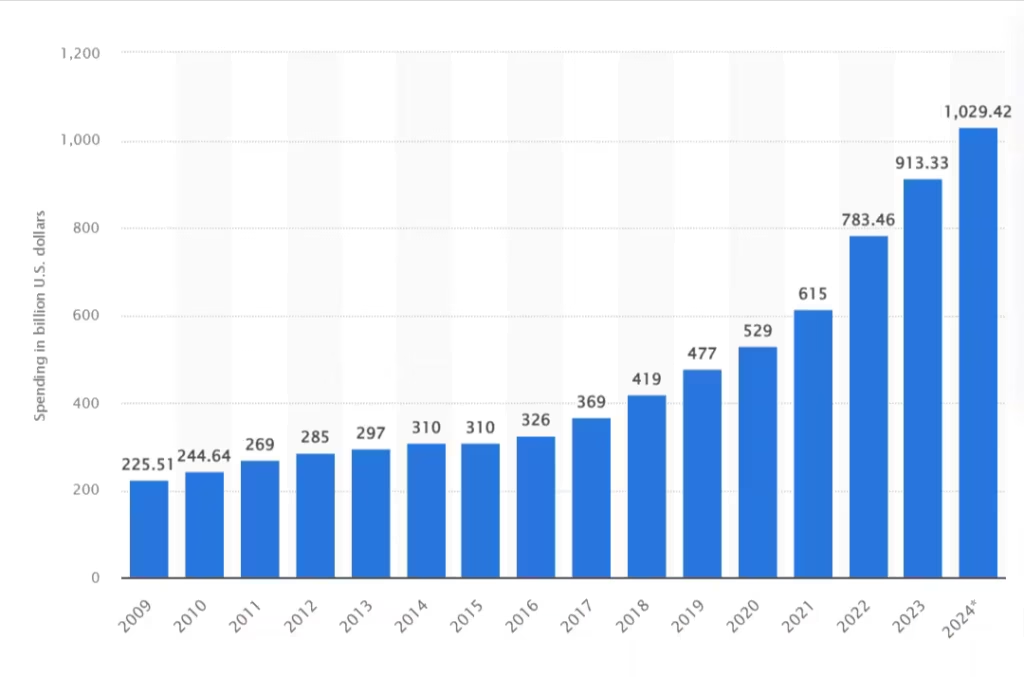
    Every year companies spend heavily on their software development projects. According to Statista, IT spending on enterprise software development is expected to reach $1029.42 billion by the end of 2024.

    Common software KPIs to avoid

    Reducing these costs and improving efficiency needs due diligence prioritizing what software development KPI metrics to track.

    Here are some that you need to avoid for improved efficiency.

    Code Simplicity

    Code simplicity is an understanding of the code. Basically, it is how developers perceive code as easy to maintain or modify. While simple code is easy to maintain, some intricacies make it redundant as a software development metric.

    For example, code simplicity is based on the developer’s perception, which can differ based on the developer’s experience and skill.

    Another major issue with code simplicity is overachieving. Developers strive to simplify code without solving key issues impacting software performance and security.

    Code stability

    Many people mistakenly believe that code stability means not making any changes. This myth goes against the principles of agile practices that prioritize continuous improvement.

    Fact of the matter is it limits the number of changes and bugs. Yes, code stability does not always support the rapid changes required for your system according to a dynamic market.

    Placing too much emphasis on code stability can prevent helpful updates and improvements, hindering advancements for your system. So it is best to avoid these software development metrics.

    Sprint burndown

    Sprint burndown chart is often used in Scrum to monitor the remaining work in a sprint, but unlike other software development KPIs, it has limitations.

    IT narrows to focus on short-term goals and can result in negative outcomes.

    For example, if you focus too much on sprint burndown, you may pressurize your team to finish all tasks by the sprint’s end. Too much pressure can lead to faster development, but quality suffers. So, you should avoid this metric.

    Release burndown

    Release burndown chart keeps track of the remaining work for each sprint in a release cycle. While it provides a bigger picture than the Sprint Burndown, it can be misleading.

    If the scope of your project changes frequently, it can’t accommodate all the changes or additions to the backlog over time.

    Relying heavily on this metric can lead to wrong perceptions of progress and deadlines, forcing teams to rush or inflate estimates.

    This distracts them from focusing on delivering actual value and effectively meeting customer needs.

    Why should you track software KPIs?

    Software development KPIs hold the key to the most important parameters for measuring the progress, quality, and value of a project.

    They offer a quantifiable means to evaluate the effectiveness of the development process so that every code commit and sprint is in line with the overarching business goals.

    KPIs reflect performance in achieving business goals and help teams adapt to them. It is always easy to see progress through these metrics after projects or sprints.

    Based on the low-performing metrics, business processes or workflows may need to be adjusted to correct course and optimize the development lifecycle.

    KPIs provide context for budgets, timelines, and development issues.

    They help reflect the minimum amount of time and money needed to deliver high-quality software and the existence of possible bottlenecks or areas for improvement.

    Team members and management are able to manage the time and budget for the projects efficiently.

    They become very helpful tools for setting goals and planning tasks. Furthermore, they act to monitor overall performance.

    By incorporating KPIs in software development, they can maximize efficiency, quality, and return on investment.

    What types of KPIs should you focus on?

    Software development teams should monitor key performance indicators (KPIs) to assess and enhance performance. Monitoring KPIs helps identify areas for improvement and improve project success.

    The primary KPI categories include:

    • Efficiency KPIs gauge the speed and efficiency of the software development process.
    • Quality KPIs aim to uphold high standards and pinpoint areas for enhancement in the software product.
    • Performance KPIs concentrate on the software’s technical performance elements directly influencing the user experience.
    • User Engagement KPIs help understand how users engage with the software and spot opportunities to enhance the user experience.
    • Financial KPIs aid in comprehending the economic impact of the software development endeavors and ensuring alignment with business objectives.

    FAQs

    Q1.What is a software development KPI?

    A software development KPI is a metric used to evaluate the effectiveness and success of software development processes in reaching business objectives.

    Q2.What are the most important KPIs for software development?

    The most important KPIs for software development are Lead Time, Deployment Frequency, Change Failure Rate (CFR), and Mean Time to Recovery (MTTR).

    Q3.What software should I get for KPI tracking?

    For effective KPI tracking, use software solutions like Jira for task management, Datapad for data visualization, and Pluralsight for skill assessments and progress tracking.

    Track your key software development metrics with Zennaxx

    Tracking key performance indicators (KPIs) in software development is crucial as it provides hard data to share with teams and stakeholders.

    These metrics allow you to evaluate the performance of your team, diagnose problems, refine processes, measure the developer experience, or acknowledge a job well done.

    Optimizing software development needs effective tracking of KPIs to gain insights into processes, workflows and environment configurations that impact outcomes.

    You can’t afford to just keep your project in auto pilot mode because one small error can break the entire process flow causing massive issues.

    However, tracking software development KPIs extensively is also challenging and requires massive effort.

    This is where Zennaxx can help you with software development KPI tracking solutions tailored to your business needs. Get your estimate now and track every KPI efficiently.

    Read Also:

  • What Are The Factors Affecting The Cost Of Mobile App Development?

    What Are The Factors Affecting The Cost Of Mobile App Development?

    Businesses today are increasingly mindful of their investments and expenses to ensure better returns and resource consumption. While expenses like marketing campaign budgets are negotiable, mobile app development costs are non-negotiable.Indeed, an application has transitioned from a “nice-to-have” to a “must-have” for businesses. Users now prioritize easy-to-use, accessible, and interactive applications, acknowledging that such apps can be expensive.

    Nevertheless, these applications can be considered investments, as they can yield significant ROI and enable businesses to reach a broader audience. Understanding the factors influencing app development costs can help businesses save a considerable amount of money.

    By planning the application and its functionality effectively, costs can be reduced. To learn more about the key factors affecting the cost of mobile app development, continue reading this blog post.

    Estimating the cost of mobile app development

    The price of building a mobile app may vary significantly based on a variety of variables. Exactly how much does it cost to develop an app?

    According to Clutch, a typical software costs $171,450 to develop, but an MVP (Minimum Viable Product) may be built for $10,000 to $20,000.

    The wide variation in app development prices is due to various variables, including the product’s complexity, the density of its features, the vendor’s location, the system software or platform, and others. To figure out how much an app will cost to create, we’ll look at all factors in more depth.

    According to a report, mobile users consume over 50% of the total internet traffic. and over double the amount of time as desktop users.

    On average, consumers download 30 apps each month, and mobile applications account for 57% of all digital media consumption.

    Factors That Affect The Cost Of The Mobile App Development

    The App’s Type and Size

    Depending on business requirements, different types of applications can be chosen. They can be categorized into three types based on functionality:

    Basic/Simple apps

    These applications are developed using a single platform and consist of standard user interface components for limited functionalities. They primarily provide information to users and have minimal usage.

    Examples include calculators and weather apps. Basic apps are typically small in size and may not require backend development or API integration.Basic app development cost: $10,000 – $15,000

    Data-driven app

    Calendars, maps, and weather solutions are all examples of data-driven applications that receive a large amount of data, evaluate it, and share this with users.

    These types of apps have dwindled in usefulness over the past several years and are now often launched as side effects. How much would it cost to build a data-processing application?Data-driven app development cost: $15,000 – $20,000

    Social network app

    Social networking applications – Facebook, Instagram, LinkedIn, and so on – are self-explanatory. They must manage millions of interactions, conversations, and the sharing of information between individuals. All this requires a robust infrastructure service and a higher initial investment. How much would it cost to develop a social networking application?

    Social network app development cost: $60,000 – $300,000

    Apps with user authentication and personalized data

    An authenticating app is like a loyalty app in that users must log in to access certain features. The program saves and syncs user data across devices. This is a more complex, and therefore more costly, project which will necessitate user monitoring.Authentication app development cost: $40,000 – $80,000Example: Loyalty app by Starbucks

    eCommerce app

    Amazon, Alibaba, and other markets provide eCommerce applications. They need a broader range of services, including registration process, human engagement, catalogs, category pages and details, and payment methods. We offer a price estimate for a simple eCommerce app.

    Simple eCommerce app development cost: $60,000 – $300,000

    Example:Amazon

    Moderate apps

    These applications offer more features and functionalities compared to simple apps, such as personalized user experiences andpayment options. They often require API integration and involve advanced data processing. Examples include e-commerce, news, and social media apps. As they are developed for multiple platforms, moderate apps are of medium size.

    Complex apps

    These applications have intricate user interfaces, require real-time data processing, and offer extensive functionalities. They often integrate third-party services. Examples include ride-sharing, food delivery, and enterprise mobile apps. Due to backend programming requirements, complex apps are typically large in size.

    Complex app development cost:$50000-$500000

    The choice of application type depends on the specific requirements. Many startups opt for basic or moderate apps. The complexity of the application significantly influences the cost of mobile app development, as higher functionalities entail increased time and cost.

    Operating systems for devices – iOS vs Android

    The choice of operating system significantly impacts the cost of mobile app development, including maintenance expenses. Here are the cost considerations for both iOS and Android platforms:

    Android

    Android stands out as one of the most popular operating systems among app developers for several reasons:A. Apps are highly compatible with various devices and screen sizes.B. Google Play Store charges a one-time registration fee, which is comparatively lower than Apple App Store fees.

    C. Android app developers often charge less than iOS developers, as expertise in Java or Kotlin is sufficient for development.

    However, there is a significant drawback to developing for Android. These apps require extensive testing and optimization across various devices and operating system versions due to the platform’s wide compatibility range.

     iOS

    Businesses often explore iOS apps due to their compatibility with a limited number of devices, making it easier to optimize performance. Nonetheless, iOS apps tend to be subtly more expensive than Android apps due to the following reasons:

    A. The need for Mac hardware, enrollment fees in the Apple Development program, and compliance with stringent App Store review processes.B. iOS app users typically spend more on in-app purchases compared to Android users.

    Alternatively, businesses can opt for cross-platform apps to mitigate the challenges of choosing between iOS and Android. These apps offer a cost-effective solution by utilizing a single codebase deployable across multiple platforms.

    Devices and Platforms

    The cost of mobile apps depends on the platform and device they’re developed for. Platforms like Android, iOS, or cross-platform optionsall affect development costs.

    Developing for Android means dealing with various device types, including TVs and watches, which adds complexity and cost. iOS apps, on the other hand, are limited to iPads and iPhones. But they require learning Swift, Apple’s programming language and following strict rules, making them more expensive. Device type and generation also matter.Generally, Android apps are cheaper to develop than iOS ones. Knowing these factors helps businesses plan and budget for app development effectively.

    The Development Team’s Structure and Location

    Hiring an excellent team to build a mobile app certainly comes at a price. However, this expense is crucial, as the right team can help reduce the overall cost of app development by selecting the ideal framework, platform, and ensuring compliance for user security.

    Businesses have the option to choose a freelance app developer for end-to-end app development at a budget-friendly price, or they can opt for a team with dedicated personnel for each stage of development. While selecting a team may increase development costs, having a reliable team can yield desirable results within set timelines.

    In addition to team structure, the team’s location also impacts app development costs. If the team is based in the same office or city, it becomes easier to manage timelines, which further influences the determinants of mobile app development costs.

    Mobile Application UI/UX

    The look and feel of your application are paramount to customer engagement. This aspect, often defined as User Interface (UI) and User Experience (UX), is the cornerstone of a well-made application.

    As the saying goes, “the first impression is the last impression.” Therefore, the design of the UI, logos, content flow, wireframes, and ease of usability are crucial and can be achieved by hiring an expert in the field. UI/UX designers‘ pricing varies based on their experience, the complexity of the applications, and the design elements involved.

    App Security Costs

    If there is one area where a business should not cut costs or second-guess their decision, it’s app security. Undoubtedly, it is the most vital component as it protects the app and its users against security threats, data breaches, and fraudulent activities.

    According to a recent report, smartphones have an average of 80 installed applications. Improperly secured applications can pose potential risks to users. Today, people store crucial data on their phones for better accessibility, making it crucial to have the right security measures in place.

    While implementing excellent security measures may impact the pricing of app development, it ensures the safety of user data, which is of utmost priority.

    Maintenance and Marketing costs of an app

    Maintenance is pivotal for ensuring the smooth functioning of an application, involving checking for bugs, security threats, and overall performance.

    While implementing excellent security measures may impact the pricing of app development, it ensures the safety of user data, which is of utmost priority.

    Functionalities and Features of an app

    Functionalities and features are key factors in mobile app budgeting. Apps with limited functionalities, such as standard user interface components, are generally less expensive than those requiring access to features like GPS or camera permissions. These additional functionalities contribute to the overall cost of your mobile application.

    Choosing the business model

    Businesses select the type of applications based on their specific requirements, target users, products or services, and app usability. These factors directly affect both the timeline and cost of mobile app development. For instance, simple apps designed for internal communication or information sharing tend to be less expensive compared to e-commerce apps. In summary, the type of business and its desired outcomes significantly influence the cost of app development.

    The price of developing a mobile app

    The cost of developing a mobile appvaries depending on factors such as complexity, platform, and functionalities. It typically starts from $5000 for basic apps and can go up to $500,000 for complex and feature-rich apps. However, the pricing also depends on the location of the development team and their charges.

    Conclusion

    Today, businesses prioritize cost-effective applications that are user-friendly, engaging, and aligned with their goals. Understanding the various factors influencing mobile app development enables businesses to strategically plan their app, considering its complexity, functionalities, and essential components necessary for excellence.However, having the right team of experts is crucial, as they can assist businesses in allocating their resources wisely based on their specific requirements. With the guidance of skilled professionals, businesses can ensure optimal investment in their applications, leading to successful outcomes.

    At Zennaxx, our expert team has assisted numerous businesses in building mobile apps through adequate planning, research, and innovative, customer-centric approaches. Leveraging our experience and expertise, we can help you reach millions of app users and capitalize on the potential of mobile apps as the best platforms to connect with your customers.

    FAQs

    Q1.How does the complexity of an app affect its development cost?

    The complexity of the application directly influences the cost of app development. Straightforward applications with minimal requirements require less time, resources, and effort to build. Conversely, applications with more requirements and added functionalities typically demand more time, cost, and expertise to develop. Apps that are quicker to build result in lower costs. Therefore, the complexity of an app can significantly impact its development cost.

    Q2.What are the key considerations for estimating app development costs?

    Factors such as the complexity of the app, platform, design, composition of the development team, security, maintenance, functionalities, updates, quality assurance, and integration are key considerations for estimating app development costs.

    Q3.How do you determine the cost of developing an app?

    Clarity regarding the app’s requirements, functionalities, integrations, APIs, complexity, preferred platform, development team charges, and marketing budget is essential for determining the cost of developing an app.

  • An Ultimate Guide to Ecommerce Website Costs for Your Business 

    An Ultimate Guide to Ecommerce Website Costs for Your Business 

    Online buying is now etched in the human psyche and has become synonymous with “convenience.” You can buy almost everything online these days, which is why more and more businesses are looking to go online.

    The global eCommerce market is set to reach $53.27 trillion by 2032, growing at a CAGR of 14%. So it does make sense to build an eCommerce website for your business.

    However, a major concern is the cost if you are a brick-and-mortar store looking to digitize your business.

    Yes, eCommerce website costs can be higher if you don’t plan well. However, most businesses fail to comprehend how to manage this cost.

    What are the components of eCommerce development cost, and how can you reduce it?

    This article will give you all the answers needed to calculate the eCommerce website costs.

    Benefits of Investing in ECommerce Website Development

    Investing in eCommerce website development can bring several business benefits. Some key business benefits of eCommerce website development are:

    • Admin capabilities: Spring comes with features and tools that make managing and administering applications easier.
    • Properties files: It allows the use of properties files for easy configuration and management of application settings.
    • Type-safe configuration: Spring supports type-safe configuration, enabling developers to configure applications more intuitively.
    • Web development: The framework offers a comprehensive toolkit for building web applications.
    • Application listeners and events: Spring supports event-driven architecture, allowing developers to create applications that respond to events.

    Things to Consider Before Creating an Ecommerce Website

    Whether you want to build a t-shirt eCommerce brand offering cool prints for your customers or simply create an online thrift store, multiple factors contribute to your success.

    These include the type of online store you need for your business, products, and budget.

    What type of online store are you expecting to have?

    Choosing which type of online store to develop depends on the target market, products, and business model. Some of the types that you can consider for your online eCommerce store are,

    • Individual brand websites are online stores that sell products from a single manufacturer or service provider.
    • Online eCommerce or retail stores that bring together multiple vendors on the platform for users to connect and transact.
    • Niche market stores focus on selling specific products in categories such as pet supplies, groceries, and men’s grooming products.
    • Online subscription stores provide recurring product deliveries to customers who subscribe to specific services or products like beauty boxes.
    • Digital product stores allow you to sell online assets like apps, ebooks, music, and software.
    • Services stores help you sell access to online services like freelance marketplaces, courses, and travel bookings.

    Which online stores you want to develop depends on how you sell your product or service—“Online or Offline.”

    Do you plan to sell your products online? Or do you already have a brick-and-mortar store?

    Whether or not you plan to build an online store business from scratch impacts ecommerce website cost.

    Logistics constraints and operational obstacles are reduced if you already have a brick-and-mortar business and want to digitize it.

    This means you will focus more on building the eCommerce online store rather than overseeing the entire operation, including offline activities.

    For example, your procurement is sorted if you are a T-shirt printing business with a brick-and-mortar retail store.

    But you are a 100% online eCommerce store offering customers print-on-demand t-shirts.

    In that case, you need to manage everything from procurement of raw materials to finding vendors and handling online listings.

    This means you will have budget constraints that affect eCommerce website costs.

    What is your ecommerce development budget?

    Every organization spends more than half of its project budget on development activities. This is why you need an eCommerce development budget.

    ECommerce development costs depend on factors like the complexity of features, project scope, stacks required, and specific business goals.

    Here is a breakdown of your expected expenses for each aspect of eCommerce websites:

    • Development costs, including front-end, back-end, and third-party integrations, contribute heavily to the cost of an eCommerce website. Ecommerce development costs can reach $135,000 or more.
    • The website design budget will include the cost of creating responsive designs and custom graphic visuals.
    • Integration of payment gateways , inventory management, and other essential functionalities also need fund allocation.
    • Testing costs of eCommerce websites also contribute to the overall costs.
    • Ensuring mobile responsiveness can cost you a UX in the range of $2000 to $30000.
    • Marketing costs also contribute to the eCommerce website cost, which includes PPC advertising, copywriting, SEO, and other services.

    This is just an overview of the breakdown, but other factors must be considered. For example, what shipping options do you offer for your eCommerce business? These do affect the cost.

    What are your shipping options?

    If you are setting up an eCommerce online store, you must consider how you will ship goods to customers. It takes some time to determine if you can fulfill shipping requirements.

    Would you instead hire someone else to do the shipping or do it yourself?

    Also, should customers worldwide be able to buy from your site?

    You decide what you can do. But you need to consider its cost! Shipping adds to the already costly development cost.

    Which option you choose for shipping does impact the cost of an eCommerce website.

    How Do You Calculate Ecommerce Costs?

    Setting up an eCommerce website can be costly, with expenses varying based on many factors. Launching an eCommerce store can range anywhere from a hundred to a hundred thousand dollars. But all of it boils down to the below factors.

    Infrastructure Costs

    Creating an internet shop requires incorporating aspects related to expenses.

    Now let’s delve into these factors,

    Software costs

    The pricing of eCommerce solutions can differ based on their features, service offerings, and software categories. Selecting the platform is vital when starting a store.

    Below are some eCommerce platforms to consider.

    BigCommerce

    BigCommerce stands out as an eCommerce platform recognized for its easy-to-use interface and faster setup.

    Its user-friendly layout empowers newcomers to craft visually appealing websites. You can also leverage efficient shop pages from BigCommerce to streamline product showcasing and order handling.

    The headless options from BigCommerce offer businesses versatility. It allows integration with CMS and other systems for advanced capabilities.

    Magento

    Magento is a reliable and feature-rich platform that offers both on-premise software and externally hosted solutions.

    It supports the ability to tailor and customize it entirely, but technical expertise is a requirement with Magento.

    Magento has a steep learning curve, and being flexible may challenge less seasoned users. It requires significant effort and knowledge from experienced users to manage Magento.

    Shopify

    Shopify stands out among the other eCommerce solutions with a simple interface and drag-and-drop functionality.

    It is an ideal option for beginners. However, as businesses advance and need more sophisticated features, BigCommerce may be a better choice.

    Shopify development allows you to set up a simple website quickly, but you may need additional coding or integration of third-party apps for advanced functions.

    Domain name costs

    One of the most common eCommerce website costs is domain name registration.

    Renewing a domain name is a recurring annual expense, about $2-20 per year. It is paramount to keep track of your costs as your business expands.

    Domain renewals are one steady fee you need to consider. Include this and other operating costs like transaction fees, subscriptions, storage of your inventory, and fulfillment.

    Here are some of the critical domain name registration services and their prices.

    Domain Name Registrar Price for .com Domain (First Year) Price for .com Domain (Renewal) Price Additional Services
    Namecheap $8.88 $13.98 Free Web hosting, email, SSL certificates
    GoDaddy $11.99 $17.99 $7.99/year Web hosting, email, SSL certificates, website builder
    Domain.com $9.99 $14.99 $8.99/year Web hosting, email, SSL certificates, website builder
    Google Domains $12 $12 Free None
    IONOS $1 $10.00 $0.99/month Web hosting, email, SSL certificates, website builder
    HostGator $12.95 $14.95 $12.95/year Web hosting, email, SSL certificates, website builder
    Bluehost $12.99 $17.99 $0.99/month Web hosting, email, SSL certificates, website builder
    Network Solutions $10.99 $14.99 $7.99/year Web hosting, email, SSL certificates, website builder
    Register.com $12.99 $14.99 $9.99/year Web hosting, email, SSL certificates, website builder
    1&1 IONOS $1 $10 $1/month Web hosting, email, SSL certificates, website builder

    Ecommerce hosting

    Now that your domain name is locked down, it’s time to decide on a website host. Finding a hosting service provider is crucial if you want total control over your hosting environment.

    Depending on a hosting service’s traffic and technical needs, you must pay $80 to $730 or more.

    More bandwidth, backups, and security features can add up to the cost of an eCommerce website. Not to mention the time spent maintaining the server.

    SSL certificate costs

    SSL certificates are your security haven! It helps you secure the communication between your website server and the browser.

    You can buy SSL certificates from the leading certificate authority(CA) by creating a certificate signing request(CSR).

    This CSR will have all the details of your organization, which CA will verify to issue an SSL certificate, which you can install on your eCommerce website. An SSL certificate can cost you $20-$70 per year.

    Payment processing costs

    When setting up payment processing for your eCommerce business, you must consider the costs: the various payment gateway options, transaction fees, and additional charges affect your bottom line.

    Payment Gateway Transaction Fee Additional Fees
    PayPal 2.9% + $0.10 per transaction None
    Stripe 2.9% + $0.30 per transaction None
    Authorize.net 2.9% + $0.30 per transaction $25 monthly fee

    Some factors considered while choosing a payment gateway include transaction fees, additional fees, currency and region support, and conversion rates.

    ECommerce businesses can optimize their payment processing expenses and improve their bottom line by carefully reviewing the payment gateway options and associated costs.

    ECommece Website Costs Based on Developer type

    Developer-based costing depends on many factors, including experience, developer skill set, and what type of engagement model you choose.

    Outsourcing companiesand freelance developers use different models to offer development services, including hourly, monthly, and fixed costs.

    Another essential factor to consider is how you plan to use the developers. For example, hiring developers is redundant if you plan to make a DIY eCommerce website, and you will need an all-in-one platform like Shopify.

    Hiring an eCommerce website developer to freelance can be cost-effective, but specific limitations exist.

    A significant limitation of hiding freelancers is the need for more quality control. Freelancers may be working on multiple projects, which can lead to divided attention on your projects.

    However, considering the pricing, a freelancer can cost you $10,000 to $50,000 or even more. On the contrary, you can leverage an eCommerce web development agency for comprehensive services.

    From design, development, and deployment, these agencies offer services costing you between $15,000 and $3,50,000.

    Size of the website

    Prices for an eCommerce website differ according to its extent and complexity. This means you spend less if the website is small but more when complex features exist, and you can expect higher costs.

    Small websites typically cost between $1,000 and $10,000. Medium eCommerce websites cost between $10k and $50k. The cost can increase to $50k and above for more complex and large websites.

    You can calculate the total costs using website cost calculators such as Shopify, Bigcommerce, Wix, or Squarespace.

    These calculators leverage several parameters to calculate eCommerce website costs, including product catalog, specific features, and traffic level.

    Type of design and development

    The cost of developing an eCommerce website can vary significantly depending on the type of design and development required.

    Options include using pre-designed themes and plugins or opting for custom development.

    If you use pre-designed themes and plugins, the cost can range from $5,000  to $1,50,000. It includes a pre-designed theme with customization and the integration of various plugins for additional functionality.

    On the other hand, if you choose custom eCommerce website development, the cost can range from $1,500 to $20,00,000 or more.

    The price depends on the complexity of the design and functionality required.

    Design Type Cost Range Features Included
    Theme Based $5,000 to $150,000 Pre-designed theme with some customization, integration of various plugins.
    Custom Development $1,500 to $20,000,000 or more Unique design, customized functionality, integration with third-party applications, and advanced features.

    ECommerce Platform Cost

    Shopify, Magento, and WooCommerce are eCommerce platforms with various price levels. Prices could be as low as $30/month for an essential service.

    More complex services from these platforms cost more. Here is the price range for Shopify and BigCommerce

    • Shopify- 29−299 per month
    • BigCommerce- 29.95−299.95 per month

    Customization Cost

    Customization involves tailoring the eCommerce site to meet specific functional requirements.

    This includes theme customizations, features, and unique integrations to add advanced functionalityto your eCommerce website.

    For example, you can integrate third-party apps to enable multi-language support on your eCommerce website.

    Basic customizations cost between $1000 and $10,000, but advanced customizations cost up to $30,000 or higher.

    Customization Cost

    Payment Gateway Integration

    Online eCommerce stores can use payment gateways to securely process payments. There are also costs included in the account setup fee and fees charged per transaction.

    Each provider differs in what they charge for setup fees, as it can be between $0-$500.

    Usually these make up between one and 3.5% rate commissions. They might also provide instruments to perform settlements and payments themselves.

    Content Creation Cost

    Copywriting plays a vital role in developing content for eCommerce websites.

    Copywriters craft product descriptions, advertising, and marketing copy to capture attention and convince clients to take desired actions.

    Product descriptions provide targeted information about merchandise, helping clients make informed decisions.

    Blog posts offer valuable insights, educate readers, and establish thought management. Marketing copies promote products or services on your eCommerce website.

    The cost of copywriting offerings varies depending on content type, duration, and complexity. Apart from copywriting, you must also invest in creating graphics and visuals for your website.

    Prices for copywriting and graphics creation can vary across service providers.

    Third-party integrations

    Third-party integrations for eCommerce website development can vary depending on the complexity of the services you want to integrate.

    For example, if you are integrating AI-based technology into your website, it will cost more.

    Third-party integrations can cost from $20,000 to $25,000, and some services may even begin at $1,000.

    Such integrations can be plugins, app extensions, or third-party applications that help add functionalities to the eCommerce website.

    Mobile Responsiveness Cost

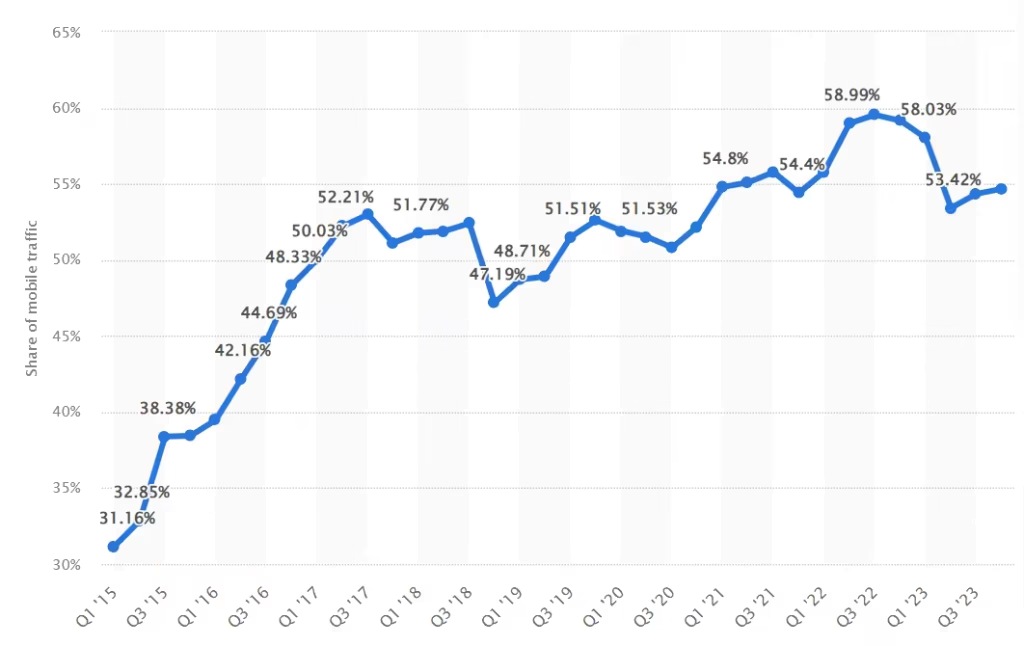
    Mobile traffic is one of the major contributors to your eCommerce platform’s overall visitor count. Statista reports that half of web traffic comes from mobile, making smartphone responsiveness a key aspect.

    Your eCommerce website needs to be mobile-friendly and designed to provide a consistent experience across devices.

    Global Mobile Traffic Statistics

    Ensuring a mobile-responsive website can cost you between $500 and $2,000. When you already have an existing site.

    But for a basic blog or portfolio site, the cost of mobile responsive designs ranges from $300 to $500.

    SEO Optimization Costs

    SEO optimization for an eCommerce website enables businesses to improve visibility and conversions. It includes the implementation of different strategies that will improve organic search rankings for your eCommerce website.

    You can optimize SEO by ensuring product images added are relevant to keywords along with title tags, meta descriptions, and well designed sites.

    ECommerce SEO costs vary based on the service provider, location, target audience, and specific requirements.

    Prices for eCommerce SEO range from $750 to $5000 monthly for most small-to-mid-sized businesses.

    However one-time projects cost between $1000 to $30,000. ECommerce SEO consultants’ hourly rates range from $100 to $300 per hour.

    Ready to Build Your Online Store?

    Let’s Create Something Amazing Together with Our E-commerce Development Services!

    Maintenance and Support costs

    Maintaining the performance of your eCommerce website is crucial to ensure there are no disruptions.

    For example, if you sell limited edition shoes online and you decide to have an end-of-season sale to clear stocks, a poorly maintained website will not hold against massive traffic.

    So, you need a well maintained eCommerce website and will have to spend on effective maintenance.

    The cost of maintaining an eCommerce website depends on multiple factors, like the website’s size, the complexity of the platform, the number of integrations, and the level of security and performance required.

    Here are some eCommerce website maintenance costs:

    Small eCommerce websites

    • Website maintenance: $250-$500 per month
    • Security and protection: $0-$100 per month
    • File and database backups: $0-$50 per month

    Medium eCommerce websites

    • Website maintenance: $500-$2,500 per month
    • Security and protection: $0-$100 per month
    • File and database backups: $0-$50 per month

    Large eCommerce Websites

    • Website maintenance: $2,500-$10,000+ per month
    • Security and protection: $0-$100 per month
    • File and database backups: $0-$50 per month

    Enterprise eCommerce websites

    • Website maintenance: $600-$1,000 per month
    • Security and protection: $0-$100 per month
    • File and database backups: $0-$50 per month

    Conclusion

    Building an eCommerce website can be costly because it has several components, including design, maintenance, SEO, etc.

    The cost of each component adds to your eCommerce website costs, and you need to strategize the entire development process.

    You also need to factor in the costs of domain name registrations, security costs, and expenses of creating a mobile responsive site.

    However, you need a reliable eCommerce development partner to optimize costs and create a high-performance site for your business.

    Zennaxx can help you build such eCommerce websites at minimal cost.Get an estimate nowof your eCommerce website cost.

  • What is Cloud Migration? Strategy, Process, and Tools

    What is Cloud Migration? Strategy, Process, and Tools

    A cloud migration strategy is a structured approach for transitioning workloads to the cloud. The most common models are the “6 Rs” or “7 Rs,” which define key migration paths: Rehosting (lift and shift), where applications are moved with minimal changes; Replatforming, which involves slight modifications to leverage cloud capabilities; Refactoring or Rearchitecting, which redesigns applications for cloud-native use; Repurchasing, where legacy applications are replaced with cloud-based solutions such as SaaS; Retiring, which decommissions outdated applications; and Retaining, where certain workloads remain on-premises due to compliance or technical constraints.

    The migration process typically includes five main phases. Assessment involves analyzing the current infrastructure, applications, and data to evaluate cloud readiness and set priorities. Planning follows, with the creation of a detailed roadmap, strategy selection, and identification of dependencies and risks. In the Migration Execution phase, workloads are moved using selected tools and strategies with minimal disruption. Testing ensures that applications and data function correctly in the new environment. Finally, Optimization focuses on improving performance, cost-efficiency, and security, along with establishing ongoing management practices.

    Various tools support cloud migration and fall into three main categories. Public Cloud Provider Tools include native solutions like AWS Migration Services, Azure Migrate, and Google Cloud Migration Tools, offering integrated features for assessment, migration, and optimization. Third-Party Tools, such as Carbonite Migrate, CloudEndure Migration, and RiverMeadow, provide cross-platform support, automation, and low-downtime migration. Open-Source Tools, like Terraform, enable infrastructure-as-code, supporting automated and customizable cloud resource provisioning across multiple platforms.

    What are the types of cloud migration strategies?

    Here are the six common types ofcloud migrationstrategies that organizations can consider when planning their move to the cloud.

    They know it as the six Rs: rehost, re-platform, repurchase, retain, retire, and refactor.

    Each type has a unique strategy for transferring data and applications.

    With this detailed information, you can make the right decisions about migrating to the cloud.

    Rehosting (“lift and shift”)

    Rehosting means moving your current environment from on-premises hosting to the cloud while keeping most of the configuration unchanged.

    It’s a quick way to achieve ROI as you move an exact copy of your stack to the cloud. This approach is appropriate for companies with a conservative culture or that lack a long-term cloud strategy.

    Replatforming

    Replatforming is similar to rehosting in that it depends on making changes to optimize your landscape for the cloud.

    The core architecture remains unchanged, but minor changes are made to improve performance.

    Replatforming is ideal for conservative organizations that want to build trust in the cloud while improving system performance.

    Repurchasing

    Repurchasing means moving applications to a new, cloud-native product, typically a SaaS platform such as Salesforce.

    This could mean getting less familiar with the current code, but it can be economical, mainly if you come from a highly customized legacy environment.

    Refactoring

    Refactoring, or rearchitecting, is rebuilding applications from scratch to take advantage of cloud capabilities that are not currently available.

    This is triggered by the demand for cloud auto-scaling and serverless computing features. Refactoring is the most expensive option but aligns well with future cloud versions.

    Retiring

    After you evaluate your application portfolio for cloud readiness, some applications may become obsolete.

    Turning them off can result in significant savings, potentially strengthening the business case for other migration-ready applications.

    Retaining

    Cloud adoption may not be feasible in certain situations. Compliance requirements or a lack of readiness for specific applications may cause migration delays.

    Organizations can revisit cloud computing later and prioritize migration based on business needs.

    Each type of migration has its own set of benefits and challenges. Knowing your organization’s needs and objectives can help you select the best cloud migration strategy.

    Connect to the best cloud migration strategy consulting to better understand.

    Adaptive Software Development Process

    Phases of Cloud Transformation

    The cloud transformation process is commonly divided into five stages: prepare, plan, migrate, operate, and optimize. These phases provide a complete system for migrating workloads and data to the cloud, reducing disruption while increasing benefits.

    Prepare

    Before launching a cloud migration, you must clearly define your business objectives. These goals range from increased agility and cost savings to improved performance and scalability.

    An initial assessment of the current IT infrastructure makes it easier to understand the resources available and what needs to be migrated.

    Building a complete business case for each application to be migrated is also essential, outlining the expected total cost of ownership in the cloud versus the current setup.

    Cloud cost calculators can help you predict future costs by incorporating storage, computing resources, instance types, operating systems, and specific performance and networking needs.

    Plan

    Once your business objectives are set and the capacity for cloud migration is evaluated, you can create a detailed migration plan.

    This plan should include a roadmap indicating which workloads will be migrated and in what order.

    This phase should also include decisions about the preferred cloud architecture and any necessary changes to existing applications or data.

    It is also essential that you meet migration-related compliance and security requirements.

    Evaluating the environment and determining migration factors, such as compliance requirements and important application data, can help identify the data that needs to be migrated and the migration strategy that should be used.

    Migrate

    Data, applications, and workloads are moved to the cloud during the migration phase.

    Several ways exist, such as rebuilding, refactoring, or lift-and-shift applications.

    Data migration is a necessary process that must be carefully managed to avoid disruptions to business operations.

    Before moving on to migrating other workload elements, each one should be tested to ensure it works in the new environment.

    It is also essential to synchronize changes to the source data during the migration process.

    Operate

    You can enter the operating phase once workloads are successfully migrated to the cloud.

    This involves managing workloads in the cloud environment, monitoring performance, managing resources, and maintaining security and compliance.

    Real-time monitoring contributes to data security and regulatory compliance. You should focus on meeting performance and availability benchmarks to achieve their goals.

    Discover the power of our Cloud Migration Services

    Embrace efficiency, scalability, and innovation. Let’s take your business to new heights.

    Optimize

    The final phase focuses on optimizing the performance and efficiency of the cloud environment.

    This includes optimizing cloud operations, identifying cost-cutting opportunities, and using cloud-native features or services to improve performance.

    Continuous optimization is essential, as you can strive to improve cloud operations and increase business value over time.

    Understand the critical stages of cloud migration to reduce risks and disruptions and maximize the return on investment.

    These steps can help you transition smoothly to the cloud and achieve your desired business outcomes.

    What are the benefits of migrating to the cloud?

    Businesses can benefit from cloud migration by saving money, increasing flexibility, and improving scalability.

    It helps access data and applications from anywhere with an internet connection, promoting collaboration and remote work capabilities.

    Let’s understand the benefits of cloud migration.

    Improved Security

    Cloud migration gives powerful security features that often beat traditional network systems.

    The “shared responsibility” concept used in cloud settings ensures data privacy and security.

    Cloud platforms such as Amazon have prioritized security from the start, giving users confidence in the safety of their data.

    Scalability

    You can quickly scale your resources up or down in response to fluctuating IT demands and organizational needs.

    Cloud services provide flexible adjustments and give businesses efficient chances to change market conditions, unlike traditional solutions that require long-term contracts and fixed infrastructure.

    Scalability improves your resources and reduces your organization’s costs by removing the need for excessive infrastructure maintenance.

    Cost Efficiency

    Cloud migration also reduces costs by eliminating the expenses of maintaining on-premises data centres.

    You can optimize your IT budgets and allocate resources more efficiently by using pay-as-you-go models and reducing overhead costs.

    Studies have shown that migrating to the cloud can result in significant savings on operational expenses, energy costs, andIT maintenance, allowing organizations to reinvest those funds in core business activities and innovation initiatives.

    Smooth Integration

    Cloud migration helps with the easy integration of systems and services. It increases overall operational efficiency and productivity.

    Moving to the cloud can provide several benefits, such as smooth processes, shared systems, and improved teamwork.

    Cloud environments facilitate automatic updates and infrastructure maintenance, reducing the burden on IT staff and performance.

    Accessibility

    Your employees can now work from anywhere, anytime, and on any device, providing universal access to data and apps.

    This accessibility removes geographical limits and enables remote collaboration, flexibility, and productivity.

    Cloud services also provide monitoring, backup, and logging capabilities for every member’s data availability and facilitate disaster recovery efforts.

    Decreased Footprint

    Cloud migration helps to support environmental sustainability by improving resource utilization and lowering energy consumption.

    Unlike traditional on-premises data centres that require constant energy consumption, cloud environments dynamically scale server capacity based on demand.

    This consolidation reduces IT operations’ overall environmental footprint, mitigating their impact on the planet and aligning with corporate sustainability objectives.

    Furthermore, cloud providers frequently invest in renewable energy sources and energy-efficient technologies, which reduces the environmental impact of cloud computing.

    Ready to extend your business with cloud migration?

    Discover effortless cloud migration with our services. Say hello to efficiency, scalability, and innovation. Let’s extend your business together.

    What are the challenges of cloud migration?

    Migrating to the cloud provides multiple advantages in technology, but it also brings some challenges. Here are some of the key challenges you may face during the cloud migration process:

    Downtime

    Transitioning from in-house servers to the cloud may cause temporary server outages.

    However, if not handled properly, these outages can significantly impact application performance.

    You can minimize downtime through meticulous planning, backup systems, and efficient resource allocation.

    Data loss

    Data is especially vulnerable to loss or compromise during the migration process.

    To protect sensitive data and reduce the risk of a breach, you must implement strong cloud security measures such as privileged access management and application encryption.

    Resource management

    IT professionals used to managing physical servers may find it challenging to transition to the cloud.

    You may need to educate your employees on the new infrastructure or introduce new IT management roles.

    You may also need to restructure their operations to manage cloud resources more effectively.

    Interoperability

    Integrating existing applications into cloud environments can take time and effort.

    Processes may need to be adjusted to meet the standards of the cloud provider to ensure seamless communication between legacy systems and the cloud.

    Interoperability issues can impede a smooth transition to the cloud and disrupt business operations.

    Lack of Strategy

    Without a well-defined migration strategy, you might encounter various issues throughout the migration process.

    For the cloud transition to succeed, a thorough plan must handle issues like risk management, application compatibility, and data migration.

    Cost Management

    Cloud migration may create unnecessary expenses if you are not carefully managing it.

    To avoid budget overruns, you must accurately estimate the data transfer, storage, and usage costs.

    Implementing cost-cutting tools and strategies can assist you in optimizing cloud spending and maximizing returns.

    Vendor Lock-In

    Depending on a single cloud provider can limit flexibility and scalability. To reduce the risk of vendor lock-in, companies should use a multi-cloud or hybrid cloud strategy.

    This gives you more service options and keeps you from relying on just one provider.

    Data Security and Compliance

    Data security and compliance standards must be maintained during the cloud migration process.

    You must ensure that cloud environments meet regulatory requirements and have robust security measures to protect sensitive data.

    Challenges also come with new technological steps; you must first be aware of them for solutions. This awareness of the challenges will now help to find solutions.

    Trends in IoT App Development

    Migrating Data to the Cloud with NetApp Cloud Volumes ONTAP

    Migrating data to the cloud can be complicated, require multiple steps, and sometimes create many challenges.

    One of the most challenging aspects, particularly in large enterprises, is the transfer and synchronization of significant data volumes. This raises many issues, sometimes without a proper solution.

    NetApp’s cloud solutions aim to make migration easier by providing tools for fast, secure data movement and synchronization.

    This solution will cover your most common issues and ensure a smooth migration. Let’s learn about the great benefits of using NetApp’s cloud solutions for data migration.

    Faster Transfers, Lower Costs

    Via Cloud Volumes ONTAP, NetApp provides awide range of toolsto speed up data synchronization, automate procedures, and guarantee data security throughout cloud migrations.

    Thanks to NetApp’s SnapMirror data replication technology integrated into Cloud Volumes ONTAP, you can quickly move workloads and data to the cloud, adhering to pre-established schedules and maintaining continuous synchronization even after the initial migration phase.

    Cloud Volumes ONTAP’s storage efficiencies help to reduce network bandwidth costs during migrations by shrinking storage footprints and speeding up data transfers.

    SnapMirror allows users to use FAS or AFF ONTAP storage systems to move data quickly between the cloud and on-premises environments.

    NetApp provides cloud sync for migrations involving non-ONTAP systems.

    High Availability with Cloud Volumes ONTAP

    One of the most critical metrics for measuring uptime is the ability to anticipate and mitigate potential challenges to business continuity during cloud migration.

    Availability Zone problems, drive malfunctions, and incorrect network configurations are some of these difficulties.

    NetApp’s Cloud Volumes HA configuration addresses these concerns by having a recovery point objective (RPO) of zero and a recovery time objective (RTO) of less than 60 seconds.

    A dual-node infrastructure that writes changes to both nodes simultaneously during storage operations enables this level of resilience.

    As a result, in the event of a node failure, operations seamlessly transition to the remaining node, ensuring uninterrupted service from both the application and end-user perspectives.

    These features improve your cloud environment’s resilience and protect it from service disruptions.

    They allow you to support critical workloads and data migration processes without needing expensive, high-availability setups on the application side.

    It’s worth noting that this service provides customized configurations for each cloud provider.

    Refer to the links below for more information on high-availability AWS, Azure, or Google Cloud configurations.

    Data Protection

    Cloud Volumes ONTAP uses NetApp Snapshot technology to create application-aware snapshots without performance impact and with minimal storage space.

    These snapshots can be created in a matter of seconds, regardless of the size of the volume being copied.

    Unlike traditional methods that involve copying all data in the system, NetApp Snapshots only replicate modified data by manipulating block pointers.

    Cloud Volumes ONTAP’s application-aware snapshots provide an economical and highly effective solution that ensures system protection with little overhead for ongoing migrations.

    Additionally, users can streamline backup procedures by having the snapshot creation process fully automated.

    This method frequently offers advantages over using native disk backup services from Google Cloud, AWS, or Azure.

    Data Classification

    Understanding the scope and location of data movement is more critical during migration operations.

    NetApp’s BlueXP classification tool is a robust data governance and classification solution capable of automatically discovering, mapping, classifying, and managing enterprise data regardless of where it is stored—on-premises or in the cloud.

    Through BlueXP classification, users gain comprehensive visibility and control over data, which is made possible by automated processes, AI-driven metadata, and data context analysis.

    For businesses starting on migration initiatives, these functionalities are invaluable in identifying the location of sensitive data and enabling appropriate measures to safeguard it by privacy laws.

    The tool also helps identify duplicate and obsolete data, streamlining the migration process by allowing for clean data transfers.

    Cost Optimization

    Cloud Volumes ONTAP provides significant benefits through a suite of storage efficiency features, including thin provisioning, data compression, duplication, compaction, data tiering, and FlexClone writable clones.

    These features work seamlessly together to reduce storage consumption and data transfer costs.

    Companies that implement these efficiency measures can realize significant cost savings, ranging from 50% to 70% on storage and data transfer expenses.

    Want to Automate Your Business Process With a Software Solution?

    Zennaxx, a leading software development firm in Canada, has delivered 700+ bespoke solutions spanning various industries.


    Contact Us

    Proven Success with Cloud Volumes ONTAP

    Numerous businesses have used Cloud Volumes ONTAP to simplify workload migrations and achieve significant storage efficiency gains, resulting in considerable cost savings.

    Here are some of the satisfied customers:

    AWS

    Monash University, Australia’s largest university, successfully implemented an AWS cloud migration strategy utilizing Cloud Volumes ONTAP.

    The university used Cloud Volumes ONTAP for AWS to efficiently decommission its data centres and seamlessly migrate its extensive student data and educational software repository to AWS storage.

    Monash had to ensure that student, business, and research activities were maintained throughout the migration process.

    According to Monash’s infrastructure leader, Cloud Volumes ONTAP was critical in enabling a seamless transition to the cloud.

    Cloud Volumes ONTAP enabled Monash University to quickly and confidently navigate its cloud migration journey by seamlessly migrating data and extending the benefits of its onsite NetApp data management and data protection to AWS.

    Azure

    A global clothing retailer headquartered in San Francisco, with five distinct clothing brands and 3,300 locations in over 90 countries, found success with Cloud Volumes ONTAP.

    The retailer was forced to adopt a cloud migration strategy to strengthen its brands’ online presence, but managing enormous amounts of image and video data in the cloud and effectively executing the migration process presented a challenge.

    With the flexibility required to support their Azure migration strategy, Cloud Volumes ONTAP for Azure was the answer.

    The retailer could store and manage their extensive collection of multimedia assets efficiently and move their operations to the cloud as a result.

    Google Cloud

    A Fortune-500 ranked global healthcare services and products company headquartered in the UK, with 50,000 employees catering to hospitals, pharmacies, physicians, labs, and health systems worldwide, successfully utilized Cloud Volumes ONTAP to streamline their Google Cloud migration.

    The company’s transition to Google Cloud was a strategic move towards embracing a cloud-first approach, aiming to migrate all legacy systems to the public cloud.

    The migration project required a reliable platform to move data between the cloud and the company’s on-site data centres without interruption.

    It was also crucial for the platform to enable a smooth multi-cloud experience because data migration involved both Google Cloud and AWS.

    The company chose it as their migration platform because Cloud Volumes ONTAP can transfer data to Google Cloud and maintain user-friendliness in multi-cloud environments.

    With features like multiprotocol file sharing and persistent data storage for Kubernetes clusters, Cloud Volumes ONTAP enabled data to be managed successfully across multiple cloud platforms.

    Conclusion

    Now, it’s clear what the cloud migration strategy is. Every business is accepting a new working method and switching to cloud migration.

    A successful cloud migration strategy will make your business more stable and flexible. The future of technology is highly dependent on cloud migration.

    This blog provides enough information about cloud migration to clarify the concept of planning cloud migration.

    Contact us for a more detailed discussion on how to do cloud migration and how the complexities of cloud migration affect your business.

    Zennaxx software solutions can provide expert guidance and support for a smooth switch to cloud migration.

    Read Also: 

  • 15 Java Frameworks In 2025 and Their Uses

    15 Java Frameworks In 2025 and Their Uses

    A Java framework is a reusable design structure that offers a foundation for building Java applications with the help of reusable code, libraries, and tools, with particular design patterns to make development easier. The main uses of Java frameworks include sped-up development, enhanced code quality, consistency with imposed standards, and improved security through embedded features.

    Java frameworks reduce the complexity of tasks, enhance code reusability, and promote more collaboration among development teams.According to JetBrains’ survey, Spring Boot and Spring MVC consistently hold the top 1 position as the most used web frameworks for Java development. According to Netguru’s report, over 90% of Fortune 500 companies are reported to be using Java for their software development needs in 2025.

    Snyk’s study reports that Java frameworks are essential within enterprise settings, with Spring Framework leading adoption. Microservices find lightweight frameworks such as Micronaut and Quarkus popular, while full-stack frameworks such as Jakarta EE are also vital.

    Spring Boot is the best Java framework and an excellent option, considering its extensive capabilities and community backing. Spring Boot is the most popular, most used, and easiest to learn for web development.Listed below are the 15 most-used Java frameworks in 2025. Java Framwork List

    • Apache Kafka: Apache Kafka is a distributed streaming platform used for real-time data pipelines and event-driven architectures. It has unique features like publish-subscribe messaging, horizontal scaling via partitioning, and fault tolerance through replication.
    • Spring Framework: Spring Framework is a modular enterprise Java framework used for building web apps, REST APIs, and microservices. It has unique features like dependency injection (DI), aspect-oriented programming (AOP), and Spring Boot auto-configuration.
    • Apache Camel: Apache Camel is an integration Java framework used for connecting heterogeneous systems via Enterprise Integration Patterns (EIP). It has unique features like 300+ pre-built connectors, Java/XML/Groovy DSLs, and message mediation.
    • JavaServer Faces (JSF): JSF is a component-based UI Java framework used for server-rendered web applications. It has unique features like Jakarta EE integration, reusable UI widgets, and server-side lifecycle management.
    • Quarkus Framework: Quarkus is a cloud-native Java framework optimized for Kubernetes and serverless apps. It has unique features like sub-second startup times, GraalVM-native compilation, and live coding.
    • Hibernate ORM: Hibernate ORM is a database-mapping Java framework used for object-relational persistence. It has unique features like Hibernate Query Language (HQL), multi-database support, and automatic caching.
    • Play Framework: Play Framework is a reactive web Java framework used for scalable apps and REST APIs. It has unique features like hot code reloading, stateless architecture, and async I/O support.
    • Apache CXF: Apache CXF is a web services Java framework used for SOAP/REST implementations. It has unique features like WS-* standards compliance, JAX-WS/JAX-RS interoperability, and extensible messaging.
    • Google Web Toolkit (GWT): GWT is a client-side Java framework used for browser apps via Java-to-JS compilation. It has unique features like type-safe DOM manipulation and code obfuscation.
    • Vaadin Framework: Vaadin is a server-driven UI Java framework used for business web apps. It has unique features like 100+ prebuilt components and automatic client-server communication.
    • Micronaut Framework: Micronaut is a cloud-efficient Java framework used for microservices. It has unique features like compile-time dependency injection and low memory footprint.
    • Grails Framework: Grails is a Groovy-based Java-compatible framework used for rapid web development. It has unique features like dynamic scaffolding and GORM ORM integration.
    • Blade Framework: Blade is a lightweight MVC Java framework used for small web apps. It has unique features like 500KB footprint and embedded Netty server.
    • Apache Accumulo: Apache Accumulo is a distributed key-value store with cell-level security. It has unique features like NSA-developed access controls and sorted key design.
    • Apache Lucene/Solr: Apache Lucene/Solr is a search engine library (Lucene) and server (Solr). It has unique features like faceted search, relevance tuning, and distributed indexing.

    Apache Kafka

    Apache Kafka is an open-source Java framework distributed streaming platform used to construct real-time data pipelines and stream applications. The unique features of Apache Kafka include the publish-subscribe messaging paradigm, horizontal scaling via partitioning, fault tolerance through replication, and the capability to process large amounts of data at low latency. According to the Apache Kafka org, over 80% of all Fortune 100 companies trust and use Kafka, which plays a central role in contemporary data architecture for real-time analytics, event-driven microservices, and data integration.The primary uses of Apache Kafka include streaming data integration between systems, constructing real-time streaming applications, and serving as a message broker for event-driven architectures.

    The secondary uses of Apache Kafka are log aggregation, monitoring application metrics in real-time, and a commit log for distributed systems.Apache Kafka’s advantages include high throughput, low latency, fault tolerance, horizontal scalability, real-time data processing, and a large, active community. The disadvantages of Apache Kafka include being difficult to set up and maintain, the possibility of over-engineering for basic messaging requirements, and dependence on ZooKeeper.

    The scenarios to use Apache Kafka include applications that need real-time processing of data at scale, developing event-driven microservices, and developing durable data pipelines. The Apache Kafka framework can be avoided for small request-response interactions or applications with extremely low data volume and no scalability or fault-tolerance requirements.

    Spring Framework

    Spring Framework is a wide-reaching and popular Java enterprise application development framework used to provide an infrastructure for creating stable, scalable, and maintainable Java applications.Spring’s strength lies in the core features that are Dependency Injection (DI) and Aspect-Oriented Programming (AOP), encouraging loose coupling and modularity. According to 6Sense, over 15,260 companies have started using Spring Framework as a web framework tool due to its full-stack ecosystem comprising Spring Boot, Spring Data, Spring Security, and Spring Cloud.The primary uses of the Spring framework are creating enterprise-grade applications, web applications (particularly with Spring MVC and Spring Boot), RESTful APIs, microservices (with Spring Cloud), and batch processing.

    The secondary uses of the Spring framework are integrating with other Java technologies and frameworks and serving as a basis for testing and security implementations.The Spring’s advantages include a mature ecosystem, widespread community support, encouragement of best practices, fantastic documentation, and extreme flexibility and configurability. Disadvantages of the Spring framework include a high learning curve for novice users because of its rich features, and the “magic” of auto-configuration in Spring Boot may obscure certain underlying mechanisms at times.

    The Spring Framework is used for complex Java applications, particularly enterprise systems, web applications, and microservices, where a solid and well-supported framework is needed. Spring is not used for extremely tiny, trivial programs where the expense of a major framework could surpass the advantages.

    Apache Camel

    Apache Camel is an open-source integration framework designed to simplify and make more accessible the integration of disparate systems to developers. It offers an Enterprise Integration Patterns implementation through a Java-based Domain Specific Language (DSL).Apache Camel’s unique feature is its wide repository of components supporting multiple protocols, data formats, and transports. 6Sense reports that Apache Camel has a market share of 0.60% in the data-integration market without needing expert knowledge of the underlying technologies.

    The primary uses of Apache Camel include integrating heterogeneous systems, data transformation and routing, message mediation, and developing enterprise application integration (EAI) solutions. The secondary uses of Apache Camel include service orchestration and choreography implementation, and message-driven application development.

    The benefits of Apache Camel are a great variety of supported components, good routing and mediation flexibility, several DSL options (Java, XML, Groovy), and integration patterns. The weakness of Apache Camel is that it has a learning curve related to its routing engine and the huge variety of components, and debugging hard routes sometimes may be difficult.

    Apache Camel is used when consolidating several heterogeneous systems with different protocols and formats of data. Apache Camel is not used for stand-alone applications that do not demand extensive integration with other systems.

    JavaServer Faces (JSF)

    JavaServer Faces (JSF) is a Java specification used for developing component-based user interfaces for web applications.JSF’s unique features are component-based architecture, which allows developers to develop UIs through composing reusable UI components. The Web Technology Survey states that 11,336 websites are using JSF.The primary use of JSF is developing server-side rendered web application UIs with a component-based methodology.

    The secondary use of JSF includes creating reusable UI component libraries.The benefits of JSF include simplified UI construction, tight integration with the Java EE platform, and a good set of standard UI components.

    The disadvantages of JSF are a higher learning curve and a difficult request-response lifecycle.JSF is used for enterprise Java web applications where a component-based, server-side rendering strategy is desired and close integration with Jakarta EE is advantageous. JSF is not used for single-page applications (SPAs) or when client-side rendering and greater control over the front end are needed.

    Quarkus Framework

    Quarkus is a Kubernetes-native Java framework for cloud-native and serverless application development. It seeks to have rapid startup times, low memory use, and developer happiness.The most important features of Quarkus are its supersonic subatomic developer experience, rapid startup times, and low memory use, which make it extremely container environment-optimized. Quarkus’s popularity is increasing rapidly because it supports microservices and serverless architectures.

    The primary uses of Quarkus include developing microservices, serverless functions, containerized applications, and cloud-native Java applications. The secondary uses of Quarkus include creating command-line interface (CLI) applications and other performance-critical applications.

    The advantages of Quarkus are fast startup times, minimal memory footprint, great developer experience with live coding and hot reloading, and first-class support for Kubernetes and serverless platforms. The disadvantages of Quarkus include not being a mature framework, such as Spring, and not being mature in all domains.

    The Quarkus framework is used for new microservices, serverless deployments, and cloud-native applications where resource efficiency and quick startup are paramount. The Quarkus framework is not used for legacy applications with intricate dependencies that may not readily accommodate Quarkus’s architecture.

    Hibernate ORM

    Hibernate ORM (Object-Relational Mapping) is a robust and popular Java framework that maps Java objects to relational database tables.

    The unique features of Hibernate ORM include automatic table generation, several mapping strategies, caching facilities, and a robust query language (HQL). According to the Java Developer Productivity Report, 51% of developers use Java persistence technologies like Hibernate. Its popularity arises from its ability to hide the complexities of JDBC and database-specific SQL.Simplifying data interactions with a database in Java applications, supporting CRUD (Create, Read, Update, Delete) operations, and data persistence management are primary uses of Hibernate ORM.

    Support for complex relationships between data and using caching for performance improvement are secondary uses of Hibernate ORM.The benefits of Hibernate ORM are that it abstracts the database details, makes data access code easier, supports multiple databases, and provides features for caching and performance improvement. The disadvantages of Hibernate ORM include imposed performance overhead, complicated mappings, and inefficient SQL generated.

    The Hibernate ORM is used in most Java applications that must access relational databases, particularly those with sophisticated object models. The Hibernate ORM is not used in extremely simple applications with little database access or where control of SQL on a fine-grained level is critical.

    Play Framework

    Play Framework is a high-productivity Java web application framework that adheres to the Model-View-Controller (MVC) pattern and focuses on convention over configuration.Play’s most important features are hot code reloading, integrated asynchronous I/O, a stateless architecture, and a developer-centric workflow. According to Software Mill, Play Framework was considered the most popular project on GitHub in 2013, and it is still an active project with a new version released every few months.

    The primary uses of the Play framework include developing contemporary, scalable web applications and RESTful APIs with emphasis on developer productivity. The secondary uses include building real-time web applications with WebSockets.Play’s advantages are high developer productivity, hot reloading, intrinsic support for asynchronous operations, RESTful by design, and a lean API. The disadvantages of the Play framework include a smaller community in contrast to Spring and complicating debugging.

    Play framework is used for quick web application and API development, where developer productivity is a concern. Play is not used for extremely big, complicated enterprise applications where the vast Spring ecosystem could be more valuable.

    Apache CXF

    Apache CXF is an extensible services framework with open-source capabilities that assists developers in creating and consuming services using multiple transport protocols and message formats such as SOAP and REST.
    The strength of CXF is its capability to manage the differing service communication requirements, supporting a range of standards and being extremely configurable. Enlyft reports that 3502 companies use Apache CXF, a widely used tool for developing interoperable services within enterprise environments.The primary use of CXF includes building and consuming web services (SOAP and RESTful), service-oriented architectures (SOA) implementation, and integration of heterogeneous applications using services. The secondary uses of CXF are message-oriented middleware (MOM) patterns, including implementation and support for different security standards for services.

    The benefits of CXF include extensive support, heavy extensibility and configurability, and good support for both SOAP and REST. The disadvantages of CXF include a higher learning curve because of its complexity and the number of options, and configuration can be wordy at times.

    CXF is used when developing or consuming services that must conform to certain industry standards or handle multiple communication protocols. CXF is not used for extremely straightforward API development, where a lighter framework may be adequate.

    Google Web Toolkit (GWT)

    Google Web Toolkit (GWT) is an open-source Java framework for developing software used to write web applications on the client side using Java and then compiling them to optimized JavaScript.
    The most striking feature of GWT is the front-end code written in Java, which gets compiled into effective JavaScript. According to 6Sense, GWT has a market share of 0.72% in the website optimization market. Its popularity has fallen a bit with the emergence of native JavaScript frameworks, but it still applies to teams heavily committed to Java.

    The primary uses of the GWT Framework include creating complex, client-side web applications with a major focus on maintainability and writing in the Java language. The secondary use of the GWT Framework is developing reusable UI components in Java to be utilized in web applications.The benefits of GWT are enabling front-end development with Java, type safety, organization of code, and a wide range of UI widgets.

    The disadvantages of GWT include slow compilation to JavaScript, the generated JavaScript may not always be as optimized as hand-coded JavaScript, and a small developer community.

    GWT is used for teams with a strong Java background who want to code front-end in Java for complex applications. GWT is not used when looking for optimal performance and fine-grained control of the front end using new JavaScript frameworks.

    Vaadin Framework

    Vaadin is a Java web application framework that emphasizes developer productivity. Vaadin enables developers to create rich, interactive web UIs using Java without the need to directly write HTML or JavaScript.Vaadin’s unique feature is its server-driven architecture, where UI logic is in Java, and the framework takes care of rendering in the browser. According to 6Sense, Vaadin has a market share of 2.67% in the front-end framework market and is widely used by Java developers who prefer to develop modern web applications rapidly using a familiar language.

    The primary uses of the Vaadin Framework are developing business applications and enterprise web UIs with intricate data handling and user interactions. The secondary uses of the Vaadin Framework are building internal tools and dashboards.The advantages of Vaadin are high productivity for developers, tight Java integration, a comprehensive set of UI components, and server-side handling of client-server communication.

    Vaadin’s disadvantages are that the server-driven approach may at times cause increased server load and higher latency than client-side rendering for some kinds of applications.Vaadin is used for Java developers to quickly build interactive web applications without extensive front-end knowledge.

    Vaadin is not used for extremely dynamic, client-side intensive applications or where very low-level control of front-end rendering is needed.

    Micronaut Framework

    Micronaut is a small, fast, JVM-based framework for creating modular, unit-test-friendly microservices and serverless applications designed to emphasize quick startup times and minimal memory usage.The unique features of Micronaut are its ahead-of-time (AOT) compilation, dependency injection, and reactive programming support. 6Sense reports that Micronaut has a market share of 0.55% in the other-dev-tools market, as it is ideal for cloud-native environments and has a focus on performance.

    The primary uses of Micronaut are microservices development, serverless functions, and other JVM-based resource-constrained applications. Micronaut’s secondary uses include command-line application development and other high-performance backend systems.

    Micronaut’s advantages include extremely quick startup times, a small memory footprint, great microservices patterns, and an active community. The disadvantages of Micronaut are more recent than some mature frameworks, so the ecosystem may still be maturing in some areas.

    Micronaut is used for new microservices and cloud-native apps where performance and resource utilization are paramount. Micronaut is not used for legacy applications with intricate dependencies that are hard to port.

    Grails Framework

    Grails is a dynamic web application framework that is constructed on top of the JVM with the Groovy programming language that supports convention over configuration and quick development.The unique features of Grails are its dynamic nature because of Groovy, its use of convention-over-configuration, and its command-line interface (CLI) for scaffolding. According to the 6Sense report, Grails has a market share of 0.38% in the web-framework market, as its popularity lies in its capacity to accelerate web development.

    Creating web apps quickly with Groovy, particularly prototypes and apps where time to market is of high value, is the primary use of Grails. The secondary uses of Grails include creating RESTful APIs and backend infrastructures.Grails’ advantages include fast development thanks to Groovy and conventions, a strong CLI, and a relatively straightforward learning curve for developers who have experience with dynamic languages. Grails’ disadvantages include that it affects libraries and community availability.

    Grails is used for projects where quick development and a dynamic language are essential. Grails is not used for large enterprise applications where Java-based framework maturity and a large ecosystem are more of a priority.

    Blade Framework

    Blade is a lightweight, high-performance Java web framework based on the MVC pattern and is simple and easy to use.
    The main features of Blade are that it is small in size, yet high-performing, and has a simple API. The popularity of Blade is due to its simplicity, with developers finding it less opinionated and therefore more attractive than more complex frameworks.

    The primary use of Blade is developing lightweight web applications and RESTful APIs rapidly and efficiently. The secondary uses of the Blade framework include building small- to medium-sized web applications.The advantages of the Blade Framework are that it is extremely lightweight and performant, easy to learn and use, and has a lean and intuitive API. The drawbacks of Blade include fewer community and ecosystem than more established frameworks, and not including some built-in features of larger frameworks.

    The Blade framework is used for small to medium-sized web applications and APIs where speed and simplicity matter. Blade is not used for extremely large or complicated enterprise applications that need a richer set of features and a larger user base.

    Apache Accumulo

    Apache Accumulo is a distributed, highly scalable key-value store offering sorted, indexed storage of very large datasets, which includes cell-level security and adjustable consistency.Accumulo’s distinctive features are its cell-level security, sorted keys for effective range scans, and massive scalability design. According to Enlyft, 159 companies use Apache Accumulo, as its popularity lies in areas demanding fine-grained access control and dealing with very large datasets.

    The primary uses of Apache Accumulo include storing and querying big, structured, and semi-structured data sets with fine-grained security needs. Supporting complex data analytics and aggregation over huge data sets is the secondary use of Apache Accumulo. Apache Accumulo advantages include extreme scalability, cell-level security, effective range queries, and fault tolerance. The disadvantages of Apache Accumulo are that it is difficult to install and maintain, requires a good knowledge of distributed systems, and its API is unique compared to other databases.

    Apache Accumulo is used for applications requiring storing and querying huge volumes of data with strong security needs at the data cell level. Apache Accumulo is not used for applications that have less data or no particular requirement for cell-level security and distributed scalability.

    Apache Lucene/Apache Solr

    Apache Lucene is a high-performance, full-text search engine library. Apache Solr is an enterprise search server based on Lucene, offering an out-of-the-box search platform.Lucene’s strength is its efficient and powerful indexing and search algorithms. Solr enhances this by incorporating features such as faceting, distributed search, and a RESTful API. Enlist says that the Apache Lucene/Solr project has seen over 2,000 commits from 98 unique contributors and almost 800 pull requests in 2024.

    The primary uses of Apache Lucene include creating full-text search capabilities in applications, constructing search engines, and data analysis using search. Developing recommendation engines and conducting text-based data mining are secondary uses of Apache Lucene.

    The advantages of Apache Lucene are high-performance search, open indexing, and robust query language, and Solr offers an easy-to-use search server. Apache Lucene’s drawbacks are that it is difficult to set up and optimize for best relevance, and understanding the complexities of search algorithms can be challenging.

    Apache Lucene is used in applications with strong and effective full-text search requirements over large amounts of text-based data. Apache Lucene is not used for applications with simple data retrieval needs that don’t involve complex text searching.

    What are the uses of Java frameworks?

    Use Of Java Frameworks Listed below are the uses of Java frameworks.

    Mobile Applications

    Java frameworks aid mobile app development process by driving their backend infrastructure, giving them the platform for data storage, business logic, and user authentication. API build-outs that are consumed by mobile clients on iOS and Android. Java was used in native Android application development; modern mobile frontend development is mostly built using platform-specific languages or cross-platform libraries such as React Native and Flutter.

    Java frameworks like Spring Boot, Jakarta EE, Micronaut, and Quarkus form the basis for developing secure and scalable backend services for facilitating the running of mobile applications in different domains such as e-commerce, social media, banking, and ride-hailing apps while simplifying data exchange and processing in the background.

    Desktop Applications

    Java frameworks are required to develop cross-platform desktop applications. Swing and JavaFX are the main GUI toolkits offering UI components and layout management, and supporting the MVC pattern for better organization. Stable Swing offers reliability, while contemporary JavaFX offers better graphics and media features.

    NetBeans Platform and Eclipse RCP frameworks allow the development of modular and extensible desktop applications and are applied in numerous applications such as enterprise dashboards, less complicated 2D games, utility tools, business applications, and development environments.

    Logging frameworks such as Log4j are required for monitoring applications, and the MVC pattern can be supported by using these UI frameworks or some libraries such as Apache Pivot.

    Web application development

    Java frameworks in web application development provide structure, tools, and best practices that accelerate the development of scalable and maintainable solutions. Java frameworks employ the MVC pattern to isolate concerns, handle requests and routing securely, support dynamic content construction, simplify data binding and form handling, and provide security features and data access integration.

    Popular frameworks for web application development, such as Spring Boot, Jakarta EE, Play, and Vaadin, are extensively used. These frameworks have a tremendous amount of web applications ranging from difficult enterprise dashboards written in Vaadin or JSF to full-fledged e-commerce websites, social networking sites, content management sites, and online banking websites written in Spring Boot or Jakarta EE, which are themselves good platforms for backend coding and utilization of the MVC pattern too.

    Front-end development

    Modern front-end development is relegated to JavaScript. Java frameworks do not disappear from the scene in some scenarios, such as server-side rendering using Spring Boot and templating engines. Java-focused frameworks such as Vaadin allow one to build rich web UIs primarily in Java and are suitable for use with enterprise dashboards and internal business applications, though their application is quite different from the client-side focus of modern JavaScript frameworks.

    Backend development

    Java frameworks form the foundation of backend development, with strong tools and architectures to build scalable, secure, and manageable server-side applications and APIs to drive web and mobile clients.

    For example, Spring Boot provides rapid development and a wide ecosystem for purposes such as RESTful API building, data processing, and security. Jakarta EE provides a standardized platform for enterprise-level backend systems, and lightweight frameworks such as Micronaut and Quarkus are cloud-native environments. Quarkus and Micronaut are microservices-based and are designed for efficient handling of business logic, data storage, and communication with other services.

    Games development

    Java frameworks are employed for developing games for less complicated 2D games, strategy games, or UI-based games, with Swing and JavaFX offering basic graphics functionality, event processing, and UI widgets. The specialized game development frameworks and game engines, such as LibGDX and jMonkeyEngine, which are Java-based, offer more specialized functionality and performance tuning to meet the special requirements of game development.

    Logging

    Java frameworks are critical to successful program logging, enabling standardized mechanisms for the logging of events, errors, and debugging data. The widely used frameworks, such as Log4j and SLF4j, offer flexible control of log levels, output locations (console, files, databases), and style.

    These frameworks allow developers to track application usage, debug problems effectively, and audit trails, complementing other Java frameworks used for web, desktop, or backend applications to offer end-to-end application insight.

    Graphical user interface

    Java libraries are critical to building desktop application graphical user interfaces (GUIs). Swing offers an established and platform-independent UI component set, and JavaFX offers a newer and more GUI-oriented set that supports rich media and CSS styling.

    These libraries allow developers to build interactive desktop applications with windows, buttons, menus, and data presentation, responding to user input and handling data visual presentation. These libraries are used separately or in combination with other Java libraries responsible for executing the application’s backend logic and data.

    MVC Architecture

    Java frameworks are essential for the MVC structure by introducing tools and conventions to keep data management (Model), presentation of UI (View), and user input processing (Controller) separate. Spring MVC, Apache Struts, JSF, and Play Framework introduce powerful mechanisms for developing well-structured and maintainable web applications, such as in the development of interactive enterprise dashboards, where data is controlled, visualized, and managed through these MVC elements.

    How do Java frameworks compare to other mobile app frameworks?

    No, Java frameworks are different from mobile app frameworks. Some Java frameworks are used for assisting mobile development, as in the backend or for mobile web application creation. Java frameworks are not utilized for native or cross-platform mobile application creation, like frameworks like React Native, Flutter, or the native iOS and Android SDKs. Mobile frameworks are designed exclusively for constructing mobile application development around user interfaces, device capabilities, and platform functionality, based on alternative programming languages and architectures than standard Java backend frameworks that largely deal with server-side logic and enterprise systems.

  • The Ultimate Guide to the Top 5 Payment Gateways in Canada

    The Ultimate Guide to the Top 5 Payment Gateways in Canada

    Doing business with anyone or anywhere is now easy with the internet. Working with a Global client for a software development company is so easy.

    However, after the work is done, the main phase of business is payment processing.

    Choosing the right payment gateway for your organization is the most challenging.

    Finding the best payment gateway is vital because of unknown charges and taxes from different countries.

    If you seek the best Canadian payments gateway on this blog, we will help you choose the right one in Canada.

    Are you tired of using different online Canadian payment software? Especially for businesses in the software world, having the right payment system is a big deal.

    Canadian software development businesses are shifting online.

    So, finding a safe payment gateway for Canadian payments is now essential.

    We short out payment gateways to keep our money safe and give you a smooth transaction experience.

    In this blog, we discuss the 5 best global payment gateways in Canada.

    Moneris Solutions

    Moneris is one of the giant payment gateways in Canada. It handles approximately 3 billion transactions annually, serving businesses of all sizes.

    According to an internet survey, this is the most popular Canadian payment gateway. Moneris Payment Gateway was founded in Toronto, Canada, in 2000.

    It primarily employs a flexible pricing model. You have to check your prices regularly because Moneris has been known to raise your expenses progressively yearly.

    It charges a monthly subscription fee of $19.95 and a 2.75% credit card fee.

    This pricing structure allows businesses to budget for their payment processing needs efficiently.

    Moneris offers excellent features and services to its customers. These include real-time reporting, fraud prevention tools, and support for multiple currencies.

    Moneris Solutions is a reliable go-to forsoftware development businesses.

    With its range of secure payment options tailored for the Canadian market, Moneris promises that your customers can pay for your software products with peace of mind.

    Moneris has joined hands with well-known companies such as Sage Accounting, RBC, and BMO.

    Also, it offers small businesses services such as keeping track of inventory and sales. Because of these good features, it is one of Canada’s top payment service providers.

    PayPal Canada

    PayPal CA is known for its user-friendly interface, making it a top choice for enterprises.

    Its simplicity and accessibility make it easy for businesses and customers to navigate the payment process seamlessly.

    The fees it charges are dependent on the type of service. As a standard, it is 2.9% + $0.30 per transaction.

    If the monthly volume is reached, this 2.9% goes down; it can go up to as low as 1.9% + $0.30.

    The pro solution that processes American Express, Visa, and Mastercard has a monthly fee of $35 and regular transaction fees.

    It enables transactions in various currencies, allowing businesses to cater to an international customer base without dealing with multiple payment systems.

    This makes it an ideal choice for software businesses aiming to expand their reach beyond Canadian borders and tap into a broader market.

    Stripe

    Stripe, Inc. is an international financial services and software as a service (SaaS) firm founded by Irish Americans. Its headquarters are in South San Francisco, California, and Dublin, Ireland. Stripe was founded in 2009 by Irish entrepreneurs John and Patrick Collison in Palo Alto, California.

    Stripe provides application programming interfaces (APIs) forweb developers to integrate payment processing into their websites and mobile applications.

    In 2012, the company introduced Stripe Connect, a multiparty payments solution that enables software developers to integrate payments seamlessly into their products.

    A billing product for online businesses was added to the company’s service offering in 2018, allowing them to handle invoicing and subscription recurring revenue.

    They don’t charge annual maintenance or startup costs.

    The only price is a transaction fee of 2.9% + $0.30 per transaction. Stripe’s pricing model is straightforward, making it a popular choice for businesses of all sizes.

    Stripe offers advanced fraud protection tools and customizable reporting features to ensure secure and efficient Canadian payment processing.

    Authorize.Net

    Authorize.Net is a well-established net payment gateway provider known for its longevity and reliability in the market.

    It was launched in 1996 in Utah by Jeff Knowles. As of 2004, it had about 90,000 customers worldwide.

    With over 450,000 merchants using its services, it has positioned itself as a reputable application for a secure payment gateway in Canada.

    If you are considering the right Canadian payments gateway for your business or organization, Authorize.Net is excellent.

    It offers many options that can be customized to fit your needs. Customization makes it a top choice for companies with different payment requirements.

    Authorize. Net charges a small monthly fee, making it accessible to businesses of various sizes.

    For the primary 2.9% + $0.30 transaction fee, a merchant must pay a $49 setup fee + $25 per month.

    Authorize.Net has excellent features like tools to spot and stop fraud, the ability to set up recurring payments, and the option to accept various currencies.

    These features can level up how you handle payments, no matter what kind of business you run or where you operate.

    Afterpay

    In October 2014, Molnar and his then-neighbour Eisen founded Afterpay even More than 150,000 people use Afterpay businesses worldwide.

    Afterpay has become a popular payment gateway in Canada, allowing customers to pay for their purchases over time.

    This clear fee structure makes it an appealing option for customers seeking a simple and convenient payment method.

    Afterpay’s user-friendly interface on various e-commerce platforms makes it more successful.

    Responsible lending practices have garnered trust and loyalty from both customers and merchants.

    With its expanding global presence, Afterpay continues revolutionizing how people shop and pay for purchases.

    A variable fee ranging from 4 to 6% plus 30 cents is added to each transaction through Afterpay.

    Most BNPL services will generally charge in the same bracket as their offerings, which are accessible for shoppers if they pay back on time.

    Afterpay is all about making shopping super easy. With its friendly way of doing things and many stores joining in, it’s changing how we shop.

    You can buy stuff now and pay for it later in easy bits. It’s like this excellent option that lets you control your spending while still getting what you want immediately.

    Planning to streamline payments in your app?

    Let’s integrate a secure payment gateway for seamless transactions. Let’s make paying easy!

    Conclusion

    Picking the right payment gateway can be tricky, especially with different fees and taxes from various countries.

    In this blog, we looked at the best five global payment gateways in Canada, highlighting their features, prices, and which businesses they’re best for.

    A trustworthy payment system is crucial for Canadian software businesses going digital. As e-commerce grows, having a secure payment gateway is a must.

    These gateways keep transactions safe and make things easy for companies and customers. Feel free to comment with any questions; we’re here to assist you.

    Read Also: 

  • 13 Software Development Best Practices You Can’t Miss in 2024

    13 Software Development Best Practices You Can’t Miss in 2024

    Summary:

    To ensure successful software development projects in 2024, follow key best practices like DRY, testing automation, version control, and security measures. These practices eliminate repetitive tasks, identify bugs early, and improve quality. By adhering to these practices, you can save money and ensure project success

    Advent of new innovations like generative AI has only strengthened the need for robust software development. However, such integrations and demands of advanced functionalities in the market is making the software development a complex process.

    So, why and how to ace software development?

    Addressing the why first!

    Gartner report indicates that enterprise software development spending will increase to $1,029,421 million by 2024 growing at 12.7%. So, if you want to save money on your software development projects, you need to strategize it.

    Now to the second question- HOW?

    This article will answer how to ace your software development with the best practices you can implement for your projects.

    DRY principle

    Don’t Repeat Yourself or DRY is a software development best practice that eliminates the need to apply logic to each change in the system. It aims to reduce repetitive tasks and the need to make changes at every place where logic is applied. DRY works on the simple principle of not repeating the same coding task each time.

    DRY, formalized by Andy Hunt and Dave Thomas in their book “The Pragmatic Programmer,” is one of the most used software development best practices. One key aspect of software development is designing classes. DRY allows you to reduce the repetition of logic implementations in multiple portions of the code.

    • It allows developers to create an abstraction layer of standard, functionality and implement specific portions of code.
    • Dry also improves the readability of code, eliminating the need to write comments explaining the necessity of variables.
    • Further, it helps reduce unnecessary attribute creation in tables, making the database far more efficient.

    YAGNI principle

    YAGNI (“You Aren’t Gonna Need It”) is a practice of leveraging Extreme Programming(XP). This principle allows you to focus on core features and avoid spending time developing additional features. It ensures that your core functionality is first developed and tested, reducing resources spent on non-essential features.

    This principle helps simplify the code by reducing the need to create codes for non-essential functions. It also reduces the complexity of integrating more features and ensuring communication across APIs and databases.

    Testing best practices

    Testing is an essential element of your software development best practices checklist because if you don’t test the product well, it can lead to problems like bugs, errors, and impact on user experience. So, the best approach is to test it properly and create a strategy for reliable software testing. Here are some best practices for software testing that you can use.

    • Testing automation is one of the significant software development best practices for reducing product testing time. It also helps reduce manual efforts, allowing developers to focus on innovation and developing core business functions.
    • Pair programming is where two programmers work collaboratively to ensure better results. One of the developer’s codes and the other assesses, evaluates, and decides on possible trade-offs before finalizing the release.
    • Test-driven development(TDD) is an approach that emphasizes writing tests before creating the source code for software. The core method of TDD is to ensure that every piece of code is tested first, even before it’s written. It follows an iterative cycle called the “red-green-refactor” cycle. In this approach, you create automated tests that define the code’s specific behavior.

    software development practice

    Version control

    Version control systems help you track the progress of your software coding throughout the SDLC. It maintains the record of every iteration with release details, timestamps, and configurational changes. Version control is crucial for your business because it lets you track whether your releases work successfully across devices, platforms, and operating systems.

    So, if a newer version of the software or a feature has issues on a specific platform, you can track the cause of concern and what changes in code are not working properly.

    Software development teams can understand the evolution of features by reviewing earlier versions and pinpointing specific flaws. This means if you are preparing a software development best practice checklist, version control becomes a crucial part.

    Pay attention to style guides

    Paying attention to the branding style for your software development is important for the front end and back end. It ensures code consistency, readability, and maintainability for your software development process.

    Whatever programming language you use for software development, each has a specific style guide, and while it’s not a compulsion to follow the same guide everywhere, consistency has merits.

    For example, if you are following a specific style guide, it becomes easy for onboarding new developers to understand the documentation and quickly start coding.

    The software development process can get slow and tedious without a proper style guide. However, you can use a linter tool for static code analysis.

    Planning software development?

    Ready to elevate your software projects? Partner with us for seamless software solutions.

    Naming conventions

    When it comes to efficient coding as a software development best practice, naming conventions become crucial. It provides a framework for naming variables, functions, classes, and other code elements.

    When a codebased does not have consistent naming, it can make the code hard to understand, debug, and maintain for teams. Proper naming convention avoids confusion and makes the function of all code elements clear for developers.

    Here are some key naming convention aspects,

    • It improves code readability through proper naming conventions which is easy to decipher for developers.
    • Evolving codes require consistent naming which allows new developers to quickly accalamitize with the process flow.
    • Proper naming also helps avoid bugs which often stems from confusing code names.
    • Teams can collaborate better with the right naming conventions making task distribution and tracking easier.
    • Large and lont-term projects need naming which is easy to understand over a longer period with increasing code structures.

    Design before coding

    Designing your functions, features and making objectives clear to the team is crucial before you start coding. If not done prior to the coding phase, it can lead to several issues, and you may not be able to achieve the business goal.

    Making important decisions like architecture design, database structure, backend frameworks, and API integration flow needs to be finalized before you start coding. If not done before coding, retrofitting can be complex and tedious for software development teams.

    Don’t push too many features

    Have you ever boarded an ovrerloaded plane? Chances of landing safely goes haywire when you have too much baggage onboard and same is with software development process. Yes, if you try to add too many features and launch everything together, chances of errors increases multifold.

    The best software development best practice in this scenario is minimum viable product (MVP). This is an approach where you build a shippable version of the software with the minimum features needed for it to function.

    This reduces the need to code extensively and launch everything together. Rather you can first release core functions and develop non-essential features gradually releasing with each iteration.

    Maintain staging and production environments

    Maintaining your staging and production environments can help reduce errors, improve user experience and lower your operational costs. Staging environments allows testing the code, builds and updates in a production-like environment before you deploy the software.

    Thisimproves the user experience by ensuring every function works well and is highly responsive. It also allows you to detect the errors early and reduce operational costs preventing costly downtime and maintenance.

    Staging environments mirror the production environment and help in understanding how software behaves in specific scenarios. Using this software development best practice you can ensure high quality product delivery that is resilient and performs better in every scenario.

    Carry out code reviews

    Code reviews are like product checks that ensure your software is ready to cope with user requests and function as per need. In other words, it’s like taking a ride of the car after being manufactured, ensuring the engine offers the performance required.

    Source

    And it is also similar to on-ground engine checks that engineers do before a plane takes off. Reviewing the code is crucial because you don’t want a software in the market that does nothing!

    But is that all?

    No! Code reviews do more than just check your software does what it is meant to do.

    • It helps teams create documentations to improve collaborations and improve knowledge sharing
    • Enables developers to maintain coding standards adhering to industry standards
    • Ensures robust software delivery and user experience

    Use The Right Framework

    Frameworks are your structured guide ways that help streamline processes, coding flow, and offer consistent style guides. Further, it provides pre-built components and functionalities which enables you to build web apps rapidly.

    Integrating frameworks into your software development plan is key to streamline workflows, ensure quicker time-to-market and quality. So, how to choose the right framework for software development?

    Here are key pointers to have in your software development best practices checklist while choosing a framework,

    • Select the framework that aligns with the programming language your team knows of.
    • Compare framework options based on scalability needs, features, project scope, and size.
    • Ensure you choose a secure framework that helps protect sensitive information through higher security features.
    • Look for a framework with a massive community that helps you resolve key issues with the software.

    Keep Documenting Your Progress

    Documenting your progress is not just crucial for new developers coming on board but also for refactoring features as and when needed. Imagine you have issues with specific features not working on specific versions.

    Identifying the changes implemented and tracking deployments back in time can be difficult without documentation.

    Use a Virtual Machine for Sandboxing

    Using a virtual machine to leverage sandboxing is one of the secure software development best practices that you can use to isolate environments. This isolation allows you to test software and find the root cause behind anomalies or specific changes in the software behavior.

    You can run code in a virtual machine and identify potential issues with software security. It also helps you to find vulnerabilities and threats within the sandboxed environment which are otherwise complex to look for while connected with servers.

    Further, it allows developers to emulate specific scenarios and operating system environments to understand how software behaves. By sandboxing you can ensure effective testing without disrupting the operational flow.

    Following software development best practices

    In the end, it’s all about execution! How well you plan your software development does not make that huge a difference if your execution is flawed. This is where software development best practices like designing for code, choosing the right framework, optimizing the staging environments, reviewing code, and sandboxing can help.

    Creating a cohesive software development strategy, including best practices that best suit your project, can yield results in sync with your organizational goals. This is where you need a strategic software development company like Zennaxx that,

    • Analyzes your requirements
    • Understands the business goals
    • Designs your software development plan
    • Leverages software development best practices

    And delivers exactly what your business needs! Get your estimate and start your software excellence journey.

    FAQs

    Q1.WHAT ARE THE 5 SOFTWARE DEVELOPMENT PHASES?

    Typically five software development phases in an SDLC are, requirements gathering, software design, development, testing, and maintenance.

    Q2.WHICH SDLC MODEL IS BEST?

    The SDLC model, which is most popular and considered efficient for organizations, is Agile. It follows the approach of incremental iterations, early delivery, and continuous improvement over the conventional waterfall method.

    Q3.WHAT ARE THE LEVELS OF A SOFTWARE DEVELOPER?

    Three levels of software development based on experience are junior, mid-level, and senior. Junior developers have 1-3 years of experience, mid-level developers have 3-8 years of experience, and seniors have more than 8 years of experience developing software.

    Q4.WHICH FIELD IS BEST FOR SOFTWARE DEVELOPERS?

    Software developers can explore different fields for better growth opportunities. However, in recent times, times web app development has piqued interest, and with integrations of innovations like generative AI, web app development has become more attractive for software developers.

    Q5.WHICH SOFTWARE SKILL IS MOST IN DEMAND?

    Full stack software development is one of the most demanded skills in the market right now. As full-stack developers are capable of working on both front-end and back-end, it is a far more efficient way for businesses to develop software.

    Read Also: 

  • Why and How to Implement a Facility Management Software

    Why and How to Implement a Facility Management Software

    Businesses face intense competition and complexity nowadays because of massive networks and projects. Businesses put a lot of effort into building strong frameworks to guide them in their work.

    However, while focusing on these larger goals, they frequently overlook the facilities they must manage, leading to inefficiency and maintenance issues.

    Consider your facility the center point of the success of your enterprise. It is where everything comes together perfectly.

    It takes more than just spreadsheets and conventional methods to manage the facility, from upkeep to organization.

    That is why specialized software is essential for managing your company’s facilities.

    Developing such software requires technical expertise.

    Working with a company that can manage and custom-develop software for your specific needs and has a portfolio of the same studies and solutions. Here, we discuss the implementation of facility management software.

    What is Facility Management?

    Facility management supervises and coordinates the efficient and effective operation of a company’s facilities and infrastructure.

    It implies a wide range of activities targeted at keeping facilities such as buildings, equipment, and utilities well-maintained and functioning correctly.

    It also covers space planning, resource management, maintenance, and repairs. Facility management also includes safety and compliance measures to protect the health and well-being of employees and guests.

    Facility management improves productivity by streamlining operations and creating a safe, comfortable, and functional work environment.

    What is a Facility Management Software?

    Implement Facility management software is a comprehensive solution for businesses to manage their offices and operations.

    It helps in planning, implementing, and controlling all activities within a facility, including maintenance, repair, communication, and scheduling, all from an accessible web-based platform.

    In short, organizations can maintain productivity, oversight, and security throughout their premises, resources, and workforce thanks to this centralized method.

    One primary advantage of implementing facility management software is its ability to streamline operations and save time, money, and effort on routine tasks.

    It provides businesses with a comprehensive view of their facility’s health and performance by offering asset and work order management, vendor management, site maintenance, scheduling, and compliance tools.

    Investing in the appropriate facility management software can result in long-term benefits. Optimizing space usage, analyzing spending patterns, and increasing efficiency can all help businesses cut operational costs, increase productivity, and drive growth and success.

    Types of Facility Management Software

    Every business is unique, so using facility management software (FMS) should be based on your needs, not just what others are doing.

    Selecting software that will increase operational efficiency and support your objectives requires careful consideration of your business requirements. You can choose the best facility management software for your company by learning more about the available various types.

    Integrated workplace management system

    Integrated workplace management software (IWMS) is used to manage people and operations within a facility and optimize resource and property management processes.

    This type of software can improve the functionality of your organization’s assets and resources, making it particularly useful for property managers who want to manage their entire infrastructure and assets from a single, centralized platform.

    Key features of IWMS include:

    • Project Management: Organize and oversee projects effectively.
    • Property and Lease Management: Manage properties and leases more efficiently.
    • Asset and Maintenance Management: Keep track of assets and schedule maintenance tasks.
    • Scheduling Maintenance Management: Plan and schedule maintenance activities for smoother operations.

    What Software Development Steps

    Computer aided facility management System

    Computer-Aided Facility Management (CAFM) software manages facilities and improves daily operations. Its main goal is to increase operational efficiency through collaboration with individuals and groups.

    Facility managers can plan and execute maintenance tasks within a business location with the assistance of various administrative tools provided by CAFM.

    Key features of CAFM include:

    • Asset Management: Manage and track assets effectively.
    • Space Management: Optimize the use of available space.
    • Room Reservations: Handle room bookings and scheduling.
    • Maintenance Management: Plan and manage maintenance tasks efficiently.

    Computerized maintenance management system

    Computerized Maintenance Management Systems (CMMS) are similar to CAFM software but focus on a company’s scheduling, tracking, maintenance, and repair tasks.

    This software improves communication between managers and service providers, resulting in better business outcomes.

    CMMS helps with preventive asset maintenance and thoroughly monitoring an asset’s lifespan. This can help to reduce overall costs and improve operations.

    Key features of CMMS include:

    • Building Space Management: Efficiently manage and optimize building spaces.
    • Equipment and Asset Management: Track and maintain equipment and assets effectively.
    • Automated Maintenance Scheduling: Automatically schedule maintenance tasks to prevent breakdowns.
    • Reporting and Analysis: Generate reports and analyze data for better decision-making.

    Enterprise Asset Management

    Enterprise Asset Management (EAM) is a collection of software, systems, and services intended to maintain and control operational equipment.

    It aims to optimize asset quality and utilization, boost productivity, and lower operating costs.

    From purchase through disposal, EAM assists businesses in monitoring and managing their physical assets.

    EAM helps companies to make better decisions and improve asset performance by providing real-time data and analytics.

    Transform Your Facility Management Effortlessly

    Empower Your Facility Management Strategy with Developer Expertise: Let’s Craft Your Solution Together!

    Key features of EAM include:

    • Work Management: Plan, schedule, and oversee work activities to ensure assets are well-maintained and operational.
    • Supply Chain Management: Manage the flow of goods and services, including procurement and inventory, to support maintenance and operations.
    • EHS Initiatives: Oversee environmental, health, and safety programs to maintain a safe and compliant work environment.
    • Lifecycle Asset Management: Track assets throughout their lifespan, from acquisition to disposal, to maximize their performance and value.

    Features of a Facility Management Software

    A FMS’s functionality is shaped by several features. Facility management tools are evolving to become more innovative, interconnected, and sophisticated by adding new capabilities.

    Here are some essential features to know when using these tools in your business operations.

    Simplified Work Order Management

    A critical feature of facility management software that simplifies work order and project management is work order management.

    It lets you track and record work order tasks, performance, and detailed documentation.

    This software includes a detailed dashboard that allows team members to create work requests, assign tasks to individuals, and track the hours, inventory, and resources used to complete a work order.

    Businesses can use this feature to improve employee productivity and accountability while increasing asset and equipment performance.

    SaaS Platform

    Facility management software is a SaaS platform that allows you to keep detailed logs of work order tasks, performance, and documentation.

    It provides a flexible dashboard where you can quickly generate work requests, assign tasks to team members, monitor hours, and resolve work orders.

    Facility management software provides regular updates and insights into current work orders. This feature significantly increases employee productivity and accountability while improving the performance of your assets and equipment.

    You can enjoy the benefits of effective work order management. For more expert advice on optimizing your facility management processes, consider contacting our team for a consultation.

    Third-party Integrations

    The software increases efficiency. It does this by connecting with other business systems. It also makes data exchange more accessible and reduces manual data entry or duplication.

    Facilities managers can save time and reduce errors. They can do this by accessing data from asset management, work order management, and financial systems on a single platform.

    Syncing asset information with asset management systems makes sure assets and equipment are accurately recorded.

    Generating work orders from maintenance requests allows for timely issue response.

    Connecting to financial systems allows for better budgeting and cost tracking.

    Sharing data with other stakeholders improves decision-making and communication in the whole organization.

    Accessible Contractor Directory

    The software provides an easy-to-access contractor directory. It is regularly maintained and updated with contract information.

    This directory helps you find qualified contractors quickly. They have the skills for specific projects. It streamlines the selection process and ensures you can access the needed expertise for many tasks.

    Simplified user interface

    A facility management system dashboard should have a user interface that is simple, clean, and modern. A streamlined user interface reduces clutter when viewing team data, shortens training time, and allows for faster team expansion.

    This simple design guarantees Effective navigation and user-friendliness for every team member.

    You can implement many more features and benefits in your facility management system by discussing them with the development team. You can also regularly stay updated on new features and improvements by communicating with the development team.

    Why Should You Implement Facility Management Software?

    Using traditional methods, managing multiple facilities simultaneously can be difficult.

    All operations are centralized into a single web-based dashboard with facility management software, eliminating the need for manual, paper-based processes or checklists.

    This software automates repetitive tasks and optimizes resource utilization, resulting in efficient and productive facilities.

    Here are a few reasons why implementing facility management software is so important:

    Automate repair and maintenance

    A management system simplifies repair and maintenance. It allows property managers and store owners to focus on other parts of the business, such as sales and delivery.

    You no longer need to spend time coordinating with maintenance staff and can use facility management software, such as IWMS, to monitor the facility in real-time.

    You can set repair schedules in advance and automate maintenance requests when certain conditions are unmet.

    This level of control and automation improves facility operations and facilitates a smooth, efficient workflow.

    Make buildings energy-efficient

    Commercial and industrial buildings in the transportation, gas, and manufacturing industries run a variety of facilities and systems, including HVAC, water filtration, and lighting.

    These operations consume a lot of energy, significantly impacting operational budgets.

    A vital facility management software solution can assist in making critical systems more energy-efficient.

    These solutions enable full energy audits. They show which systems use the most energy and where energy use can be cut.

    They do this while keeping standard operations. These tools contribute to cost savings and overall sustainability by optimizing energy consumption.

    Prolong service lifecycle of systems and assets

    A facility management system has management tools and capabilities. It helps organizations get the most value from their assets and improve service lives.

    Regular maintenance ensures systems operate efficiently for extended periods, and maintenance reports provide information on which systems require immediate attention.

    The software allows you to plan repairs and schedule maintenance and machinery replacements. You can do this at the best times. It reduces downtime and boosts productivity. This proactive approach generates a high return on investment by improving operational efficiency and reducing disruptions.

    Optimize layout and installation of critical systems

    Putting in critical systems can be expensive. But, facility management systems let managers, architects, and engineers see the whole facility on one dashboard.

    The reports, audits, and analytics work together. They help business stakeholders make informed choices.

    These choices ensure the efficient operation of critical systems. These insights improve ROI by improving system performance and reducing energy consumption.

    How to Implement Facility Management Software?

    Implementing facility management software is complex. It needs careful planning and research. This is to meet your company’s unique needs and goals.

    This involves knowing what tasks the software should do. And how it can guide better performance.

    Every organization goes through five phases to implement facility management software:

    How to Implement Facility Management Software

    Identify the personnel

    It’s essential to identify who will be using the facility management solution. This could be anyone, but you must have a clear picture.

    For example, frontline workers submit maintenance tickets through the CMMS portal.

    Managers update the employee directory. Executives use data dashboards for real estate and financial decisions.

    Facility managers use the data to improve the workplace. IT administrators connect office devices to the system.

    Find out who requires what and why, then assess which features, benefits, and functions are most valuable to simplify the next steps.

    Get your software developed

    You can choose between facility management software companies that provide ready-to-use solutions and custom software development services. Going the custom route is often the best choice for this stage.

    Pre-built software may not include all the features your company needs or unnecessary extras, making it an expensive option.

    On the other hand, custom software development ensures that you get exactly what your business requires and ongoing support to keep the software running smoothly.

    Use the knowledge you’ve gained to inform your decisions during the software development process. This phase is crucial because it involves precisely designing the facility management software that your company requires.

    Define and build out the system

    With your custom software completed, it is time to align workflows and integrate them into your existing operations.

    Start by finding the processes and tasks the platform can automate. Then, improve your data collection and analysis in the software.

    Set up integrated communication and collaboration features and transform manual processes to manage them efficiently within the software.

    An experienced custom software development company like Zennaxx will guide you through setup. They will help you streamline each part of the system for your business.

    Program and deploy

    Before you roll out your software system, test it well. Make sure it meets your needs and works as intended. This stage, sometimes called the “wash, wax, and polish” phase, is where the system is fine-tuned and ready for deployment.

    However, testing can disrupt operations and frustrate employees. So, it’s essential to carefully manage these final steps:

    • 1. Test Workflows and Processes: Make sure all workflows and processes work smoothly and according to your plans.
    • 2. Set Up Employee Credentials: Establish appropriate employee credentials based on permissions and access requirements.
    • 3. Identify Cross-Departmental Connections: How different departments connect through portals and workflows.
    • 4. Conduct a Security Audit: Ensure security and accessibility across multiple applications. By addressing these key points, you can minimize disruptions and facilitate a smooth transition to the new system.

    Normalize usage

    With your facility management system now implemented, make it the foundation for organizational activities.

    This software should be used to drive operations and decision-making, so standardizing its use across various departments and functions in your facility is the most effective way to maximize ROI.

    Integrating the system is a forward-looking process that helps you meet the demands of your workplace and supports substantial growth.

    By making the software an integral part of daily operations, you can optimize efficiency and pave the way for long-term success.

    Conclusion

    Technology for facility management is constantly improving day to day. It brings in new developments to create durable and innovative systems.

    These systems fulfill standard business needs and deliver standout outcomes. A facility management solution improves operations and maintenance.

    It uses better practices that make your facility proactive, not reactive. The company is growing and has a global footprint.

    They can help you make custom facility management software to improve your business.

    We have over 150 skilled developers. They deliver interactive solutions to clients worldwide.

    They transform software and maximize your return on investment. Contact us for custom facility management software development tailored to your business requirements.

  • 12 Different Types Of QA Testing You Must Know

    12 Different Types Of QA Testing You Must Know

    Did you know that there are many testing methods in software development? Each types of QA testing has a specific purpose.

    It includes scrutinizing tiny parts of code and ensuring that whole applications run well on many devices.

    These testing methodologies have particular goals. They evaluate specific applications or use tactics.

    Their goals, applications, or tactics are used to classify them. Knowing this spectrum is more important because it helps us make a complete testing strategy.

    This strategy covers all aspects of software quality. In this blog, we’ll explore various QA testing methodologies.

    They apply to web and mobile applications. We’ll offer insights into manual and automated testing.

    What is QA Software Testing?

    QA software testing ensures that the software meets the right quality standards. It’s like giving the software a thorough check-up to catch any problems or inconsistencies.

    There are different types of tests. Functional testing, for example, checks the software’s main features.

    There is also regression testing. It makes sure updates don’t mess up what’s already working.

    Usability QA testing checks how easy it is for users to navigate the software.

    There is also performance testing. It measures how well the software handles different loads.

    QA isn’t just about finding bugs. It’s also about setting and keeping standards.

    These standards ensure products are reliable.

    A good QA testing system boosts customer trust, makes a company more credible, and helps things run smoothly and quickly.

    It’s a big deal in many industries, and organizations often follow standards like ISO 9000 to ensure their QA practices are up to scratch.

    QA started in manufacturing but is now a crucial part of software development and many other fields.

    When should you use automated testing vs. manual testing?

    Deciding between automated and manual QA testing depends on many factors, including the project’s nature, timeline, budget, and specific testing needs.

    Automated QA testing is great for repetitive tasks. Running the same tests often is an example. It is also common in regression testing and provides benefits.

    Automated testing cuts testing time and effort for big projects with many features. It ensure consistency in test execution, reducing the chances of human error. Automated QA testing is excellent for handling complex tests.

    These tests may be complex to replicate by hand. However, they can detect issues early in the development cycle, allowing for prompt resolution.

    Manual QA testing is valuable for exploratory testing. Testers explore the software to find unexpected issues or behaviors.

    Manual testing is suitable for evaluating the user experience. Human testers can give subjective feedback on usability, intuitiveness, and satisfaction.

    Test cases need to be more well-defined and change rapidly in these situations.

    Manual QA testing offers flexibility and adaptability. Testers often use manual testing for user interface testing.

    Testers visually inspect elements and interactions. They do this to ensure they meet design and usability requirements.

    Manual testing may be cheaper at first for small projects or those with limited resources. This is especially true if automation needs a significant upfront investment.

    Using both automated and manual testing is often best. Automated QA testing methodologies can cut repetitive tasks.

    It provides quick feedback on specific functions. Manual testing offers the human touch.

    This is needed for exploratory testing, user experience assessment, and handling unpredictable scenarios.

    The Different Types of QA Software Testing

    Different types of QA testing methodologies are used during software development. High-quality products not only attract customers but also make your business successful.

    Here’s a comprehensive list of the various types of QA software testing that you should be aware of when developing and deploying a web or mobile application.

    Unit Testing

    One of the most critical phases of developing software is unit testing, which developers perform. It involves inspecting individual units of code alone.

    This is to verify that they work accurately as intended. These units could represent functions, methods, or classes within the codebase.

    The importance of unit testing cannot be overstated. It plays a crucial role in finding and fixing bugs early in development.

    Developers independently verify each unit’s functionality using this method. It gives them confidence in the reliability of the software’s higher-level features.

    For example, suppose a developer adds a new function to an e-commerce application.

    The function calculates the total price. To verify the function, we need unit tests. The tests will check that it computes the total price accurately and use various inputs, like taxes and discounts.

    Can Unit Testing be Automated?

    Yes, JUnit and NUnit make it possible to automate unit testing. These frameworks make it easier to create and run unit tests.

    They help find errors earlier and use better software. JUnit is a trendy testing framework among Java developers.

    It is made for writing and running unit tests in Java. It ensures code accuracy and reliability.

    Developers working in languages like C# may find NUnit a good alternative. It is made for the .NET framework. It includes many features.

    They make it easier to create and run unit tests in .NET languages. They support making reliable software and improving testing.

    Component Testing

    Testing software components is essential because it evaluates separate units of code, which could include functions, classes, and methods.

    The main goal is to ensure each unit does its tasks correctly. Component testing is essential in thesoftware development lifecycle.

    It comes between unit testing, which checks functions, and system testing, which evaluates the whole app.

    During component testing, testers thoroughly inspect each component. They do this to find and fix any problems. The goal is to ensure these components work seamlessly with the rest of the software system.

    For example, component testing for a web application involves looking at how a login component functions. They test every input element.

    This includes passwords, usernames, and submit button clicks. This careful approach ensures each part works perfectly. Then, they’re added to the login system.

    Can Component Testing be Automated?

    You can automate component testing using specialtools and frameworks. They make the process faster and more efficient for running test cases on code components.

    One prominent tool is Testigama, an open-source solution widely used to automate web application testing.

    Testigama allows testers to script test cases and interact with specific code components, such as web forms and UI elements, allowing for more thorough component testing.

    Furthermore, while JUnit is commonly associated with unit testing, it can also be helpful for component testing. JUnit allows testers to evaluate specific Java classes and methods alone.

    Integration Testing

    Integration testing is crucial for software. It involves examining the interactions between different modules in an application, a key aspect of QA testing types.

    Its main goal is to confirm that these parts work together well and that they should deliver the desired outcomes when combined.

    We identify problems like data flow discrepancies, communication errors, and inconsistent interfaces through testing.

    They can occur during the integration of software system components. We find them by focusing on the integration points.

    Integration testing comes after unit testing, which involves testing individual parts.

    Integration testing comes before system testing, which evaluates the whole system.

    For example, take an e-commerce website. Integration testing ensures that the shopping cart and the payment gateway work smoothly.

    These tests may include adding items to the cart and starting the checkout, as well as verifying that payments are handled correctly.

    They also include showing the payments in the order status. The testing procedure is thorough. It guarantees the function and trustworthiness of the system’s parts.

    What Software Development Steps Can Integration Testing be Automated?
    Yes, you can do this with testing frameworks and special tools. These tools make it easier to run tests, which cover interactions between components.

    Postman, a popular tool for API testing, is one example of such a tool. Postman automates API integration testing.

    It provides an easy interface for creating and running test suites. The software system’s multiple components can be efficiently validated through its usefulness.

    Testsigma also distinguishes itself as an AI-driven test automation tool. It streamlines the process of automating end-to-end and integration testing.

    Testers can automate the testing of integrated software with Testsigma. It uses AI to streamline the creation and running of test scripts. This approach ensures thorough testing coverage and increases the integrated system’s reliability.

    End-to-End Testing

    End-to-end testing, called E2E testing, is a thorough form of quality assurance(QA) testing.

    It involves thoroughly examining an application’s functionality from start to finish. The main goal is to make sure all system parts work together well.

    This testing method involves checking the whole application or website. It validates its performance from the end user’s perspective. This includes rating different parts.

    For example, the UI, network, databases, and backend. End-to-end testing focuses on users. It confirms the system’s overall behavior.

    This includes its functionality, security, durability, and dependability. End-to-end testing comes after integration testing. It comes before acceptance testing in software testing.

    End-to-end testing in a web application entails evaluating the full user journey, from the first login to the final checkout.

    For example, E2E testing ensures that users can log in. You can then browse products, add items to your cart, proceed to checkout, and complete the purchase.

    You can do all of this without encountering errors or disruptions. This thorough testing approach ensures a smooth user experience at all stages of using the application.

    Can End-to-end Testing be Automated?

    Absolutely! End-to-end testing can be automated. This has significant benefits for efficiency and dependability.

    Automated tests simulate real users. They interact with an application. The tests ensure its functionality. It identifies potential problems well.

    Appium distinguishes itself as an open-source automation solution intended exclusively for mobile applications.

    It supports Android, iOS, and Windows apps. This makes it great for testing on many mobile devices and platforms.

    Appium’s robust features make testing mobile applications more accurate and efficient by streamlining the automation of tests.

    In addition, Testsigma is a cloud-based tool for test automation. Its codeless method transforms the process. Testsigma makes end-to-end testing easy to create and maintain.

    It works for both technical and non-technical team members by eliminating the need for manual coding.

    Its accessibility improves quality assurance, speeds up testing for web apps, mobile apps, and APIs, ensures collaboration, and boosts productivity.

    Performance Testing

    Performance testing is important in types of QA testing methodologies. It assesses a system’s speed, responsiveness, stability, and performance.

    Performance testing measures how well an application performs. It does this under various conditions.

    Performance testing is an important non-functional testing type. It finds and fixes performance bottlenecks.

    These may arise in application load increases. No company wants to deliver a product with slow response times or frequent outages. It includes some different tests, like:

    Load testing: IT tests application stability and response time under expected user loads.

    Stress Testing: Tests application stability and response time under higher-than-expected user loads.

    Scalability Testing: Tests application stability and response time under increasing user loads.

    Volume Testing (Flood Testing): Tests the database’s capacity to handle a large volume of data.

    Endurance Testing (Soak Testing): Tests application stability and response time under sustained loads over an extended period.

    Performance testing detects all system bottlenecks and helps to optimize performance. It guarantees that the program can successfully manage the anticipated workload.

    Ready to optimize your testing?

    Explore the 12 types of testing to fortify your software quality. Have questions or need assistance?

    Can Performance Testing be Automated?

    Absolutely! Apache JMeter, an open-source program designed for load and performance testing, is a noteworthy tool.

    Testing teams can evaluate web applications, APIs, and other systems. They do this by using JMeter to build thorough test plans.

    These plans replicate different user scenarios. It is a well-liked option for businesses looking to automate their performance testing procedures efficiently because of its versatility and feature set.

    In addition, LoadRunner is a unique, highly automated performance testing tool. It supports many protocols and technologies for simulating realistic user loads.

    This makes it great for enterprise-level performance testing.

    If you want to automate performance testing and ensure the best performance of your applications under many conditions, choose LoadRunner.

    Regression Testing

    One of the most essential parts of software testing is regression testing. It verifies that an application will work after new updates or changes.

    As software moves through multiple upgrades, it is expected to introduce logical or user interface changes. However, these adjustments unintentionally interfere with already-existing features, which could result in flaws or problems.

    The main goal of regression testing is to find and fix such issues. It does this through a series of tests.

    The designers have created the tests to recheck parts of the application. The QA team can find and fix regressions or surprises from the updates.

    They do this by being proactive. This approach ensures the software stays stable and reliable.

    Can Regression Testing be Automated?

    Successful automation of regression testing can save a lot of time and guarantee that existing functionality will be recovered when code changes are made.

    Automated regression testing tools allow for rapid application retesting to detect new defects.

    Testsigma is a versatile test automation tool that supports various applications, including desktop, web, and mobile platforms.

    Testers can use Testsigma to automate regression testing across multiple technologies and platforms, streamlining the testing process and increasing efficiency.

    Sanity/Smoke Testing

    Smoke testing and sanity testing are similar types of QA and software testing. They aim to quickly check an application’s essential functions and help determine if further testing is necessary.

    Smoke/Sanity testing ensures that important system functionalities operate at a high level of efficiency.

    Testers can use Testsigma to automate regression testing across multiple technologies and platforms, streamlining the testing process and increasing efficiency.

    For example, you should test the policies for buying, adding pets, and making quotes. These are critical tests for a pet insurance website.

    Before comprehensive testing, do smoke/Sanity testing. It ensures these features work as intended.

    Can Sanity Testing be Automated?

    Teams can configure Jenkins, a powerful open-source automation server, to run automated sanity/smoke tests whenever code changes occur.

    Its highly customizable design allows seamless integration into the development pipeline, continuous integration, and automated testing.

    Jenkins enables developers to automate sanity checks for each code update, providing real-time feedback on the software build’s stability and functionality.

    Travis CI, on the other hand, is a cloud-based continuous integration platform built specifically to automate sanity/smoke testing in the development pipeline.

    It seamlessly integrates with version control systems such as GitHub and automatically runs predefined tests whenever code is updated.

    Travis CI automates the sanity test process, ensuring critical functionalities are verified quickly and consistently with each code change.

    System Testing

    System testing is vital in the software testing process, encompassing validation of a fully integrated system among various types of testing within QA.

    They are designed to thoroughly examine a working software system, seeking and fixing any bugs or discrepancies with the specifications.

    System testing evaluates a system’s behavior and performance by examining how its parts and subparts interact.

    This complete evaluation ensures that the system works as intended. It meets both functional and non-functional requirements.

    System testing often happens after integration testing. During integration testing, we merge and test individual components as a whole. System testing comes before user acceptability testing.

    In user acceptability testing, end users review the system to check it fulfills their needs and expectations.

    Can System Testing be Automated?

    Automating system testing effectively provides numerous benefits such as efficiency, repeatability, and accuracy.

    Automated system testing ensures the integrated software runs smoothly.

    It also ensures it consistently meets the requirements. Testsigma is a notable test automation tool. It is cloud-based and automates system testing without code.

    Teams can use Testsigma to simplify creating, maintaining, and executing tests for web and mobile apps. Its simple interface makes it usable by non-technical team members.

    It promotes collaboration and streamlines testing. Cypress is another robust automation tool. It was made specifically for end-to-end testing of web applications. Testers can confirm that parts of the system work together.

    User Acceptance Testing

    User Acceptance Testing (UAT) is the final phase of software testing, which end users or client representatives carry out. The primary goal is determining whether the software meets their needs and is ready for production deployment.

    UAT is critical in the software development cycle. It checks function and how well the software meets user needs.

    For a banking application, user acceptance testing involves having real bank customers test the software.

    They do this to ensure that transactions are handled correctly and securely. Users perform tasks like bill payments, fund transfers, and balance checks to ensure the system works as they expect.

    Can User Acceptance Testing be Automated?

    User Acceptance Testing (UAT) is mainly manual. End users or client representatives do it. They check that the software meets their needs and expectations.

    Automation might be complex in UAT due to its user-centric design and the need for human judgment. However, some tools can help with specific procedures.

    For instance, TestRail is a test case management application that simplifies the UAT procedure.

    It enables users to effectively document test cases, record test results, and track UAT progress. While not a complete automation tool, TestRail improves the organization and administration of UAT activities.

    Accessibility Testing

    Testing accessibility is vital in all types of QA. It ensures that applications are usable for people with disabilities.

    It includes visual impairment, hearing impairment, color blindness, and more. The testing process involves checking many parts of the application.

    These parts include font sizes, color contrasts, screen reader compatibility, and keyboard navigation. The goal is to ensure the app is accessible and usable by all users, no matter their ability.

    Accessibility testing is essential for promoting inclusivity in software design and meeting the diverse needs of users.

    Developers can create applications that are more than functional. By prioritizing accessibility, they can also consider the unique needs of people with disabilities.

    The focus on inclusivity reflects a dedication to giving all users equal access to digital resources. This fosters a more fair and accessible digital environment.

    Can System Testing be Automated?

    Whether web accessibility testing can be fully automated is challenging to answer.

    While automated tools exist, they are only sometimes foolproof and may require human intervention to be effective. Axe CLI is one fully automated tool for this type of testing.

    For example, you can use tools to scan your website for accessibility issues. Then, have humans confirm these findings to ensure they are correct.

    Automate the generation of reports outlining accessibility issues, and then manually review and address them.

    Learn how to make an app like Uber: process, costs, and tips. Start your ride-hailing app development journey now!

    White Box & Black Box Testing

    White box testing is a systematic process that examines a software application’s internal structure and provides insight into its code, algorithms, data structures, and architecture.

    It’s similar to peering into a white box for transparency. Black box testing allows testers to validate an application’s functionality without knowing its internal workings.

    They treat it as a closed entity. They observe outputs and execute inputs without accessing the underlying code.

    While white box and black box testing are essential components of a comprehensive testing strategy, they serve different purposes and offer distinct advantages.

    White box testing enables extensive code coverage. It helps testers find potential vulnerabilities, logical errors, and code inconsistencies.

    Black box testing checks software from the end user’s viewpoint. It ensures that the software meets the requirements and provides the desired user experience.

    Can System Testing be Automated?

    Yes, system testing can be automated to a certain extent.

    While some aspects of system testing, such as regression testing and performance testing, may lend themselves well to automation, other elements, particularly those involving user interface validation and user experience testing, may still require manual intervention.

    According to QA Testlab’s findings, Selenium is one of the top choices for detecting errors in web applications.

    Our validation of these findings stems from our experts’ utilization of Selenium across various projects, encompassing black box automation, white box automation testing, and parallelization.

    Compatibility Testing

    Compatibility Testing is essential among Types Of QA Testing to ensure seamless performance across diverse platforms and environments.

    Software must undergo testing to ensure compatibility with various browsers, operating systems, network environments, and devices in order to function properly.

    No matter which technology the user chooses, this QA testing attempts to ensure a flawless user experience.

    Compatibility testing measures performance on many platforms. It also checks if software components work with different versions of each other, with hardware setups, or with other software.

    When releasing software, it is advisable to test compatibility, especially for applications that function on multiple platforms and devices.

    Checking that an e-commerce website works and looks correct across multiple browsers (Chrome, Firefox, Safari), devices (tablets, smartphones, and desktops), and other platforms.

    Compatibility testing ensures that software provides a consistent user experience. It works across a wide range of environments. It increases customer satisfaction and reduces post-release compatibility issues.

    Can System Testing be Automated?

    Once you’ve created your compatibility testing matrix, you can use it to automate your tests with various tools and techniques.

    Selenium, Cypress, and TestCafe are test automation frameworks that allow you to write and execute test scripts across various browsers and devices.

    These frameworks streamline the testing process and ensure consistent results across multiple environments.

    BrowserStack, Sauce Labs, and LambdaTest are cloud-based testing services. They offer access to various testing environments, including browser versions, operating systems, and mobile devices.

    These services allow you to perform compatibility testing without setting up and maintaining physical testing environments, saving you time and resources.

    Conclusion

    The fundamental goal of software testing is to ensure the delivery of high-quality software. Testers do more than check important features.

    They also spend time finding small errors. These errors can greatly affect the whole system. This requires different types of QA testing methodologies to cover the entire application lifecycle.

    In this blog, we explore key types of QA testing methodologies. We look at their role in software quality and the role of automation.

    We also list various QA automation tools. Our experienced QA testers dedicate themselves to thoroughly testing every aspect of the software to ensure high quality and performance.

    Contact us if you have any further software development questions or want to discuss your ideas with our Zennaxx expert.

    Read Also: 

  • Custom web development that can transform your business

    Custom web development that can transform your business

    Custom web apps are widely used and offer practical ways to buy and make reservations. Development firms can help create adaptable apps for businesses.

    Web apps are versatile, adaptable to different systems, methodologies, and business sizes, enhancing customer experience and internal workflow.

    They are accessible via browsers and don’t need to be downloaded, unlike native apps, which can be costlier and redundant.

    What is custom web application development?

    Well, it’s about creating websites that are made to order for a business. Developers don’t use ready-made templates to create a website.

    They start from the beginning, using front-end web development and back-end web development. This way, they can make a unique site that fits a company’s specific needs.

    It’s not just about how it looks; it’s about making an online space that truly responds to what the business is all about.

    Custom web development process

    Collect the information

    This crucial stage in the growth process is usually disregarded. Information about the company is vital to ensure your web design is going in the appropriate direction.

    Understand the company’s objectives. Do you intend to make sales of goods and services? Or do you want to increase your brand image?

    Now, do some audience research. Are there young people in the audience? Or are they grownups? To create effective web development, everything is required.

    Thorough planning

    Once you have adequate information about the company, website design, and development services must create sitemaps and wireframes.

    With the data garnered in the first phase, a sitemap is created. A site map’s main objective is to develop a website and make it user-friendly for visitors.

    A website’s visual layout is described in a wireframe. Choose the features and functionalities you desire in a site aside from that.

    Login, email subscription, admin, live chat, and many more features are all part of this function.

    Design

    The success of your online company is incredibly reliant on your website design. The target audience will be taken into account when designing the website.

    A website you create for a school differs entirely from the one you make for products. Other considerations include a theme, color scheme, and the placement of text, photos, videos, etc.

    The design layout will organize your page logically, which makes it visually appealing.

    Development

    In this stage, developers running programs are working on your website’s design. A website’s functionality and performance are coded by a web developer.

    This is the most crucial stage of development since it is when the graphic design from the previous step comes to life.

    Sitemaps indicate that the primary page is created before any other pages.
    You may now begin developing the website. Other components created in the earlier processes are used to develop a simple web design.

    According to the site hierarchy described in the sitemap, the landing or main page is typically generated first, followed by adding all other web pages.

    At this point, you must thoroughly understand every development technology you want to utilize.

    Content writing

    It’s time to compose the content for your website now that the development phase is complete.

    To capture people’s attention, the content must be excellent and compelling To help users locate what they’re looking for, the material should be altered for the website using headings, subheadings, tags, etc.

    In order to reach your company’s objectives, it is essential to continuously create and share content, a process referred to as content authoring.

    This can enhance brand visibility among customers, educate them about new products or services, generate potential leads, and attract new clientele to the business.

    Testing

    It is yet another standard step in the creation of a website. All the pages and links are tested to ensure they function correctly before the site goes online.

    Run a spelling checker application to check for any typing problems, then go through each form and script.

    Use code validators to ensure that your code compiles with the most current web development standards. Your website is evaluated at this stage for several factors, such as:

    • Website speed
    • Compatibility across browsers
    • Various screening tests

    Before a website is published on the World Wide Web, it undergoes all the essential checks.

    Maintenance

    After a website is launched, services will start working. Most developers are eager to offer maintenance services to prevent additional annoyance.

    The organization has a variety of responsibilities, including providing clients with project materials and source code, responding to feedback, and providing post-development assistance.

    This phase is equally important since the website’s primary goal begins when it becomes accessible to users.

    Choosing CMS

    – WordPress is the ideal, affordable, and user-friendly CMS for websites
    Hiring a WordPress developer is the best option for creating and managing a website
    – Many businesses use WordPress for its simplicity and features
    – Large and small companies, including Sony and eBay, use WordPress for their websites
    – WordPress has evolved beyond blogging and is popular for web development
    – A WordPress designer can create a professional and results-driven website

    Planning web development?

    Ready to elevate your web projects? Partner with us for seamless web app solutions.

    Why does having a custom web application matter?

    Custom web development is about more than just having a pretty website. It goes beyond that. It’s all about giving users a unique experience when they visit a website.

    Developers take the time to understand the people who will use the site and then add features that those users will love.

    This makes the whole interaction more exciting and meaningful.

    A well-designed, custom website does more than show off products or services. It also builds trust.

    A website that looks professional and is easy to use makes a business seem reliable and credible.

    It lets firms be different by adding unique features, cool designs, and smooth website functions.

    It helps a company leave a lasting impression on visitors and sets them apart.

    Easy scalability

    Your needs change as your firm expands. Choosing an off-the-shelf software solution will become problematic when the cost of licensing support for your company increases.

    Smaller firms may be better suited for off-the-shelf software solutions when operations are still in flux. Making a software solution allows you to expand and scale your firm.
    For instance, Pizza Hut’s digital infrastructure could have been more effective.

    Their product’s lack of scalable architecture made for an awful user experience.

    The specialists stepped in at this point and completely redesigned their app, which was incredibly engaging and fully functioning.

    A scalable, bug-free, quick, and simple meal ordering and delivery software was now available to consumers.

    Meet customer requirements

    It’s critical that the software solutions being utilized to satisfy corporate demands can adapt as those needs change and evolve.

    Businesses may ensure that their products are continuously updated and meet the most recent client requests by using a method of continuous software product development.

    This method enables the product to be regularly modified and updated depending on input from users and consumers, ensuring that the final product is precisely required.

    Ultimately, this results in a better overall client experience and higher satisfaction.

    Optimise your business process

    Time is money in the corporate world. The more quickly you can streamline and improve your business’s procedures, the more successful it will be.

    To optimize their processes, many organizations are turning to software product development.

    Product development can assist you in optimizing everything from sales and marketing to accounting and HR by developing custom software that is especially suited to match your demands.

    Therefore, consider investing in some reputable software development services if you’re seeking a means to speed up your company process and clear up any confusion you may have about the software development process. You won’t be sorry.

    More productivity

    Compared to firms employing custom software, businesses that rely on off-the-shelf software solutions frequently encounter interruption and do not offer the complete capabilities and features the company requires for its operations.

    A website specifically tailored to the company’s requirements can increase staff productivity and efficiency. Employees may now satisfactorily execute their work responsibilities thanks to adequate software that complies with the demands of the position.

    Software Integration

    You may reimagine your company operations by integrating new software with an old one through custom web application development.

    Customized software may readily integrate into the software ecosystem of any organization and reduce the likelihood of integration problems.

    Bespoke web application development makes it simple for organizations with antiquated systems to modernize their operations and make the critical switch to the cloud and mobile.

    Better reliability

    When a corporation buys off-the-shelf software, it depends on the company that created it.

    You have no control over the company’s terms and conditions, price, or future. You will only have a limited time to find a new software supplier if that firm abruptly ceases upgrading the product.

    Because of this, you may use custom software for as long as you wish. Although there may be some maintenance fees, you won’t have to worry as much overall.

    Constant technical support

    No matter how excellent a piece of software is, it will inevitably have flaws or need to be updated. When this occurs, contacting customer service is essential to getting your needed help.

    With bespoke software development, companies may benefit from ongoing assistance from a devoted team of IT specialists who are constantly accessible for post-launch maintenance to reduce downtime and maintain the effectiveness of business operations.

    What are the benefits of custom web development

    Think of a custom-built website as an intelligent investment for the future. As your business grows, your website needs to grow with it.

    Custom development makes that growth easy by allowing you to add new features without slowing down.

    It’s flexible, too – you can make changes as your business evolves, keeping your website dynamic and best in user experience (UX) design for search engine optimization.

    Custom web development lets your business personality shine through in every part of your website – from colors and fonts to pictures and layout.

    This unique and cohesive design makes your brand easy to recognize and builds trust with visitors. Your custom-designed website becomes an online version of your brand, creating a lasting impression.

    You can use high-quality graphic design for websites.

    It’s about how visitors feel when they use your website. The interface is carefully designed for easy navigation and smooth interaction.

    By knowing what your target audience likes, custom-built websites create an experience that visitors enjoy and remember.

    Custom web development vs. template-based websites

    Here we discuss the basic features and difference between custom web development and template based websites.

    Aspect Custom Web Development Template-Based Websites
    Setup Time Takes more time as the website is built from scratch. Quick to launch since ready-made templates are used.
    Flexibility Highly adaptable to unique business requirements and workflows. Limited flexibility due to predefined layouts and structures.
    Adding Features New features and integrations can be added with ease. Adding custom functionality can be difficult or restricted.
    Adaptability Can evolve over time as business needs change. May struggle to accommodate rapid changes or complex requirements.
    Optimization Every component can be optimized for speed, performance, and efficiency. May include unnecessary code, which can reduce performance.
    User Experience Delivers a faster, smoother, and more personalized user experience. Performance and design limitations may affect user satisfaction.
    SEO Performance Built with SEO best practices for improved search engine visibility. Slower loading speeds and template limitations can impact SEO.
    Cost Higher initial investment but provides better long-term ROI. Lower upfront cost, though long-term scalability and value may be limited.
    Business Success Enhances functionality, branding, scalability, and overall business growth. Limited customization may restrict long-term business success.

    Factors to consider when choosing a web developer

    • Portfolio crucial for web developer selection
    • Diverse portfolio showcases expertise and tech skills
    • Industry understanding adds value for tailored solutions
    • Clear communication channels essential for collaboration
    • Agile development method prioritizes flexibility and iterative progress

    Successful examples of custom web development

    E-commerce Makeover:

    Problem: A big online store had issues with its website – it wasn’t easy for customers, and some parts were old-fashioned.

    Solution: The experts gave the website a special makeover, adding personalized suggestions for products, making it super easy to buy things, and making the site look nicer.

    Healthcare Help:

    Problem: A healthcare place needs a safe and easy website for patients to book appointments and manage their medical info.

    Solution: They made a special website with extra security and easy features for patients and doctors. It had safe ways to share info, reminders for appointments, and a simple place for patients to check their details.

    Tips for recruiting custom web development company

    Finding the ideal companion is a choice that should be made with time. After all, you are investing your hard-earned cash in a project on your bucket list.

    The following are the best recommendations for choosing a web development company:

    Background check of the company

    Contact the companies that have previously employed your desired partner to verify their experience and other professional trajectories.

    You may also read their testimonials to glimpse what previous customers have to say. This will allow you to learn about their experiences and the results they ultimately obtained.

    Check abilities and technical knowledge

    For your product’s highest caliber, your custom web application development partner must be proficient in contemporary software development.

    Check to see whether they are knowledgeable about technology and business.

    Hiring a customized web application development company with experience with multiple business verticals and distinct software components is always brilliant.

    Type of services they offer

    You must establish and comprehend the requirements of your project before settling on a custom web application development partner.

    You must carefully examine each software product development service that the business offers.

    Working with companies that provide a complete service cycle, such as software development, testing, and design, is more convenient.

    After the program launch, you should also determine if the business offered the necessary support and upkeep.

    Check the experience

    One of the critical elements in the current software development process is experience.
    You should double-check an organization’s years of experience in the field and the kinds of projects they have worked on.

    Check out a directory website like Clutch, where you can see all the information about the business, including reviews and comments from past customers.

    Knowing your experience can help determine whether the organization fits your software development demands well.

    Software development methodologies

    Each software development business has a distinct method for creating user-friendly software.

    Typically, enterprises adopt flexible techniques.

    For instance, most software development firms use an agile software development process, which allows for total process adaptability to various changes that may occur throughout the redevelopment of an application.

    A select handful, nevertheless, only use a few approaches. Nowadays, businesses use Agile or Scrum methodologies for software development.

    Cost of project

    The cost is one of the first inquiries you make when concluding a deal.

    The software development team’s scope, size, and composition determine the price of creating an application.

    In addition, there are several other contributing elements, such as implementing other features and the technological stack.

    Make sure you conduct your study to learn the cost of creating a specific project so that you can defend the fees requested by the business.

    The future of custom web development

    Artificial intelligence (AI) is becoming a big part of custom web development as technology moves forward.

    Adding AI to websites makes them better. Machine learning helps websites adapt and improve in real-time.

    It makes the user experience more dynamic and tailored to each person.

    Progressive Web Apps(PWAs) are getting more popular as an excellent way to develop websites.

    PWAs are a mix of web and mobile apps, taking the best from both. They load quickly, work offline, and provide a smooth user experience.

    Custom web development’s future is about making things super personal and user-friendly.

    People want websites to know what they like and show them something they care about. Custom development uses data to build websites that can change and adapt.

    Conclusion

    In the twenty-first century, an online presence is essential for business success. Hiring a web developer is effective for scaling online. A mobile-friendly site design is crucial.

    Collaborating with a design company offers tailored websites.

    Custom web design requires deep programming knowledge. Custom websites focus on consumer requirements and can set your business apart.

    Avoid the design trap and create something representative.

    Top web development firms tailor websites to your organization’s objectives. The goal of web design is to create purposeful products.

    It’s common to lose sight of objectives in web design.

  • How Much Does It Cost to Develop An App in Canada

    How Much Does It Cost to Develop An App in Canada

    Your business runs smoothly and successfully in your town, but your brand identity needs to be stronger online. It happens when your business is in popular cities in Canada.

    Because the public of Canada uses applications for almost every job. From ordering food to managing finances, everything will be done by application.

    If you are searching for the average cost of building an app in Canada, this guide will help you. This blog covers iOS and Android app development costs with affecting factors and cost breakdown.

    We focus on an app development cost estimate and discover hidden costs and considerations.

    Market Size and Revenue

    • The Canadian app market generated $2.8 billion in revenue in 2023. This represents a steady growth trend from previous years.

    Users and Engagement

    • There are over 31 million smartphone users in Canada, representing a high smartphone penetration rate of over 80% -Business of Apps.
    • Canadians spend a significant amount of time on mobile apps, with an estimated 19 billion hours spent in 2023.
    • Over the past year, there have been 1.23 billion app downloads by Canadian users.

    What are the App Development Costs in Canada?

    According to Statista, the money made from creating software apps in Canada is expected to grow by 6.29% annually.

    This means the total market value could reach US$7.23 billion by 2028. So, if you’re making a mobile app to improve your business, it’s your best choice now.

    As per Canadian mobile application budgeting, the cost of developing a mobile application starts from CAD 9000 to CAD 200000.

    The range of budget depends on your application features and factors. In the below table, according to application difficulty, we can guess the price range:

    Type of Mobile App Estimated Cost Sample Application
    Basic Application CAD 9,000 – CAD 18,000 Simple To-Do List App
    Medium-Sized Application CAD 20,000 – CAD 35,000 Weather App
    Large Application CAD 40,000 – CAD 60,000 Social Media Platform
    Advanced Application CAD 70,000 – CAD 90,000 Fitness Tracking App
    Corporate-Level Application CAD 90,000 – Custom Pricing ERP System

    These are the basic costs of developing an app, but you can change and minimize them by understanding this deeply.

    How Much Does It Cost to Develop an App for iOS, Android and for cross-platform?

    An essential iOS app development cost estimation is around $20,000 to $200,000, depending on the application, like what features you want, how big the app is, and how complicated it is.

    For Android apps, the cost is around $10,000 to $120,000. This depends on things like how complex the app is, its type, the design, and if it’s going on the Google Play Store.

    If you want iOS and Android app development costs, they usually start at $15,000 and can go up to $150,000. The price is influenced by factors like how much code can be reused, the framework used, the development team’s size, and where they are located.

    It’s best to know software development rates in Canada to get an accurate development cost. They can look at what you need and give you a detailed plan. Understanding the costs for different parts of making an app can help you plan better.

    Average Cost of Building an App in Canada on Business Categories

    Here’s how much it might cost to develop an app in Canada based on different types of businesses:

    Basic App:

    Cost: CAD 9,000 – ongoing

    Examples: SMS apps, Camera, Calculator

    Essential apps with simple features. These mobile applications are often a good fit for small businesses. Essential apps are good options for establishing a presence on the internet.

    It works for simple tasks such as SMS and calculating numbers.

    Data-Based App:

    Cost: CAD 20,000 – ongoing

    Examples: Weather app, Calendar app, Maps

    Data-based apps work with third-party APIs for accurate data information. This kind of application is built for real-time information sharing with users.

    Connecting to external sources increases the cost of developing an app.

    Social Media Apps:

    Cost: CAD 50,000 – CAD 240,000

    Examples: Facebook, Twitter, Instagram

    Social media appswith dynamic and engaging visualization. These trending applications are worthy because of the trend. You must have to analyze the whole market before starting to develop. These apps require substantial development to support user interactions, discussions, media sharing, and real-time updates.

    E-commerce Apps:

    Cost: CAD 60,000 – CAD 280,000

    Examples: Alibaba, eBay, Amazon

    E-commerce apps demand strong back-end support. Because managing product, profile, and payment interaction must be costly.

    Also, with the features of transactions, it uses high security and needs extra features.

    On-Demand Apps:

    Cost: CAD 70,000 to CAD 80,000 or more

    Examples: Uber, Uber Eats, Streaming platform app

    Some successful applications have been not only in Canada but all over the world. This application has a number of users from different places and with different technologies.

    So, for this type of application, design, and development, Fees are increased. You can’t compromise while creating this kind of application.

    Marketplace Apps:

    Cost: CAD 280,000 or more

    Examples: Booking.com, Airbnb

    Platforms connecting sellers to buyers, combining features of e-commerce and on-demand apps. Marketplace apps often have higher complexity to manage features.

    This type of application is basically created for both Android and iOS platforms.

    Marketplace Apps:

    Cost: CAD 80,000 or more

    Examples: Amazon Dash Button

    Apps integrated withInternet of Things (IoT) devices or hardware. App development cost estimation is high because of hardware integration with software complexities.

    IoT software development often needs exceptional work to function correctly with specific devices.

    Factors Affecting in App Development Costs

    Users have different tastes, just like nationality and location. So, it’s essential to make your app suit your site, city, and nation. If your app is entering a competitive field, it’s like trying to be noticed in a huge competition.

    You might need some attraction base, like advanced features and a smooth user experience, to leave a lasting impression.

    If your app has some heavy-duty functions like real-time sync or fancy algorithms, it will take more time and effort.

    Also, if your app works with other apps through third-party services, it can get complex and cost more.

    Features are like the stars of your app show. The fancier and more dazzling the show, the more it will cost. An essential app is like a simple dinner with friends – not too expensive.

    But if you want a feature-packed, fancy app with custom designs and unique twists, it’s like throwing a grand party. Just remember, each extra feature adds a bit more to the bill.

    Let’s talk about platforms like iOS and Android. Think of them as different both for development and customers. Having your app in multiple stores will get more users.

    It’s simple, but it costs more. Each platform has its rules and styles, so prepare your app for both platforms.

    Some tools are free, and some you need to buy or rent. Similarly, some technologies come with licensing fees, and some might need specialists who know their way around.

    If you’re thinking big and want your app to grow, planning for scalability is like building a house that can handle additions in the future. It might cost more upfront, but it pays off later.

    How to Manage Average Cost Breakdown in Development:

    Working under your arms is an essential factor in designing and developing, which helps you manage costs. Before going into the factories, understanding each element is necessary.

    User Interface (UI) Design: Implementing a good UI design takes 10-15% of the total cost to develop an app. It adds good visual elements and an overall feel to your application.

    User Experience (UX) Design: This involves the app’s overall user journey, interaction flow, and usability. It consumes 15-20% of the total application design and development fees.

    Frontend/Backend Development: Software development rates in Canada cover 25-30% of the cost of frontend development and 30-40% of the total cost of backend

    Quality Assurance (QA): This involves testing the app for bugs, performance issues, and the specified requirements. It consumes 15-20% of the total cost.

    Ongoing Support: 15-20% of the total cost. This includes post-launch support, bug fixes, updates, and addressing issues that arise after the app is live.

    These percentages are rough estimates of the average cost of building an app in Canada.

    It is based on factors such as the complexity of the app, the development approach, and the project’s specific requirements. Canadian mobile application budgeting for developers and designers can influence these percentages.

    Work closely with your development team to get a more accurate breakdown based on your project’s unique characteristics and goals.

    Regional Variances also Affect App Development

    Regional variances in app development in Canada can also affect iOS and Android app development costs. It can be influenced by factors such as the local talent pool, living costs, and market demand.

    Here’s a general overview of the differences between Toronto, Vancouver, and Montreal.

    Toronto has a robust tech industry with skilled developers and designers. The availability of experienced professionals may contribute to relatively higher development costs.

    The cost of living in Toronto is relatively high, which can impact salaries and, consequently, the overall mobile app development pricing.

    The demand for mobile app development services is significant in Toronto, reflecting the city’s status as a central business hub.

    Vancouver also has a thriving tech sector, though it may be slightly smaller than Toronto. The city’s proximity to the U.S. and its quality of life may attract skilled professionals.

    Vancouver has one of the highest living costs in Canada. This can influence developers’ salaries and contribute to higher overall development costs.

    The demand for app development services is subs potential, driven by diverse industries.

    Montreal is known for its vibrant tech and gaming industries. The city’s bilingual nature (English and French) may provide access to a diverse talent.

    Montreal generally has a lower cost of living compared to Toronto and Vancouver. This can lead to relatively lower development costs.

    While the demand for app development in Canada, the cost of services may be more competitive.

    These are general observations for the right decision. Project costs can vary based on project requirements, the complexity of the app, and the specific skills needed.

    Economic conditions and industry trends can influence regional variations over time. I work with teams and make informed decisions regarding app development costs.

    Considering mobile development in Canada?

    Let’s create a cutting-edge app that sets your brand apart. Get in touch to kickstart your mobile development journey today!

    Hidden Costs and Considerations While Launching the App

    Before developing an application, you must be sure about hidden costs and considerations about application launching, like API, clouds, and maintenance changes.

    APIs and Integrations: If your app needs third-party services or APIs for added functionalities, accessing or integrating these services may come with a price tag. They enhance the experience, but there’s a fee.

    Cloud Services: Storing, hosting, or processing data in the cloud can be convenient, but it’s not free. Cloud service providers like AWS or Azure might charge ongoing fees. An initial budget of $10,000 to $30,000 can be considered.

    Submission Fees: You’ll likely pay a submission fee to showcase your app on platforms like the Apple App Store or Google Play Store. App store submission fees usually range from $25 to $100 for one time only.

    Transaction Fees: App stores may also take a cut of each transaction within your app, especially for in-app purchases or subscriptions. It’s like a commission for using their marketplace.

    Bug fixes and updates: Beyond the grand opening, there’s ongoing work. Fixing bugs or rolling out updates for feature enhancements can increase costs. Ongoing maintenance costs can be estimated at 20–30% per year’s initial development cost.

    Operating System Updates: Changes in mobile operating systems might demand tweaks to your app to stay compatible.

    Data Security: Protecting user data demands robust security measures, including investments in encryption, secure authentication, and regular security audits.

    Being mindful of these hidden costs allows for more accurate budgeting. The developing industries only give you an estimated calculation for development, but after the outcome, many factors also have to take charges from you to run your application.

    Tips for Cost Control in Mobile App Development in Canada

    These tips will help you control your app development cost estimation.

    Prioritize features strategically: Start with a minimum viable product. MVP adds the necessary components for your app’s core functionality. This allows you to launch quickly, gather user feedback, and make informed decisions about further development.

    Focus on the essential features of your app. Leave out the ones you don’t really need.

    Cross-Functional Teams: Hire developers with multiple skills who can handle different aspects of the project. It reduces work and improves the development process.

    Promote collaboration between team members with diverse expertise. This can lead to faster problem-solving and more efficient development.

    Open-Source Technologies: Leverage open-source technologies and frameworks. Open source often provides robust solutions without the need for expensive licensing fees.

    Open-source projects usually have a supportive community, which can be beneficial for troubleshooting and finding solutions to issues without additional costs.

    Automated Testing: Implement automated testing to catch bugs early in development. Implement CI/CD pipelines to automate the testing and deployment processes, ensuring a more efficient and error-free release cycle.

    Outsourcing and Offshoring: For non-core activities, consider outsourcing specific development tasks. Study offshore development options, where development can be done in regions with lower labour costs without compromising quality.

    These are some essential tips that help reduce your costs and make your app development process fast. With these tips, you can save money while developing a new mobile application.

    Conclusion

    This blog covers the cost and reducing factors of app development in Canada. In this guide, you can cover all kinds of costing and managing tips and reports for your deep information.

    You can know how each factor affects your budget from this guide.

    Because of this comprehensive guide, businesses in Canada can gain a better understanding of the factors that affect the cost of app development.

    Different apps, from essential to advanced, come with varying development costs. The choice between iOS, Android, or cross-platform development influences costs.

    App development costs depend on features, customization, timeline, and resources.

    Understanding the right points and choosing the right app development company can make your business intelligent and efficient in the digital market.