Zennaxx

Author: Zennaxx Team

  • Augmented Reality in Retail: How 3D and AR Is Reshaping The Industry

    Augmented Reality in Retail: How 3D and AR Is Reshaping The Industry

    Product Experience has been the driving factor for businesses worldwide, but it has been primarily physical or one-to-one interaction.

    However, the introduction of Augmented Reality in the retail industry has transformed how customers interact with brands. Product experience is now virtually exciting for customers.

    Such levels of innovation in the retail sector have led to revenues going through the roof. Interactive 3D graphics overlaying actual elements in a live environment allow retail brands to provide a real-life experience. The customization level makes this overlay technology attractive for most businesses. Brands can leverage this technology and customize entire campaigns, improving conversions.

    Take the 3D furniture models used by Made.com, which resulted in 25% more sales for the retail brand. Similarly, you can leverage 3D and Augmented Reality in the retail industry use cases.

    This article will help you with different ways to use 3D and AR technologies in the retail industry. But first, you need to understand the transformative potential of Augmented Reality in changing how customers buy your product.

    Augmented Reality Shopping Is Transforming the Buying Experience

    Conventional marketing had its limitations. One is accessibility! Specific products can only be accessed or experienced physically; that is where AR has been transformative. Take an example of a shoe pair, furniture, or sunglasses.

    Experiencing these products virtually needed innovative technology, which was only feasible with the introduction of AR.Here is how Augmented Reality in the retail industry has been transformative:

    Understanding The Product Market Fit

    As a brand, your product may be new. Testing the product on scale requires extensive testing. At the same time, this is easy for a physical product as you can create prototypes and ask a category of customers to use it.

    However, if you are to test a service or product on a scale that requires investments in prototyping, it can become challenging.For example, you want to test a new sunroof design for the cars you manufacture.

    There may be more viable options than physically creating several prototypes. Instead, an AR version of the feature allows customers to understand how the new sunroof looks and feels. This allows car retailers and manufacturing brands to test their products without spending heavily.

    Redefining Product Trials

    Virtual try-on technologies have recently become a part of almost all eCommerce apps. 

    From marketplaces like Amazon to individual brand apps, virtual try-on technologies improve the product experience. A virtual try-on allows customers to experience different products, such as clothes and makeup. Customers can preview products virtually and gain a clear understanding of their appearance, usage, and other features, which allows them to make informed decisions. virtual try-on

    Take an example of the nail polish try-on provided by Revlon.

    You can leverage augmented reality to know whether a lipstick or nail polish shade looks good on you. Going above the normal AR usage, Revlon offers an AI-based model that shows how well the shades look on her. Similarly, you can leverage AR in retail industry use cases, primarily virtual reality.

    Boosting Brand Awareness

    Retail marketing is all about showcasing your product’s USP. However, your products don’t get the wise value they need without the proper brand presence and customer awareness.Without visibility, a lack of understanding makes the product almost nonexistent in the market.While conventional marketing channels can help you market the product, AR can add more value. Using AR in your retail marketing campaigns can offer customers a unique and immersive experience. It improves awareness and helps boost brand presence in the market.

    Competitive Advantages

    AR offers a competitive edge for your retail brand, especially if you can articulate the use case. For example, a virtual try-on differs from your differentiator, and many other retail brands use the same tech. However, using AR tech to offer a competitive edge can make your brand stand out.  Augmented Reality in Retail

    Take the example of the giant fashion brand H&M, which has created a differentiator through virtual showrooms.

    H&M has allowed customers to leverage AR/VR technology for virtual try-ons of different styles in real-life environments and the metaverse. The meta environment will also enable customers to experience materials that may not be possible in a real-life scenario.

    Immersive Interactions

    A significant change AR has brought to the retail industry is enriched interactions. Customers can now have immersive, far more personalized interactions with the brand. The flag bearer of such innovation has been the adoption of AI in the retail industry.

    Brands now leverage AI with AR/VR to provide real-time intelligent features. For example, Google introduced AR content on its Google Maps platform through the Lens feature at the I/O event.Users can search for a location and experience the AR content if it’s available for that destination.

    For now, it’s available to select partners, including the Singapore Tourism Board, which is using it to promote locations with “Merli’s Immersive Adventure.”

    Similarly, you can leverage Google’s API to introduce immersive interactions for customers whenever they search for your brand store.

    How Is Augmented Reality Shopping Used in Ecommerce?

    Augmented Reality has been pivotal for eCommerce businesses due to prototyping capabilities. It allows brands to offer a realistic experience for customers through a blend of 3D imagery and powerful overlay technologies.

    Augmented Reality shopping is a great way to improve conversions if you are an eCommerce business. Promoting AR shopping and encouraging customers to opt for it can enhance sales- HOW?

    AR Helps Convert Faster!

    AR in eCommerce has distinctive benefits; if you can leverage it, your brand can benefit massively. The main advantages of using AR in eCommerce offerings are customer retention and faster conversions. Proposed conceptual model
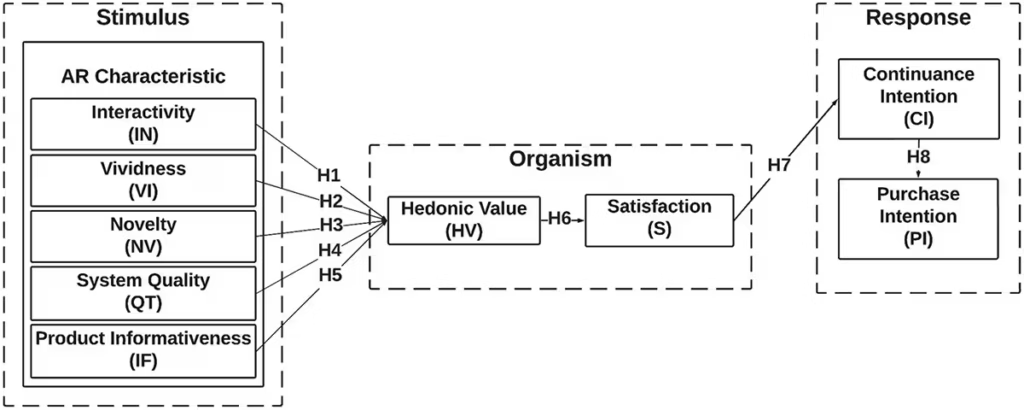
    Source

    According to a study, different attributes of AR impact the hedonic value(HV). It measures the value a customer receives while experiencing a product or service.

    Higher HV can lead to better continuance intention(CI). This means that customers will repeatedly use your service or product. Some of the AR attributes that contribute to higher HV are,

    • Interactivity
    • Vividness
    • Novelty
    • System Quality
    • Product Informativeness

    The study helped me understand how each of the above attributes impacts HV. For example, the study indicated that interactivity and novelty significantly impacted HV, while product informativeness, vividness, and system quality did not. Using AR, you offer your customers an immersive and interactive environment. Plus, AR’s novelty affects customers’ purchase intention(PI). In simple terms, AR boosts customers’ intention to use and purchase your product continuously.

    Enhance Your Retail Experience with Augmented Reality!

    Ready to revolutionize the way your customers shop? Contact us today to explore how AR can elevate your retail business. Let’s create something extraordinary together.

    Purchase Gamification

    AR usage in eCommerce has made shopping more of a fun game. Virtually shopping for a product can become mundane without engaging elements.AR provides engaging content for customers to interact with and enjoy shopping.It adds a sense of customer gaming activity through virtual events, quizzes, competitions, and digital rewards. You can further amplify the gamification approach through rewards and discounts.

    Product Visualizations

    AR has been transformative for customers looking to buy products that fit their real-life settings. Customers can visualize the entire product and understand how it fits in. For example, Amazon’s AR-enabled feature allows users to visualize any product in their room. This feature allows customers to visualize the look and feel of a product in their personal space. It can boost conversion chances and enable customers to make purchase decisions quickly.

    Realistic Reviews

    AR-based experiences allow customers to provide a more realistic review of the product. This means increased authenticity for the reviews. What makes these reviews an advantage for brands is the kind of pull they have on other customers. AR-based reviews can act as a lead magnet for your brand, attracting more customers through unique, dynamically accessible content.

    Higher User Engagement

    Augmented Reality helps improve user engagement, ultimately allowing eCommerce brands to increase customer association.

    Higher user engagement also helps brands get data insights on purchasing behavior, preferences, and product attributes that customers like. This allows organizations to improve their products and increase conversions. Knowing the audience becomes more important now that you understand why using AR in eCommerce matters.

    Who Uses Augmented Reality Shopping?

    Augmented Reality shopping has become popular among millennials and GenZs. Millennials were born between 1981 and 1996, while GenZs were born between 1997 and 2012.

    Both these generations are target audiences for retailers looking to improve sales. But what has led to these generations opting for AR shopping is the “Phygital” trend.

    Most millennials and Generation Z users want to experience products before they buy.This means they seek a consistent brand experience across physical and digital channels.Augmented reality in the retail industry has enabled brands to provide a consistent experience virtually similar to what they can offer at physical showrooms.Here are some examples of brands that target the phygital approach with AR!

    Dior’s Perfume Try-Ons

    AR try-ons can amplify customer experience, and Christian Dior Parfum’s campaign is live-proof. Known for its fashion and beauty products, Dior launched an interactive AR campaign for its lipstick range in Eid 2023.

    This campaign targeted young women searching for lipstick during the holiday season. Initial research by Dior’s team revealed that the search for beauty products was 35% higher during the Eid period. So, they ran this campaign in Saudi Arabia, UAE, Kuwait, and Qatar, targeting more than 4 million people.

    Revolut’s Unlockable AR

    Revolut, a financial app, celebrated the June 2023 launch of an ultra membership plan by creating an AR experience. It created mysterious silver “Platinum Portals” that appeared across European cities. Augmented Reality in Retail

    Source 

    Users can scan the QR code at the base of a sculpture and unlock the AR experience by displaying Revolut’s metal card.

    Escape to a Malfy World

    The famous Italian gin brand Malfy leveraged an AR shopping experience to attract more customers.

    The experience showed how drinking Malfy’s gin can take customers to the Amalfi coast in Italy on a sunny day. It was surreal, created through a combination of immersive images and a 360-degree view. Such experiences are viral among millennials and Genzs, so leveraging AR shopping for your brand does make sense.

    What Makes a Great Augmented Reality Shopping Experience?

    A great AR shopping experience hinges on several key elements bridging the gap between the physical and digital shopping realms.

    Immersive Product Visualization​

    Customers love 3D imagery, and seeing it in a live environment can make all the difference. It offers immersive visualization for customers to examine products from various angles. These 3D images also allow customers to visualize how items like furniture or decor would look and fit in their space. Apps like IKEA Place have mastered the art of using photorealistic 3D furniture models to enhance customers’ visualizations.

    Personalized Recommendations

    Integrating AR with advanced technologies like machine learning and AI can help you provide personalized recommendations to customers. It also allows brands to upsell and cross-sell products to improve revenues. Personalized recommendations also help improve customer satisfaction and allow you to retain more users.

    Enhanced Product Education

    Not all products have an easy learning curve. As a brand, you must educate customers on the ins and outs of using a product. This is where you can use AR technology to do so. Plus, you can help customers maximize and improve the potential of product usage through AR-based lessons.

    Optimized Customer Journeys

    Last, using AR technology can improve the entire customer journey. Customers interact at multiple touchpoints while exploring, considering, and buying your product. You can introduce AR-based technology at different interaction points to improve customer journeys.

    Use Augmented Reality Shopping to Increase Your Sales

    Growing demand for Augmented reality in the retail industry is pushing many brands to develop interactive apps.

    Adding the immersive 3D content has been enabling the brands to not only engage customers but offer a product experience that resembles the physical interaction.

    Many brands are now using AR to enable virtual showrooms, AR try-ons, and improve conversions.

    However developing such AR capabilities for your business does require expertise in 3D imagery integrations and developing immersive experience. This is where Zennaxx can help you with advanced AR development services. Get an estimatefor your project now.

    Read Also: 

  • How to Create an Effective SaaS Marketing Plan

    How to Create an Effective SaaS Marketing Plan

    The software-as-a-service (SaaS) enterprise is trending now. The value of the global software as a service promotion market by using 2023 might be around $197 billion.

    It rises every day with the use of SaaS in industries and corporations. The SaaS platform is straightforward in getting the right of entry to and use for purchasers within a brief term.

    Because of the ability and scalability of an effective SaaS strategy, it’s an entirely usable and sincere platform for organizations.

    Many agencies are developing SaaS platforms and beginning to provide unique offerings to their clients. These platforms offer a wide range of offerings associated with the primary desires of trending businesses.

    How do you hold your status out in this marketplace? Companies need to recognize and offer precise and innovative answers that address the specific pain points of their target customers.

    Creating a suitable platform for your customers allows you to apply your softwareprogram.

    This guide covers an effective SaaS strategy and how to plot and create your SaaS software. Before developing SaaS, we move over each factor one by one.

    Understanding SaaS Marketing

    SaaS advertising is a simple, short and accessible form of software program that is furnished through the Internet.

    It is like using the software as a service promotion, which allows organizations to invest cash in growing non-public packages.

    It is simple to use for enterprise and B2B markets without proudly owning the software, and that is why it’s far a dream profits supply for many SaaS businesses.

    The importance of consumer lifetime fee (CLV) makes it specific in SaaS advertising and marketing. CLV calculates how much revenue a patron is projected to offer.

    Because of this, it’s essential to recognize client prices and feedback to your SaaS platform.

    Now, let’s talk about the demanding situations and opportunities of SaaS. SaaS groups face proving their product’s ongoing cost to hold subscribers addicted.

    Customer satisfaction and retention are the most critical factors in the success of the SaaS enterprise. Regular updates and upgrades to the software have made SaaS necessary. This increases the person’s revel in and keeps the carrier up-to-date.

    Identifying Target Audience

    Finding your target audience’s ache factors is a satisfactory way to recognize your customers. This is the most vital step when you begin considering growing something.

    Make sure to cover particular points regarding customer troubles. Research in deep elements and attempt to understand from the basis.

    Start with the aid of growing the profile character of your customers to your mind and studying the complete story. This will assist you in recognizing the simple wishes and conduct of customers and their companies.

    By expertise in their pain factors, you can tailor your productor service to deal with the one’s precise wishes.

    Now, you have got an idea of your target market. Starting to take feedback from new customers can further improve your expertise of their pain factors in detail. Please talk about the problems they are facing with the software.

    Implement this factor on your new SaaS platform earlier than launching.

    Crafting a Compelling Value Proposition

    Your cost proposition is like a sturdy signal that publishes human beings in your SaaS platform. It’s now not approximately saying it is good; it is about showing why. Here, we are mentioning all capabilities that are essential in a proposition plan.

    • Highlight the multiple benefits of using your SaaS software.
    • Explain it like a custom option for commercial enterprise issues.
    • Get deep into SaaS marketing and note each user’s trouble for making easy software.
    • Try to execute habitual tasks mechanically to make their work less complicated.
    • Cognizance of long-status issues and try to make the ideal in shape for the user’s wishes.

    Solve every form of trouble, including time and price savings, and provide the new functions out of the running.

    Display your mission as a logo by showcasing your product. Launch it like a brand to benefit more excellent humans’s beliefs.
    Because of the marketplace’s opposition, agreeing with and unswerving to the customers is essential.

    Integrating Digital Channels in Your SaaS Marketing Plan

    Content marketing for SaaS platforms

    A successful SaaS marketing plan depends on the use of different online channels. Let’s explore a mix of inbound and outbound strategies to build a solid online presence. Learn how to use digital marketing for SaaS products to expand your business plan.

    One of the most potent and desirable solutions is content marketing. Create top-notch, informative content that directly deals with your audience’s challenges. This includes engaging blog posts, in-depth whitepapers, illuminating case studies, and educational tutorials.

    This content showcases your expertise and builds trust with your customers. Regularly update your content to stay relevant and express your commitment to providing valuable information. This method helps you find your audience and gain their trust for your product.

    Social Media Advertising for Subscription Services

    Social media advertising for subscription services is a thriving hub for jumping into the market in seconds. With the help ofsocial media, you can directly interact with your audience. Take advantage of paid advertising on platforms like LinkedIn, Twitter, and Facebook to target specific customers.

    Craft compelling ads that highlight the unique benefits of your SaaS solution. This effective SaaS strategy can increase visibility and generate leads from a list of potential users. Customize your messages to each platform’s audience and use analytics to refine your targeting.

    Email campaigns for SaaS customer engagement

    Email campaigns are essential for building and maintaining relationships with your users. Develop targeted email sequences, including on-boarding emails to welcome new users and newsletters to keep your audience informed.

    Strategic and well-designed emails guide users through their journey with your software.

    Personalize your emails based on user behaviour to create a more meaningful connection—craft email campaigns for SaaS customer engagement as per your audience’s needs. Choose a valuable and engaging email campaign that helps to convince customers.

    SEO Techniques for SaaS Companies

    Try to optimize your website and content as per SEO rules. Solid SEO techniques for SaaS companies help to be discoverable by your target customers.

    It helps to reach the person who is searching for the same solution that has already been implemented on your SaaS platform. By using relevant keywords, you are creating valuable content and enhancing the overall user experience on your website.

    Stay updated with SEO trends and adapt your strategy to shiftingsearch engine algorithms.

    Integrating these digital strategies into your SaaS marketing plan will create valuable connections with your target audience. Remember, the digital market is dynamic, so regularly assess and adapt your strategy to stay ahead in the competitive SaaS industry.

    Planning mobile development?

    Ready to elevate your app development projects? Partner with us for seamless app development solutions.

    Understanding Customer Acquisition in the SaaS World

    Having a top-notch customer acquisition strategy is perfect for a SaaS marketing plan. Let’s explore the fundamental elements of customer acquisition in the SaaS industry that make this effective SaaS strategy a guarantee for success.

    B2B SaaS Marketing Mastery

    Being present online is more than just crucial for SaaS products catering to other businesses (B2B). Take it up a notch by directly reaching decision-makers. Attend industry events, collaborate with influencers, and use an account-based marketing plan.

    So customers can trust your brand and believe that your product is suitable for a marketing audience. Personalized communication builds trust with decision-makers, making your outreach more effective.

    Lead Generation Brilliance for Startup Success

    Effective lead generation is the heartbeat of customer acquisition. Use methods like offering exclusive content, hosting webinars, and giving free trials. As you attract leads, gather valuable data to understand their needs. It’s easy to makelead generation for software startups as per customers’ needs.

    Branding Excellence in the SaaS Landscape

    Building a strong brand is not just about having a logo; it’s about telling a story that resonates with your audience. Clearly express your brand’s values, mission, and how your software solves the unique problems of users in the SaaS market.

    This clarity in branding attracts customers and creates a sense of loyalty. Keep your branding message consistent across all interactions to strengthen its impact.

    Building a successful SaaS business is about something other than getting customers. A perfect company it’s about developing long-lasting connections.

    Retention and Up selling Tactics

    Regular engagement is the primary thing of consumer retention. Keep customers inside the loop through updates, customized conversations, and responsive customer service. Deal with any queries or problems to expose your dedication to their pleasure.

    Look for comments to peer at what people want from your SaaS. This allows you to keep improving it all of the time. Set up a non-public network or forum for customers. This way, they can share helpful guidelines and insights.

    Offer flexible pricing strategies in the software industry that target buyer segments. Promote loose-of-fee models to allow clients to experience your software earlier than committing. Think about the use of exclusive pricing degrees to satisfy one-of-a-kind desires.

    Also, look at the benefits of imparting yearly subscriptions for clients looking for lengthy-time period commitments. Provide clean data about online marketing plans for software companies. This allows customers to make well-informed selections about exceptional alternatives for them.

    Keeping clients is vital. However, upselling gives a way to boost the fee of every patron you attract—spot probabilities of introducing customers to more capabilities or upgraded plans that match their increasing wishes.

    Leverage customized suggestions primarily based on their utilization styles to exhibit the benefits of upgrading. Incentivize upsells with special promotions, discounts, or unique get-proper-to-new functions.

    When you integrate those retention and upselling strategies, you not only enhance your contemporary consumer base but also set the foundation for the sustainable boom.

    Remember, within the SaaS narrative, consumer relationships are dynamic. Listen, adapt, and keep to provide a price to ensure your clients no longer stay; however, thrive as advocates for your logo.

    Conclusion: Implementing Your SaaS Marketing Plan

    You want to take a complete marketplace technique to make a successful SaaS marketing plan. Start from targeting the audience and supplying value to the customers. Use virtual channels and impose patron acquisition and retention strategies for marketing.

    Check how properly your advertising and marketing are doing to create a powerful SaaS method—change products based on what is taking place in your enterprise. Be quick to adjust your SaaS platform to what your clients want. Use clever marketing strategies for your enterprise to succeed in a competitive marketplace.

    Use this manual as a road-map to navigate the exciting journey of software as a service promotion. It will assist in making sure that your software program continues to meet the converting needs of users.

  • Augmented Reality in Ecommerce: How Does it Work?

    Augmented Reality in Ecommerce: How Does it Work?

    What is the reason why your customers buy unique pairs of clothes and return them the next day?

    A customer purchases a beautiful sofa for their home and returns it with feedback that it’s big for their home.

    One problem with eCommerce for a long time has been that customers do not need help to touch and get the exact feel of the products before buying them.

    But augmented reality (AR) is changing this, making shopping online and in stores feel more like one experience.

    With augmented reality, your customer can see how that couch will look in their living room or how that dress will fit without leaving the house.

    After the eCommerce market became tough, AR brought a new revolution in online shopping.

    AR is now an important part of eCommerce because it provides new experiences in online shopping.

    Explore our in-depth guide to learn how AR is changing the way we shop online and will affect eCommerce in the future.

    Global Consumer Report: Current and Future Shopping Trends

    With a 77% annual growth rate from 2019 to 2023, the augmented reality (AR) market is changing how people shop online.

    Increasing Consumer Engagement

    Over 32% of shoppers are currently using AR, which shows how well it interacts with customers.

    AR methods clearly have a big effect on customer interest because they get 200% more engagement than traditional methods.

    A Lasting Change

    Using AR online shopping isn’t just a trend; it’s a big change. It raises shoppers’ expectations and creates new opportunities for retailers because it makes shopping more immersive and personalized.

    Boosting Retailer Success

    AR can help retailers improve their Conversion Rate Optimization (CRO).

    Augmented reality (AR) makes shopping more fun, which gets more people to complete their purchases and increases sales.

    The Future of Augmented Reality in eCommerce

    AR will soon be an important part of online shopping, changing the way online stores work.

    If stores use AR, they’ll be able to meet changing customer needs and make shopping more enjoyable.

    Augmented Reality in Ecommerce Statistics

    Consumer Adoption on the Rise: As of 2024, over 32% of consumers leverage AR while shopping online. This indicates a continued rise from previous years in augmented reality in ecommerce.

    Expanding User Base: Estimates project there will be a staggering 1.73 billion global AR users on mobile devices by the end of 2024, reflecting significant growth in the technology’s accessibility.

    Boosting Engagement: AR experiences demonstrably outperform traditional methods. They captivate users with 200% more engagement compared to non-AR alternatives.

    Retailer Preference for AR: A significant 61% of retailers prioritize offering customers an Augmented Reality ecommerce experience, recognizing its value in enhancing the online shopping journey.

    Demand for AR Integration: The desire for AR is clear – 71% of eCommerce buyers are willing to shop more frequently if AR technology becomes more widely available.

    What is Augmented Reality?

    Augmented reality (AR) is a technology that puts digital content into an authentic user experience.

    AR improves the user’s experience by combining computer-generated visuals, sounds, text, and graphics with their surroundings.

    Examples of AR in Life

    • Visual Search: AR lets you search by pointing your mobile camera at real-life objects.
    • Google Maps Live View: Helps users visualize destinations with real-world overlays.
    • Gaming and Social Media: Apps like Pokémon Go and Snapchat filters are popular AR applications.

    AR is used in many fields to improve marketing and operations. Online and offline retailers heavily invest in AR to develop distinctive brand experiences.

    This technology is quickly becoming an important tool for better customer engagement and sales.

    How is Augmented Reality Different From Virtual Reality?

    When people talk about technology, they often use the terms “augmented reality” and “virtual reality” to mean the same thing, but they are actually different terms.

    Augmented reality adds to the world that you can still see and experience in some way.

    Virtual reality is a completely immersive experience that puts you in a world that people made. The real world is sometimes hidden from you and is not meant to be experienced.

    For virtual reality, you may need to hold controllers and wear a headset. It would help if you also made sure that the place where you live is safe.

    However, for AR, you usually only need a smartphone or, in some cases, AR glasses. You won’t have to clear the room to enjoy the experience because you’ll know everything around you.

    Types of AR Applications

    Different augmented reality (AR) technology types each have their own special features. The most common types of AR apps are broken down below:

    • Marker-based AR: This form of augmented reality (AR) takes its cues from a predetermined item (the “marker”) placed in front of the camera to activate various forms of amusement. When the AR device finds the marker, it replaces it on the screen with a 3D version of the object that goes with it. The user can see and interact with the object more clearly from various angles.
    • Markerless AR: Markerless AR doesn’t need a specific object to turn on content like marker-based AR does. You can place virtual objects wherever you want and interact with them by rotating and moving them.
    • Location-based AR: Geographic location data is used to show digital content in certain places with this type of markerless AR. Pokémon Go is a popular example of a game that overlays digital creatures in real locations.
    • Projection-based AR is augmented reality that uses projections, puts fake light on real surfaces, and sometimes lets users interact with it. Examples of projection-based AR include the holograms in sci-fi movies like Avatar and Marvel movies.

    Types of AR Applications

    How Ecommerce Businesses Are Using Augmented Reality

    Augmented reality in ecommerce connects customers to the product so that they can feel the product overview.

    Customers can see how products fit into their daily activities with AR, satisfying them.

    Virtual Try-On Solutions

    Sometimes, customers see a product online, take it without any matching tone, and return it.

    This common frustration can lower conversion rates because consumers still determine if the product matches their online mindset.

    Customers can try on clothes, accessories, makeup, and even eyeglasses virtually before they buy them. This helps them decide if they like how something looks on them.

    Preview Placement

    Preview placement with AR solves this problem by allowing people to see how a product will look in their space right now.

    For instance, customers can use their iPhones and iPads to view accurate 3D models of their couches in their living rooms by downloading the Burrow at Home app from the DTC furniture brand Burrow.

    Interactive User Manuals

    If your product is hard to learn, an interactive AR user guide could be just what you need. Users can get on-page, context-based help from these manuals to learn how to use your product.

    Many AR user guides scan the item and use animated arrows and pictures to show you which buttons to press and how to use them.

    Social media filters

    These AR filters on Instagram and Snapchat aren’t just for fun anymore; they’re also very useful for businesses.

    Using these filters, users can virtually try out new products, which increases engagement and gets them to tag your brand in their content.

    Augmented reality filters can help your brand stand out on social media and show what makes you special. People are also considering AR in new software product ideas and love it in all types of social media apps.

    Ready to Transform Your E-commerce Experience with Augmented Reality?

    Have questions or ready to take the next step? Reach out to us today and let’s innovate together.

    The Benefits of Augmented Reality in Online Shopping

    Augmented reality (AR) is changing the online shopping experience with the latest technology.

    Your customer can get closer to your product and make the right decision with different shapes and colours. Here are the key benefits AR brings to online shopping:

    Enhanced Conversion and Sales

    Augmented reality (AR) can greatly boost online sales by giving customers a more accurate perception of goods.

    This strategy will make your business more trustworthy and increase your productivity. Studies show that augmented reality users are 30% more likely to buy something.

    An additional study by Harvard Business Review discovered that AR can boost conversion rates by 20% by lowering hesitation at the checkout stage.

    Reduced Product Return Rates

    Augmented reality in ecommerce helps reduce product rejections by letting customers see items clearly and accurately before buying them.

    This makes customers more likely to be happy with what they buy.

    Customers can see how items will look in their space with AR, which helps them ensure the item fits well and meets their needs. This cuts down on returns because of problems with size.

    Personalized Shopping Experience

    Augmented reality makes shopping very personalized for your customer base.

    Customers can try on clothes, accessories, or makeup virtually to see how they look before buying. They can also visualize how furniture or decor will fit in their home.

    This interactive experience increases customer interest and satisfaction. AR can also suggest items based on what you’ve bought before, which makes shopping more personalized to customer tastes.

    Elimination of Physical Space Requirements

    AR will also reduce the need for physical stores in the future by providing an immersive online shopping experience.

    With a virtual showroom, customers can look at products realistically from anywhere. They can make purchases from home and still feel the product as if they were in a store.

    It removes the limitations of physical distance and provides a time-saving experience for the customers.

    Competitive Advantage

    Using AR can help your business stand out from others in the same field.

    Due to the low number of retailers using AR right now, implementing this technology can help your company stand out as innovative and customer-focused.

    This will attract tech-savvy customers looking for the best online shopping experience because it shows that your brand is up-to-date and cares about what your customers want.

    It’s easy to see how AR can help eCommerce. It is important to determine how much it will costand what you need to do to make an AR app for your online store.

    Contact Zennaxx to inquire about the cost of developing an AR app in 2024.

    How to Bring Augmented Reality to Your Ecommerce Store

    Now, you want to know the basic steps for integrating AR into your eCommerce business. Here, we give you a checklist to check these steps before implementing AR in your store.

    Clarify your business objectives

    First, you need to understand your goals. Make them clear: What do you want to achieve with augmented reality, and how will it benefit your customers?

    • Business Goals: Everyone’s business goal is the same: to reduce product returns, increase sales, or improve customer engagement in-store.
    • Customer Benefits: How will AR improve the shopping experience? Can it show customers how products would look in their space or allow them to try on items virtually?

    Making a list of your objectives will help you choose the appropriate AR technology and ensure that it benefits your clients.

    Choose the Right Augmented Reality Tools

    You can choose the right AR tools once you know your goal. Consider these factors:

    • License Type: If you’re on a budget, look for AR platforms that offer free licenses. Remember that free versions may have fewer features than paid ones.
    • Supported Devices: Decide which devices (like mobile phones, tablets, or AR glasses) your AR app will help. Make sure the tool you select is compatible with these devices.
    • Supported Operating Systems: If you want your app to work on multiple operating systems (iOS, Android, etc.), check that your chosen platform supports them.
    • Capabilities: Consider each platform’s capabilities. If you require location-based features, make sure the platform supports Geo-location services.

    Market Your New Tool

    When your augmented reality app is complete, you must inform your customers about it. Here are some ways you can spread the word:

    • Create a Demo Video: Make engaging videos that show how to use your AR app. Share these on your website, social media, and other marketing platforms.
    • In-App Instructions: If you want people to understand how to use the AR features, ensure the app has a clear guide with easy-to-follow instructions.
    • Shareable Content: Encourage users to share their AR experiences on social media by making them funny or interesting. This can increase visibility and attract more customers from other platforms.

    This basic instruction will upgrade your store’s visibility and functionality for your customers.

    Let’s look at some popular brands, how they introduce augmented reality in manufacturing, and what impact they create in business.

    Case Studies of Augmented Reality in the eCommerce Sector

    1. Do you still need clarification about implementing augmented reality in ecommerce stores?

    Some popular brands say they use these technologies in business and get benefits. Let’s see how these features greatly impact your eCommerce store.

    Case Study: IKEA Place App

    The IKEA Place app has been a popular home furniture selling platform since early 2017 and is still the first choice of people.

    The IKEA Place app provides the AR facility to check the furniture at the customer’s home easily. Before buying something, this cool tool lets people see how it will look and fit in their space.

    IKEA Place App

    Since its release in 2017, the app has become very famous, and by August 2022, it had over 4.9 million users.

    It has had a big impact on IKEA’s business. Product returns are down by over 30%. With this drop in returns, the company saves time and money, and employees work faster and better.

    The app makes shopping more enjoyable and makes customers happier by helping them make better decisions about what to buy.

    Case Study: Snapchat and Puma’s Collaboration

    Snapchat and Puma collaborate by sharing exclusive brand content and promotions with their followers.

    Through this partnership, Puma wants to get the word out about its tracksuits and suede shoes in a new and interesting way.

    Snapchat and Puma’s Collaboration

    Snap’s data shows that about 250 million users have used this augmented reality feature.

    This significant level of engagement demonstrates how AR has the potential to alter how people shop for clothes online.

    This feature elevates the shopping experience and boosts brand engagement and sales by letting users virtually try on clothes.

    According to these case studies, augmented reality (AR) technology is changing the eCommerce business in useful ways for customers and companies.

    Wrapping Up

    Technology’s use in visualization and representation of data has become increasingly popular in recent years.

    The need for businesses to understand large amounts of complex information in a more palatable format is driving this trend.

    Apple has also released Vision Pro, which makes it easy for users to create and customize data visualizations. So why are we not thinking about upgrading our eCommerce business with these new technologies?

    Figuring out the different kinds of augmented reality, their uses, and their benefits can help you decide if it’s the best option for your business.

    The augmented reality app development company Zennaxx has made cutting-edge AR solutions for small businesses, startups, and unicorns for almost ten years.

    Contact us to discuss your business ideas and get personalized consultation for AR integration in your eCommerce business.

    Read Also:

  • 11 Types of Web applications: CMS, PWA, SWA, DWA, and EWA

    11 Types of Web applications: CMS, PWA, SWA, DWA, and EWA

    The web-based applications function over the internet, providing dynamic interactions, cloud storage, and cross-platform accessibility. A website application runs in a web browser without requiring installation, offering businesses scalability and real-time data processing.

    The most popular web applications include content management systems (CMS), progressive web applications (PWA), and enterprise web applications (EWA), widely used in e-commerce, social media, and SaaS platforms.

    The most widely used types of web applications are progressive web applications (PWA) and content management systems (CMS) due to their flexibility, offline functionality, and ease of content management. Examples of popular web-based applications include Google Docs, Amazon Web Services, and WordPress, serving millions of users globally.

    Listed below are 11 types of web applications.

    • Content Management Systems (CMS): The content management systems (CMS) web applications allow users to create, edit, and manage digital content without coding expertise.
    • Progressive Web Applications (PWA): Progressive web applications (PWA) provide app-like experiences in web browsers with offline support and fast loading.
    • Static Web Applications (SWA): The static web applications (SWA) web applications deliver fixed content without user interaction, making them suitable for informational websites.
    • Dynamic Web Applications (DWA): The dynamic web applications (DWA) web applications allow real-time content updates based on user interactions and databases.
    • E-Commerce Web Applications (EWA): E-commerce web applications (EWA) facilitate online buying and selling with integrated payment gateways and product catalogs.
    • Single Page Web Applications (SPA): The single page web applications (SPA) load content dynamically on a single page for a seamless user experience.
    • Multi-Page Web Applications (MPA): The multi-page web applications (MPA) use multiple pages to structure extensive content and features.
    • Web Portal Applications (WPA): Web portal applications (WPA) provide a centralized platform for users to access multiple services.
    • Animated Web Applications: The animated web applications enhance user engagement by incorporating animations and interactive elements.
    • Rich Internet Applications (RIA): The rich Internet applications (RIA) web applications deliver desktop-like experiences within a browser using advanced UI components.
    • JavaScript-Powered Web Applications: The JavaScript-powered web applications use modern JavaScript frameworks to create high-performance, interactive user experiences.

    Content Management Systems (CMS)

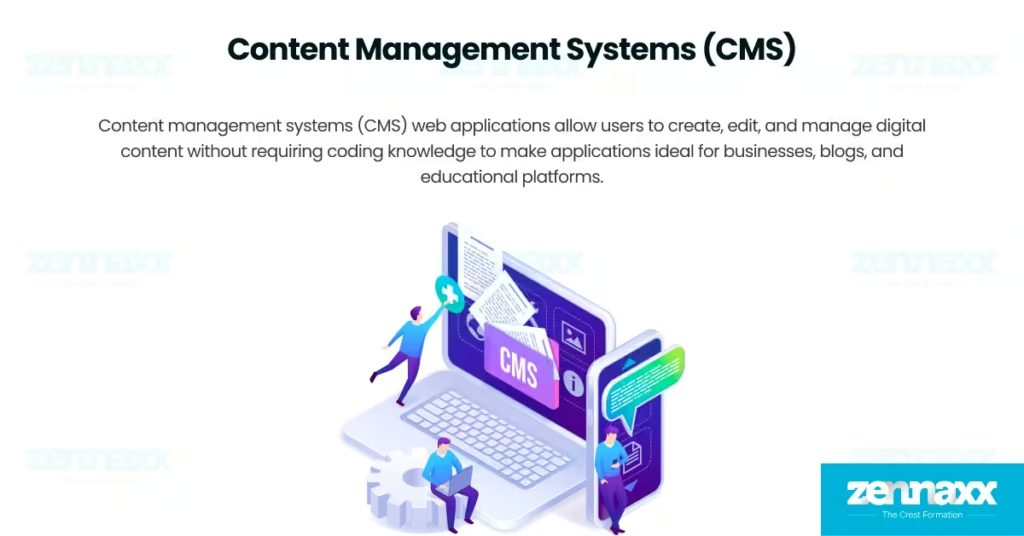
    content management system-cms Content management systems (CMS) web applications allow users to create, edit, and manage digital content without requiring coding knowledge to make applications ideal for businesses, blogs, and educational platforms.
    The global CMS market is expected to reach $123 billion by 2026, which highlights CMS’s growing demand for web development. The development of content management systems (CMS) web applications includes frontend and backend programming using PHP, Python, or JavaScript, with databases like MySQL and PostgreSQL for content storage.

    Developers rely on frameworks such as WordPress, Joomla, and Drupal to create scalable, flexible CMS platforms that support thousands of websites globally.The unique features of content management systems (CMS) web applications include drag-and-drop editors for easy design, version control for content tracking, and role-based access for multi-user collaboration.

    The efficiency of content management systems (CMS) web applications depends on quick content updates, plugin integrations, and SEO-friendly architecture that enhances website visibility and usability. The challenges of content management systems (CMS) web applications include plugin dependency, potential security risks, and customization limits compared to fully coded websites, which may restrict advanced development flexibility for businesses and developers.

    The examples of content management systems (CMS) web applications include WordPress for business websites, Joomla for educational platforms, and Drupal for government portals.

    Progressive Web Applications (PWA)

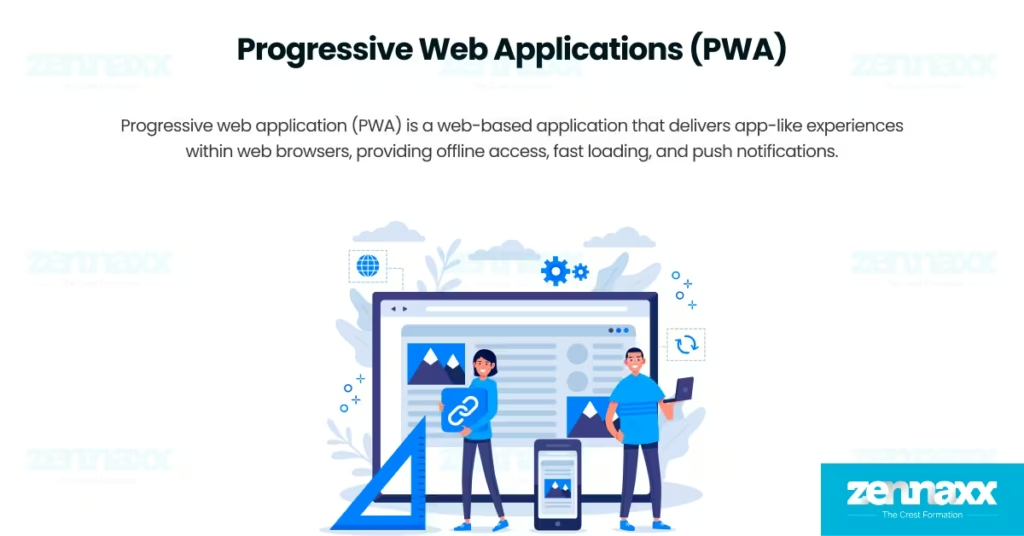
    progressive web application pwa Progressive web application (PWA) is a web-based application that delivers app-like experiences within web browsers, providing offline access, fast loading, and push notifications. The global adoption of PWAs is increasing rapidly, with businesses reporting up to a 36% improvement in conversion rates due to their lightweight nature and enhanced accessibility.
    The development of progressive web applications (PWA) includes frontend technologies such as HTML, CSS, and JavaScript, combined with service workers and Web App Manifests to enable offline functionality and background synchronization. Developers use frameworks such as React and Angular to create responsive and high-performance PWA applications that work across multiple devices.The unique features of progressive web applications (PWA) include offline support, automatic updates, and reduced loading times.

    The efficiency of progressive web applications (PWA) is reflected in cross-platform compatibility, lower data consumption, and no app store restrictions, which makes applications suitable for e-commerce, news portals, and social media platforms. The limitations of progressive web applications (PWA) include restricted access to device features and dependency on modern browsers for full functionality. The examples of progressive web applications (PWA) include Twitter Lite for lightweight social media access, Starbucks PWA for online ordering, and Pinterest PWA for visual content browsing.

    Static Web Applications (SWA)

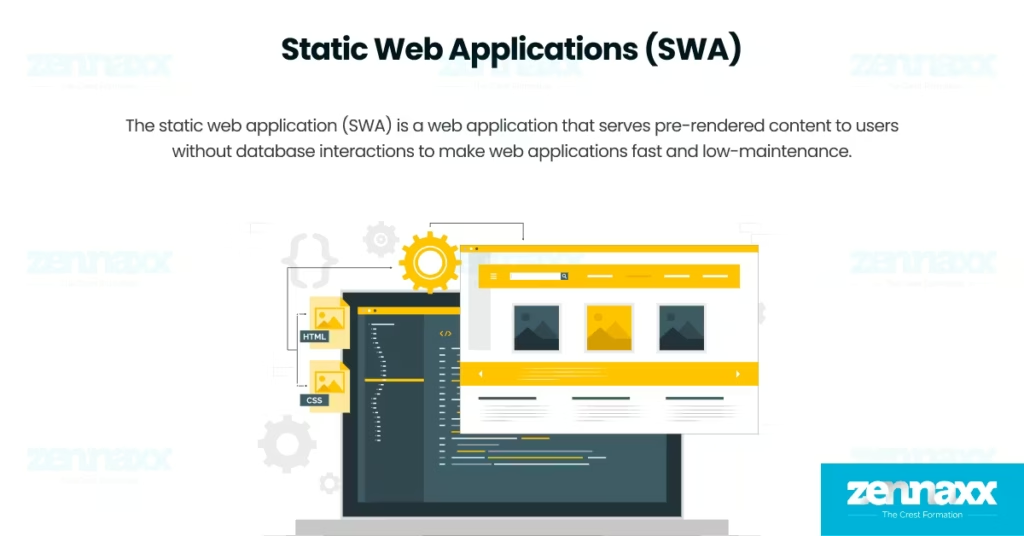
    static web applications swa The static web application (SWA) is a web application that serves pre-rendered content to users without database interactions to make web applications fast and low-maintenance. The development of static web applications (SWA) includes writing HTML, CSS, and JavaScript, with no need for backend databases. Developers use frameworks such as Jekyll, Hugo, and Gatsby to generate static web pages efficiently.
    The unique features of static web applications (SWA) include fast loading speeds, high security, and low server requirements to make SWA reliable and cost-efficient applications. Static web applications (SWA) efficiency is reflected in quick deployment, improved security, and minimal server load, making them suitable for personal websites and informational pages.

    The limitations of static web applications (SWA) include restricted interactivity and the need for manual content updates. The examples of static web applications (SWA) include GitHub Pages for hosting documentation, HTML-based resume websites for personal branding, and Jekyll-generated blogs for content marketing.

    Dynamic Web Applications (DWA)

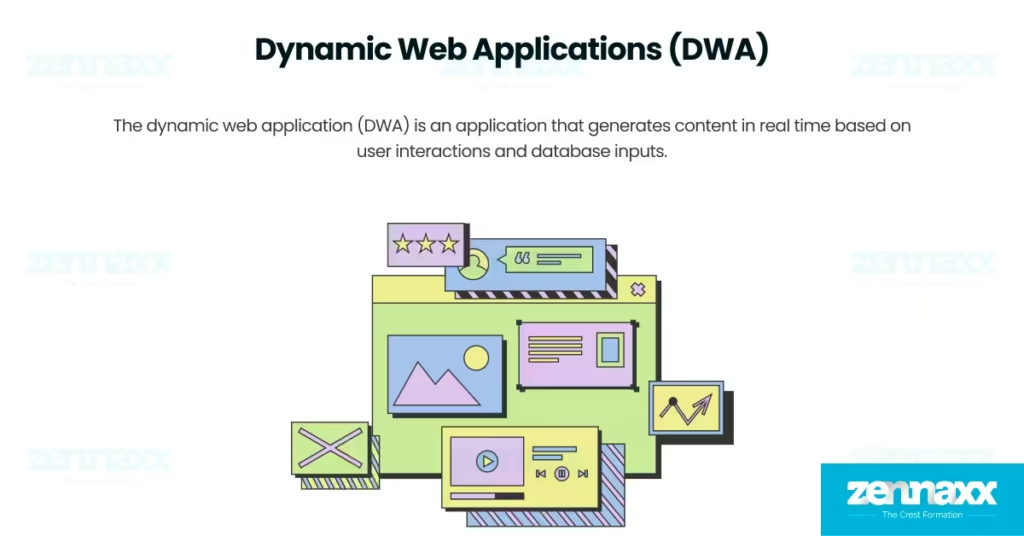
    dynamic web applications dwa The dynamic web application (DWA) is an application that generates content in real time based on user interactions and database inputs. The development of dynamic web applications (DWA) includes using server-side scripting languages such as PHP, Python, and Node.js paired with databases such as MySQL and MongoDB.
    Developers use frameworks such as Django, Laravel, and Express.js to create interactive and scalable dynamic applications. The unique features of dynamic web applications (DWA) include real-time content updates, personalized user experiences, and advanced database integration, ensuring high engagement levels.

    The effectiveness of dynamic web applications (DWA) is demonstrated through customized user experiences, automation, and database connectivity, making them essential for news websites, social media platforms, and online stores. The challenges of dynamic web applications (DWA) include higher server resource usage and complex maintenance compared to static applications.

    The examples of dynamic web applications (DWA) include Facebook for social networking, Netflix for personalized streaming, and Amazon for e-commerce transactions.

    E-Commerce Web Applications (EWA)

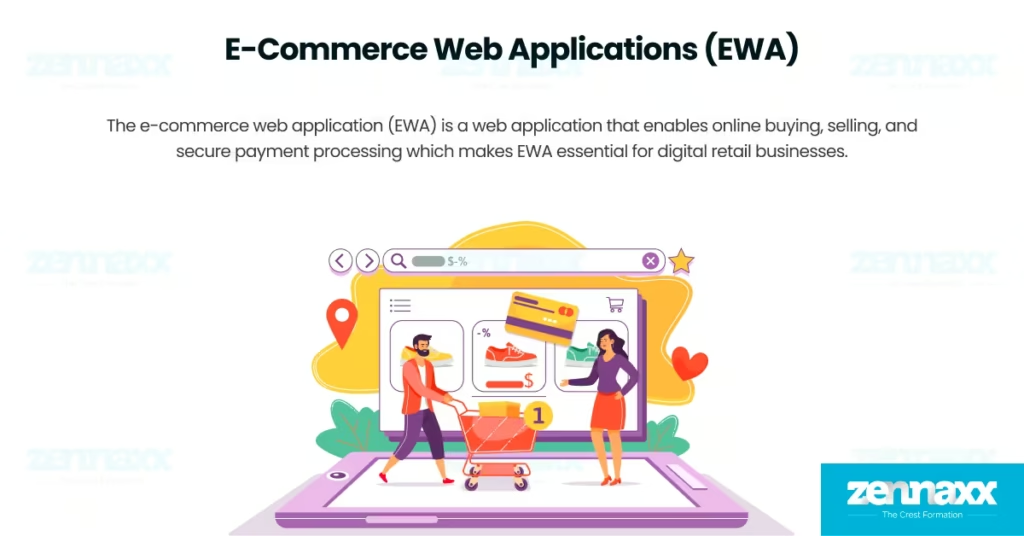
    e-commerce web applications ewa The e-commerce web application (EWA) is a web application that enables online buying, selling, and secure payment processing which makes EWA essential for digital retail businesses. Developing e-commerce web applications (EWA) includes frontend frameworks such as React, Vue.js, and Angular, while backend development includes Node.js, PHP, or Python with databases such as MySQL and PostgreSQL.
    The distinctive qualities of e-commerce web applications (EWA) include inventory management, user authentication, and seamless checkout functionality, ensuring a smooth shopping experience. The advantages of e-commerce web applications (EWA) include global reach, automated transactions, and scalability.

    The challenges of e-commerce web applications (EWA) include complex database management and security concerns related to online payments. The examples of e-commerce web applications (EWA) include Amazon for large-scale online retail, Shopify for small business storefronts, and eBay for marketplace transactions.

    Single Page Web Applications (SPA)

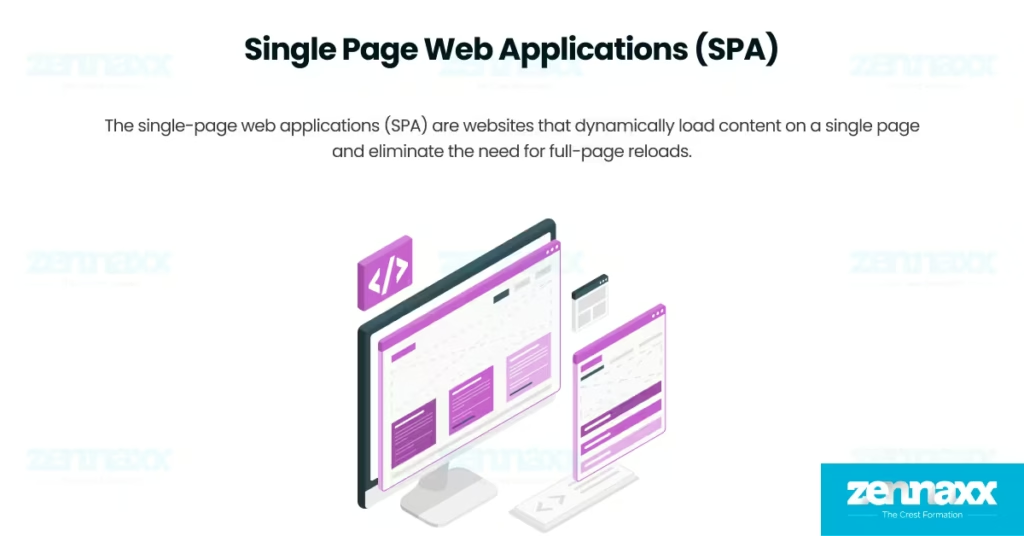
    single page web applications spa The single-page web applications (SPA) are websites that dynamically load content on a single page and eliminate the need for full-page reloads. The adoption of SPAs has increased by 35% in modern web development as businesses seek faster, interactive user experiences. The development of single-page web applications (SPA) includes JavaScript language and Angular framework combined with RESTful APIs and GraphQL for data handling. The notable aspects of single-page web applications (SPA) include real-time updates, smooth navigation, and improved speed to develop a highly responsive interface.
    The strengths of single-page web applications (SPA) include faster performance, better user experience, and reduced bandwidth usage to make SPA suitable for social media platforms, dashboards, and real-time applications. Single-page web application (SPA) limitations include SEO challenges and increased initial load time.

    The examples of single-page web applications (SPA) include Gmail for email management, Google Maps for location tracking, and Trello for project management.

    Multi-Page Web Applications (MPA)

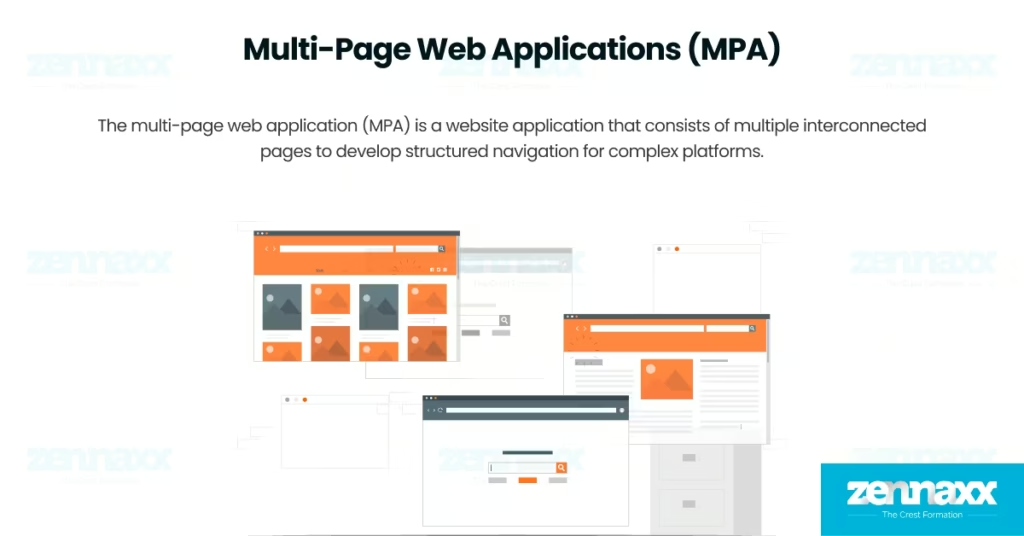
    multi-page web applications mpa The multi-page web application (MPA) is a website application that consists of multiple interconnected pages to develop structured navigation for complex platforms. Businesses develop multi-page web applications (MPA) to support large-scale applications requiring deep content structures.
    The development of multi-page web applications (MPA) includes languages such as HTML, CSS, and JavaScript with backend technologies such as PHP, Ruby on Rails, and Java Spring Boot. Multi-page web applications (MPA) features include better content organization, enhanced SEO, and detailed user interactions. The benefits of multi-page web applications (MPA) include structured navigation, improved searchability, and scalability, which make MPA ideal for news websites, online education platforms, and e-commerce stores.

    Multi-page web applications (MPA) drawbacks include slower page loads compared to single-page applications and higher server requests. The examples of multi-page web applications (MPA) include Wikipedia, Amazon, and BBC News.

    Web Portal Applications (WPA)

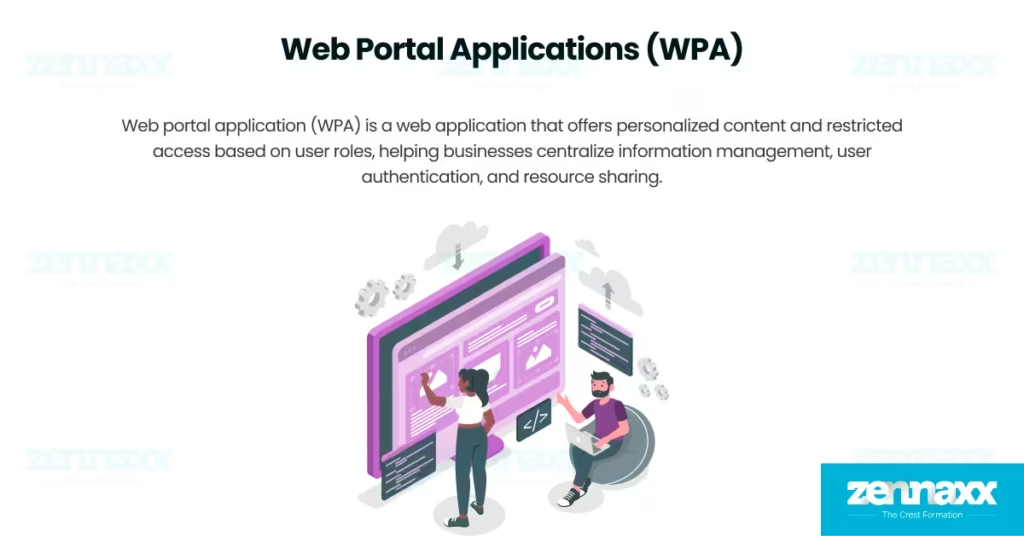
    web portal applications wpa Web portal application (WPA) is a web application that offers personalized content and restricted access based on user roles, helping businesses centralize information management, user authentication, and resource sharing. The global web portal market is projected to surpass $9 billion by 2027, as businesses and organizations prioritize secure and integrated digital services for efficient operations and user engagement.  Developing web portal applications (WPA) includes backend technologies such as PHP, ASP.NET, and Python Django, paired with databases like PostgreSQL and Oracle for secure data handling.The features of web portal applications (WPA) include customized dashboards, multi-user access, and content segmentation.
    The efficiency of web portal applications (WPA) is demonstrated through seamless data access, role-based security, and multi-user support, making WPA suitable for banking portals, healthcare management systems, and employee dashboards.

    The challenges of web portal applications (WPA) include complex security implementation and high maintenance requirements, which may require continuous updates and monitoring. The examples of web portal applications (WPA) include Google Drive for cloud-based storage, PayPal for financial management, and student portals for university records.

    Animated Web Applications

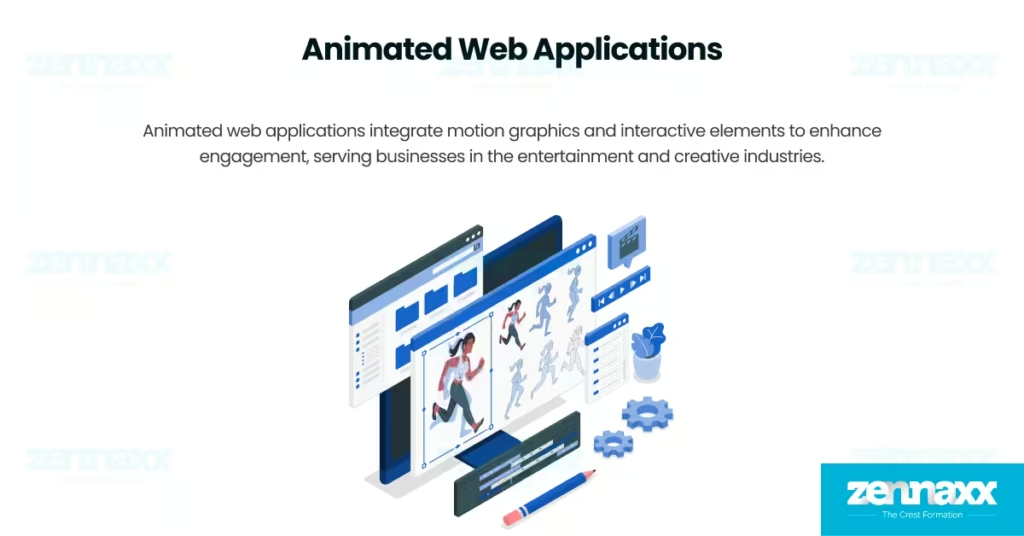
    animated web applications Animated web applications integrate motion graphics and interactive elements to enhance engagement, serving businesses in the entertainment and creative industries. The use of animations in web applications has increased by 40% in digital marketing, as businesses leverage motion design to improve brand recognition.
    The development of animated web applications uses JavaScript, WebGL, and CSS animations, with frameworks such as Three.js and GSAP, to create dynamic and interactive user experiences. The features of animated web applications include smooth visual transitions, interactive storytelling, and immersive user experiences to make animated web applications popular in digital marketing and media production.

    The effectiveness of animated web applications is reflected in improved audience retention, interactive storytelling, and visually appealing interfaces. The challenges of animated web applications include higher resource consumption and longer development time.

    The examples of animated web applications include Airbnb’s interactive landing page for travel booking, Nike’s for animated e-commerce, and Awards websites for creative design portfolios.

    Rich Internet Applications (RIA)

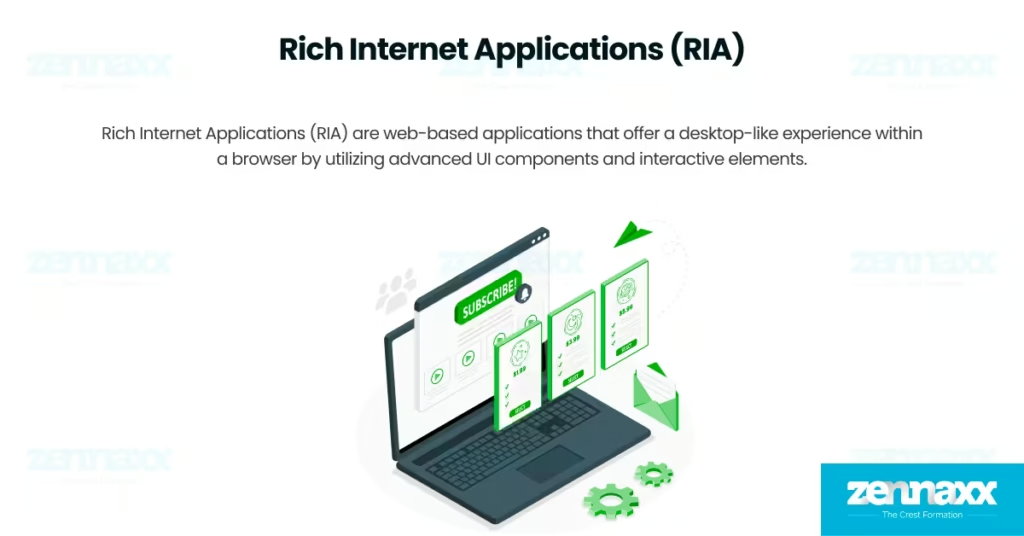
    rich internet applications ria Rich Internet Applications (RIA) are web-based applications that offer a desktop-like experience within a browser by utilizing advanced UI components and interactive elements.
    The RIA market continues to expand as businesses prioritize high-performance web applications for improved functionality and user engagement. The development of rich internet applications (RIA) involves frontend technologies such as JavaScript, HTML5, and CSS combined with frameworks like Adobe Flex, Microsoft Silverlight, and Google Web Toolkit (GWT) to create feature-rich interfaces. Developers integrate asynchronous data loading and multimedia support to enhance interactivity.

    The notable aspects of rich internet applications (RIA) include faster data processing, real-time updates, and enhanced multimedia integration. The efficiency of rich Internet applications (RIA) is reflected in smooth user interactions, improved UI responsiveness, and cross-platform compatibility.

    Rich Internet applications (RIA) challenges include higher system resource usage and security concerns due to extensive browser dependencies. The examples of rich Internet applications (RIA) include Google Docs for online document collaboration, Canva for graphic design, and Netflix for high-quality video streaming.

    JavaScript-Powered Web Applications

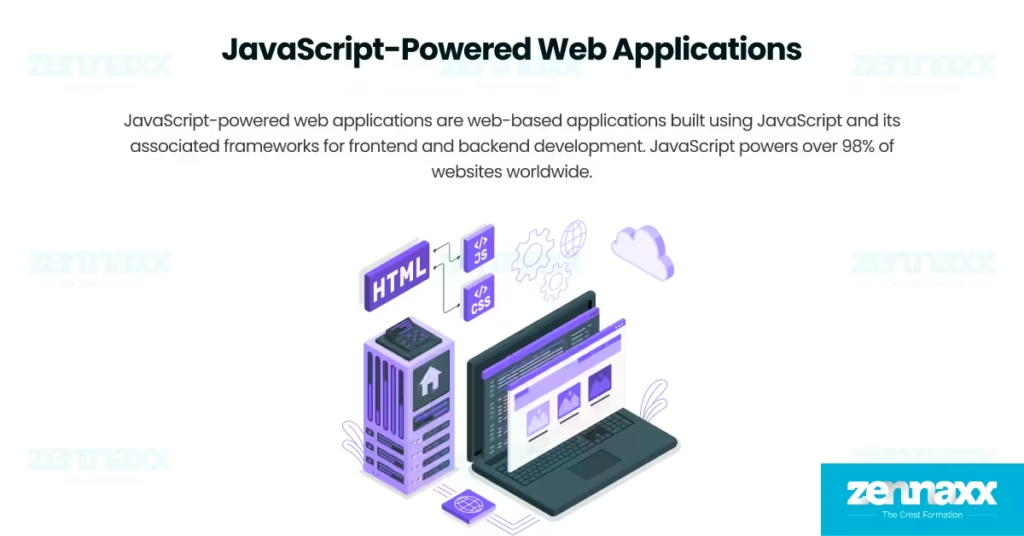
    javascript-powered web applications JavaScript-powered web applications are web-based applications built using JavaScript and its associated frameworks for frontend and backend development. JavaScript powers over 98% of websites worldwide.

    The development of JavaScript-powered web applications includes using Node.js for backend processing, along with frameworks such as React, Angular, and Vue.js for UI development. Developers use JavaScript-based libraries and tools to enhance scalability and responsiveness.

    Notable aspects of JavaScript-powered web applications include real-time responsiveness, reusable components, and extensive framework support to allow businesses to develop dynamic and scalable applications. Their performance is reflected in enhanced interactivity, modular development, and cross-platform compatibility.

    The challenges of JavaScript-powered web applications include reliance on JavaScript engines and security risks. The examples of JavaScript-powered web applications include WhatsApp Web for instant messaging, Trello for task management, and Slack for workplace communication.

    What Is the Best Type of Web Application?

    The best type of web application is chosen based on the application’s ability to fulfill specific business goals, offer scalability, and provide an excellent user experience through advanced features and adaptability. Progressive web applications (PWAs) are ideal for mobile-like experiences, offering offline access, app-like functionality, and push notifications, which make PWA highly effective for retail and service industries, such as Starbucks and Uber.

    Single-page applications (SPAs) work best for speed-focused platforms, as they provide fast navigation and reduced server load to enable responsive user interactions for platforms such as Gmail and Google Maps.

    How Are Web Apps Different from Other Types of Mobile Applications?

    Web apps are different from other types of mobile applications because web applications are accessed through web browsers and do not require installation, making them platform-independent, while mobile applications are downloaded from app stores and are platform-specific.

    Web apps are cost-effective to develop and easier to maintain, whereas mobile applications deliver higher performance and better hardware integration.

    How Web Applications Are Developed?

    Web applications are developed using frontend technologies such as HTML, CSS, and JavaScript combined with backend programming languages such as Python, PHP, or Node.js for server-side functionality. The web app development process includes designing user interfaces, integrating databases such as MySQL or MongoDB, and ensuring scalability and security through frameworks such as Angular or Django. The structured approach to developing web applications enables developers to create responsive, feature-rich web applications that meet business goals and user expectations.

    What Programming Languages Are Used to Develop Web Applications?

    Programming languages used to develop web applications include JavaScript, Python, Java, PHP, and Node.js, which enable developers to create scalable and interactive web solutions. JavaScript is widely used for frontend interactivity, while Python, Java, PHP, and Node.js handle backend logic, database operations, and server-side functionality.For frontend development, HTML and CSS are used as markup and styling languages to structure and design user interfaces, while JavaScript enhances interactivity.

    Backend development relies on server-side languages such as Python, Java, PHP, and Node.js to manage data processing, authentication, and overall application performance.

    What Frameworks Are Used to Develop Web Applications?

    Frameworks used to develop web applications include Angular, Django, Express.js, Laravel, Spring Framework, Flask, ASP.NET, and CodeIgniter, which provide pre-built components, scalability, and security for efficient development.

    Angular, Django, and Express.js are widely used for single-page applications, backend management, and high-performance APIs, while Laravel, Spring Framework, and ASP.NET offer structured architectures for enterprise solutions. Flask and CodeIgniter are preferred for lightweight, fast development, making them ideal for small-to-medium-scale applications.

  • Software Maintenance Costs: How To Estimate And Optimize

    Software Maintenance Costs: How To Estimate And Optimize

    Having a great idea isn’t enough to build a successful software product. Once a product is technically completed, it does not automatically function as intended or meet the customer’s needs.

    You must maintain the product’s functionality and relevance, which requires frequent updates and enhancements.

    Software maintenance costs can be a significant barrier for founders. So, how can you avoid overspending on maintenance while still ensuring that your IT solutions are supported at an affordable price?

    In this blog, Zennaxx shares industry best practices to answer this question and provide effective solutions. Let’s start!

    The need to monitor maintenance costs

    One of the most critical aspects of software management is monitoring maintenance costs.

    Young tech entrepreneurs frequently believe software expenses are one-time costs eliminated with development or purchase.

    However, industry experts estimate that over 90% of software costs are due to ongoing maintenance, which many businesses overlook.

    This can lead to budget problems and even derail entire projects. Modern software solutions are complex and require ongoing updates and maintenance.

    These are labor-intensive tasks that require prior planning. Maintaining customized software can be even more costly because it requires a full-time, specialized support staff.Proper documentation is necessary for efficient software maintenance because it saves developers the time and effort of sifting through massive amounts of code to find and fix bugs.

    Knowing these costs and planning for them can significantly impact a software project’s success.

    Basic cost breakdown

    Software maintenance is the most crucial part of the software lifecycle because it involves intricate processes with varying levels of complexity and cost.

    Companies must be aware of the three main maintenance categories and how they affect their overall spending to manage these costs properly.

    Corrective Maintenance

    This type of maintenance addresses any issues that may arise with the software. These issues may occur during the initial testing phase or after the software has been released to users.

    Roughly 20% of all software maintenance expenses go toward corrective maintenance. It ensures the program operates without trouble and fixes issues quickly.

    Adaptive Maintenance

    Adaptive maintenance entails updating software to align with industry standards and new technologies.

    These updates keep the software relevant and competitive. It also makes it an essential part of technological maintenance.

    Adaptive maintenance typically accounts for around 25% of total software maintenance costs.

    Enhancing Maintenance

    Perfective maintenance is improving software performance, adding new features, or removing unnecessary ones in response to user feedback or company objectives.

    Over 35% of software maintenance expenses may be attributed to this maintenance, which is essential for user satisfaction.

    While these types of maintenance form a significant portion of the overall expenses, they do not encompass the total cost of ownership (TCO).

    TCO includes many other factors. These factors are deployment costs, licensing fees, legal costs, and app store or search engine commissions.

    It would be best if you also considered other indirect costs. These include marketing and employee training. They also include hiring specialized personnel.

    Total Cost of Ownership

    Factors that affect software maintenance costs

    Several factors influence software maintenance costs, both technically and non-technically. Understanding these factors is necessary for effective budgeting and maintenance planning.

    Technical Factors:

    • Technical Requirements: Maintenance costs directly relate to the product’s initial vision and required features. Costs may increase because more time and experience are needed to implement more complex requirements.
    • Programming Language and Style: The programming language used and the style with which the code is written can impact maintenance costs. Supporting well-written, maintainable code is more accessible and less costly.
    • Module Independence: Modular software design makes maintenance easier because individual components can be updated or replaced without affecting the entire system.
    • Software Testing: Proper testing during development can cut maintenance costs by detecting problems early on. Continuous testing ensures that the software remains functional and reliable.
    • Documentation: Having thorough and current documentation speeds up and simplifies maintenance tasks, which lowers overall costs.
    • Hardware Stability: Reliable and stable hardware reduces the number of unexpected issues and costs associated with running software on a faulty infrastructure.

    Non-Technical Factors:

    • Team Composition and Seniority: The maintenance team’s composition and experience level impact costs. Highly skilled and experienced professional teams may command higher fees but can solve problems more efficiently.
    • Software Lifecycle: Maintenance costs may vary depending on the stage of the software lifecycle. Mature software may necessitate more updates and adjustments to remain current.
    • External Environment: Changes in industry standards, technology, or legal requirements can all contribute to higher maintenance costs.

    Other Influential Factors:

    • Time: Project timelines can affect maintenance costs, especially if there are delays or unexpected complications.
    • Risks and Improvements: Anticipating and mitigating potential risks can help control costs. Regular updates and preventive maintenance ensure the software remains competitive and functional.
    • Taxes and Fees: Costs related to hosting, licenses, developer accounts, and regulatory changes can all add to the overall expenses.

    Considering these factors holistically can help companies manage software maintenance costs and have a more efficient maintenance process.

    Wondering how to cut down your software maintenance costs?

    Our team of experts is here to help. Contact us today for tailored solutions to your software needs.

    Ways to cut down software maintenance costs

    As technology advances and new versions emerge, you must upgrade and maintain your software. Sometimes, it becomes more difficult and costly because of regular checkups and the choice of different development technologies.

    • 1. Use DevOps: DevOps is a modern technique for software development that helps reduce maintenance costs. It creates a continuous workflow where old and new software modules work smoothly in your project. When changes are implemented, the DevOps methodology ensures you and your users have a smooth transition.
    • 2. Automated Monitoring Tools: Uptime Robot, Site24x7, and Tornimo can detect bugs and errors automatically. Monitoring your software and providing comprehensive documentation saves you time and effort.
    • 3. Plan Carefully: Proper planning can help avoid unexpected expenses and delays. A well-managed software system helps your business stand out and thrive.
    • 4. Get Accurate Cost Estimates: Tools such as Galorath’s SEER Project Management Application can help you get a more accurate estimate of your software maintenance costs. You can manage your finances by consulting with a professional like Zennaxx.

    These are the main beneficial ways to cut down on maintenance costs.

    You can get more information on optimizing your software maintenance budget by discussing it with our experienced project management team and starting your project under our expert guidance.

    Accurately estimate your software maintenance costs.

    Estimating software maintenance costs correctly is essential for calculating the total cost of ownership (TCO) and projecting the return on investment (ROI).

    Here are some crucial steps and considerations to take:

    Understand Software Lifecycle: Understand the software’s lifecycle, maturity, and potential evolution. Consider how long the software will be used and how it will evolve.

    Determine Maintenance Activities:

    • Corrective Maintenance: Bug fixes and addressing security vulnerabilities.
    • Adaptive Maintenance: Adjusting the software to changes in the operating environment.
    • Perfective Maintenance: Improving performance or usability.
    • Preventive Maintenance: Proactively mitigating potential issues.

    Assess Historical Data: Analyze historical data from similar projects, including maintenance logs and costs, to gauge potential future maintenance expenses.

    Factor in Software Complexity: More complex software typically requires more maintenance. Consider the number of features, integrations, and the overall complexity of the software when estimating maintenance costs.

    Estimate Staff and Resource Needs: Determine the size and expertise of the maintenance team required. Consider whether you need in-house staff or can outsource the maintenance tasks.

    Cost Estimation Tools: Tools like Galorath’s SEER Project Management Application can help provide precise estimates by determining the project’s scope, complexity, and expected evolution.

    Consider a Maintenance Agreement: If you plan to outsource maintenance, consider negotiating a contract with set costs. This can help to graph your maintenance budget and provide a precise cost of future expenses.

    By following these steps in your project, you can gain better control over future maintenance costs and make more informed decisions for your software and business success.

    Software maintenance cost defined

    Changes and updates in software after updates are necessary to keep your customers engaged.

    Every improvement leads to a small maintenance cost. Although the software is running perfectly smoothly due to market improvements, this also creates loopholes in your budget.

    Software maintenance is a big part of the overall cost of owning software. It makes up about 75% of the total cost. Here’s we understand the various types of software maintenance costs:

    • 1. Corrective Maintenance (20%): These are the costs of resolving problems or bugs discovered after software deployment. This type of maintenance guarantees that the software functions properly and corrects any issues that may arise during use.
    • 2. Adaptive Maintenance (25%): This category’s costs include modifying the software to keep it functional in a changing business environment. This could include updating the software to work with new hardware, operating systems, or regulations.
    • 3. Perfective Maintenance (5%): This entails improving or enhancing software to improve its overall performance and usability. It includes upgrading existing features or adding a few improvements to maximize the software.
    • 4. Upgrades (50% or more): Upgrades are the costs of ongoing innovation and adding new features to software. This is frequently the most expensive component of maintenance costs as businesses strive to keep the software current and competitive.

    Knowing and planning for multiple maintenance costs helps you control long-term software expenses. This information will help you make a better decision about your new project.

    How can Zennaxx help with software maintenance costs?

    Every small part of cost-cutting matters in software development. Zennaxx helps you identify possibilities for cost savings without sacrificing quality by closely studying every facet of your software maintenance process.

    We offers strategies for streamlining processes, reducing manual labor, and optimizing resources, ultimately leading to long-term cost savings.

    Zennaxx uses modern tools and technologies to reduce manual labor in software maintenance.

    Zennaxx’s developers use advanced technology to speed up processes, reduce human error, and lower long-term costs.

    Combining new technologies and our previous software development experience makes us a perfect fit for your future project.

    Why choose Zennaxx for software maintenance costs?

    Zennaxx software solutions show a rough graph of projected maintenance costs over time.

    It helps you make more accurate budget planning and software health decisions.

    With 15 years of software development experience, we understand the intricacies of software maintenance and can make better suggestions.

    We help identify critical cost components and possible outcomes by changing parameters, allowing for early testing of design, functionality, and cost tradeoffs during the development cycle.

    We have experience maintaining various types of software and dealing with multiple business models, allowing us to make tailored recommendations based on your specific needs and goals.

    Zennaxx software solution is your long-term partner in ensuring the health and success of your IT systems.

    Our expertise in software maintenance and cost analysis will assist you in making informed decisions that are in line with your business objectives.

    Contact us to help you optimize your software solutions for long-term success.

    FAQs

    Q1.How much does it cost to maintain a software platform?

    Approximately 15–25% of the total development cost is spent annually on software maintenance. These costs vary according to the software’s complexity and the type of maintenance required. It may sometimes go up and down with the software upgrade process.

    Q2.Software maintenance cost vs development cost?

    Maintenance costs are ongoing expenses for supporting and updating software, whereas development costs are the initial costs for developing the software. Maintenance expenses can add up to 90% of the total cost throughout the software’s lifetime.

    Q3.How do you calculate maintenance costs?

    The 15% rule appears simple enough to understand at first glance. You take the total software development value and calculate 15% of that figure. For example, if your home’s appraised value is $250k, the 15% rule says you must set aside at least $37.5k for home maintenance yearly.

    Q4.Why is software maintenance cost so high?

    Software maintenance costs can be high because of the constant need for market updates, bug fixes, and user experience improvements. Changes in technology, compliance requirements, and user feedback necessitate ongoing work to keep software relevant and functional.

    Q5.How Much Does Travel Software Maintenance Cost?

    The average cost for travel app maintenance will be 15 – 20% of the total cost of travel software development. For example, if your travel app costs $50,000, you must pay 15% – 20% for maintenance.

    Read Also: 

  • How to build an EHR system? Features and cost breakdown

    How to build an EHR system? Features and cost breakdown

    Building an Electronic Health Record (EHR) system is a significant undertaking that can transform healthcare delivery.

    EHR systems are digital versions of patients’ paper charts, and they provide a wide range of benefits for healthcare providers, patients, and businesses.In this comprehensive post, we will dive into the world of EHR systems and explore how to build one, the key features required for an effective EHR system and the technological and team requirements for EHR software development.

    What is an EHR system?

    An Electronic Health Record (EHR) system is a digital platform that centralizes patients’ medical histories, including diagnoses, medications, treatment plans, immunization dates, allergies, radiology images, and laboratory test results. EHR systems improve the quality of care and operational efficiency by streamlining data sharing among healthcare providers.

    Market Statistics

    • High adoption in hospitals: Nearly all (96%) non-federal acute care hospitals in the US have adopted certified EHR systems as of 2021 according to healthit.gov.
    • Widespread use among physicians: Around 88% of office-based physicians in the US use some form of EHR technology, with 78% utilizing certified EHRs according to healthit.gov.
    • Improved care quality: A survey suggests that 85% of healthcare providers believe EHRs enhance patient care quality according to market.us.
    • Increased efficiency: 75% of providers report faster access to patient information with EHRs -market.us.
    • Market Size: Estimates vary slightly, but the US EHR market was valued at around $11.88 billion in 2022 -Insights10.
    • Growth Rate: The market is projected to have a modest Compound Annual Growth Rate (CAGR) of around 2% from 2022 to 2030, reaching an estimated size of $13.92 billion- Insights10.
    • Market Dominance: North America, with the US as a major player, holds the largest share of the global EHR market, accounting for around 43.76% of the revenue in 2023 – Grand View Research.

    Types of EHR Systems

    On-Premise EHR

    On-premise EHR systems are installed on local servers within the healthcare facility. This setup provides healthcare providers with greater control over their data and security.However, it can be more expensive to maintain due to the need for physical infrastructure and dedicated IT support.

    Cloud-Based EHR

    Cloud-based EHR systems are hosted on remote servers and accessed via the internet.

    This type of EHR is cost-effective as it reduces the need for on-site infrastructure. It also offers accessibility, allowing healthcare professionals to retrieve patient data from anywhere with an internet connection.

    The Benefits of EHR System For Primary Stakeholders

    EHR systems offer numerous advantages for the primary stakeholders in the healthcare industry, including businesses, hospitals, and patients.

    Leveraging cutting-edge technology, EHR systems transform healthcare delivery, ensuring that all parties benefit from increased efficiency and better health outcomes.

    Benefits of EHR Software Development For Businesses

    Reduced Administrative Costs

    Implementing an EHR system can significantly lower administrative costs by reducing paperwork and streamlining billing, scheduling, and record-keeping processes.This efficiency not only saves time and resources but also allows healthcare facilities to allocate funds to other critical areas.

    Improved Workflow Efficiency

    EHR systems automate routine tasks, allowing healthcare providers to focus more on patient care rather than administrative duties.

    With this improved workflow, businesses can efficiently utilize staff time and increase productivity, to enhance healthcare service delivery.

    Better Decision Making

    EHR systems offer healthcare providers real-time access to critical patient information, such as medical history and current medications.Access to comprehensive patient data enables healthcare providers to make informed decisions quickly.

    Through better decision making, healthcare service providers can improve patient outcomes, create better treatment plans, and ensure quality healthcare service delivery. Benefits of EHR System Development For Hospitals

    Benefits of EHR System Development For Hospitals

    Improved Patient Care

    EHR systems provide immediate access to comprehensive patient records, enabling healthcare providers to make informed decisions and deliver timely, accurate treatments.This leads to improved patient outcomes and higher satisfaction with the quality of care delivered by the hospital.

    Reduced Risk of Medical Errors

    EHR systems reduce the chances of medical errors by providing accurate, real-time access to patient records.With features like automated alerts for allergies and drug interactions, hospitals can ensure safer prescription practices to enhance patient safety and improve the quality of care.

    Better Coordination

    EHR systems facilitate seamless communication and collaboration among healthcare providers within the hospital.This ensures that all members of a patient’s care team have access to the same information, leading to more coordinated and effective treatment plans.

    Streamlined Operations

    EHR systems streamline hospital operations and boost productivity by automating administrative tasks, reducing paperwork, and enhancing communication among departments.This leads to more efficient use of resources, faster patient processing, and improved workflow

    Data Security and Regulatory Compliance

    EHR systems help hospitals stay compliant with healthcare regulations and standards, such as HIPAA, to minimize the risk of legal issues and penalties. Implementing an EHR system ensures a high level of security for sensitive patient information.The system utilizes robust encryption, access controls, and audit trails to protect data from breaches and unauthorized access in order to help hospitals comply with regulations and maintain patient trust.

    Planning to develop EHR software?

    Contact us today and let our team of experienced professionals transform your vision into an innovative and user-friendly app that stands out in the market!

    Benefits of EHR Software Development For Patients

    Quick Access to Medical Records

    Patients can easily access their medical records through patient portals that enable them to view test results, treatment plans, and medication histories.This quick access empowers patients to take an active role in their healthcare and make informed decisions.

    Elimination of Test Duplications

    By centralizing patient records, EHR systems help prevent unnecessary repeat tests and procedures.This not only reduces healthcare costs but also minimizes patient inconvenience and exposure to potentially harmful diagnostic tests.

    Improved Medication Management

    EHR systems streamline prescription management, reducing the likelihood of medication errors.Patients benefit from accurate, electronic prescriptions, easy refill requests, and better tracking of their medication history, which enhances medication safety and adherence.

    Reduced Wait Times

    Automated appointment scheduling and efficient record-keeping in EHR systems lead to shorter wait times for patients.This improved efficiency ensures that patients spend less time in waiting rooms and receive timely medical attention.

    The Must-Have EHR Software Requirements

    To build a successful EHR system, your software must have certain key features.These features ensure the system is efficient, secure, and user-friendly to enhance healthcare operations and improve patient care.Let’s consider some of these essential features:

    Document Management

    Managing patient documents digitally ensures all records are up-to-date, easily accessible, and securely stored.It eliminates the need for physical storage space, reduces the risk of lost or damaged records, and allows for quick retrieval of patient information during consultations or emergencies.

    Patient Details

    Accurate patient details are crucial for effective treatment and care coordination.Your EHR system should capture comprehensive patient information, including medical history, allergies, and current medications, to provide a complete view of the patient’s health and enable informed decision-making by healthcare providers.

    Prescription Management

    Streamlining prescription management with digital prescriptions helps reduce errors and improve efficiency.It allows healthcare providers to quickly generate, track, and manage prescriptions, ensures accurate dispensing by pharmacies, and facilitates easy refills for patients to enhance medication management.

    Data Access Control

    Ensuring that only authorized personnel can access sensitive patient data is vital for maintaining privacy and compliance with regulations.Implementing robust data access control mechanisms, such as role-based access and audit trails, helps protect patient information from unauthorized access and potential breaches.

    Appointment Scheduling

    Automating appointment scheduling reduces no-shows and enhances patient satisfaction. It allows patients to book, reschedule, and receive reminders about their appointments.For healthcare providers, it optimizes the use of their time, reduces administrative workload, and improves overall efficiency in managing patient visits.

    Reporting

    Generating detailed reports is essential for tracking performance, compliance, and patient outcomes.Your EHR system should offer customizable reporting features that provide insights into various aspects of healthcare operations, helping providers make data-driven decisions and continuously improve the quality of care.

    Labs Integration

    Integrating lab results directly into the patient’s EHR ensures quick and easy access to diagnostic information.This integration reduces the time needed to retrieve and review lab results, facilitates better communication between healthcare providers and labs, and improves the diagnostic process.

    Invoicing

    Simplifying billing processes with automated invoicing streamlines financial operations.Your EHR system should support the generation of accurate invoices, track payments, and manage insurance claims, reducing administrative burden, minimizing billing errors, and ensuring timely reimbursement for healthcare services rendered.

    The Technology and Team Required for EHR Development

    EHR software development requires the combination of a robust tech stack and a skilled development team to ensure your system meets all necessary standards.

    So let’s take a look at the necessary technology stack and team composition you need to ensure a successful EHR development project.

    Technology Stack

    • Frontend: HTML, CSS, JavaScript (React, Angular, or Vue.js)
    • Backend: Node.js, Ruby on Rails, Python (Django or Flask)
    • Database: SQL (PostgreSQL, MySQL) or NoSQL (MongoDB)
    • Cloud Services: AWS, Azure, or Google Cloud
    • Security: SSL/TLS, encryption, and compliance with HIPAA and other regulations

    Development Team

    • Project Manager: Oversees the project, ensuring it stays on track and within budget. The project manager coordinates team efforts and manages timelines to meet project goals efficiently.
    • Business Analyst: Gathers requirements and translates them into technical specifications to ensure that the development team understands the project’s needs.
    • Developers: Developers write the code, ensuring your EHR system functions smoothly and efficiently. Their expertise in various programming languages is crucial for building a robust and scalable system
    • Database Administrator: Database administrators manage data storage, retrieval, and security. They ensure data integrity, optimal performance, and adherence to data privacy regulations.
    • Quality Assurance: Ensures the system is free of bugs, conducts thorough testing, and verifies that all requirements and standards are met before deployment.
    • UI/UX Designers: Designers create intuitive interfaces and user-friendly designs with a focus on delivering a seamless user experience. They bring your ideas to life while ensuring your EHR system is easy to navigate.
    • Compliance Experts: Compliance experts ensure the EHR system meets all relevant healthcare regulations and standards. Their knowledge helps maintain legal compliance and protect patient data.

    How to Build an EHR system?

    Building an EHR system requires careful planning and execution. From ideation to developing and launching the system, our EHR software development team follows a proven process to build innovative EHR systems.

    Let’s explore the key stages involved in developing a successful and efficient EHR system.

    Validation of Idea

    Before diving into EHR software development, you should validate your idea. Conduct extensive market research to understand the specific needs and expectations of your target audience.

    Gather feedback from potential users and stakeholders to ensure your EHR system will address real problems and offer valuable solutions.

    EHR Prototype

    Create a detailed prototype to visualize your EHR system. This early model helps in identifying design flaws and gathering feedback.It allows stakeholders to experience the system’s interface and functionality, before full-scale development. With this prototype, early adjustments can be made to save time and resources in the long run.

    Design, Development and Testing

    Focus on user-centric design, ensuring your EHR system’s interface is intuitive and easy to navigate. The EHR software development phase involves coding and integrating various features based on your user requirements and business needs. Implementing rigorous testing is essential to identify and fix bugs, ensuring the system is reliable, secure, and performs well under different conditions.

    Launch and Maintenance

    After thorough testing, launch the EHR system. Post-launch, provide ongoing maintenance and updates to ensure the system remains secure and functional.

    This includes fixing any bugs, adding new features, and ensuring compliance with changing regulations.

    Things to Consider When Building EHR Software

    Now let’s take a look at some key considerations to keep in mind for successful EHR software development:

    Get EHR Compliance and Certifications

    During EHR software development, it’s important to ensure your EHR system is in compliance with relevant regulations, such as HIPAA.Obtain the necessary certifications to ensure that your system meets industry standards for security and privacy in order to protect patient data from breaches and maintain trust with users.

    Create a Mobile Version of the EHR

    Developing a mobile version of your EHR system enhances accessibility and convenience for healthcare providers and patients.Mobile access allows for real-time updates, on-the-go consultations, and improved patient engagement. This makes healthcare management more efficient and responsive to changing needs.

    Data Migration

    Data migration is a critical step when transitioning from paper-based or other digital systems to a new EHR.This process involves accurately transferring and formatting all patient records while ensuring no data is lost or corrupted.

    Track Your EHR System Performance

    Regularly monitoring your EHR system’s performance helps identify areas for improvement and ensures it meets user needs.

    Tracking key performance indicators (KPIs) like system uptime, user satisfaction, and data accuracy helps maintain a high-quality, efficient, and reliable EHR system for all stakeholders.

    The Cost of EHR Software Development

    The cost of developing an EHR system can vary widely depending on various factors, including the system’s complexity, features, and the development team’s location.

    On average, the cost ranges from $50,000 to $500,000

    Web-based EHR platform – $40,000 – $65000

    Mobile EHR platform – $60,000 – $100000

    Conclusion

    Building an EHR system is no small feat, but with the right approach, technology, and team, it can be a game-changer for your healthcare facility.Remember, the key is to focus on user needs, compliance, and continuous improvement.

    How can Zennaxx Help With Your EHR project?​

    Zenaxx specializes in developing customized EHR systems tailored to your specific needs. Our experienced team of developers, designers, and healthcare experts can help you build a secure, efficient, and user-friendly EHR system.We offer end-to-end solutions, from initial planning and analysis to development, testing, and ongoing maintenance. Contact us today for your EHR development needs.

    Read Also: 

  • How Much Does Software Development Cost?

    How Much Does Software Development Cost?

    Estimating the time and cost of developing new custom software is complex for businesses.

    It isn’t very easy for many new companies to determine the exact amount of time and price necessary for creating a new software product.

    But does it have to be this hard, or do you need the right strategy to solve it?

    This is perhaps due to the structure of each project, which is often unique: no software project is similar to the other, for each has its specific objectives and many factors around its development.

    An important part of the cost of making software is that each factor is unique to software development.

    You may have many more questions about how to calculate the cost of custom software development than just the cost itself.

    To answer these questions, let’s look at some prerequisites that are necessary to calculate the cost.

    For a better understanding of development cost estimation, read the Adaptive Software Development Guide before we start.

    Let us now look at the most important things that must be in place before we can accurately estimate how much software will cost you in 2024.

    Statistics

    • The global software development market is massive and expected to reach a staggering $1.03 trillion by 2027, reflecting a healthy Compound Annual Growth Rate (CAGR) of 25.54%.
    • This growth is mirrored by the IT sector as a whole, which is projected to surpass pre-pandemic levels by 2024 with a CAGR of 5%.
    • When it comes to project focus, the majority (84.7%) of software development revolves around enterprise applications, with business automation (53.6%) and e-commerce (38.5%) taking the lead.
    • The global developer population is booming, reaching an estimated 26.9 million in 2023 and is expected to hit 28.7 million by 2024, a significant increase of 3.2 million. The United States alone boasts an impressive 4.3 million developers.
    • Outsourcing software development remains a popular strategy for businesses, with a global market exceeding $4.4 trillion in 2022.

    Prerequisites to Estimate the Software Development Cost

    Talking about important requirements during scoping sessions when working with a software development company is very important.

    Zennaxx is a professional organization that will walk you through the entire process, from outlining your project’s objectives to discussing ways to make money.

    As per our decades of experience in software development, we advise you to make these three things clear on paper before starting to work on your software.

    Project Goals

    The first step is to explain your project goals clearly. A well-defined goal helps design software that meets your needs and stays within budget.

    It also keeps the development team focused and aligned with your vision. The more specific the goal, the faster the development process, leading to greater software development costs.

    Target Audience

    Software development success depends on knowing your target audience and market. This group is usually made up of people who want your products or services.

    Conducting extensive market research, competitor analysis, and identifying current trends will provide you with a clear picture of your intended audience.

    The effort and time invested in this step will impact the overall cost of the software development.

    Types of Software

    Know what kind of software you need before you get a rough idea of how long and how much it will cost to develop software.

    Time and money will naturally be required for more complicated software with more features.

    The investment is worth it, though, because making software that works well together and has many features can give you an edge in the market.

    Some Popular Software Types And Their Cost Estimates

    We create custom software solutions for specific business needs. Organizations are able to increase productivity and simplify operations with their help.

    Here are some of the most common types of custom software solutions and their expected costs:

    Content Management Systems (CMS)

    Businesses can create and update various content types, including blogs, press releases, videos, and so on, with the help of a custom content management system (CMS) designed according to a user’s specific requirements.

    Examples: WordPress, Joomla, Wix, and Ghost

    Estimated Costs: $35,000 – $80,000 Average

    Customer Relationship Management Systems (CRM)

    CRM systems assist in tracking customer relationships, attracting new clients, and managing vendor and partner interactions.

    Custom CRM systems are more useful for large organizations with a specific target audience and complex business operations.

    Examples: Salesforce, HubSpot

    Cost Estimates: $35,000 – $300,000

    Enterprise Resource Planning Systems (ERP)

    ERP softwareenables businesses to manage their daily activities, such as procurement, inventory, supply chain, accounting, logistics, and risk management.

    Productivity can be improved through custom ERP solutions, which also help make better decisions by reducing mistakes and ensuring automation for task centralization.

    Examples: SAP ERP, Oracle ERP Cloud

    Cost Estimates: $50,000 to $300,000

    SaaS (Software-as-a-Service) Products

    A third-party cloud service provider hosts applications as part of the SaaS model of software distribution, which makes them accessible to users online.

    Examples: Slack, Asana, DropBox, MailChimp

    Cost Estimates: $100,000 to $250,000

    E-commerce Platforms

    Custom e-commerce platformsare tailored to specific business needs, enabling seamless online transactions, inventory management, and customer service.

    These platforms can support various business models, from B2B to B2C, and can be integrated with other systems like CRM and ERP for enhanced functionality.

    Examples: Shopify, WooCommerce, BigCommerce

    Cost Estimates: $20,000 to $150,000

    You can get different kinds of custom software solutions, and each one can have a big effect on how well and efficiently your business runs.

    Once you know what your business wants and needs, you can pick the right software and buy a product that will give you the best return on your money. check out detailed guide on Ecommerce website development Cost.

    Factors That Affect Software Development Costs

    Some important factors affect the total cost of software development, making it hard to estimate.

    We need to understand these factors to make an accurate estimate and prepare the project plan.

    Let’s go over the primary elements that impact the estimate of software development costs.

    Type of Software Project

    Your software project’s basic structure has a big impact on how much it costs. What are the primary categories of software development?

    New Software Development

    Developing new software, including specialized solutions for individual companies, is part of this process.

    From basic apps to elaborate systems tailored to specific needs, new software development covers the gamut.

    Everything from conceptualization and planning to development, testing, and launch is part of the scope of work.

    Software Modification

    Improvement of current software in order to add new features, fix bugs, or increase functionality.

    For this kind of project, the main goal is to change and improve existing software systems to meet new needs or fix problems.

    New features could be added, performance could be improved, or the user interface could be made better.

    The extent of the necessary changes will have a significant impact on the cost of developing software.

    Software Integration

    Implementing custom code to link existing software to other programs or systems, like adding plugins or changing data between inventory and accounting systems, improves the overall efficiency of the system.

    Sometimes, integration projects are hard because the systems involved aren’t compatible or are very complicated.

    Software Integration

    Web Development

    Creating customized web-based applications and platforms. Websites, web apps, and other web-based programs with many functions are all included.

    Many web development projects need specific knowledge of web technologies, and they can be very different in terms of size and difficulty.

    Each type of software project needs a different set of skills and resources to be developed, which has a direct effect on the total cost of software development.

    Before you can make an accurate cost estimate, you need to know what kind of project you have.

    Size of the Project

    The features and functionalities of a project typically determine its size, which is another crucial factor. Here’s a breakdown of project sizes and their associated costs:

    Small-sized Development

    These projects involve minor changes like bug fixes and UI tweaks, with limited client interaction.

    Development projects of a smaller scale are often simple and demand little in the way of manpower.

    They concentrate on making minor changes or improvements to an existing system rather than undertaking major overhauls.

    Approximate Cost Range: $5,000 – $30,000

    Medium-sized Development

    Medium-sized projects have a clear scope and frequently use single-source data applications.

    Simple mobile app development and web interface redesign are two examples.

    Larger projects need more work than small ones, and they usually have a clear list of deliverables and milestones.

    Approximate Cost Range: $20,000 – $100,000

    Example: Redefining the UI/UX strategy for Domino’s app, which increased mobile app conversions by 23%.

    In this example, the project involved significant improvements to the user interface and user experience, resulting in increased customer engagement and higher conversion rates.

    Large-sized Development

    Large projects are hard to understand because they involve massive databases, integrating many systems, and adding more security measures.

    These projects frequently necessitate extensive planning and collaboration across multiple teams and departments.

    They may also include multi-platform development, such as creating apps for Android, iOS, and web platforms.

    Approximate Cost Range: $60,000 – $150,000

    Enterprise-sized Development

    The most extensive and complex projects, enterprise software development involves building robust frameworks to digitally transform entire business processes.

    These projects prioritize high security, rigorous error handling, and data integrity.

    Enterprise-level software often needs to handle large volumes of data and support numerous users simultaneously.

    Approximate Cost Range: $80,000 – $250,000

    Enterprise projects usually require a high degree of customization and must be designed to integrate seamlessly with existing enterprise systems.

    They often involve significant client interaction and collaboration to ensure that the software meets all business requirements and regulatory standards.

    Development Team Size (As per Project)

    Your development team’s size is one of the most important things that affects how much software development costs after you know what kind of project you have and how big it is.

    Your team should have a developer, a project manager, and a QA tester at the very least.

    Coding, management, and quality assurance are the backbone of software development, and these positions are crucial to their execution.

    Where a developer works has a big effect on how much they get paid per hour. For example, developers in North America tend to charge more than those in Asia or Eastern Europe.

    The following roles and their typical hourly rates should be taken into account to guarantee that your team is appropriate for the specific requirements of your project:

    • Project Manager: This person keeps the team on track, manages deadlines, and plans the project. The hourly rate is between $50 and $150.
    • Business Analyst: Analyzes business requirements to ensure the project aligns with business objectives.

    Hourly rates can range from $40 to $120.

    • UI/UX Designer: This person creates the experience and user interface. The hourly rate is between $30 and $100.
    • Architect: Makes plans for the structure of the software and is in charge of the technical direction. The rates per hour are between $60 and $200.
    • Database Expert: Manages database design and optimization. For every hour, it costs between $40 and $140.
    • Developer: Writes and maintains code. Hourly rates range from $30 to $150.
    • QA Tester: This person tests the software to ensure it is free of bugs and meets quality standards. Hourly rates range from $20 to $80.

    Here are some approximate hourly rates for developers in various regions:

    • North America: $70 – $150
    • Western Europe: $50 – $120
    • Eastern Europe: $30 – $80
    • Asia: $20 – $50
    • Latin America: $30 – $70

    You can effectively manage your project’s budget and ensure successful software development by carefully choosing the right mix of roles and knowing how their locations affect costs.

    Other Factors That Indirectly Impact the Software Development Cost

    When planning the cost of software development, several less obvious factors can impact your budget. You can think of some of these indirect costs as follows:

    Designing the User Interface (UI) and User Experience (UX)

    You have to prioritize the software design for any project. Interfaces and user experiences (UI and UX) that are well thought out make software look attractive.

    However, a great design takes time, and testing it demands an expert designer with high costs. You lose more time and money every time you test and modify the design to be better.

    Type of Development Team

    Who you hire to build your software also affects costs. You have three main options:

    In-house Team

    This means that you should have your own employees make the software.

    Because they are so involved with your business, this usually leads to good results, but it’s also the most expensive choice because of salaries, benefits, and other costs.

    This is a good choice for long-term projects because everyone works together, which makes it easy to talk to each other.

    Outsourced Team

    You can hire an outside company to do the work for you. The cost is usually lower than hiring a team to work in-house, and they can do good work because they have the right tools and skills.

    In-house teams can communicate more directly than with outside teams, but communication via project managers is still common. Detailed Comparison.

    Freelancers

    The cheapest option is to hire freelancers. They may not be part of a dedicated team, though, so the quality might not be as good and communication may be harder.

    When money is tight and the project is small and short-term, this method works well.

    Maintenance After Launch

    It’s important to keep your software up-to-date and running smoothly after you release it.

    If you want to stay competitive, maintenance means fixing bugs, giving updates, and adding new features.

    It costs money to keep your software running well and flexible enough to adapt to changes in the market.

    Features

    The number and complexity of features in your software will directly affect the cost. More features mean more development time and testing.

    Users will be more interested in your software if it has a lot of features, but you should weigh what you want against what you can afford.

    Technology Used

    The technologies that you decide to use for your project will also affect the cost of development.

    You can make your software stand out with advanced technologies like artificial intelligence (AI) or data analytics.

    It would increase the cost, but we recommend it to grow your business quickly in the market.

    If you have doubts about how to implement AI technology in your software, our consulting call will help you take a wise step toward advanced development.

    There are also differences in costs based on the level of expertise needed and where the development team is located.

    Understanding these factors will help you better estimate the true cost of developing custom software and make smarter decisions that fit your goals and budget.

    Are you planning software development?

    Contact us today for expert guidance and support to bring your project to life. Our dedicated team is here to assist you every step of the way!

    Custom Software Development Cost Estimation Techniques

    Estimating the cost of custom software development correctly is also important. Several techniques can help break down this complex process into manageable parts.

    Understanding these methods can give you a realistic view of the effort, time, and money required.

    Empirical Estimation Technique

    One common method is the Empirical Estimation Technique. This approach uses data from similar past projects to estimate the costs.

    It involves some assumptions and a bit of educated guesswork. The technique then applies evidence-based formulas to provide a rough cost estimate during the project’s planning phase.

    It’s like looking at what others have done before and using that information to predict what your project might cost.

    Heuristic Estimation Technique

    Another useful method is the Heuristic Estimation Technique.

    This approach quickly estimates the average cost of software development by considering multiple factors and relationships within the project.

    It’s particularly handy for complex projects where decisions need to be made swiftly.

    By examining the project from various angles, this technique provides a rough cost estimate that can guide early decision-making.

    Analytical Estimation Technique

    The Analytical Estimation Technique is another effective method. It breaks the project into smaller tasks or components.

    Each task is then assigned a standard time and cost based on past experiences.

    A detailed estimate for the entire project is formed by summing these up.

    This approach offers a more granular view of the project’s costs, ensuring each part is carefully considered.

    When you understand these methods, you should also be aware of the various cost estimates you might get.

    In India and Canada, software development companies will give you estimates based on the goals, requirements, and first conversations about your project.

    Please let us know your specific requirements so we can create an estimate that meets your expectations.

    Comprehending the Types of Cost Estimates

    Cost estimates come in three different types, each with a different level of accuracy for various stages of the scoping process.

    A different type of cost estimate is used for each stage of scoping.

    Ballpark Estimate

    Consider this a rough sketch to know  software development cost estimation. You can get a rough idea of how much you may need to spend from it.

    You can use this estimate to see if the software development company is a good fit for you and their services are within your budget.

    It could be more detailed, but it gives you a general idea.

    Budget Estimate

    This one has a bit more information and helps you strategize how to develop your project and how much money you’ll need for each stage.

    If you can share your budget with the development team, this estimate will help you see if they can work within your set amount.

    Every project has some time and cost risks, so you should be prepared to be flexible here.

    SoW (Statement of Work)

    This method gives you the most detailed estimate of software development costs. The document details the project’s timeline, deliverables, and activities.

    By outlining your needs and strategy in detail in the Statement of Work (SoW), you can offer the development company a precise cost estimate.

    This method provides a detailed development document and details the costs to the development company.

    Now you know the types of cost estimates. Let’s talk about how to estimate how long software development will take.

    How to Estimate Software Development Time-Frame?

    Below is a rough flowchart of the software development time estimation based on the above-mentioned factors.

    To estimate the software development time, we have categorized the size of the projects into small, medium, large, and enterprise.

    How to Estimate Software Development Time?

    Size of Project Software Modification Software Development Software Integration Building from Scratch
    Small 1–2 Weeks 3–6 Weeks 3–6 Weeks 4–8 Weeks
    Medium 2–5 Weeks 4–8 Weeks 3–6 Weeks 3–8 Weeks
    Large 2–6 Months 6–18 Months 8–12 Months 10+ Months
    Enterprise 3+ Months 5+ Months 6+ Months 8+ Months

    So, with all this in mind, it is concluded that making software cost estimates is hard. To understand how much custom software development costs.

    You can connect Zennaxx for professional guidance on software development costs estimation.

    Expert Key Tips for Understanding the Accurate Time and Average Cost of Custom Software Development

    Breakdown the Work

    Breaking down large tasks into smaller, manageable parts gives a clearer view of the requirements and helps identify additional questions related to software development.

    Example:

    • Large task: Building the front page.
    • Estimated time: 8 hours.

    Post breakdown:

    • Creating a CTA section – 4 hours
    • Latest updates section – 2 hours
    • Adding service and solutions section – 6 hours
    • Adding contact us page – 5 hours

    This breakdown shows that the total time exceeds the initial estimate, highlighting the importance of detailed task analysis.

    Ask Questions: Do Not Assume

    Clear task descriptions are crucial for estimating the cost of custom software development.

    Always ask your development team about their approach to the project. This improves communication and provides a better understanding of the cost justification.

    Communicate in Depth with Your Development Team

    Accurate estimates are challenging when there is a lack of communication.

    Ensure you and your development team are aligned on time and cost expectations. Regular and detailed discussions with your project manager can address important questions such as:

    • Is the task or process new for the team?
    • Does the team have all necessary information?
    • Are team members fully aware of project expectations?

    Don’t Forget the Overlooked Details

    Efficient cost estimation must consider all parts of the development process, including:

    • Initial setup
    • Revisions
    • Testing
    • Bug fixing
    • Deployment

    These steps are essential for accurate software development cost estimation.

    Rough Estimation

    The rough estimate provides a near-accurate offshore software development cost estimation for your information.

    It lists the general stages, work required in development, and anticipated results of the project.

    This estimate’s precision ranges from 60 to 80% and gives an average cost idea but is not the final cost.

    We work with the rough estimate to make things as easy for you as possible if there are any question marks.

    Detailed Estimation

    Our development team conducted the detailed estimate, which is a more precise and accurate cost assessment.

    This estimate is based on the type of software, the tech stack, the features, the design complexity, the wireframes, and other details.

    Following this framework will give you a clear and accurate idea of the cost of your software development. This will help you make smart decisions and plan your budget well.

    build mvp

    Here are the steps carried by our experts to offer a clear-cut cost estimation to our clients:

    Initial Consultation

    Our process begins with a consultation call, where we establish a connection and gather key project details.

    If you’re interested in moving forward and request a software development pricing quote, we will set up a video call and, if possible, an in-person meeting to explore your project requirements in depth.

    Detailed Requirement Analysis

    To provide an accurate cost estimate, we conduct a thorough meeting to dive into the specifics of your app idea.

    We understand that determining the exact cost of software development can be complex, so we actively listen to your needs.

    This involves reviewing a detailed list of features, technical specifications, personal preferences, and desired release date.

    This comprehensive understanding helps us provide an accurate cost estimate for your software development project.

    Quote Preparation

    With all the necessary information, we prepare an initial cost estimate for your project.

    Our experts use various techniques to calculate the cost, tailoring each estimate to meet your project’s unique requirements.

    Proposal Presentation

    After completing the evaluation process, we promptly provide a detailed proposal outlining the estimated software development cost.

    We also offer valuable insights to optimize your product’s potential within the available resources, ensuring the best possible outcome for your project.

    How Can Zennaxx Help You with Custom Software Development Cost Estimation?

    Experienced companies like Zennaxx are always building cutting-edge digital products with outstanding returns on investment.

    We provide custom software development services that strategically fulfil your business requirements.

    Implement new technologies like IoT, cloud computing, DevOps, data science and analytics, and more to make your software more flexible.

    We can reduce software development cost estimation by applying an agile development process, 24/7 support, and strong data security.

    With over 15 years of experience, we have expanded our reach to various regions, including Europe, the US, the UAE, and more.

    Before we begin development, we conduct a thorough consultation to fully understand your needs and assess the viability of your project.

    Once we clearly understand your needs, we will carefully develop a custom software solution that will fulfil your requirements.

    FAQs

    Q1.How long does software development usually take?

    Development time varies depending on the size and complexity of the project. Breaking down tasks, clear communication and regular updates with the development team help estimate the time frame accurately.

    Q2.How long does software development usually take?

    Software development times depend on your software features and developer skills. Some performance tasks, clear communication, and regular updates with the development team help estimate the time frame accurately.

    Q3.What is adaptive software development?

    Adaptive software development allows you to create flexible software that works well with others and learns from mistakes. It also allows teams to quickly deliver high-quality software to customers and change their minds when needed.

    Q4.What should I prepare before contacting a software development company for a cost estimate?

    Clearly outline your project goals, target audience, and the type of software you need. Having detailed requirements ready will help us provide a more accurate estimate.

    Read Also: 

  • What Is Software Consulting? How To Choose Right Company?

    What Is Software Consulting? How To Choose Right Company?

    Businesses must leverage the latest technologies to stay ahead in the rapidly evolving digital landscape. And software consulting companies play a pivotal role in this process by offering expert guidance to enable you to successfully build and implement software applications that enhance operational efficiency and foster business growth.

    This comprehensive guide dives into software consulting, its importance, and the numerous benefits it brings to businesses.

    What Is Software Consulting?

    Software consulting is a specialized service that involves offering expert advice and strategies to help businesses optimize their software strategies, navigate the challenges of building custom software, and efficiently implement IT solutions.

    Software consultants possess extensive knowledge in software development, which enables them to provide tailored solutions that align with your company’s unique requirements.

    Typically, a software consulting company evaluates your software needs, identifies areas for improvement, and recommends solutions to optimize performance and achieve your business goals.

    Whether you’re a small startup or a large corporation considering software development or implementing IT solutions, software consulting can provide the strategic guidance needed to maximize the value and impact of your project.

    Defining Software Consulting And Its Importance

    At its core, software consulting is about bridging the gap between business needs and technology solutions. It encompasses a range of services, including software development, system integration, technology strategy, and project management.

    In today’s fast-paced world, where using theright software solutions can significantly impact an organization’s efficiency, competitiveness, and profitability, software consultants play a crucial role in helping businesses navigate the complex landscape of technology.

    They bring a wealth of knowledge and experience to the table, enabling companies to make informed decisions and implement effective strategies.

    Roles And Responsibilities Of A Software Consultant In Your Business

    Software consultants wear many hats and undertake various roles to ensure the success of your software projects. Here are some of the primary responsibilities of a software consultant:

    Requirement Analysis And Understanding

    Software consultants conduct thorough requirement analysis to understand your business needs, goals, and challenges.

    This involves gathering detailed information to ensure that the proposed software solution aligns perfectly with your operational and strategic objectives.

    Providing expert advice

    Leveraging their extensive knowledge, software consultants provide expert advice on the best technologies and practices

    They guide your business in making informed decisions about the most suitable programming languages, frameworks, and tech stack for your software development project, ensuring the selected solutions are effective, scalable, and future-proof.

    Creating customized solutions

    Software consultants design and develop customized software solutions tailored to the specific needs of your business. These solutions address your unique business challenges, improve efficiency, and support your company’s growth and innovation goals.

    Troubleshooting and Problem-Solving

    Software consultants are adept at troubleshooting and resolving software-related issues. They quickly identify problems, analyze their root causes, and implement effective solutions in order to minimize downtime and ensure smooth business operations.

    Client Training and Support

    By providing comprehensive training and support, software consultants ensure clients and their teams can effectively use and maintain the new software. This includes hands-on training sessions, documentation, and ongoing technical support.

    Staying Updated with Technology

    Software consultants continuously stay updated with the latest technology trends and advancements. This ongoing education allows them to provide cutting-edge solutions and keep your business ahead of the competition in a rapidly evolving tech landscape.

    Planning software development?

    Ready to elevate your software projects? Partner with us for seamless software solutions.

    Benefits of Hiring a Software Consultant for Your Business

    There are numerous advantages to hiring a software consultant for your business, from cost-efficient software development to reduced time-to-market. Here are some key benefits to consider when bringing a software consultant into your business.

    Cost Savings

    Hiring a software consultant ensures cost-efficient software development and implementation of IT solutions. They help you avoid costly mistakes, optimize resource allocation, and minimize unnecessary expenses to maximize your return on investment.

    Faster Time-to-Market

    Software consultants accelerate your time-to-market by leveraging their expertise and streamlined processes. They efficiently manage development timelines, identify potential bottlenecks early, and implement best practices.

    This ensures quicker delivery of high-quality software solutions, giving your business a competitive edge.

    Building Software Knowledge

    Software consultants leverage their extensive knowledge and expertise to help businesses understand and utilize complex software solutions effectively.

    They can provide valuable insights and training to ensure your team understands modern software practices and technologies, leading to better decision-making and more effective use of software tools.

    Honest and Realistic Analysis

    Software consultants offer an unbiased assessment of your existing software systems and processes. This honest analysis helps you identify inefficiencies and areas for improvement, providing a clear path to enhance productivity and performance.

    Process Optimization

    Through process optimization, software consultants enhance business workflows, improve software release cycles, and boost team collaboration.

    They implement tailored solutions that improve efficiency, reduce costs, and enhance operational effectiveness to drive better business outcomes.

    Upgrading Existing Systems

    Software consultants can help you modernize outdated systems to ensure your business leverages the latest technologies for improved efficiency and cost savings.

    They assess and upgrade your existing systems to meet current and future business needs. This ensures your technology infrastructure remains robust, scalable, and capable of supporting your business growth.

    Assistance with Initial Design

    From concept to implementation, software consultants offer invaluable insights during the initial design phase of software projects.

    Their expertise ensures that your software architecture is solid, user-friendly, and aligned with your business goals. And they ensure your systems are set up for scalability and future growth.

    Building MVP or PoC

    Developing an MVP or PoC allows your business to test ideas before fully committing resources in order to save time and costs.

    With this approach, you can reduce risks and improve the final software product by validating ideas, testing functionalities, and gathering user feedback early in the development process.

    Software consultants can help you build Minimum Viable Products (MVP) or Proof of Concepts (PoC).

    Skills Of A Successful Software Consultant

    Successful software consultants possess a diverse skill set that enables them to solve complex problems. They blend technical expertise with strong interpersonal skills to deliver innovative solutions efficiently. Let’s consider some of the critical skills of good software consultants:

    Technical Expertise

    Software consultants possess in-depth technical knowledge of software development, coding languages, and IT infrastructure. This expertise enables them to design, implement, and optimize effective software solutions tailored to clients’ needs.

    Analytical Prowess

    Strong analytical skills allow software consultants to evaluate complex problems, identify patterns, and build cutting-edge solutions. This ability is crucial for effective problem-solving and optimizing business processes.

    Communication Proficiency

    Effective communication is key for software consultants. They must be able to clearly convey technical concepts to technical and non-technical stakeholders, ensuring everyone understands the project’s goals, progress, and outcomes.

    Project Leadership

    Software consultants excel at leading projects from inception to completion. They have competence in employing project management methodologies for effective planning, execution, and monitoring. They coordinate teams, manage timelines, and ensure that project goals are met, delivering high-quality results on time and within budget.

    Adaptability

    The ability to quickly adapt to new technologies, trends, and changing business requirements is essential for software consultants. This flexibility ensures they can provide relevant and up-to-date solutions for their clients.

    Collaboration Skills

    Software consultants work closely with clients and teams, fostering a collaborative environment. Strong collaboration skills help in understanding client needs and ensuring the successful implementation of software solutions.

    Leadership Qualities

    Leadership qualities are vital for software consultants to inspire and guide teams, make strategic decisions, and drive projects to successful completion, ensuring client satisfaction and project success.

    Business Insight

    A strong understanding of business operations and strategies allows software consultants to align their technical solutions with your overall business goals, ensuring the software contributes to your company’s success.

    Client Education

    Educating clients on software usage and best practices is crucial. Software consultants provide training and resources to ensure clients can effectively use the new software and maximize its benefits.

    Time Management

    Effective time management skills enable software consultants to prioritize tasks, meet deadlines, and manage multiple projects simultaneously, ensuring timely delivery of high-quality solutions.

    Continuous Learning

    A commitment to continuous learning keeps software consultants updated with the latest industry trends and technologies. This dedication ensures they provide cutting-edge solutions and maintain their expertise.

    Risk Management

    Software consultants identify and mitigate potential risks throughout the project lifecycle. Taking a proactive approach to risk management ensures project stability and reduces the likelihood of unforeseen issues.

    Excellent Documentation

    High-quality documentation is essential for maintaining clarity and consistency. Software consultants excel at creating detailed, accurate documentation for projects, facilitating better understanding and future maintenance.

    How do you choose the Best Software Consulting Service?

    Selecting the right software consulting service is critical to the success of your project. Here are some tips to help you make the best choice:

    Expertise and Experience

    Select consultants with a strong track record and deep knowledge of software development and business optimization. Their experience should include successful projects that align with your specific needs, ensuring they can provide tailored, effective solutions.

    Reputation and Reviews

    Examine client testimonials and case studies to evaluate the consulting service’s reliability and quality. Positive reviews and a solid reputation indicate dependable, high-quality service. Seek recommendations from trusted sources to confirm their credibility and performance.

    Clear Communication and Support

    Ensure the consulting service prioritizes transparent communication and provides continuous support. They should keep you informed with regular updates and be readily available to address any questions or issues throughout the project, fostering a collaborative partnership.

    Security Measures

    Opt for a consulting service that implements stringent data security measures to protect sensitive information. Their commitment to safeguarding your data reflects their professionalism and dedication to maintaining confidentiality and preventing unauthorized access.

    Cost-Effectiveness and Flexibility

    Assess the consulting service for value, ensuring competitive pricing without compromising quality. Choose a service that can adapt to your changing business needs, offering scalable solutions and flexibility as your company grows and evolves.

    Conclusion: The value of software consulting in today’s world

    Software consulting is a valuable service that can help businesses navigate the complexities of technology and achieve their goals. Consultants offer expert guidance, optimize processes, and ensure seamless software implementation.

    By working with skilled software consultants, you can leverage their expertise and experience to build solutions that enhance your organization’s operational efficiency and drive sustainable growth.

    Ready to take your business to the next level with expert software consulting? Whether you’re a startup or a large enterprise, you can leverage our expertise to build high-quality applications and efficiently implement IT solutions in your business.

    Contact us today to discuss how our tailored solutions can drive growth, efficiency, and innovation in your organization.

    Read Also: 

  • Benefits of Augmented Reality You Need to Know in 2024

    Benefits of Augmented Reality You Need to Know in 2024

    What if your friend needs the perfect shade of lipstick while buying on an eCommerce platform?

    Before the introduction of Augmented Reality(AR), your friend may have to purchase from an offline store by first testing the shade.

    With advanced AR technologies and innovations, you can now get a virtual shade catalog to test at your will.

    This is not the only AR use case; it now sees adoption across domains for multiple uses.

    From virtual surgery assistance to education and retail sales, AR is now transforming the experience of products or services across business domains.

    But before you think of investing in AR, here are some aspects to consider,

    • AR development needs expertise.
    • Integration into existing apps can be a problem.
    • It needs infrastructure to support interactive features.

    So, is AR worth your investment, support, and time?

    Though there are challenges to AR app development, its benefits are beyond your expectations.

    This article aims to help you understand AR’s benefits, use cases, what market leaders think, and market demand.

    What is Augmented Reality?

    Augmented Reality(AR) is an interactive technology that combines computer-generated 3D content with natural-world environments.

    Through a hardware device, AR overlays digital information onto the user’s view of a real-world environment.

    Using AR technology, you can add a layer of the digital environment to your surroundings. For example, Google Maps offers live directions to a location through arrows leveraging AR technology.

    Similarly, there are many other use cases. Another example is eCommerce platforms like Amazon, which offer AR features to tell you how specific products will look and feel within your space.

    Augmented Reality: The Stats

    • Market for AR implementations is expected to grow at an annual rate of 8.97% (CAGR 2024-2029), resulting in a projected market volume of $62.0 billion by 2029. (Statista)
    • The largest market segment within the AR market is AR Software, expected to reach a market volume of $13.0 billion in 2024. (Statista)
    • The number of AR users is expected to reach 3,728.0 million by 2029, with a user penetration rate projected to be 52.8% in 2024 and an average revenue per user (ARPU) expected to be $11.91.(Statista)
    • 2 in 5 consumers are likely to pay more for the product initially available for testing on AR (ThinkMobile)
    • Gartner predicts the revenue for AR/VR headsets to reach $370 billion by 2034. (Gartner)

    Augmented Reality: it’s like real life, but better.

    When you think of AR, the first example that comes to mind is a Snapchat filter or a game leveraging such 3D environments.

    However, AR goes beyond the usual perception of virtual environments.

    For example, businesses can leverage approaches like “Marker-based AR,” where the content is tied to specific forms of a visual market.

    Building an AR app using the marker-based approach offers a more immersive experience.

    The app captures footage of real-world elements using a device camera and analyzes the image or pattern to display the information on the screen.

    The object recognized with the market-based approach is then replaced with a 3D version.

    This allows users to view an object in the AR environment from multiple angles. Similarly, several different methods of AR development provide users with real-life experiences.

    However, it requires considerable investment, including app development. You must first understand why you chose AR for your business.

    Why augmented reality (AR)?

    AR transforms large volumes of data and analytics into animations at its core. These animations or images overlay original objects in the video.

    This brings to life the abstract idea of an object, ensuring customers get an immersive visual experience.

    ar-blog

    Take, for example, Burberry’s AR campaign in collaboration with Google. Through this collaboration, Burberry leveraged the Google search tool to provide customers with AR experiences.

    Customers can experience an AR version of the product on the scale when searching for Burberry items on the Goole search.

    Burberry’s AR experience is just one use case, but there are endless possibilities for businesses.

    This is why AR technology is witnessing massive adoption among enterprises. However, better product visualization is not the only difference that AR offers.

    What are the key benefits of Augmented Reality?

    The benefits of AR extend to advanced functions that not only improve user experience but also help increase conversions.

    A key aspect of business activity that AR helps improve is customer engagement.

    Improved Engagement With AR

    One of the significant benefits of Augmented reality is immersive customer engagement through lifelike experiences.

    For example, IKEA leverages the “IKEA Place” app to allow customers to place furniture they like virtually in their homes.

    This allows customers to visualize how furniture looks and feels in their homes. It elevates the customer experience and helps users personalize the entire purchasing process.

    Similarly, businesses can leverage AR to personalize experiences, improving their perception of the products.

    While it offers a personalized customer experience, the benefits of AR go beyond personalization and offer a more competitive edge.

    Competitive differentiation

    AR enhances the experience of a product or service, giving your business a competitive edge. Brands have long used conventional marketing approaches for their products.

    However, AR has changed the game for brands now. Significant brands are leveraging massive campaigns integrating AR-based technology.

    However, if you can get creative with AR campaigns, your brand can gain a competitive advantage. Take Coca-Cola’s #TakeATasteNow campaign as an example.

    While the soft drinks market is saturated, Coca-Cola is a giant player. Yet, it repeatedly leverages innovative campaigns to create competitive differentiation through unique experiences.

    AR campaigns

    Source 

    Coca-Cola’s interactive marketing campaign used a large digital out-of-home (DOOH) paired with AR. This unique approach offered customers the exciting experience of controlling screens in real-time.

    Coca-Cola’s interactive marketing campaign used a large digital out-of-home (DOOH) paired with AR

    Source 

    The campaign was installed at over 13 locations across the UK, encouraging users to scan the QR code on their phones.

    Once scanned, users were delighted to find a digital bottle on their smartphone, allowing them to change graphics live on the large display in the middle of the busy streets of London, Manchester, and other cities.

    Similarly, you can leverage AR campaigns to provide a unique brand experience and differentiate your business.

    However, the type of customer experience you can offer will depend on your products and services.

    Targeted learning

    The learning and development of employees attract higher costs each year. A Statista report shows that organizations spend more than $1200 annually on training each employee.

    Spending such a massive budget on learning and development employees without specifics is like shooting at random targets in the dark.

    The best practice, however, will be to identify critical areas of improvement and provide a more specific training program.

    This includes leveraging technologies like AR. One benefit of AR for employee learning and development is a targeted approach.

    You can create interactive training modules that engage employees and provide targeted learning.

    Another critical benefit of augmented reality is the reduced cost of training. Medium and small-sized businesses often don’t have enough budget to spend on each piece of equipment and machinery.

    Reduced return rates

    A significant benefit of augmented reality technology is the reduced returns of products for eCommerce businesses.

    AR allows enterprises to bridge the gap between customers’ physical shopping experience in a retail store and the convenience of online purchases.

    Customers can visualize the products in their custom environments and make purchases accordingly.

    First and foremost, AR offers dimensionally accurate visualizations. So customers can understand the space heuristics and how a product will fit into the environment.

    Especially when you have an average return rate of 17.6% of return rate for online sales worth $245 billion, AR can be a savior for your business.

    Incredibly accessible

    AR applications offer excellent accessibility for customers with different conditions. If your customers suffer from color blindness, AR can adapt to the environment accordingly, providing accessibility.

    Another benefit of augmented reality is the improved experience of products. For example, customers can’t understand the texture and feel of a product without physical touch.

    However, with AR, you can give your customers an idea of the product’s texture.

    Much higher conversions

    AR enables eCommerce businesses to improve conversion through engaging content. A report shows that 72% of customers are more inclined to purchase the AR experience.

    So, there is no denying that adding AR to your app experience can attract more customers and also help improve conversion rates.

    You can even launch AR-exclusive products to improve conversions, offering a more personalized experience.

    Implement AR technology in your app

    Integrate AR technology into your app. Reach out to our expert developers to elevate your product with innovative features.

    Data, Everywhere

    A key benefit of using augmented reality for your business is an enriched customer experience, which offers tons of data.

    This data is essential for companies to understand customers’ preferences, likenesses, and specific requirements.

    Using AR, you can also collect feedback data for products or services, helping you improve efficiency.

    Adding attributions is the best way to ensure you get deeper insights through the integration of AR.

    Now that you know the benefits of augmented reality, it’s time to hear from your peers!

    What do industry leaders think?

    With massive benefits and widespread adoption of augmented reality technologies, many market leaders feel “It’s the future of CX.”

    While some leaders believe AR fused with ML and AI will make a difference, others think it’s still nascent.

    We’re still in the early stages of AR adoption in surgery, but with access to cutting-edge technologies like machine learning and convolutional neural networks for processing video information, we’re on the brink of exciting advancements in the field.

    -Marc Mackey, General Manager and Senior Vice President, Enabling Technologies

    I think people ship different products that they will call AR, that don’t have the ability to actually deliver a person, here, that you feel is with you. You might get notifications, you might get some glasses products that could be pretty useful and could do different things. But I think there’s still some basic technology things that need to get worked on, that we’re focused on.

    -Mark Zuckerberg, Founder, Facebook

    Augmented Reality Applications Across Different Business Domains

    Versatility and transformative potential across various business domains are significant benefits of augmented reality. Some of the considerable applications across domains are,

    • Provides immersive and interactive educational content, increasing employee training efficiency.
    • Offers realistic practice environments, reducing training costs and improving skill retention.
    • Allows customers to visualize products in their space before purchase, enhancing customer satisfaction and reducing return rates.
    • Enables real-time, interactive directions and information, improving large venues’ customer experience and operational efficiency.
    • Overlays instructions and guidelines directly onto equipment, minimizing errors and downtime.
    • Brings historical sites and attractions to life, boosting visitor engagement and increasing tourism revenue.
    • Creates unique, engaging promotional content, driving brand awareness and customer interaction.
    • Enables virtual meetings with interactive 3D models, enhancing team productivity and reducing travel expenses.
    • Assists surgeons with detailed, real-time imaging, improving precision and patient outcomes.
    • Creates engaging and interactive gaming experiences, opening new revenue streams and increasing user engagement.
    • Enables virtual try-ons for clothing and accessories, increasing online sales and customer satisfaction.
    • Allows virtual placement of furniture and decor, improving client satisfaction and decision-making.
    • Assists technicians with real-time data and troubleshooting, enhancing service quality and customer trust.

    AR in Retail

    AR has been phenomenal for many eCommerce businesses, captivating customers with unique experiences.

    From product visualizations to gamification of the shopping experience, the benefits of augmented reality in retail are unparalleled.

    For example, Marks & Spencer’s AR app allows customers to navigate through supermarkets easily.

    The British retailer launched an app called “List Go,” which helps customers have a better shopping experience.

    ar-blog-4

    Source

    Customers can add a shopping list of products, and the app provides direction through AR elements on the screen.

    These elements or markers make navigation through the supermarket easier for customers.

    Healthcare Industry

    AR provides medical students interactive 3D human anatomy models, improving their understanding of the subject.

    Surgeons use AR for real-time guidance during complex procedures, increasing precision and patient safety.

    Take this Twitter pot as an example. It shows how physicians can examine patients remotely using AR technology.

    The app provides a hyper-realistic image of the person’s ear, which the physician can explore to understand the issue and offer a diagnosis.

    AR-based rehabilitation exercises help doctors explain medical conditions and treatment plans to patients through visual aids, enhancing comprehension and consent.

    They also keep patients engaged and track progress accurately, improving recovery outcomes.

    AR in Education

    AR has transformed education from earlier headsets to modern AR-based interfaces.

    Students can understand complex topics by leveraging 3D models, simulations, and immersive content.

    A famous example is Google Expeditions, which leverages AR to help students explore historical sites on a virtual field.

    Similarly, an app like Human Anatomy Atlas can help students understand the human body easily through AR.

    AR in the Travel and Tourism Industry

    AR has revolutionized how tourism can be experienced from the convenience of your home. Plus, you can leverage AR travel guides to improve the entire experience.

    AR guides can help travelers reach their desired destination quickly.

    AR can create interactive landmarks for travelers using overlays, creating an immersive experience.

    For example, on its unveiled date, you can reimagine your favorite landmarks, like the Eiffel Tower. However, with AR, the possibilities of making your travel and tourism business effortless are endless.

    AR Use Case in Real Estate

    Visually experiencing a property and getting a visual idea of what the space could be makes AR a worthy investment.

    Prospective buyers can visualize the property using AR overlays on their mobile applications.

    Customers can remotely experience room layouts, furniture arrangements, and the need for upgrades of existing property.

    Unlock the Potential of AR for Your Brand.

    Whether to use AR or not is a decision that needs consideration. However, if you analyze the benefits of augmented reality, investing in it makes sense.

    From improved conversions to product visualizations, personalizations, and accessibility, AR benefits help businesses maximize ROI.

    If you plan to implement AR into your apps, your profits will surge.

    However, implementing such a technology requires expertise, which is where Zennaxx can help. Submit your requirements and get an estimate of your AR development project now.

    Read Also: 

  • Meditation App Development: Everything You Need to Know

    Meditation App Development: Everything You Need to Know

    Being stress-free today is a challenge. People often uninstall social media applications to avoid the chaos all around the world, but do you think this is the ultimate solution?

    Leading a stressful life, we have often involved yoga, meditation, and other workouts in our daily routine.

    Smartphones have become so embedded in our lives that they cannot be removed; they are here to stay and are getting smarter each day.

    So here is the chance and a big opportunity for you to develop a top-notch meditation application for your audience.

    The rise of mindfulness and meditation apps has transformed how app users manage their stress today.

    Let’s learn more about meditation apps and their potential benefits, which can help you quickly escalate your business

    What is a meditation app?

    The meditation app is a phone application that helps you meditate and practice daily. It perfectly guides and assists you in learning the different meditation techniques according to your mental needs.

    From deep breathing to mindfulness, it helps relax and elevate daily productivity.

    Let’s look at the types of meditation that you can use to meet your body’s and mind’s needs.

    Types of meditation apps

    Mobile applications are one of the easiest ways to reach a larger audience, but what is better than introducing meditation applications?

    Several types of wellness applications need to be known and implemented in daily routines. We’ve researched and curated the best applications for you, so you don’t have to.

    Let’s get into it without any further ado.

    Guided meditation apps

    Guided meditation apps are among the best types because they can provide audio and video recordings along with one meditation instructor who guides you throughout.

    The instructor will help you develop the right meditation practice and reduce stress, improving your well-being.

    Mindfulness apps

    The mindfulness meditation app helps people practice all the mindfulness activities with the guide’s instructions. Mindfulness involves focusing on the present and not worrying about the future.

    It involves multiple types of meditation, such as personally guided meditation, and mHeadspace Health is now in charge of managing it. It helps in developing mindfulness practices.

    Yoga and meditation apps

    This type of app is especially for those who do not have time to physically attend yoga or meditation classes.

    The Yoga and Meditations app guides you through different levels and types of yoga, perfectly set in your daily routine.

    Besides yoga, it has meditation-guided sessions to help you relax and lead a stress-free life.

    Sleep meditation apps

    The sleep meditation app helps individuals solve problems or struggle with sleeping and maintaining their sleep cycle.

    These apps typically offer listening to calm music during bedtime sessions, which can lead to peaceful sleep. These applications help the individual according to their problem.

    Plenty of customized options include a peaceful bedtime timer routine, which helps create a calm environment that allows you to sleep throughout.

    Personalized meditation apps

    Personalized meditation apps help customize the meditation experience for every individual according to preference.

    They use customized meditation sessions that study algorithms that will help you achieve your goals and personal preferences.

    Meditation acts differently for different individuals, and thus, every session is tailored for every individual.

    Software Development

    Features of a meditation app

    Each application is built differently for its purpose. Some core features are essential and basic for each application to build a  mobile application.

    Easy onboarding

    The meditation app is not for regular users; they need motivation to download and follow it. Onboarding should be simpler and involve fewer steps so that beginners stay motivated.

    Meditation should be fun and pleasing, and users tend to stay curious to use the application further.

    Sign up through email or social media

    You can sign up for a meditation app using your email address or social media handle. This is a more convenient option for users and is simple to use according to their preferences and needs.

    Content Library

    The content library allows users to save their sessions, music, and other guided practice that will help them select and use it when needed for the sessions.

    Offline mode

    Offline mode is more convenient when there is no network or internet connection. This feature is especially useful when users want to meditate and continue with their sessions at places without connectivity.

    Trackers and statistics

    This feature includes metrics and the duration of meditation sessions, where the frequency of practice can be measured.

    Metrics such as the duration of meditation sessions, days of meditation, and frequency of practices over a particular time are measured. This will help users stay motivated and track their journey with ease.

    Reminder notifications

    Reminders help remind users to stay consistent and continue their practice by sending reminders.

    They can set their preferred schedule when they want to practice and meditate, and accordingly, reminders will be notified so that they never miss out on any sessions despite busy schedules.

    Device integration

    You can sync your meditation apps and your progress with the devices you use daily, such as smart watches, iPads, or other fitness trackers, to enable you to track progress on the go.

    Payment renewal

    It easily helps users subscribe again or purchase premium plans when needed with the payment renewal window.

    It also ensures that the payment transaction is done safely and allows users to use the application with the recurring payment model to receive regular updates.

    How to make your meditation app: Steps to follow

    Decide on a type and target audience

    Knowing your target audience is one of the crucial parts of your research before realizing or even developing your application.

    Divert the focus of your meditation apps more towards mindfulness, relaxation, or expert meditation practices that will help the audience choose a relaxing activity they prefer out of multiple options.

    This will help you know what type of audience is choosing a relaxing activity.

    Research your competitors

    Competitor analysis is important as it provides information about what you can provide to your audience that others do not.

    It helps quickly escalate the application in the market as it is differentiated from other existing applications.

    Hire a team

    It is important to have a skilled team by your side, including developers, designers, and content creators. You can hire a team from a development company, too.

    This will help the application escalate easily and be perfectly visible in the market.

    Design

    Developing a user-friendly application is one of the important parts, as it provides an engaging and visual design interface to users, which is more appealing and helps users stay intact in your application.

    The design and user interface should align with the purpose that they are serving.

    Develop

    Develop very particular features and functionalities that accomplish the application’s goal and purpose.

    It is important to develop the right technology to ensure application compatibility across multiple devices and platforms.

    Add integration

    Allow applications to integrate with third-party platforms, such as various payment options.

    Users should seamlessly integrate with the features or platforms they use daily that serve the purpose of the meditation app.

    Test

    Test the application numerous times and check all the small details with bugs or issues. Fix them immediately and test again.

    Test inside and out and on multiple devices & multiple way before launching.

    Release and support

    Launch the app on both the App and Play Store stores so that maximum users can leverage the application’s functionalities with the updated features.

    Do not forget to provide support, as users might feel stuck or have problems using the application, and real-time support can solve their issues immediately.

    Track and analyze user engagement

    It is important to monitor user engagement and see how they interact with the application. Keep track of the total number of downloads, active users, and session length that users choose.

    This will help you gain insights into what changes are supposed to be made, and the goal should be to make the application user-centric.

    Cost of building a meditation app

    Developing an application will undoubtedly require a greater financial investment than anticipated. A single application involves various expenses.

    Here are the list of things that will cost you to build a top-notch meditation app:

    • Business developers
    • Servers and it’s cost
    • Support and maintenance
    • Project managers
    • Designers
    • Both platform developers, Android and iOS
    • Backend and frontend developers
    • QA tester and engineer
    • Content creator and marketer

    Apart from the manual support needed to build an app, there is an inside cost that needs to be taken care of, including the application’s features.

    However, the cost always depends on the individual companies’ methods of creating an application and launching it in the market.

    If we count on an average, the platform cost will be between $25000 and $35000. If a company is looking for more advanced features and is serving on both platforms, iOS and Android, it will cost almost double that.

    At Zennaxx, we can help you build a versatile meditation app on a budget.

    Planning Meditation App Development?

    With extensive experience in app development and a deep passion for mindfulness, we’re dedicated to creating the best meditation app for you.

    Factors Influencing the Cost of Building a Meditation App Like Headspace: Keep It Small

    Complexity of the App

    The app’s complexity is defined by the application, including the number of features, design, user interface, multiple integration opportunities, and the development costs involved in building one application.

    App Design

    App design is always expected to be attractive and visually appealing. To do so, more resources are needed, which can lead to more monetary investment and spending compared to a simple design layout.

    App Development Platform

    The audience can be represented by both Android and iOS.

    Choosing between both platforms is difficult, so it is always targeted that the app should be realized on both platforms, and that may take different development requirements and ultimately increase the cost.

    Development Team Size

    The larger the developing team, the more it will cost. Developing a top-notch meditation app indeed requires the help of experts and experienced developers, and they will always demand higher rates than average developers.

    Meditation App Development Stages

    Development stages include anything from 1 to 10, including planning, developing, execution, implementation, and marketing. All these stages are challenging and require the utmost cost.

    Features to Include

    To develop an application means it should be different from the already existing applications on the market.

    To develop apps with various meditation programs and include features, those features will surely stand out from other applications on the market but increase the cost of development.

    Conclusion

    Due to this lifestyle, stress impacts everything from eating to sleeping. Making a meditation app is a unique way for business owners to boost customer health and happiness.

    Software that brings calm to pandemonium can tap into a booming demand.

    Zennaxx has expert teams that can help you create a fantastic meditation app. We’ll support you throughout the process to make your app stand out and improve users’ lives.

    Working with us helps your clients live healthier, more balanced lives, placing your meditation app at the top of a growing industry.

    Read Also:

  • 16 Healthcare Business Ideas for Startups To Build The Next Unicorn

    16 Healthcare Business Ideas for Startups To Build The Next Unicorn

    Healthcare businesses have been piqued over the years by new advancements in technology. For example, Activate Health helps users improve health, wellness, and productivity by using AI. Similarly, many upcoming startups and entrepreneurs are trying to improve health by leveraging technologies like AI.

    This has led to the digital health market growing at a CAGR of 25% and an estimated value of $549.7 billion by 2028. There is no denying that this market looks lucrative for entrepreneurs.

    But you need a unique healthcare business idea to have a competitive edge. Fret not! Here are some unique ideas to create the next healthcare unicorn.

    Global Healthcare App Usage

    • Over 300 million people worldwide used health apps in 2023.
    • The industry generated $3.43 billion in revenue that year.

    Healthcare App Usage

    • Around 84 million people in the US rely on healthcare apps.
    • 32% of Canadians use health apps on mobile devices.
    • 27% of US adults check health apps multiple times a day.
    • Popular uses include tracking sleep (48%), fitness (34%), and general health monitoring (blood pressure, nutrition etc).

    Market Trends

    • Despite some decline, healthcare app usage remains steady with potential for growth.
    • Focus on chronic disease management, mental health support, and preventative healthcare is increasing.

    Healthcare Business Ideas for Startups

    Online Pharmacy

    Online pharmacy as a business idea has gained significance over the years, and Amazon’s PilPack acquisition made a strong case. Amidst the rivalry between Amazon and Walmart, acquiring an online pharmacy market saw massive traction.

    Such a deal of $350 billion for an online pharmacy business was a positive sign for many startups and entrepreneurs. Online pharmacy apps allow users to order prescription medications and have them delivered.

    These apps provide a fast and accessible platform for searching, selecting, and ordering medicines, ensuring safe and timely delivery to customers.

    Online pharmacy apps integrate consumer profiles with electronic health records (EHR) to access data on a patient’s previous treatment history and facilitate aggregation with pathology services.

    These apps also offer features such as user authentication methods like biometrics, search and filtering capabilities for medications, and more.

    Furthermore, online pharmacy apps simplify and automate tasks related to drug database management, drug delivery, and prescription management, thereby streamlining the process of healthcare services.

    VR and Metaverse Apps for Mental Health

    Virtual reality and metaverse apps are transforming your daily mental routine. It may sound like science fiction, but it is a reality in the modern app development market.

    Take the Headspace XR, for example. It offers what you can call a meditation verse! It is a metaverse environment where users can improve their mental health using AR/VR headsets.

    Such apps are interesting because they use cognitive behavioral therapy to help users overcome mental issues and negative thoughts.

    Another fine example is Innerworld, which counsels people with harmful negative thoughts through anonymous avatars that leverage chats and interactions in the metaverse.

    Similarly, you can develop advanced VR and metaverse apps with unique features to improve users’ mental health.

    Medical Records Administration

    Hospitals worldwide deal with massive patient records, including prescriptions, health reports, and regulatory documents.

    Handling massive medical records can become challenging, which is where your app can help. A medical record administration app can help manage patients, reports, and critical documents.

    You can develop an electronic health record (EHR) app that can help healthcare organizations manage medical inventory and improve efficiency through employee training on such data.

    Some key features you can add to medical record administration apps are :

    • Advanced search capabilities allow patients to look up doctors and their profiles.
    • Integration of patient medical records into wearable devices for remote access.
    • Instant access to patient records for doctors across locations and devices.
    • Integration of medical records into electric billing systems.
    • Offer multi-language support for patients to upload and access medical records.

    Developing a medical record administration app can open up new avenues for you to explore, such as offering pharmacy deliveries based on prescriptions within the app.

    Telehealth Apps

    Telehealth apps are gaining traction as a leading online healthcare business idea due to the ease of access to a doctor they provide.

    Patients with recurring diseases and ailments who cannot move physically or reach a hospital have benefited from such apps.

    Due to the massive customer base, developing a telehealth app can be a fruitful business idea for startups and entrepreneurs.

    From hospitals to healthcare centers and special cancer treatment units, you can leverage the app to tap into the market’s vast user base.

    Such traction for telehealth applications has led to the market in the US alone growing at a CAGR of 23.7%. With the growing demand and massive audience to target, telehealth apps are one of the profitable healthcare business ideas you can invest in.

    Drug Rehabilitation Facility

    Drug addiction is one of the significant issues that countries worldwide are dealing with. If you consider the US alone, 50% of the population aged above 12 uses illegal drugs.

    With such a vast population struggling to deal with the drug addiction issue, creating a rehab business can be both profitable and help a cause.

    Over the years, many different startups have tried to develop new healthcare business ideas, but rehab creation has been a recent trend.

    Rehabilitation centers for people struggling with addiction can be created through counseling services both offline and online.

    Leveraging innovative technology integration, chatbot assistants that use AI to Help people with addiction can be made through a gamification approach.

    Healthcare Apps for Patients and General Users

    Nurturing Health Awareness

    Health awareness is becoming increasingly popular as a small healthcare business idea, with numerous experts, physicians, and dietitians providing essential information on wellness.

    While it may not seem like an ideal healthcare business idea, you can create mental health resources that offer immersive experiences.

    It can aid people in therapeutic interventions, anxiety control, and stress reduction.

    Metaverse and Virtual Reality (VR) can reach a broader audience. You can also provide online workshops and resources for corporate employees to understand mental health conditions.

    Such workshops can help employees recognize signs of distress and develop skills to support their colleagues. Organizations can foster a culture of empathy and understanding by providing employees with knowledge and tools.

    Alternative Medical Services

    Alternative medical services are among the most profitable healthcare business ideas.

    Many people seek holistic and integrative health solutions, which you can provide by creating a healthcare business.

    From herbal medicines to yoga and reiki sessions, you can use this healthcare business idea to your advantage.

    Using the technology, you can build online services for alternative medical services where patients can connect with experts through video calls.

    You can also create a platform where patients can schedule visits and have resources on specific practices.

    Medical Tourism

    Medical tourism has already become a profitable healthcare business idea due to a surge in patients traveling abroad for treatment.

    Due to the cost of treatment, the US is one of the most significant target regions for the medical tourism business. This has led to more than 2 million Americans traveling abroad annually for medical tourism.

    It’s a win-win situation, even if you want to build a global medical tourism business. The market is growing at a CAGR of 21.3%  for the 2020-2030 forecast period.

    However, if you want to capitalize on this market, you need a unique service.

    Here is what you can include in your medical tourism business :

    • Online portals for documentation and visa support.
    • Medical record management for patients.
    • Access to doctors on the go with a built-in chat feature.
    • Complete medical tour customizations through the app.

    Have a Business Idea in Mind?

    Our solutions are designed to streamline transactions, ensuring a seamless and secure experience for both you and your customers. Let’s turn your idea into a thriving online venture together.

    Surgical Scrubs and Uniforms

    This niche healthcare business caters to operational apparel requirements. As an essential component of hospital attire, these garments must meet strict standards for sterilization and hygiene.

    Businesses can innovate this healthcare business idea by blending materials and designs that combine comfort, safety, and function.

    You can leverage healthcare app development services to create an online platform for purchasing scrubs and uniforms. Using technology, you can convert this online healthcare business idea into a profitable entity.

    Medical Supplies

    Medical supplies are the backbone of daily healthcare operations, catering to various healthcare applications. This sector thrives on a robust demand perpetuated by continual healthcare activities, from routine clinical operations to emergency responses.

    You can create a business for medical supplies of diagnostic tools, syringes, and personal protective equipment.

    Entrepreneurs can benefit by transforming this healthcare business idea into an online entity. Startups can create a marketplace for connecting hospitals and medical equipment manufacturers for secure transactions.

    Home Healthcare Facility App Concept

    A Home HealthcareFacility app provides medical services directly to patients at their homes, giving them convenience and personalized care.

    This service benefits the elderly, disabled, and those requiring post-operative or chronic disease management. The app offers advanced features such as

    • Real-time health monitoring: Integration with IoT devices to monitor vital signs and alert healthcare providers of abnormalities.
    • Appointment scheduling: Seamless booking of doctors, nurses, and therapists with calendar integration.
    • Medication tracking: Push notifications for medication schedules and refill reminders.

    Medical Transcription Services

    Medical transcription services are essential for accurately transcribing medical voice recordings into written documents.

    This helps maintain detailed and precise patient records, vital to quality medical care. Some of the advanced features of this service include:

    • Voice recognition software uses AI-based voice recognition technology to adapt to different accents and dictation styles, ensuring greater accuracy and speed.
    • Secure data handling: The service uses encryption to keep patient data confidential and complies with healthcare regulations, such as HIPAA.
    • Real-time collaboration: This feature allows doctors to make instant edits and notes on transcripts, facilitating communication and cooperation between medical professionals.

    Health Information Web App

    Converting a health information website into a mobile app can be a lucrative healthcare business idea for startups. The app can access paid content, including educational articles, research papers, and the latest health news updates.

    AI algorithms can analyze the user’s reading habits and recommend personalized content. This ensures that users have easy access to the most relevant health information tailored to their needs.

    Furthermore, various interactive tools, such as symptom checkers and personal health assessments, can be integrated, allowing users to engage with their health data and gain valuable insights actively.

    The app can also send push notifications to users, informing them of breaking health news and the publication of new research in areas of their interest.

    This keeps users up-to-date with the latest developments in the healthcare domain. With these advanced features, you can convert a health website into a mobile app and improve the accessibility and personalization of credible medical information for users.

    Stylish Uniforms for Medical Professionals App

    Another healthcare business idea is creating an eCommerce platform exclusively for trendy and functional medical uniforms. It would offer healthcare professionals a wide range of stylish and practical options.

    You can integrate augmented reality (AR) features, allowing users to try on the uniforms virtually and see how they look. Users can customize their uniforms and preview the final product before purchasing.

    The platform would provide real-time updates on the status of orders, from placement to delivery.

    Further, you can design the eCommerce app to offer multiple categories of products, like hearing aids. Create a special section in your eCommerce app that focuses on streamlining the selection, fitting, and purchasing of hearing aids for users.

    You can integrate in-app hearing tests and enable users to schedule virtual consultations with audiologists.

    The eCommerce platform can also have a section where users can share their experiences, reviews, and hearing aid device ratings.

    With your platform, healthcare professionals can access a comprehensive solution that caters to their diverse needs.

    Learn how to make an app like Uber: process, costs, and tips. Start your ride-hailing app development journey now!

    Respite Care Service for Caregivers App

    The respite care services market is set to grow at a CAGR of 5.7%, making it attractive to many startups. Designing an app makes more sense if you consider creating such a service.

    Creating an app for this healthcare business idea can cater to caregivers’ needs. The app will make booking temporary respite care services easier.

    You can add advanced features, including flexible scheduling, allowing caregivers to choose the duration of respite care that best suits their needs.

    You can also integrate AI algorithms to match clients with compatible respite care workers based on the specific needs of the caregiver and care recipient.

    It can also provide access to support groups and educational resources, empowering caregivers with the tools and information they need to manage their care-giving responsibilities.

    Here are some unique features that you can add to the app,

    • You can integrate advanced technologies such as AI, AR, and real-time data analytics into the platform to enhance user experiences.
    • Use of advanced AI algorithms for matching respite care professionals with users to improve the efficiency of your service.
    • Integrating AR technology into the platform to improve healthcare-related services and user experiences.
    • You can also add real-time data analytics and virtual consultations to streamline healthcare-related processes and provide personalized services to users.

    Health insurance specialist service

    Health insurance specialist services have gained significant traction as one of the critical healthcare business ideas.

    These specialists are vital in bridging the gap between patients and the often complex health insurance ecosystem.

    They offer a range of administrative support and insurance counseling services. Such services help patients select appropriate health insurance plans and understand their benefits.

    Health insurance specialists help patients navigate the intricacies of the healthcare system.

    They help patients receive coverage and reimbursement according to the policy they have been issued, which benefits patients and healthcare organizations.

    With this service, hospitals and healthcare providers can streamline billing and insurance-related processes, improving operational efficiency and financial stability.

    Demand for reliable health insurance specialists is expected to grow, making this a promising and lucrative business opportunity for entrepreneurs.

    Expand Your Healthcare Business Ideas with Zennaxx

    Ever expanding digital healthcare portfolio of new startups and businesses is seeing many ideas come alive.

    From medical supplies to mental health and helping patients dealing with addiction, there are several healthcare business ideas that you can leverage for your startup.

    All you need is proper market research and a healthcare app development company that can create digital platforms that bring your vision to life.

    Zennaxxis a company offering healthcare development services for startups and medical organizations. Send details about your idea and get a project estimation today!

    FAQs

    Q1.How to start a healthcare startup business?

    To develop a successful healthcare startup, follow these steps:

    • Identify an apparent healthcare problem
    • Conduct comprehensive market research
    • Familiarize yourself with healthcare regulations
    • Build a strong network, develop a comprehensive business plan
    • Invest in technology and innovation
    • Prioritize user-centric design
    • Secure adequate funding
    • Test and iterate your product or service
    • Implement effective marketing and branding strategies

    Q2.What are some promising healthcare business ideas for startups?

    Promising healthcare business ideas for startups include telemedicine, HealthTech solutions (AI-powered diagnostics, wearables), elderly care, medical tourism, wellness coaching, mental health services, and healthcare staffing.

    Q3.How can entrepreneurs leverage advanced technologies?

    Entrepreneurs can leverage advanced technologies such as AI, AR, and real-time data analytics to enhance their healthcare business ideas’ operational efficiency and user experience. For example, AI-powered caregiver matching, AR-enabled medical uniform eCommerce, and data-driven virtual consultations can help startups stand out in the competitive healthcare market.

    Q4.What are the key factors to consider when starting a healthcare business?

    When starting a healthcare business, essential factors are understanding regulatory compliance, identifying unmet needs, building a solid team, securing funding, and establishing effective partnerships.

    Q5.What resources are available for aspiring healthcare entrepreneurs?

    Healthcare entrepreneurs can support their business ventures with resources such as startup programs, networking events, online communities, education tools, and funding sources.

    Read Also:

  • React Native vs Native: What to choose for App Development

    React Native vs Native: What to choose for App Development

    You need to pick the right technology stack if you are a mobile app developer or business owner.

    Selecting between native and React Native is a common riddle nowadays.

    Software developers have traditionally used native languages to make mobile apps.

    But now that React Native is more popular, many popular mobile apps are being rewritten.

    These include Facebook, Instagram, Pinterest, Uber, Discord, SoundCloud, and Skype.

    Mobile developers have a big problem to solve: should they use React Native instead of full native development for mobile apps?

    Zennaxx will provide you with common factors to help you choose the best platform before you make any decisions.

    In this guide, you will learn about React Native vs. native development, emphasizing their advantages and disadvantages to help you choose the one that best suits your requirements.

    Brief overview of React Native vs Native application development

    Native Application

    A native application is created for a platform or device. Because it is tailored to a specific operating system, it can fully use the device’s hardware and software capabilities.

    This results in improved performance and the ability to leverage cutting-edge technologies like biometrics oraugmented reality more effectively than web or mobile cloud apps designed to be generic across multiple systems.

    React Native Application

    React Native is a mobile application development framework that uses JavaScript to create native iOS vs Android applications.

    Because it uses native components to render the user interface (UI), it has the same look and feel as the native app while being easier to move around and using a familiar development process.

    Created by Facebook, React Native facilitates smooth and easy cross-platform mobile development.

    The main programming language in React Native is JavaScript, and the JSX extension is, by default, included to make writing declarative UI components easier.

    Factors to Consider for Deciding The React Native vs Native Right Mobile App Development Approach

    Both platforms are the best for developing mobile apps. Looking at some of the most important things to think about when choosing between React Native and Native mobile app development:

    Development Time

    When comparing native development to React Native, it is very important to consider the time it takes to develop.

    Due to their technical differences, native development requires writing separate code for both Android and iOS platforms.

    This requires two distinct teams—an Android development team and an iOS development team—to make your app available on both platforms.

    Additionally, any change in the code requires rebuilding and running the entire project, leading to extra effort and increased development time.

    With React Native, the same developers can write a single codebase for both platforms.

    This means the same code can be used to make apps for both Android and iOS. Hot reloading in React Native further reduces development time and effort by allowing you to deploy changes without having to rebuild the project.

    Mobile App Cost

    When selecting the best technology for your project, keep the mobile app development cost in mind.

    According to leading mobile app development companies, developing an app with React Native can save 30%-35% of the cost of developing a native app for the same project.

    This is because React Native lets you use the same code on multiple platforms, which speeds up the development process.

    React Native also has a large and active community of developers who support and keep the technology up to date.

    So, if price is the most important thing to you, React Native is the best choice for developing your mobile app.

    UI/UX Experience

    When comparing React Native to native development, users’ interfaces (UI) and experiences (UX) are important considerations.

    There are two types of code in React Native: platform-specific code and functional code, which can be used more than once.

    It can be hard to create a complex UI with custom views, navigation patterns, animations, and smooth transitions, though. It is also hard to ensure that UI/UX standards are the same on Android and iOS.

    The UI/UX of mobile apps is improved when they are developed natively since every screen is specifically made for both iOS vs Android platforms.

    Since Native development provides better mobile app experiences, it wins the comparison between React Native and Native app development.

    Scalability

    When comparing Native technology to React Native, React Native gives mobile app developers more ways to handle more work in an app and release updates with better features.

    We can see that React Native is better than Native app development when it comes to being able to grow.

    Performance

    React Native uses JavaScript, which only has one dedicated device thread and cannot execute multiple asynchronous tasks simultaneously.

    The java script framework also doesn’t support many popular modules and features, which makes it difficult to use native device features, new technologies, and complex manipulations.

    Native apps are built with Swift, Java, or Kotlin, and they are better suited to working with advanced features, performing complex calculations, and integrating advanced hardware devices.

    Developers of mobile apps can make more types of apps with this because it is based on Native technologies.

    software development practice

    Programming Language

    When comparing Native and React Native development, the programming language used is an important consideration.

    Native programming languages for Android vs iOS, such as Kotlin, Java, and Swift, are well-known for their strict type-checking and object orientation.

    Due to extensive documentation and well-defined rules, they are relatively simple to learn, but becoming proficient with them may take some time.

    JavaScript, used in React Native, may appear to be easier to learn at first, but it has flaws, loopholes, and less comprehensive documentation.

    This may pose difficulties for React Native developers in fully grasping the language.

    Long-Term App Scope

    Choosing between Native and React Native for app development requires thinking about the long-term goals.

    Apple and Google support native platforms, which receive timely tools to add features, fix bugs, and release updates without preventing apps from working.

    Updates aren’t as important for React Native. The tools and updates need to be in sync with Apple and Google, which makes it hard to create and release new versions.

    It’s also less certain how long support will last, which makes one wonder if React Native is a good choice for developing long-term apps.

    Interactivity with Native Apps

    A native mobile application offers users an amazing experience by allowing them to interact with and access data from other native applications with ease.

    However, using React Native does not allow for the same level of interaction.

    Because React Native apps need third-party libraries to talk to other native apps, they can’t access as much data.

    Therefore, React Native is not the best choice when developing mobile apps that need to constantly interact with other native apps.

    API and Third Party Libraries Support

    Native app development frameworks can directly access all APIs, making integration simple. However, React Native technology has limits on how APIs can be used.

    Some APIs can be used with it, but to use more complicated ones, you might need to build a connection layer with Native technologies.

    If a lot of API integration is required, Native development is a better choice than React Native.

    Native Module Support

    Many cross-platform use cases work great with React Native, but it might not have all the APIs to cover all native mobile features.

    React Native needs native module support to get to these APIs that aren’t available to everyone.

    Because of this, the people making the React Native app need to be good at writing code in both languages.

    Such constraints do not apply when developing a Native mobile app for Android or iOS devices.

    From this, it is clear that when pitted against React Native, native app development is the best option.

    App Security

    Native app development languages like Swift, Objective-C, Java, and Kotlin are object-oriented and highly typed, while JavaScript, on which React Native is based, is less so.

    There are also a lot of third-party libraries and APIs that React Native depends on, which can make it harder to find errors and raise the risk of bugs in the development process.

    App Maintenance

    Native application development may require considerable effort and time to complete app maintenance.

    This is because each native platform requires a unique approach to bug resolution.

    Unless support for native apps is needed, fixing bugs on a single platform is usually enough when using React Native to make mobile apps.

    With this streamlined method, maintenance can be done more quickly and easily than with Native development.

    The major difference for React Native vs Native

    You can make mobile apps in two ways: with React Native or native app development. Each has its pros and cons.

    Knowing the differences between these two styles is important for making smart choices about a mobile app development project.

    Here is a table comparison showing the main differences between building apps with React Native and Native:

    Aspect React Native Native
    Development Language JavaScript (React) Swift/Objective-C (iOS), Java/Kotlin (Android)
    Performance Near-native performance, though it may vary depending on the application. Optimal performance with full access to platform capabilities.
    Code Reusability High – write once and reuse most of the code for both iOS and Android. Low – requires separate codebases for each platform.
    UI/UX Provides native-like components, but some platform-specific limitations may exist. Delivers fully native components and the best user experience.
    Development Speed Faster development due to a shared codebase. Slower development because each platform is built separately.
    Third-party Libraries Extensive library ecosystem, although library quality can vary. Smaller ecosystem, but libraries are generally more stable and optimized.
    Access to Native APIs Good access, though some features may require native modules or bridging. Complete access to all native APIs and platform-specific features.
    Maintenance Easier to maintain with a single shared codebase. More complex maintenance due to separate iOS and Android codebases.

    When to Go With Native Mobile App Development

    Native app development may be the best choice in some situations because it has many features and works well.

    Native development is better in the following conditions, with full explanations:

    Complex Applications

    If you’re creating a complex application, such as a messaging app, native development is better suited to handle the intricate functionalities and heavy data processing.

    Native programming languages like Swift for iOS and Kotlin or Java for Android are designed to work well with very complicated apps.

    Frequent Updates

    When you plan to release regular updates, Native Development ensures that your app can easily and smoothly add new features and fixes.

    Official support from Apple and Google for their platforms means that tools and updates are easy to find.

    This lets improvements be made quickly without affecting the stability of apps.

    Focus on Native User Experience

    Native development is the best way to ensure that your users have the best experience possible. The app will feel easy to use on iOS and Android.

    You can fully use each platform’s unique features and design rules. Apps that are native to a platform can use all of its unique user interface elements, gestures, and animations to make the user experience smooth.

    Utility Apps

    Native development lets apps that use many built-in device features, like a brightness controller or an app that needs to play videos in the background, get to those features and run faster.

    Native development is the best way to develop these apps because it lets them work better with the device’s hardware and system software.

    IoT Applications

    IoT-based mobile apps work better with different hardware and sensors when built using native development.

    For IoT apps that need to talk to many devices and sensors at once, it is very important to be able to directly access device features and guarantee real-time performance.

    Single Platform Apps

    If you only want your app to work on one platform, like iOS or Android, native development can make it work best by using all its features.

    This method guarantees the app runs at its best, making the most of the platform’s features, capabilities, and design standards.

    Knowing when to use native mobile app development will ensure that your app meets the highest standards of performance, user experience, and functionality.

    Confused between Native and React Native app development?

    Contact us today for expert guidance and make the best choice for your project!

    When to Choose to React Native for Mobile App Development

    In the comparison of React native vs native, React Native is a flexible and efficient framework for building mobile apps that can be a good choice in many situations.

    It would help if you used React Native when the following conditions are true, with full explanations:

    Building a Simple and Uniform App

    If your app needs simple features and the same user interface on all platforms, React Native is a great option.

    To ensure that the app looks the same on iOS vs Android, it can reuse code components. This makes development easier and ensures that the user experience is consistent.

    Launching on Cross-Platforms

    Writing a single codebase for both iOS and Android is possible with React Native. This makes development much faster and easier.

    This is especially helpful if you want to get your app in front of more users by putting it out on more than one platform simultaneously.

    The shared codebase also makes it simpler to update and add new features.

    Creating Social Media Apps

    React Native functions are frequently used in social media apps like Facebook and Instagram.

    It’s easy to use and fast, so the framework is great for making social media apps with many features. It can handle complex interactions and updates.

    Integrating Facebook Ads

    According to Facebook, if you want to use Facebook ads in your app, React Native makes it easy to do so.

    Adding Facebook’s advertising solutions to your appwill improve its performance and compatibility.

    Developing an E-Commerce App

    React Native’s ability to make shopping the same on all devices is helpful for e-commerce apps.

    The framework’s robust support for features like real-time updates, seamless animations, and intricate navigation enhances the e-commerce platform’s engaging and user-friendly qualities.

    Our advice to startups is to think about React Native technology for the following reasons:

    • Cost Efficiency: With limited budgets, startups can leverage React Native to reduce development costs significantly.
    • Speed to Market: Because the framework supports rapid development, startups can quickly launch their products, giving them an edge over their competitors.
    • Cross-Platform Reach: Start-ups can get more customers by making an app that works on iOS and Android. This way, they can target a larger audience and enter new markets more easily.

    Many startups find React Native useful, making it a great option for quickly and easily entering the mobile app market.

    Why is React Native a Better Option for Startups

    React Native is a betteroption for startupsin comparison to React native vs native because it gives you flexibility in various ways.

    We’re going to talk about the problems that startups have when they try to make mobile apps and how this technology can help them.

    No Target Audience

    Many new startup companies have trouble figuring out who their ideal customers are and which market to focus on, which is important for making more money.

    Everyone is now confused about Android vs iOS development.

    Developers who use Facebook’s React Native don’t have to pick between Android and iOS when developing apps.

    Higher Efforts

    Startups often find it challenging to hire separate teams for apps that work on both Android and iOS.

    Finding the right people can take time and effort, which can prevent them from doing other important things.

    Using React Native for app development can help solve this problem. Starting businesses can make appsthat work on Android and iOS without hiring two separate teams.

    Limited Funds

    It can be hard for startups to get into the mobile industry because they lack a lot of money.

    They can save money on traditional native app development, but not with React Native app development.

    Starting businesses can now release their mobile apps even if they lack a lot of money.

    Launching Dilemma

    It can be hard for startups to figure out when and how to release their mobile apps on both Android and iOS in order to make the most money.

    The significance of timing in today’s business environment is becoming increasingly stressed.

    Their app can be swiftly launched on both platforms, giving them an advantage over competitors. This is where React Native comes in handy.

    We looked at how React Native is helping startups by providing them with useful help and many options.

    If you’re still not sure if you want to use React Native or not, though, the following use cases might help.

    You can choose between native and react native for your next application development, or you can follow the professional advice of the Zennaxx team when developing mobile applications.

    advanced tools

    Different Brands Already Working With React Native

    React Native has grown in importance in the market, and many well-known brands are already using this framework to suit their unique needs.

    Here are some examples of software applications that use React Native:

    Facebook

    With React Native, you can make changes quickly and have one team handle everything, which is why Facebook chose to use it for its mobile apps. Therefore, they made React Native an open-source tool so that anyone could use it.

    Walmart

    Walmart wanted to improve its app so that it worked faster on Android and iOS phones and tablets without taking too much time or money.

    Thus, it chose to build apps with React Native. Thanks to React Native, Walmart could use almost all of the same code on both platforms, helping them stand out in the market.

    SoundCloud

    SoundCloud also used React Native for its app. When it came to developing an iOS version of its app, it encountered numerous challenges.

    It couldn’t find the right team to create the iOS app, and it wanted it to be available on both platforms simultaneously.

    Therefore, it used React Native to launch its app on both platforms without the need for specialized mobile app developers.

    Bloomberg

    Bloomberg is another brand that has chosen React Native as its app development platform.

    Their team said they switched to React Native so that their consumer mobile app could meet those needs and keep up with the competition in the market.

    Wix

    Wix is designed to enable users to create their own HTML5 and mobile websites through a drag-and-drop interface, even if they are unfamiliar with website coding.

    Because of features such as hot reload, faster development speed, and results similar to those of native applications, they discovered that React Native was an ideal fit for their philosophy.

    Their development team says React Native helped them speed up the development process by 300%.

    Our Up to This Point React Native Experience

    Working with React Native has helped us offer a wider range of services. It has become the best technique for us to meet the needs of our clients with limited time, money, and resources.

    Zennaxx is known as the best React Native app development company which has helped new businesses to reach a wider market, especially startups.

    We don’t have to have two separate teams for each platform when we use React Native vs native to turn an idea into a Minimum Viable Product (MVP) and release it on Android and iOS simultaneously.

    Better communication, better use of resources, and other improvements have all been made to our app delivery process by improving it.

    We are much more productive now that we don’t have to go through the long submission process for the App Store or Google Play Store when we want to release new app updates.

    Contact us for a consultation on developing your customizable React Native application.

    FAQs

    Q1.What are the main differences between React Native and Native app development?

    React Native uses JavaScript for a single codebase on iOS and Android, cutting development time and cost with near-native performance but limited advanced features. Native development, using Swift/Objective-C for iOS and Java/Kotlin for Android, creates separate apps for each platform, ensuring optimal performance and full native API access.

    Q2.When should I choose React Native over Native development?

    If you want to make an app quickly and on a tight budget, React Native is the best choice. This is especially true if you have yet to learn who your target audience is or if you want to release on both iOS and Android at the same time. You can also choose this option if your app doesn’t need to use many advanced native features or animations.

    Q3.What are the cost differences between React Native and Native development?

    Because you only have to maintain one codebase for both platforms, developing with React Native can save you 30% to 35% of the cost of designing for Native. Native development usually requires separate teams for iOS and Android, resulting in higher costs due to duplicate efforts.

    Q4.Where do React Native and Native development stand regarding performance and user experience?

    Native apps offer superior performance and a smoother user experience due to optimized hardware and software integration. While React Native apps may struggle with complex UI/UX or resource-intensive features, they still provide near-native performance and a similar user experience.

    Q5.What are the long-term considerations for app maintenance in React Native vs Native development?

    React Native simplifies maintenance with a single codebase, making applying updates and bug fixes easier and quicker across both platforms. Native development requires maintaining separate codebases for iOS and Android, which can increase the time and effort needed for updates and ongoing support. However, native platforms receive more timely tools and updates directly from Apple and Google, ensuring long-term support and compatibility.

    Read Also: