Zennaxx

Author: Zennaxx Team

  • 11 Types of Web Portals You Need to Know With Benefits and Examples

    11 Types of Web Portals You Need to Know With Benefits and Examples

    Web portals are everywhere, whether you search for information online, apply for a government scheme, or want to know how much leave you have as an employee.

    These portals are not just about information sharing; there are also functional use cases.An eCommerce portal can enable online shoppers to browse different product categories, order items, and make payments.

    To cut a long story short, web portals can be a super tool for successful operations, depending on how you plan to design, develop, and use them.

    This is why understanding different use cases becomes crucial before deciding which web portal to build for your business.

    Knowing the use cases and benefits will help you ensure your efforts are in the right direction, avoiding the wastage of resources.

    This article helps you with twelve key types of web portals you can build for your business with benefits.

    Different Types of Web Portals

    Web portals provide single-point access for users to services or private content. They are mainly designed as gateways for users to access personalized information for specific problems.

    Customer Portal

    The customer portal is a dedicated platform where users can manage relationships with your brand. It is most common type of web portal.

    Such portals allow customers to easily track the status of their queries and access critical data, services, and brand support.

    Key benefits of a customer web portal are,

    • Customers can update their personal information on customer portals, track queries, and manage subscriptions.
    • It acts as a self-service platform for customers to easily manage profiles, accounts, passwords, and payments and get answers to specific queries.
    • Customer portals are crucial for brands because they help reduce response time.
    • It also allows brands to personalize interactions and content for the target audience.
    • Customer portals also help businesses streamline support activities for their clients.

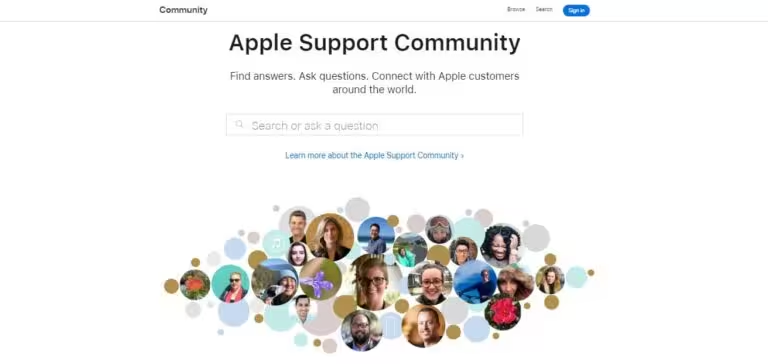
    Apple Support Community

    Apple’s community portal is a classic example of a customer portal. It is a forum-based portal that allows customers to ask queries and get answers instantly from others on the platform. It is most famous type of web portal.

    You can call it a customer-to-customer portal where users can get information about specific issues from others who have faced them or know a trick to solve them.

    Integrating AI-based chatbots can help you build customer portals that automate most user interactions. However, whether you use chatbots or not, getting the basics of your customer portal right is crucial.

    For example, adding FAQs is essential and pivotal for customer experience. A Salesforce report indicates that 39% of millennials check FAQs before interacting with a brand, indicating the importance of self-service resources.

    Corporate Portal

    The corporate portal is another online platform focused on centralizing access to company resources.

    Employees can access this portal to get information on company policies, access tools, and resolve their issues.

    A corporate portal often has features for user authentication, personalized dashboards, documentation, collaborations, effective communication, and advanced analytics.

    Some of the key benefits of a corporate portal for your company are,

    • It is a centralized repository for all your business information that employees need.
    • Corporate portals offer employees easy access to company information.
    • It allows employees to communicate with each other seamlessly with real-time interaction features.
    • Corporate portals can improve employee productivity by reducing the time needed to gather critical information.
    • You can integrate corporate portals into existing systems and automate critical tasks.

    Microsoft Sharepoint is one example of a corporate portal that provides a centralized platform for enhanced collaboration, data sharing, and content management.

    Similarly, you can use many off-the-shelf corporate portal software for your business. You can even build one from scratch leveraging web portal development services.

    Education Portal

    Educational portals are your personalized coaching platforms providing access to various resources. These portals are explicitly designed to facilitate online learning.

    It has materials and resources that are easy to understand for students provided through interactive features.

    Some of the types of educational portals that you may find are,

    • Online learning platforms provide access to educational content, courses, and resources online with a focused Approach to a specific subject or discipline.
    • University portals allow students to access resources and services offered by universities with the ability to interact with faculties.
    • Educative portals have lesson plans, educational games, and testing materials that students can use to study.
    • Professional development portals help educators and teachers upskill according to the latest innovations.
    • Parents portals are the ones that allow parents of students to manage learning. It will enable parents to access lessons on student resources and schedule essential assignments.

    Khan Academy is one of the most popular education web portals. It provides free educational resources for students across the internet.

    Experts created it to help students of all ages, covering subjects such as mathematics, science, and more.

    Informational Portal

    An informational portal can help users get information quickly. It also offers workflow management, providing on-demand public data access.

    These can be news or location-specific portals giving information for a particular region.

    A classic example is tourism portals, which allow travelers to gain insight into specific areas, including famous places, their history, and more.

    Some of the key benefits of using an information portal are,

    • Information portals offer data on various subjects, including news articles, research papers, ebooks, case studies, and more.
    • It prioritizes visual representation of the data for a better understanding of the users that access it.
    • Information portals help deliver personalized images, videos, and infographics tailored to user preferences.
    • Such portals enable enhanced communication through an instant messaging system that allows users to get information from their respective authorities.

    HR Portal

    Companies involved in internal human resource management activities mainly develop HR portals. These portals act as an access point for employees to get information on specific HR policies.

    Employees can also manage their leave applications and track the status of approvals.

    The features offered by HR portals make them a multi-functional tool for most businesses.

    For example, the HR portal offers features for job applicants to apply and track their application status.These are dynamic web portals that provide a multitude of modules for enhanced human resource management.

    Some of the key benefits of an HR portal are,

    • HR portals help new employees onboard quickly and efficiently with a personalized onboarding process
    • It allows employees to understand the company’s values, vision, and mission through handbooks and other materials.
    • HR portals also help employees understand social media policies and register complaints.
    • It also helps employees track their salaries and access salary slips and performance reviews.

    Ready to elevate your online presence?

    Start planning your web portal today for enhanced engagement and streamlined operations!

    eCommerce Portal

    eCommerce portals have been pivotal in transforming the way users shop online. It connects sellers and buyers online for transactions.Using eCommerce web portals, manufacturers and distributors can showcase their products online. Such portals streamline searching, comparing, and purchasing a product online.

    The impact of such portals is massive, with several businesses using them to go online. ECommerce sales are set to reach $7 trillion by 2027, indicating the importance of building web portals for your business.

    Key benefits of eCommerce portal

    • It unveils a wider market base for businesses other than the local vicinity of operation or the regional area of a specific country.
    • eCommerce web portals allow clients to roam and shop at their own convenience, thus improving customer satisfaction.
    • These websites help minimize the requirement of brick-and-mortar stores and other expenses like rent, electricity bills, and employees for the stores.
    • It enables incorporating big data solutions for recommendation systems and marketing of products & services.
    • eCommerce web portals include descriptions of products, their specifications and reviews on products, and comparison mechanisms that elevate online shopping.

    Sales Portals

    Sales portals are platforms that enable centralization of the sales activities for businesses. It is a digital platform designed to streamline the entire process of sales conversions.

    You can use sales web portals to enable the sales team access important data, resources and tools.

    It allows your team to enhance activities of prospective, nurturing leads, converting leads, and managing customer relationships.

    For example, Salesforce offers a web portal that comes with a suite of sales, marketing, and customer service tools.

    Key benefits of sales web portals,

    • Sales web portals are designed for modularization and customization for different sales activities
    • It provides ease of integration for different in-house applications like CRM and CMS
    • Sales web portals allow teams to handle dynamic content and personalize interactions
    • It also helps teams manage data of leads and documentation

    Government Portal

    Government portals are official web-based interfaces that enable citizens to access key policy information and civic services.

    They connect people with the government in a centralized and effective way, allowing citizens to enroll in government schemes.Such web portals can include:

    • Downloadable forms.
    • Web-based applications for civic services.
    • Directories of the public authorities.
    • Grievance registration platforms.

    Key benefits of government web portals

    • Government portals provide instant access to forms and applications under different schemes
    • Information on government policies and initiatives for the public is easily accessible through the portal
    • It allows online payment for civic services that the public avails from authorities.
    • Public service announcements become more efficient with such web portals.

    Healthcare Portal

    Healthcare portals act as an all-in-one solution for patients and professionals. It provides online communication between the patient and healthcare practitioners.

    Such patients with admit-to-discharge personal health information access, appointment scheduling, and online consultation facility.

    These portals optimize the administration of the healthcare delivery system. A key example is Electronic Health Records(EHR) portals, which enable patients to access records and communicate with physicians.

    This has become the new norm for healthcare professionals in the US, with more than 85% of them believing the EHR web portals are behind the improvements in patient care.

    Some healthcare web portals also allow patients to schedule appointments and professionals to manage them through the web portal.

    Key benefits of the healthcare web portals

    • Healthcare portals offer access to personal health records
    • It allows healthcare professionals to manage appointment scheduling
    • Such portals provide secure messaging for patients with healthcare providers
    • It improves prescription management for both patients and healthcare professionals
    • Patients can leverage the smart medication tracking features of a healthcare portal

    Community Portal

    Community portals are platforms designed to foster interaction and collaboration among people from all walks of life.

    They provide a space for members to share information, discuss topics of interest, and participate in community activities.

    These portals can be particularly useful for organizations looking to build a sense of community among employees or members.

    For example, community portals for animal welfare and art lovers can exist. Reddit and Discord are some examples of community portals where people connect, discuss, and share their views.

    Key benefits of community portals

    • Such portals offer discussion forums and blogs for community members
    • It also provides dedicated features for event calendars and announcements
    • Connecting with different people is made easier with member directories
    • Such web portals also provide resource-sharing facilities among members

    B2B Portals

    B2B portals, or business-to-business portals, are online marketplaces. These web portals allow businesses to engage in commerce with other businesses.

    They facilitate the exchange of products, services, and information. These portals help streamline the procurement process and enable businesses to collaborate effectively.

    So, why are these portals so important?

    Because B2B buyers are going online! 7 out of 10 B2B buyers prefer online buying, and this means developing a web portal makes sense.

    Key benefits of B2B portals

    • B2B web portals provide dynamic product catalogs and ordering systems
    • It offers supplier and buyer directories for better collaborations
    • B2B portals facilitate secure transaction processing, ensuring compliance with PCI DSS
    • Such tools allow businesses to compare different software services for their operations
    • It also allows businesses to find tools and equipment for their operations.

    FAQs

    Q1.Why is a web portal proper? Which are the examples of top web portals?

    Web portals are key components that gather and organize content for specific use cases. They are best for organizations that intend to create an integrated experience of access to various services. Examples of web portals include Yahoo, MSN, and Google, which offer a plethora of services like news services, emailing, and others.

    Q2.What are the types of web portals?

    You can divide web portals into vertical and horizontal ones. Vertical portals target one industry and deliver specific content and services. Horizontal portals offer a myriad of services and intend to address a massive user base.

    Q3.What is a partner web portal?

    A partner web portal is an online environment intended for partner cooperation. It serves partners such as vendors, customers, resellers, and suppliers. Such portals consolidate communication, leads, selling, and customer service.

    Q4.Is Google an example of a web portal?

    Yes, Google is a personal web portal used for information research and browsing. It also provides email, blogs, news, and maps services. Such an approach places Google in the context of a relatively ‘flat’ resource, which provides you with various content and instruments all in one place.

    Q5.What is a vertical portal?

    Vertical web portals are a type of business that is target-oriented. They provide specific materials for the target audience. For example, if you are a healthcare organization, EHR portals help patients and professionals access health records. This is a classic example of a vertical portal.

    Q6.What are employee web portals?

    An employee web portal is an online platform that consolidates information and an organization’s resources. It improves communication and cooperation within an organization. These portals minimize friction between employees and management by clarifying policies and access to vital information.

    Build a Web Portal for Your Business

    Creating a web portal can open up new avenues for your business to interact with users and personalize experience. It can also help you streamline operations, information sharing, and address customer queries.

    However the kind of benefits you get from web portals differ from one type to another. So you need to align the type of web portal you want to develop with your niche and then decide on developing it.

    If you are looking to develop a web portal for your business without all these hassles, Zennaxx can help. Get your estimate of the web portal project now.

    Read Also: 

  • Software Business Models: What Works for Your Product?

    Software Business Models: What Works for Your Product?

    People consider the software industry to be one of the most creative and rapidly changing landscapes, especially in terms of business models.

    Deciding what business model to use is not an easy task considering the numerous options that businesses have.

    Before selecting the model that is best for them, software companies will need to think about a lot of different things.This article aims to serve as a tutorial for the major software business models currently in use. The aim is to support leaders in their decisions to choose the most appropriate option for their firms.

    Our main goal is to give a thorough explanation of all the reasons for and against each model. We compare them so that software companies can choose the best model and stay safe.

    What is a Business Model?

    The first step in choosing the right business model for your software company is to know what the main goal of the company is.

    A business model is like a road map that shows how the company plans to get its products valued.

    It explains how you can make money, improve your business, and give your customers something of value. This also becomes the methods and regulations that the company’s leading team uses to guide the operation of the company.

    A well-developed business model needs to concentrate on:

    • Their chosen target customers
    • Specific fields in which they will concentrate
    • Products and services that they will offer
    • We are going to market and sell these products and services.
    • The potential costs and risks that your company might be faced with
    • The revenue you hope to make
    • Your plan on how to generate and keep a profit

    Each business model (BM) is unique in its structures and the approaches to the points discussed above for realization of the company’s aims.

    One important step in choosing the best business model for a software company is to look at the advantages and disadvantages of each model.

    Choosing Between Different Types of Business Models

    Choosing the right business model is revolutionize decision for any software company. The choice depends on several factors. These include software, target market’s needs, and long-term business goals.

    Key considerations include:

    • Revenue Streams: Will you make money from one-time sales, subscriptions, or a freemium model?
    • Customer Engagement: How will you interact with your customers? Direct sales, channel partners, or online platforms.
    • Scalability: Can your model support growth and adapt to market changes?
    • Cost Structure: What are the costs of developing, distributing, and maintaining your software?

    By evaluating these factors, you can consequently choose a business model that will maximize your success and, furthermore, align with your business strategy.

    Once you know the platform’s use case and its business model, you can only look ahead to further success.

    On-Premise Business Models

    The on-premise business model is a traditional approach in the software industry. This means selling software licences to customers. They then install the software on their local servers or computers.

    Key Features of On-Premise Business Models:

    • Control: Customers have complete control over their data and the software environment.
    • Customization: Software can be built as per the business needs.
    • Security: Data is stored locally. This benefits industries with strict privacy rules.
    • Upfront Costs: Usually, it means higher initial costs for the customer. They must buy hardware and software licences.
    • Maintenance: Customers must maintain and update the software. This may require dedicated IT staff.

    The on-premise model offers great control and security. But, it requires a big investment and resources from customers.

    This model is popular in finance, healthcare, and government. There, data security and compliance are vital.

    Cloud Software Business Models

    The cloud software business model has changed the way software is used in the business that is consumed and delivered.

    In this model, software and services both are hosted on remote servers that can be accessed over the internet.

    It helps users to use the platform smoothly without the need for software and application installation. As a result, many businesses now adopt cloud software models due to their numerous benefits.

    Key Features of Cloud Software Business Models:

    • Accessibility: Software can be accessed from anywhere with the internet. It enables remote work and collaboration.
    • Scalability: Resources can be increased as needed. It ensures performance without an investment.
    • Cost Efficiency: It’s a pay-as-you-go subscription. Use it as needed.
    • Automatic Updates: The provider regularly updates the software. This gives customers the latest features and security patches.
    • Reduced IT Burden: Cloud providers manage infrastructure. This lets customers focus on their core business.

    Software As A Service (SaaS) Business Model

    Software as a Service business model is most demanded. It delivers software application platform usage on the subscription basis.

    Customers can use the SaaS business model by taking a subscription plan and using it through web browsers to access the software. It decreases the installation hassle and overall space maintenance on the device.

    Key Features of the SaaS Business Model:

    • Subscription Pricing: Customers can make a payment annual and monthly for using the software that gives the predictable revenue management in the company.
    • Multi-Tenancy: A single software instance serves multiple customers. This saves costs and uses resources efficiently.
    • Accessibility: Users can access the software from any internet-enabled device. This promotes flexibility and mobility.
    • Automatic Updates: The provider handles all updates and maintenance. Users will always have the latest version, without disruptions.

    IaaS and PaaS Models

    IaaS (Infrastructure as a Service)

    It gives the virtualized computing resources on the internet that consists of servers, storage and overall networking. In simple terms, it is a rent IT system. It offers pay-as-you-go flexibility and scalability without hardware investment. It is the more reliable business model for most of the business structure as it is more convenient.

    IaaS was over a quarter of the cloud market where public cloud IaaS revenue increased $115 billion in 2022 to over $180 billion by 20224.

    Boost Your Business with Custom Software

    Empower your business with our custom software. Get started today—contact us for a free consultation!

    Infrastructure as a Service

    • Key Benefits: It can scale resources, cut hardware costs, and charge only for what is used.
    • Use Cases: For businesses that need control over their infrastructure.

    PaaS (Platform as a Service)

    PaaS provides a cloud-based development and deployment environment. Additionally, it includes tools, libraries, and services. This allows developers to build, test, and deploy apps without needing to manage the underlying infrastructure.The overall cloud computing market is expected to grow in the upcoming next few years. It is seen to slightly decrease in the year of 2017. The global market of public cloud services is overall projected to exceed $675 billion.

    Overall cloud service market is filled by 20% and it is considered to be one of the dominant segments. The PaaS market has surpassed $145 billion in revenue.

    Platform as a Service (PaaS):

    • Key Benefits: It speeds up development. It does this by providing pre-configured environments. It reduces the complexity of managing hardware and software. It also supports collaboration among development teams.
    • Use Cases: Great for developers who need to build apps fast. They should not worry about the underlying infrastructure.

    IaaS and PaaS have distinct advantages. They can combine with SaaS to create full cloud solutions.

    This will provide advanced features to run and manage the business. Moreover, these models offer the flexibility and efficiency to support modern businesses. Consequently, they enable innovation.

    Hybrid Software Business Models

    Hybrid software business models mix different models. This business model is one of the flexible approaches that is satisfying the diverse customer needs.

    Overall this business offers both, on-premise and cloud-based software. Customers choose the option that suits them best according to their business needs.

    Additionally, hybrid software business models serve the best of both worlds to users.It has the scalability and cost-efficiency of cloud services.

    Combining these approaches lets businesses reach a wider audience. They can also adapt better to changing market demands.

    Microsoft Office and cloud-based Office 365 are examples of Hybrid Software Business Models.It allows customers to choose between installing the software or using it online.

    It is accessed according to preference and needs further.

    Software Licensing Business Models

    Software licensing business models focus on how software is sold and used.

    The traditional approach sells licenses to customers. This grants them the right to use the software under certain conditions.

    Licensing is perpetual or a subscription-based where customers can pay one-time free to use it for lifetime.

    This model ensures customers can legally access the software. It also gives a clear way to generate revenue.

    One of the most used platforms is Adobe Creative Cloud. It is a subscription-based licensing model.

    Customers can pay monthly or annually to use the software. The recurring subscription automatically updates new features.

    Proprietary Software Business Model

    The proprietary software model involves selling software. The developer can control it with easy maintenance. Customers purchase licenses to use the software but do not have access to the source code.

    Proprietary software often includes dedicated support and updates. It gives customers a reliable, secure solution. Apple sells its macOS operating system as proprietary software.

    Customers buy Macs with macOS pre-installed. They cannot access the source code and must buy licenses to use it.

    Open Source Software Business Models

    Open-source software business models make the source code public. It must be free. Users can download, use, modify, and distribute the software without paying for it.

    Companies using this model usually earn money through support, custom work, or dual licensing.

    The latter offers a proprietary version. Open-source software boosts community collaboration and innovation. It often leads to strong, popular solutions.

    All websites are built on WordPress. It is an open-source content management system.

    It allows users to download and modify the software for free. Companies tend to make money by selling premium themes, plugins, and support.

    Other Software Licensing Business Models

    Various other software licensing business models cater to different needs. For example, freemium models offer basic features for free. They charge for advanced functions.

    Pay-per-use models charge customers based on their usage, providing flexibility and cost-efficiency. Site licenses let organizations use the software, at multiple sites, for a single fee. These diverse models offer options.

    They can be tailored to meet specific customer needs and market conditions. Spotify has a freemium model.

    Basic music streaming is free. Users can pay for a premium subscription. It adds features, like offline listening and no ads.

    Target Audience Business Models (B2B & B2C)

    Target audience business models focus on the software’s users: businesses (B2B) or consumers (B2C). B2B models serve other businesses.

    They provide specialized, high-value solutions that boost efficiency and productivity. B2C models are for individual consumers. They typically offer easy, cheap software

    First, know your target audience. This understanding helps you tailor your business model to better meet their needs and expectations. Consequently, this will lead to greater market success.

    Salesforce, B2B customer support platform is specifically designed for the particular set of target audience that is B2B and B2C companies.

    Similarly, Netflix that we use to watch movies and series where consumers can use it for streaming and avail of services directly from the web as well as by downloading applications.

    Software Revenue Business Models

    Software revenue models are ways businesses make money from their products and services.

    Many software companies prefer to incorporate connectors based on these models into their products, making them popular among large customer communities.

    Here are some of the major business models and revenue streams:

    Paid Apps & License: The company charges customers for installing and using the software. About on-premise software, this is normally a one-time, upfront fee.

    In-App Advertising: the app is free to users but the company makes the profit by selling advertising for the app. The following are some familiar advertising companies: Facebook and Twitter. It may be in a similar concept, including sponsored content online.

    In-App Purchases: Users can download the app for free but they have the option to purchase various products and services within the app. This is regularly applied on e-commerce apps.

    Subscriptions: Users remunerate a due at intervals as prescribed, monthly or annually, in order to the app and its facilities. Technically, users rent the software instead of buying it. This method is likely to be a combination of free trials and a freemium approach where simple features are available for free and advanced ones are on a payment basis.

    Usage-based Model: The company charges customers based on how much they use the product or service. This type of business model is common in B2B products.

    Transaction Fee: Companies get a small percentage from every purchase made through their portal. An illustration includes eBay or Uber.

    Charges for Support and Consulting: Revenue sources primarily stem from offering specialized and non-common services. For example, these include custom software development or consulting for corporate clients.

    Combining Business Models

    Combining business models can give a strategic edge. It can meet diverse customer needs. For example, a company might use a freemium model to attract many users.

    Then, it would offer premium subscriptions for advanced features. They could also combine B2B and B2C approaches to maximize market reach.

    By blending different models, businesses can create flexible, strong strategies.

    These will drive growth and adapt to market changes. LinkedIn has a hybrid model. It offers a free basic service to users. It sells premium subscriptions and tools to businesses for recruiting and marketing.

    Finding the Right Business Model and Staying Protected

    It is a must that you be patient and persistent while reviewing each model and then analyze how each of these software business models could help in achieving your objectives.

    The growth of your business will most probably bring about the need for you to change your operation mode so that you will be able to meet the new challenges and avail of the new opportunities.

    This means that sometimes you might have to go with different software business models.

    You should choose a model that works best for what you need now, and additionally, always be open to the changes that may be required in the future. Indeed, every software business model comes with its own unique challenges.

    Software business development is the best way to overcome these business challenges. Choosing the best software development service can help you find your best solution.

    In order to help your business keep up with the competition and adapt to changing market needs, Zennaxx Technology is, therefore, a top provider of cutting-edge software solutions.

    Read Also: 

  • Product Development Process: a Comprehensive Guide

    Product Development Process: a Comprehensive Guide

    It begins with the ideation stage until the new product is launched. However, the lack of clarity makes this process challenging for most startups and businesses.

    Every aspect needs clarity, from what functions a new product can have to the development approach you can use. Understanding the target audience, current market demand, and what your competitors offer is key to planning new product development.

    This article will focus on development approaches, challenges, and expert tips to help you plan, develop, and launch a new product.

    What is New Product Development?

    New product development(NPD) brings a vision or idea to life or even improves an existing entity on a functional level. Developing a product can involve building one from scratch or tweaking existing products for a better experience.

    It is one of the crucial aspects that many companies focus on to extend customer offerings. NPD goes beyond designing and developing an idea. It encompasses planning, designing, developing, deploying, and marketing a new product.There are several reasons for companies to invest in NPD like,

    • Keeping up with the change in customer demands
    • Bringing new features and providing more services
    • Entering a new market that is not serviceable with existing products
    • Create new revenue streams by building new products.

    Whatever your reason for investing time, resources, and money into the new product development project, there are specific considerations to make.Planning and executing each stage is crucial, especially if you are developing an idea into a full-fledged product.

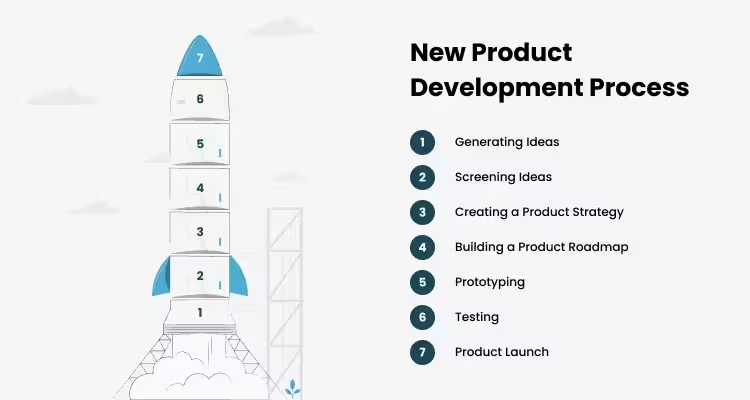
    7 Stages of New Product Development

    When you develop a new product, the process can vary from others based on what approach is used.However, you can break the entire process into seven stages, which are typical for most organizations. 7 Stages of New Product Development

    Generating ideas

    Generating ideas is a stage where you discover new concepts and avenues. Problem research is especially central to idea generation. Questions like what is the main problem that your solution will solve? Or how to solve the problem, keeping a user-centric approach can clog your mind.

    However, with effective brainstorming and market research, you can generate more innovative ideas to solve a problem.

    So here are some techniques that you can use for idea generation

    Mind Mapping

    This method helps teams sort out complex data related to a specific concept.You can start with a central idea, like a product’s name, and draw branches for meta elements like design, marketing, development process, etc.Further, smaller branches for specific tasks should be added. It allows teams to visualize how different elements in the ideation process are connected.

    Blue Sky Thinking

    Blue sky thinking is a brainstorming technique where team members generate the maximum number of new ideas without worrying about feasibility.

    Ideas can be better initially, sparking newer and bolder decisions. This approach lets your team members express new ideas without focusing on the outcome.

    Brainwriting

    This method focuses on acquiring different perspectives on new product development. Every idea is jotted down on a sheet of paper.The sheet is passed around in the circle, and teammates test each other’s ideas, adding new perspectives.

    SCAMPER

    SCAMPER stands for Substitute, Combine, Adapt, and Makeover, which helps you generate new ideas or reimagine existing products.This method is best for improving existing products because it allows teams to think of a service or product from multiple perspectives.

    Synectics

    This is the method used to remove idea blocks that every team experiences. Most teams follow specific patterns, ending up with the same repeated set of ideas.Using synthetics, you can create unrelated analogies and boost creativity. You can generate different ideas using the above methods, but screening them is crucial because only some ideas are worth your time and money.

    Screening ideas

    In this stage, teams analyze many ideas based on impact, effort, and feasibility. Screening the ideas is the key to moving to the next phase of strategizing new product development.

    So, what’s the most optimal approach for screening ideas?

    There is no one method that you can follow. However, using multiple approaches and a little A/B testing will be enough.For example, you can use a SWOT analysis of each idea and a competitive analysis.Further, you can test each idea in different scenarios and analyze the results with pre-defined metrics. You must align each metric with the key business objective and market demands.

    Creating a product strategy

    Once you select an idea, the next and most crucial step is creating a new product development strategy.This will concisely define the product’s requirements, positioning, features, and benefits. Your strategy document will be a steadfast anchor for the next stage- roadmap creation.

    Building a product roadmap

    Creating a product development roadmap is simply an action plan for your project. It will outline the activities, functionalities, and short—and long-term efforts needed. Creating the roadmap is crucial to new product development. If your team has a roadmap, the efforts will go right.So, even after spending so much time and money, you will not have the results expected at the start of the project.

    Prototyping

    The next stage is prototyping, which involves creating and testing a prototype of your new product.You need to ensure that the entire testing process is comprehensive, and this is where prototyping efficiency becomes pivotal.Create multiple prototypes and conduct A/B tests to better understand product functions and performance.

    Testing

    Once the prototype is ready, extensive tests are essential for optimal results. You must ensure your product’s functionality is tested well before users interact.

    Imagine your product being showcased to users; a bug simply makes it redundant. Recently, MKBHD or Marques Brownlee made a video reviewing the Humane AI Pin, which destroyed the reputation of this new product.

    Such cases show the importance of testing. If you don’t test your product well, considering different scenarios, your startup can suffer grave reputational damage.

    Product launch

    An English phrase commonly used in conversations is “first impression is your last impression.”This is true not just for a person but also for a product. It will harm your business objectives if you can’t make an impression with the product launch.

    This is an inherent process, as all your teams, including sales, marketing, and product delivery, will align the brand’s final messaging according to the roadmap. So, you must have a solid new product development roadmap for optimal launch.

    While creating a roadmap, you must also focus on designing, developing, and delivering the product.Each activity needs to align with the kind of product you want your target audience to perceive.

    Main Types of Product Development

    Product development types can differ based on the specific industry or domain your startup belongs to.

    For example, you can choose from software product development types if you are a tech business or startup.

    These types are,

    Waterfall Development Approach

    The waterfall development approach is the conventional method in which your team follows a specific sequence.

    It is a process that involves conceptualization, initiation, analytics, design, development, testing, quality assurance, deployment, and maintenance.

    All the above steps will be in a specific sequence. To develop a new product, your ideation stage must be executed appropriately.Similarly, every stage will depend on the previous one. This method suits startups with thorough, accurate, and specific project details. With a waterfall development approach, there is no room for flexibility.

    Agile Development Approach

    The agile development approach has transformed the way new products are developed.It is an iterative and incremental approach in which teams develop products to ensure continuous improvements. Startups looking to develop software-based new products can significantly leverage the agile development approach.Software teams can also use this approach to ensure regular feedback integration. This also allows startups to extensively test new products before launching them so that users can interact with them.

    Ready to transform your vision into reality?

    Our expert team is here to guide you through every step of new product development, from concept to launch.

    Lean Development

    Lean development is an approach that focuses on minimizing resource waste and maximizing value.Startups can optimize resources and reduce costs through this approach, especially for new product development.

    You can create lean teams that offer continuous improvements, ensuring efficiency when developing a new product.Leaner teams can work faster because such a structure makes approvals for product design and roadmaps easier. With leaner teams, the hierarchical structure is smaller, making your decision-making process rapid.

    This is crucial for any business, as transforming the idea quickly into a product can be fruitful.

    Kanban Approach

    Kanban is an approach to project management that visualizes project management with streamlined workflows.It follows lean manufacturing practices and focuses on improving efficiency, collaboration, and productivity.

    New product development requires a transparent and adaptable approach. Kanban development helps startups enhance product efficiency, eliminate bottlenecks, and deliver more value.

    Here are some key examples to help you understand how these types of new product development are developed.

    Example of New Product Development

    Understanding successful new product development efforts can provide valuable insights on how you can replicate the same.

    Here are some examples of practical strategies and practices in the NPD process.

    Netflix

    From the humble DVD rental business, Netflix has evolved into one of the most prominent OTT streaming services.

    This reveals their flexibility in considering market trends and consumer needs.However, the evolution of Netflix is attributed to the NPD process, where the following strategies took centerstage,

    • Netflix’s strategy focuses on one main principle: decreasing user friction and constantly adapting to this space based on these insights.
    • Netflix’s transition from licensing to creating original programs and a consumer-driven comprehension of the subscription model-related changes have been pivotal.

    This has resulted in the formation of an evergreen product, which has been successful for several years.

    HubSpot

    HubSpot was a CRM software with features for effective marketing and sales automation.

    Having received the customers’ data from the CRM, HubSpot realized what features could be added concerning the commonality of marketing, sales, and support.Further, its Inbound Marketing strategies were closely tied to product objectives, and consequently, the tools created reflected the audience’s needs.

    Such approaches helped HubSpot create a well-integrated ecosystem that organizes CRM and content for marketing.

    Dropbox

    Dropbox began as a file-sharing service and has evolved into a robust organizational tool that addresses team collaboration issues.

    It uses user feedback to identify pain points and has rolled out features like version history and Dropbox Paper to enhance collaboration.

    Dropbox encouraged innovation based on user interactions with the product by keeping an open feedback loop for all team members.

    This focus on turning user pain points into actionable features enabled Dropbox to grow its product suite, including the successful launch of Dropbox Business for teams.

    Every successful startup or business creating a new product has faced challenges. This can be due to a need for clarity in scope or accuracy when estimating development efforts.

    Three Challenges Teams Encounter in the New Product Development Process

    Developing new products is a prerogative for many enterprises and startups to meet market demands.However, such enterprises must overcome multiple challenges affecting the final product’s quality.

    Here are three significant challenges teams encounter during the NPD process:

    Clarity of Requirements

    A significant challenge that most startups and enterprises face while developing a new product is to finalize the requirements.

    Why is this so important?

    So, the requirements must first be defined if you are developing a new product using a conventional approach like waterfall development.Without a clear definition of requirements, the process will become suboptimal, leading to low-quality products.

    Even if you use a flexible approach like agile, clearly defined objectives are essential to maximize gains.However, most teams need help to create comprehensive requirement documents. The key reason is the need for more clarity on the new product’s core functionality and features.

    Estimating the development effort

    If your requirements are unclear, the scope of your project will be vague, leading to the second most significant challenge: Development estimations.

    Estimating your development efforts can be tricky, especially if you need to know the project’s scope and requirements.

    You also need extensive information on what features the product will need before estimating the development efforts. You need to know

    • Tools required
    • Resources needed
    • Workforce requirements
    • Complexity of functions
    • Definition of key objectives

    Once you have all this information, estimating the development efforts can be easier.

    Siloed teams

    The modern era of new product development has been pushing the culture of distributed structure.In such an approach, several distributed teams work independently on specific tasks, which are then merged to offer a suite of products. While this seems an efficient approach, it leads to the challenge of siloed teams with tools exclusive to specific team members only.

    The best way to overcome this challenge of siloed tools is to embrace the DevOps approach. It allows you to break the boundaries of teams and create a unified team.

    Another key benefit of using the DevOps approach is faster development of new products.However, before embracing the DevOps philosophy, you must understand precisely how long your product will take to develop.

    How Long Does New Product Development Take?

    Typically, any new product will take a few weeks to sometimes more than nine months, depending on specific business needs.

    If you consider digital product development, it can take 1-3 months, depending on its complex features. Some of the crucial factors to consider while estimating the timeline for new product development are,

    Ideation Time

    is the total time spent on brainstorming, idea generation, feasibility tests, and finalizing the scope.

    This stage is a significant one for most startups, and that is why it can take more time.This stage is crucial for the core business definition and drawing a roadmap for the entire NPD process. So, the extra time you need to complete this stage is justified.

    Design Time

    is the time needed to design a product, which can be between 2 and 3 weeks. This stage allows businesses to envision their product and ensure a superior user experience.

    Therefore, whatever time you spend on product design needs to be focused on improving the user’s knowledge and interaction with it.

    Development Time

    is one of NPD’s most significant time-consuming processes. Estimating development time can be complex, especially using an iterative approach.

    Agile methodology involves continuous testing and development, which means several phases of developing and testing an iteration.

    However, if you want an estimate, a simple product can’t take around 1-2 months to build. Complex products need more time.

    Expert Tips for New Product Development

    Overcoming the challenges of new product development takes efforts beyond NPD’s usual activities.It requires understanding the target audience, improved collaborations, and optimal resource usage.

    Understand the customer

    It is no rocket science for any startup or enterprise to understand that product development needs to be customer-driven.

    Understanding the target audience becomes essential for new product development if not a staple.

    Conduct extensive customer surveys to understand their pain points and build a unique selling point (USP) targeting your product.The USP must align with the customer pain points to ensure maximum market impact.

    In-depth Competitor Analysis

    Knowing your competition is the second-best approach to NPD.

    Your target customers may already be engaging with competitors or existing brands.Analyzing your competitors will help you gain insights into existing products’ great and bad aspects. Competitor analysis will also help you ensure the product has all the functions needed to compete in the market.

    And this is not just an on-off activity; you need to continuously monitor competitors throughout the NPD process and even after launching it.

    Use MVP Approach

    This is the best expert approach in the current era of extreme criticism that your product can attract at launch.

    A Minimum Viable Product, or MVP, is an approach where you first build a shippable product version.

    It will have essential features, but new versions will introduce non-functional features. So, users will have a lighter version of the product that will provide them with all the necessary functions and features.It allows startups and enterprises to get feedback on the basic features and quickly adjust to improve user experience.

    Define Key Roles

    Whether using the DevOps approach or not, you must understand the importance of defining roles.New product development is a team effort, and your NPD process can only improve with a proper definition of roles across teams. Defining each member’s responsibility will help ensure better task and resource allocation, improving productivity and low-cost development.

    Focus on Product Lifecycle Management

    Your NPD process needs to be completed when you launch the product. But it begins at the launch.Yes, product development and launch are just the initiation of a lifecycle where each stage is essential.

    Establish a dedicated team to monitor product performance and insights from customer feedback.

    This team will ensure that all customer feedback is integrated repeatedly to provide an enriched experience and that product performance is up to the mark.

    Conclusion

    New product development has several challenges, from lack of clarity to estimating accurate development efforts.However, you can create a successful product with a streamlined and efficient NPD process.However, you need not just analyze your target audience but keep tabs on what competitors are working on while constantly creating a product that fits the market. Doing all of these while you are still a startup can be challenging. You will have to create dedicated teams to ensure continuous improvements.Further, you must develop prototypes and extensively test the product before launching it.

    Even after the launch, you must maintain efficiency throughout product lifecycle management.

    Zennaxx can help you avoid all such hassles through custom product development solutions. Get an estimate for your new product development now.

  • 4 Different Types of Software Maintenance [A Detailed Guide]

    4 Different Types of Software Maintenance [A Detailed Guide]

    Software maintenance is an important aspect of the software lifecycle. As technology evolves and user expectations grow, software maintenance becomes increasingly important.

    Whether it’s fixing bugs, updating features, or enhancing performance, regular maintenance is crucial to keeping your software relevant and reliable
    And understanding the different types of software maintenance can help you improve the performance and longevity of your software. In this post, you will learn:

    • The four main types of software maintenance and their purposes
    • How to apply different types of maintenance
    • Best practices and strategies to overcome common maintenance challenges Let’s dive in.

    What is Software Maintenance?

    Software maintenance involves updating and improving a software application after it has been released.

    This process is essential to ensuring your software stays relevant and continually runs smoothly. Maintenance ensures that your software remains useful and effective, even as technology and user requirements change.Without maintenance, your software can become obsolete, insecure, and unable to meet the needs of its users.

    Though some people might think software maintenance is just about fixing bugs, it includes much more. It involves optimizing software performance, adding new features, adapting to new environments, etc.

    Understanding the full scope of maintenance helps you appreciate its value and plan for it effectively.

    Overview of the Software Lifecycle and Where Maintenance Fits In

    The software lifecycle includes the following stages: planning, development, testing, deployment, and maintenance.

    Maintenance is the final stage but it lasts the longest because it’s ongoing. It is a continuous process that begins once the software is deployed and lasts until it is no longer in use.

    After you deploy your software, maintenance ensures that it remains useful and functional. Without regular maintenance, your software application can develop issues that result in more significant problems later.

    Types of Software Maintenance

    Software maintenance can be divided into four main types. Each type serves a specific purpose and is necessary for different reasons. Let’s explore each of them:

    Corrective Maintenance

    Corrective maintenance involves fixing bugs and errors found in your software after it has been released. Think of it as patching up holes in a road.These errors could be things like software crashes, glitches, or security vulnerabilities that need immediate attention.

    For example, if users report that a program crashes every time they try to save a file, corrective maintenance would address this issue to prevent further disruptions.This ensures that your software continues to function properly and provides a good user experience.

    Adaptive Maintenance

    Adaptive maintenance involves updating your software to work in new or changing environments.This could be due to updates in the operating system, hardware changes, or new laws and regulations that the software must comply with. Imagine you have a mobile app that needs to be updated because a new version of the operating system has been released.

    Adaptive maintenance would ensure that your app continues to work seamlessly on the new OS, so your end-users can enjoy a smooth experience.

    Perfective Maintenance

    Perfective maintenance focuses on improving and enhancing your software. This type of maintenance aims to increase user satisfaction and software performance.It might involve adding new features, improving user interfaces, or optimizing app performance.

    For example, if users suggest adding a new search feature to your software, perfective maintenance would involve designing and implementing this feature.By continuously improving your software, you can meet the evolving needs of your users and keep them satisfied.

    Preventive Maintenance

    Preventive maintenance aims to prevent potential problems before they occur. This involves regular monitoring and updates to ensure that your software remains stable and secure.Think of preventive maintenance as regular health check-ups for your software application.

    It might involve updating security protocols, optimizing code, or conducting performance tests.By being proactive, you can avoid major issues down the line and ensure the long-term health of your software.

    Importance of Software Maintenance

    Maintenance is necessary to ensure that your software remains functional, secure, and efficient. As technology evolves and user needs change, you need to update your software to ensure it remains relevant. Regular maintenance helps prevent security vulnerabilities, improves performance, and ensures that your software continues to meet user needs.

    And software maintenance can help you reduce downtime and save costs in the long run by addressing issues on time before they result in bigger problems.

    Don’t Wait for Downtime

    Protect your investment with expert maintenance—ensure peak performance and seamless operations. Schedule today!

    Challenges in Software Maintenance

    Maintaining software is not without its challenges. Here are five key challenges that can impact the effectiveness of software maintenance.

    Complexity of Software Systems

    Modern software systems are often highly complex, with numerous interconnected components. This complexity makes identifying and fixing issues difficult, requiring specialized knowledge and tools.

    Solution: Use modular design principles and comprehensive documentation to simplify the maintenance process.

    Disruption to Business Operations

    Coordinating with users and other stakeholders to schedule maintenance without disrupting operations can be tricky.Also, maintenance activities can sometimes disrupt business operations, leading to downtime and lost productivity.This can be particularly problematic for businesses that rely on continuous software availability.

    Solution: Schedule maintenance during off-peak hours to minimize disruption. Use rolling updates and phased deployments to ensure continuous availability and reduce downtime.

    And maintain clear communication with users.

    Legacy Systems

    Maintaining older, legacy systems can be particularly challenging. These systems may lack proper documentation, have outdated technologies, and be poorly understood by current developers, thereby complicating maintenance efforts.

    Solution: Gradually modernize legacy systems by updating components incrementally. Also, maintain thorough documentation and provide training to current developers on legacy technologies.

    Dependency on Third-Party Components

    Many software applications rely on third-party libraries and components. Keeping these components updated and ensuring compatibility can be challenging, especially when third-party updates introduce new issues.

    Solution: Regularly monitor and update third-party components. Establish a testing environment to assess the impact of updates before deploying them to production.

    What is Software Reverse Engineering?

    Software reverse engineering involves analyzing a software application to understand its design and functionality.

    This process helps you see how the software works, even if you don’t have the original source code. This may involve decompiling the code, studying its structure, and identifying how it works. Reverse engineering is often used in software maintenance to understand and fix issues, especially when documentation is lacking or the original developers are unavailable.

    For instance, if you inherit a legacy system without proper documentation, reverse engineering can help you understand its structure and functionality.Then you can use this knowledge to effectively maintain the legacy application.

    Benefits of Reverse Engineering

    Reverse engineering helps you update or fix software when you do not have detailed information about its original development. Basically, it helps you:

    • Figure out how to safely and effectively make changes to your software
    • Understand and fix bugs, optimize performance, and add new features
    • Recover lost documentation, understand legacy systems, and ensure compatibility with new technologies

    Advantages and Disadvantages of Software Maintenance

    Now let’s explore some advantages and disadvantages of software maintenance to help you make informed decisions about managing your software. Here are five key points for each.

    Advantages of Software Maintenance

    Improved Performance

    Regular maintenance ensures your application runs efficiently and enhances performance. This helps you retain more users and maintain a competitive edge.

    Enhanced Security

    Software maintenance helps you identify and fix security vulnerabilities in order to protect your application from potential threats. With this, you can prevent major issues such as data breaches, financial losses, legal issues, and damaged reputations.

    Extended Software Lifespan

    Through regular updates and optimizations, maintenance extends the lifespan of your software. This maximizes your initial investment in building or purchasing the software and delays the need for costly replacements or redevelopments.

    User Satisfaction

    By addressing bugs, adding new features, and improving usability, maintenance increases user satisfaction. And happy users are more likely to continue using your application and recommending your business to others.

    Compliance with Standards

    Regular maintenance ensures your software complies with industry standards and regulations. Compliance reduces the risk of legal issues and penalties, ensuring your business operations run smoothly.

    Disadvantages of Software Maintenance

    Cost

    Maintaining software can be expensive sometimes. The maintenance process might require ongoing investment in resources, tools, and skilled personnel.

    Complexity

    Software maintenance can be complex, often requiring specialized knowledge and skills. This complexity can make the maintenance process challenging and time-consuming.

    Potential for New Issues

    While fixing existing problems, maintenance can sometimes introduce new issues. This can lead to additional work and unforeseen complications.

    Dependency on Original Developers

    Effective maintenance may require knowledge from the original developers, who may no longer be available. This can complicate the maintenance process and increase dependence on existing staff.

    Comparison of the Different Types of Software Maintenance

    To help you understand the differences between the types of software maintenance, here is a comparison table summarizing the key aspects of each type:

    Type of Maintenance Definition Purpose
    Corrective Fixing bugs, errors, and defects in the software. For example, repairing a feature that does not work as expected. Ensure the software functions correctly and reliably.
    Adaptive Updating the software to work with new environments, platforms, or operating systems. For example, making the application compatible with a new OS version. Maintain compatibility with changing technologies and environments.
    Perfective Enhancing the software by improving performance, usability, or adding new features. For example, introducing a new feature based on user feedback. Meet evolving user needs and improve the overall user experience.
    Preventive Making improvements that reduce the risk of future issues. For example, optimizing code, refactoring, or strengthening security. Reduce the likelihood of future problems and improve long-term maintainability.

    Best Practices in Software Maintenance

    Following best practices in software maintenance ensures that your software remains efficient, secure, and user-friendly. Here are some best practices to help you maintain and improve your software:

    Regular Maintenance Schedules

    Establish and stick to regular maintenance schedules to keep your software updated, secure, and performing well. This prevents issues from accumulating and ensures continuous improvement.

    Use of Automated Tools

    Leverage automated testing and monitoring tools to identify and address issues quickly. These tools can help streamline the maintenance process and reduce the risk of human error.

    Comprehensive Documentation

    Maintain comprehensive and up-to-date documentation for your software. This aids in understanding the software’s structure, making maintenance tasks easier and more efficient.

    User Feedback Integration

    Regularly gather and integrate user feedback to improve your software. This feedback helps ensure that your software continues to meet user needs and remains relevant.

    Proactive Issue Identification

    Implement proactive measures, such as performance monitoring and security audits, to identify potential issues before they become critical. Being proactive helps you maintain the stability and security of your application at all times.

    Conclusion

    No doubt, software maintenance is essential for improved performance, enhanced security, and user satisfaction.Ensure you have a regular maintenance schedule to stay ahead of potential issues, extend your software’s lifespan, and ensure its long-term success.Ready to maximize the value of your application through effective software maintenance?
    Contact Zennaxx today for reliable software maintenance services that enhance performance, improve security, and ensure long-term user satisfaction.

    Read Also: 

  • Custom Hospital Inventory Management Software in 2024

    Custom Hospital Inventory Management Software in 2024

    Hospital inventory management software is a critical aspect of healthcare administration. Proper management of inventory ensures that hospitals can provide uninterrupted patient care, maintain safety standards, and operate efficiently. Without it, hospitals may face significant challenges, including shortages of essential supplies, wasted resources, and increased operational costs.In this post, you will learn:

    • Why hospital inventory management is important for patient care and operational efficiency.
    • The challenges hospitals face without proper inventory management.
    • How hospital inventory management software can help overcome these challenges.

    Let’s dive into the details of hospital inventory management and discover how you can optimize your hospital’s inventory system.

    What is Hospital Inventory Management?

    Hospital inventory management refers to the systematic approach of ordering, storing, tracking, and controlling the supplies, medications, and equipment used in a healthcare facility.

    It includes everything from surgical instruments and medical devices to pharmaceuticals and everyday consumables.Effective inventory management ensures that you have the right items in the right quantities at the right time.

    It involves maintaining accurate records, forecasting demand, and ensuring timely replenishment.This process is particularly important in hospitals because the availability of supplies directly impacts patient care and safety.

    Types of Hospital Inventory

    Let’s briefly take a look at the types of inventory that hospitals maintain.

    Understanding the different types of hospital inventory can help you identify suitable software for your facility’s inventory management needs.

    Periodic Inventory

    Periodic inventory involves counting inventory at specific intervals, such as monthly or quarterly.This method provides a snapshot of inventory levels at a particular point in time. However, it can be labor-intensive and prone to inaccuracies.

    Perpetual Inventory

    Perpetual inventory continuously tracks inventory levels in real-time. This method provides up-to-date information and reduces the need for manual counting.It is more accurate and efficient but it requires reliable software and systems.

    Why is Hospital Inventory Management Important?

    Hospital inventory management is important for several reasons, including:

    • Quality Patient Care: Shortages or delays can compromise patient safety and treatment outcomes. So, the availability of necessary medical supplies and equipment ensures that patients receive timely and appropriate care.
    • Operational Efficiency: Efficient inventory management reduces waste, minimizes overstocking, and ensures that resources are utilized effectively. Consequently, this leads to cost savings and improved financial performance.
    • Compliance and Safety: Hospitals must comply with various regulatory requirements related to the storage and handling of medical supplies. Proper inventory management helps maintain compliance and ensures that expired or unsafe items are not used.

    For example, imagine a scenario where a hospital runs out of a critical medication due to poor inventory management.

    This could lead to delayed treatments, poor patient outcomes, and potential legal liabilities. By contrast, a well-managed inventory system ensures that such situations are avoided.

    Challenges of Hospital Inventory Management

    Managing hospital inventory without reliable inventory management software can be challenging. Let’s examine some of these challenges:

    Increased Operational Costs

    Inefficient inventory management can lead to increased operational costs due to emergency purchases, rush orders, and waste from expired supplies.Additionally, it increases labour costs as staff spend more time managing inventory manually.

    Sorting Pharmaceuticals

    Sorting and categorizing pharmaceuticals can be complex due to the vast variety of medications, their storage requirements, and their varying expiration dates. Incorrect sorting can lead to misplacement and inefficient use of resources.

    Stockouts and Overstocking Issues

    Stockouts occur when necessary medical supplies or medications run out, leading to delays in patient care and potentially compromising patient safety.On the other hand, overstocking leads to excessive inventory levels, increased storage costs, and the risk of supplies expiring before they can be used.

    Tracking Expiry Date of Medical Supplies and Pharmaceuticals

    Without effective inventory management, hospitals may face issues keeping track of expired medical supplies and medications.This not only leads to waste but also poses risks to patient safety if expired items are accidentally used.

    Tracking and Accountability Problems

    Manual inventory tracking methods are prone to errors and can lead to discrepancies in inventory levels.This makes it difficult to hold staff accountable for inventory usage and can result in loss or theft of supplies.

    Planning to Optimize Your Hospital Inventory?

    Ready to Transform Your Hospital’s Inventory Management? Let’s Build Your Custom Software Solution Today!

    How Hospital Inventory Management Software Helps Solve These Challenges

    To address these challenges, many hospitals are turning to inventory management software. Hospital inventory management software offers several solutions to the challenges discussed above:

    Cost Reduction Through Efficient Inventory Use

    By optimizing inventory levels and reducing waste, hospital inventory management software can lead to significant cost savings.In fact, it minimizes the need for emergency purchases and rush orders, which helps to reduce operational costs.

    Sorting Pharmaceuticals

    Hospital inventory management solutions use barcodes or RFID technology to sort and track medications automatically.This ensures that medications are stored correctly and are easily accessible.

    Automated Tracking and Real-Time Updates

    Hospital inventory management software automates the tracking of medical supplies and medications, providing real-time updates on inventory levels.

    This gives healthcare providers access to accurate information about available supplies in order to reduce the risk of stockouts and overstocking.

    Expiry Date Alerts and Batch Tracking

    The software tracks expiration dates and provides alerts when supplies are nearing their expiration date.So, it ensures that supplies are used before they expire, reducing waste and ensuring patient safety.Inventory management software supports batch tracking, which allows hospitals to manage inventory more efficiently by tracking supplies by batch, ensuring that older supplies are used first.

    Features of Hospital Inventory Management Software/System

    When choosing hospital inventory management software, it’s important to consider the key features that will benefit your facility.Let’s take a look at the essential features that your hospital inventory management software should have:

    Real-Time Inventory Tracking

    Stock tracking is a fundamental feature that provides real-time visibility into inventory levels. Moreover, it helps you monitor stock levels, track usage patterns, and identify trends.

    This feature ensures that you always have the necessary supplies on hand and can avoid overstocking or understocking.

    Medical Supply Management

    This feature manages the ordering, storing, and distribution of medical supplies.
    It ensures that supplies are available when needed and that they are stored correctly to prevent damage or contamination.

    Medical Equipment Management

    Managing medical equipment involves tracking the location, usage, and maintenance schedules of equipment.This feature helps ensure that equipment is available and functioning correctly when needed.

    Inventory Automation

    Automation reduces the need for manual intervention in hospital inventory management.
    It includes features like automated reordering, real-time tracking, and alert systems, which improve accuracy and efficiency while reducing the risk of human error.

    Integration with Electronic Health Records (EHR) and Other Systems

    The software should be able to integrate with other systems within your organization, such as EHR software, pharmacy management, and procurement systems, to ensure that inventory data is shared seamlessly across your healthcare facility.

    Integration streamlines processes, reduces duplication of effort, and improves operational efficiency.

    Detailed Reporting and Analytics

    Detailed reporting and analytics features provide valuable insights into inventory management.So, your hospital inventory management software should generate reports on inventory levels, usage patterns, and expiration dates in order to facilitate informed decision making.

    Security and Compliance

    Hospital inventory management software ensures that all inventory processes comply with regulatory standards.And it includes security features to protect sensitive data and prevent unauthorized access.
    Usability Testing

    Benefits of Healthcare Inventory Management Software

    Implementing healthcare inventory management software offers numerous benefits for your hospital. Here are some of the benefits:

    Improved Patient Care and Safety

    Healthcare inventory management software ensures that necessary supplies and medications are always available, enhancing patient care and safety.Moreover, it ensures that patients receive timely care by reducing the risk of delays in treatment and surgeries.

    Simplified Inventory Management

    The software simplifies inventory management by providing a centralized system for tracking all assets.With real-time tracking features, it ensures that you have accurate and up-to-date information about inventory levels and usage.

    Improves Accuracy

    By automating inventory management, the software reduces inaccuracies and provides easy access to analytics.

    As a result of this, you can maintain a steady supply of necessary items and make informed decisions based on data.

    Enhanced Operational Efficiency

    Healthcare inventory management software streamlines processes, improving operational efficiency.It automates inventory tracking, reordering, and expiration date management, reducing the time and effort required for manual inventory management.

    Cost-Savings and Waste Reduction

    Efficient inventory management leads to significant cost savings. It reduces waste, prevents overstocking, and ensures that resources are used effectively.Also, efficient inventory management reduces storage costs and frees up space for other critical needs, further contributing to cost savings.

    Important Factors to Consider When Choosing the Right Software for Your Hospital

    Choosing the right hospital inventory management software is critical to ensuring it meets the specific needs of your healthcare facility.Several factors need to be considered to make an informed decision. Let’s examine some of the important factors to consider when selecting your hospital inventory management software:

    Scalability and Customization Options

    Scalability is essential to ensuring that the software can grow with your hospital.Therefore, the software should be able to handle increasing inventory levels, additional users, and more complex workflows as your hospital expands.Customization options are also important to tailor the software to your hospital’s specific needs.Look for software that allows customization of features, workflows, and reports to match your hospital’s unique requirements.

    User-Friendly Interface and Training Support

    A user-friendly interface is crucial to ensure that staff can quickly learn and effectively use the software.Furthermore, the software should have an intuitive design, easy navigation, and clear instructions to minimize the learning curve.Training support is equally important to ensure that staff are adequately trained to use the software.Look for vendors that offer comprehensive training programs, including tutorials, webinars, and on-site training sessions.

    Integration Capabilities with Existing Systems

    Ensure that the software can be easily integrated with your hospital’s existing systems and IT infrastructure.Integration ensures that inventory data can be efficiently shared across IT systems within your hospital to improve accuracy.

    Cost and Return on Investment

    Cost is an important factor to consider when choosing hospital inventory management software.

    So, you should evaluate the total cost of ownership, including licensing fees, implementation costs, training expenses, and ongoing maintenance and support costs.

    Also consider the potential return on investment (ROI) by evaluating the cost savings and efficiency improvements the software can provide.Look for software that offers a good balance between cost and features to get the best value for your hospital.

    Vendor Support and Reliability

    You should consider vendor support and reliability to ensure that the software operates smoothly and any issues are promptly addressed.Look for vendors with a strong track record of providing reliable software and excellent customer support.Evaluate the vendor’s reputation, customer reviews, and support services, including availability, response times, and the quality of support provided.

    Best Practices to Follow for Hospital Inventory Management Software Development

    When off-the-shelf solutions can’t meet your healthcare facility’s inventory management needs, you should consider building custom hospital inventory management software solutions.

    To ensure your custom software meets the needs of your healthcare facility and provides optimal performance, here are some best practices to follow for effective hospital inventory management software development:

    Involve Stakeholders in the Development Process

    Involving stakeholders, including healthcare providers, administrators, and IT staff, in the development process ensures that the software meets the needs of all users. So gather feedback and input from relevant stakeholders to identify their requirements, preferences, and pain points to ensure that the final product addresses their needs and improves their workflows.

    Focus on User-Friendly Design and Ease of Use

    A user-friendly design is essential to ensure that staff can quickly learn and effectively use the software. Focus on creating an intuitive interface, easy navigation, and clear instructions to minimize the learning curve.

    Ensure Robust Data Security Measures

    Inventory data includes sensitive information that must be protected.Therefore, it is important to implement security measures that prevent unauthorized access and ensure compliance with regulatory standards. You should also ensure that the software complies with relevant regulations and standards, such as HIPAA, to protect patient privacy and data security.

    Continuously Monitor and Improve the System Based on Feedback

    Continuous monitoring and improvement play an important role in ensuring that the software meets the evolving needs of your healthcare facility.So you should gather feedback from users and monitor the software’s performance to identify any issues or areas for improvement.Then use the feedback and performance data to make necessary updates and improvements, ensuring that the software continues to provide optimal performance and meets the needs of healthcare providers.

    Regularly Update and Maintain the Software

    It’s important to conduct regular updates and maintenance to ensure that the software continues to perform optimally and remains secure.So you should develop a maintenance plan that includes regular updates, bug fixes, and security patches.

    Conclusion

    You can improve your hospital’s inventory management and ensure that your facility operates smoothly and efficiently with quality hospital inventory management software.

    With this software, you can effectively address your inventory management challenges and ensure that medical supplies, medications, and equipment are available when needed, resulting in enhanced patient care and reduced operational costs.

    Looking to improve your hospital inventory management? Partner with Zennaxx for reliable hospital inventory management software development services as well as customization and installation of off-the-shelf solutions.

    Reach out to us today to learn more about how we can help you optimize your hospital’s inventory management processes.

    Read Also: 

  • DevOps Implementation Plan: Strategy & Roadmap

    DevOps Implementation Plan: Strategy & Roadmap

    Software delivery performance is a significant indicator of how efficient your process is. However, it’s not just about processes.It would be best to have a structural change to accelerate delivery performance. Implementing DevOps can help you improve software delivery performance.

    According to Google Cloud, DevOps has the highest impact on software delivery performance. This means DevOps is the final block to solving your software delivery puzzle.

    Well, there are many dynamics to consider! DevOps implementation and actual execution can differ, resulting in suboptimal results.

    You need strategic planning, proper execution, and best practices to maximize DevOps implementations.

    This article will help you with a comprehensive guide on planning, strategizing, and implementing DevOps, along with best practices. But first, you must know the basics of DevOps.

    What is DevOps, and Why is it Important?

    DevOps is a set of practices that bridge development and operations teams for faster, more efficient, and streamlined software development.

    Embracing the DevOps culture, your organization can transform how software is developed.It enables your organizations to accelerate software delivery through automation, collaboration, faster feedback, and incremental iterations.

    This article will help you with a comprehensive guide on planning, strategizing, and implementing DevOps, along with best practices. But first, you must know the basics of DevOps.

    Understanding the Basics of DevOps

    Most organizations have a siloed structure where teams work independently. DevOps breaks down siloed teams and creates cross-functional teams that make continuous improvements leveraging CI/CD implementations.

    Using DevOps culture, you can merge operations, development, and multiple teams to form a single dedicated team.

    For example, you can integrate the security and QA teams with the development and operations teams to leverage DevSecOps.

    These teams help automate processes, improving software development time compared to the conventional approach.

    Embracing the DevOps culturewill result in merging teams and adopting tech stacks and tools that improve software development efficiency.

    These tools and technologies enable the DevOps team to efficiently deploy code and provision infrastructure.

    Why is DevOps Implementation Important?

    DevOps allows the creation of a cross-organizational working culture. Your organization will have improved accountability, transparency, and unified goals.

    In a conventional software development process, collaborations are challenged.

    Most teams work within their confined boundaries, which makes unified development activities challenging.For example, if you are developing a complex feature that integrates innovative technology like artificial intelligence(AI), you need multiple teams to work together.

    This is where an organization’s conventional structure needs to be comprehended. DevOps, on the contrary, breaks the boundaries across teams, making a unified approach to development come alive. DevOps implementation can help improve collaboration and allow your organization to build cross-functional teams.

    This means you will have talents who can work across teams in different orientations. However, the benefits of DevOps implementation are far more than just collaboration or functional teams.

    Benefits of DevOps Implementation

    The value of DevOps lies in the increased focus on developing cross-functional skills and faster software delivery.

    Beyond these two benefits, DevOps implementations help maintain consistency of product experience, system stability, and efficient planning. Here are some of the benefits you can expect from DevOps implementations.

    Organizational Stability

    Organizations that rapidly change their structure and processes are often met with resistance within the team. However, with DevOps implementations, you can reduce such resistance and improve change management. You can use a tighter feedback loop across the organization with DevOps to ensure stable operations.

    Improve collaborations through a gamification approach, where team members are encouraged to perform cross-functional tasks. Improve QA, testing automation, staging, and more.

    Plus, you will have a quicker turnaround time, which will help with speedier product delivery and improve team efficiency.

    Quicker Time-to-Market

    DevOps implementation can reduce the time to market, helping you gain a competitive edge. Enterprises have strategic product launches to gain first-mover advantage.

    However, conventional development approaches can be detrimental to such strategies..

    Implementing DevOps allows you to streamline development and rapidly build software. This can be helpful even for startups looking to take advantage by quickly bringing their ideasto market.

    However, initially, DevOps can be challenging for startups to implement with smaller teams. On the contrary, large enterprises can benefit from DevOps due to the large number of teams that work in a siloed environment.

    Improved Product Quality

    DevOps implementations paired with CI/CD enable improvements in product quality. Using DevOps, you can automate testing and accelerate deployment. Most importantly, you can test extensively, as less time is needed for testing and QA processes.

    You can implement DevSecOps practices to ensure product security. Increased security and an error-free experience can also contribute to customer satisfaction.

    DevOps can help you gain such user experience through automated CI/CD pipelines, ensuring conscious improvements to the product.

    Accelerated Time-to-Resolution

    Using DevOps practices, you can improve the feedback loop time, improving seamless communication and transparency. Most significantly, DevOps helps improve the time-to-resolution.Due to slower feedback integrations, most enterprises need help to address customer queries faster. You can leverage agile with DevOps to ensure faster feedback integration and improve response time.

    Dynamic Task Management

    You can strategize with all the expertise at the helm of planning and yet will experience sudden tasks. Such operational challenges can be complex to manage with siloed teams.DevOps ensures dynamic task management with a unified approach and streamlined processes. It allows you to prioritize important tasks with effective resource management.This means there is a sufficient workforce and infrastructure when you need resources to handle unplanned tasks.Now that you know the benefits of DevOps implementations, here is how to implement it.

    Planning to Implement Devops?

    Contact us today and let our team of experienced professionals transform your vision into an innovative and user-friendly app that stands out in the market!

    What are the Key Steps in a DevOps Implementation Plan?

    The implementation plan needs a detailed roadmap, from initiating the introduction of DevOps to integration across processes and structuring the teams based on its principles.

    Initiate the Introduction of DevOps

    An initiative to introduce the DevOps culture to your organization needs a push from management.CTOs and IT directors can primarily introduce DevOps practices across the organization. This will create a sense of authenticity and help your employees understand the vision of introducing DevOps.

    Identify The Need For DevOps

    Analyze the organizational structure, processes, and teams to identify critical areas where DevOps will play a vital role.The product design, development, and deployment processes must be analyzed mainly.

    Define Key Roles And Responsibilities

    Once you identify the key areas of DevOps implementations, you must determine critical roles that will play an active role.

    For example, you need to define teams that will be unified to form a DevOps team. Plus, you can hire DevOps consultants or DevOps management services for better planning.

    Creating a DevOps Implementation Strategies

    Most commonly, dedicated managers assigned to the implementation process design DevOps strategies. These strategies are focused on two common goals,

    • Supporting the process of continuous software releases
    • Enabling teams with efficiency and productivity through enhanced collaborations.

    You must align teams in a shared environment to achieve the above goals. This can be done by creating common team goals where each member takes on specific responsibilities.

    Choosing the Right DevOps Tools for Your Organization

    You must implement various DevOps tools, including technologies for designing, developing, testing, and managing software delivery. Choosing the right tools is crucial. They can help you automate critical tasks and enable continuous improvements.

    You need to check the DevOps tools to select the right tools to see if they align with best practices and business objectives.Here are some tools that you can use during the DevOps implementation stages,

    • Establish essential functionalities to lay the DevOps groundwork with tools like Git, Jenkins, and Spinnaker. Here, Git is used for version control, Jenkins is used for continuous integration, and Spinnaker is used for continuous delivery.
    • Use Ansible for configuration management and efficient control of your infrastructure.
    • Containerize your applications with the Docker and Kubernetes packages.
    • Optimize the performance of your applications leveraging DevOps tools like Datadog or Dynatrace.
    • Automate testing using Selenium and security testing tools like StackRox.

    Developing a DevOps Implementation Roadmap

    Once you identify the needed tools, build a roadmap for your DevOps implementation that includes critical touchpoints, areas for improvement, roles, and key objectives.The roadmap will be a foundation for your strategy for implementing it and maximizing gains.

    It will help you ensure efficient DevOps implementations with strategic plans aligned with critical objectives. Now that you have the plan ready, it’s time to implement DevOps.

    Step Guide to DevOps Implementation

    DevOps implementations need a systematic approach that involves initiating, establishing, defining, and integrating critical practices. Here is a step-by-step guide to DevOps implementation.
    devops implementation roadmap

    Initiate DevOps Practices

    Once a program or DevOps manager introduces the concept to the entire organization, it’s time to initiate critical practices.

    This allows your team to begin the DevOps implementation focused on practices such as CI/CD, agile, and others.

    Define The Objectives For the DevOps Team

    DevOps objectives are like the goalposts your teams need to know before they initiate the project.

    First, you must ensure the software quality and delivery expectations are set. Communicate key objectives regarding the software quality you want to deliver through DevOps implementations.

    Next, and one of the most important aspects of defining the objectives, is establishing KPIs.

    This allows your DevOps teams to measure the system’s performance and identify critical bottlenecks.

    Get Your DevOps Structure Ready

    Developing your DevOps team structure is one of the crucial steps in implementing it.You need to structure the team for faster development cycles and innovations that boost your business’s time to market. You can start by grouping specific teams with overlapping tasks and train team members to work across functions. Further, leverage DevOps practices to improve collaborations.

    The DevOps team structure can have dedicated team members working on CI/Cd implementations.

    Teams working on the development activities must collaborate efficiently with release managers within your DevOps structure.

    Identify the Need For Migration

    Shifting your existing app architecture from monolithic to microservices can further enhance your DevOps implementation. This will allow you to improve the speed, performance, and efficiency of software delivery. Plus, using microservices architecture, you can scale operations quickly. Updating new features will be faster without app disruptions, as each service can be updated independently.This means you can quickly release newer versions and updates without affecting the user experience. DevOps structure helps you migrate to and implement microservices architecture, enabling faster releases.But even with microservices, there can be complexities, and that is where containerization becomes crucial.

    Implement Containerization

    Using containers is an important part of the DevOps method as it provides your organization with the ease of deploying software quickly and reliably.You can containerize your applications through the following steps, Pick a way to manage containers. You can use Docker, Containers, or Kubernetes to create, deploy, and manage containers.

    • Break down your app into smaller parts—Split your app into smaller services. Put each one in a container with what it needs to work well. This ensures that it always runs smoothly. Set up automatic systems for building, testing, and deploying apps.
    • Set up container management- Use a tool like Kubernetes to handle and grow applications.
    • Keep it safe and follow the rules- Use innovative safety steps like checking images and dividing up the system.
    • Keep an eye on containers- Use tools to monitor containers, find, and fix problems fast.
    • Integrate Infrastructure With CI/CD Tools
    • Once you containerize applications, maintaining and managing them becomes crucial. You can leverage CI/CD tools like Jenkins, Bamboo, and GoCD.

    These tools will help you manage configurations and fault tolerance, monitor apps continuously, and streamline software development.CI/CD tools are the best options, especially when you need to deploy software releases quickly.

    Automate Testing and Align QA with Development

    Testing automation is one of the critical activities for DevOps implementations. While you are planning the DevOps structure and creating a roadmap, testing needs to be an active part of that plan.The first thing you need to determine is which tests you can automate.

    The second is the approach you will take to automate tests. For example, you can conduct some tests manually while automating others or go all out on the test executions.You also need to make sure your QA objectives align with development activities.

    For example, if you are developing an MVP, QA needs to first check the app’s basic function rather than go all out on testing for user acceptance and other such parameters.

    Monitor Application Performance

    The last and most important step of DevOps implementation is monitoring activities. Establishing observability systems is a key aspect of implementing your DevOps structure.These systems help you ensure high availability and resilience for your apps.It allows you to monitor the system state, leveraging logs, metrics, and traces.

    Implementing observability mechanisms using DevOps tools ensures higher app resilience against disruptions.Now that you know the key steps to DevOps implementation, optimizing results will require best practices.

    Best Practices for Successful DevOps Implementation

    DevOps practices can help you create an efficient deployment process. Implementing these practices allows you to accelerate and automate key activities across SDLC.
    best devops practice

    Embrace DevOps + Agile!

    If you have ever used the Facebook or Instagram app, you must have observed how quickly they update it.You will find an update once every couple of weeks. Such quick releases are due to agile practices.

    Embracing the DevOps culture and agile methodology, you can implement an iterative approach.

    These iterations are incremental and provide continuous growth. Plus, you can leverage sprint-based development and deployment for faster releases.

    Implement Security-First DevOps

    A security-first approach ensures users have a secure experience. From introducing DevOps to roadmap creation and implementation, you must ensure mechanisms prioritize security.For example, you can create role-based access controls(RBAC) when you define the roles and responsibilities of the DevOps team.

    You can also ensure proper authentication by implementing an adequate mechanism so that each data access request is first authenticated.This will help you reduce the need for extensive testing and improve the security of sensitive data.

    Align Your Objectives With Sprint Plan

    Aligning your sprint plans with the DevOps objectives is crucial to achieving the organizational goal.For example, if you plan to accomplish two weekly releases, your sprint plan must be designed to achieve that objective.You need to plan resources and teams and formulate strategies that can help achieve two releases per week.

    This practice best ensures optimal results at the end of each sprint. Well-aligned sprint plans can mean optimal DevOps implementations and yield the results you had planned initially.

    Equate Continuous Improvements With Learning

    Continuous improvements and learning are two activities that can be equated with strategic DevOps implementations.Educate the team on essential DevOps practices, tools, and principles using a continuous learning approach.

    One crucial aspect of constant learning is cross-functional activities, where team members across departments can be quickly oriented due to their vast experience working in different departments.

    Automate, Accelerate, and Monitor

    While automation and testing are crucial to DevOps implementations, you can’t ignore the monitoring aspect.So, plan your DevOps roadmap to combine automation-boosting acceleration with continuous monitoring.

    The best way to accelerate your software development process across the stages of SDLC is to break down tasks into small units.You can then focus on improving each unit using sprints deploying the DevOps team.

    The Future of DevOps: Emerging Tech & Trends

    Although DevOps has existed for some time, it is full of innovations. Emerging innovations in DevOps can help accelerate development and ensure quality.

    Using AI to Streamline DevOps

    AI and ML Integration with your DevOps can enhance the decision-making process. It can also automate key activities in the DevOps implementations to improve efficiency.

    The best part of integrating AI into your DevOps is how it will provide business intelligence for your organizations.Using elevated predictive analytics through AI/ML integration; you can transform the user experience.

    Embrace DevSecOps

    Embracing DevSecOps can help not only to improve security but also ensure compliance. Increasing cybersecurity threats make compliance a challenge for many organizations.Especially with stringent data regulations like GDPR, HIPAA, and PCI DSS applied across regions, you must ensure your deliverables are secure and comply with their standards.Using DevSecOps practices, you can ensure your deliverables are secure against cyber attacks and comply with all the data regulations.

    Leverage FinOps for Cloud Cost Optimization

    Cloud FinOps is like a family monthly budget policy! Yes, every stakeholder in the Cloud FinOps approach is responsible for optimizing costs and resource usage.

    It is a framework that you can leverage with DevOps to ensure maximum savings on cloud costs. Here are some essential tips to master FinOps for your DevOps!

    • Establish cloud governance policies that help reduce costs
    • Define KPIs for financial accountability and value realization
    • Modernize budgeting, forecasting, and chargeback methods
    • Use cloud cost optimization tools for better ROI.

    How to Start Your DevOps Journey WIth Zennaxx

    DevOps adoption drives success for many organizations, enabling enhanced collaboration and improved software delivery.It helps you break the boundaries of different departments in your organization and create a unified effort to achieve critical objectives.

    However, achieving this requires proper DevOps implementation, extensive planning, structural changes, and best practices. Planning, creating a roadmap, and implementing the DevOps culture across your organization can be complex.

    You need experts in DevOps implementation to ensure optimal results. This is where Zennaxx can help with a team of DevOps experts. Get an estimate of your DevOps implementation project now.

  • API Development: tools, best practice, cost & importance

    API Development: tools, best practice, cost & importance

    Any part of our lives controlled by technology is controlled by one-step advanced technology, which always works to improve efficiency and convenience. This constant technology change has completely changed how technology impacts our daily routines.

    We know the word “API,” the Application Programme Interface. If you are working as a technical developer or starting your journey as a technical developer, you will hear this word frequently.Do you know about the API? Every small thing and the developing process of the API.

    You should explore a huge world of APIs. This article gives you a chance to explore and understand APIs in detail. This article tells you everything you need to know about APIs and how to build them.

    What Is an API? Why Is It Important?

    API (Application Programming Interface) is a particular set of rules that lets multiple software applications communicate and interact with each other for more functionality. It is the method and data formats a program can use to perform simple tasks, from reading to writing data or requesting services from another application.

    It provides seamless integration between multiple systems and allows websites to easily access data from databases or mobile apps to communicate with servers. A lot of the time, APIs help build functionality and the overall user experience by letting applications talk to each other.

    Imagine you have an app for food delivery that lets people look at restaurant menus, place orders, and track when their food will arrive. You are thinking of ways to improve your app and make it more user-friendly so users can pay for their orders. You can only provide your consumers with a hassle-free payment experience by integrating the payment gateway API. So, right there, it is how API helps!

    Importance of API Development

    API development brings efficiency to developing applications

    APIs streamline the process of data exchange and overall integration functionality. It makes it easier and quicker for developers to build applications. Developers can avoid writing complex codes from scratch and leverage the existing APIs to enable the desired features, saving time and effort. Building the features from scratch will take longer without API integration and will save time.

    Flexibility and Innovation

    APIs bring a new possibility of innovation in developing user-friendly applications. It enables developers to integrate multiple types of applications with their service platform to produce the desired output. Overall, adding several features creates a robust system for companies to provide the best user experience with an easy-going application flow.

    Provide the best user experience

    APIs enhance the overall user experience by easily integrating with thetools to develop one application. One of the best daily examples we are all aware of is signing up for a new application using social media credentials. It is one of the most straightforward and fuss-free processes for new users.

    It saves time and effort and helps finish the signing-in process quickly.

    Application Scalability

    APIs allow systems to communicate and share resources easily. Such scalability is required to handle and manage the growing user base. It ensures consistent performance and reliability while seamlessly integrating with the third-party application API.

    Highly secure process

    APIs have a controlled environment for data access and overall functionality.

    It ensures that there is a secure interaction between two applications. Powerful APIs contain an authentication and authorization mechanism that protects sensitive data from unauthorized activity.

    Detail Terminologies Of API Development

    A

    API access: The ability and allowance to interact with an API enables the client to request data to create and update resources for execution.

    API authentication: Identifying the user or system to request an API ensures that only authorized users can access the API.

    API call: The customer sends a request to an API to send data that includes an endpoint, HTTP method, and headers—a request.

    API collaboration: Overall process of working with multiple stakeholders to design, develop, and manage APIs that help create and fulfil the business goals.

    API credentials: Important identifiers such as API keys or tokens ensure they are authenticated and used by a proper authorization person.

    API ecosystem: It is the network of developers, platforms, services, and APIs of a specific industry or particular organization that helps build an innovative platform.

    API Endpoint: URL where API can access resources and perform multiple actions representing the point of interaction between server and client.

    API Gateway: server that is an intermediate source between clients and backend services. It helps handle multiple tasks like requests, routing, security, rate limiting, and load balancing.

    API Integration: Overall process of connecting various applications using API for seamless data exchange and functionality for better user experience.

    API key: A unique identifier helps authenticate and authorize access to an API.

    API Lifecycle: API goes through the whole cycle, from creation to retirement. It includes design, development, testing, deployment, monitoring and maintenance.

    API marketplace: is a platform that helps facilitate the discovery, distribution, and monetization of APIs. It allows developers to find and use APIs from multiple providers.

    API mocking: It helps create stimulated API responses that help test and develop applications without depending on the actuarial API, which is helpful for development and during testing phases.

    API platform: It is a system that provides tools and services for building, managing, publishing, and consuming APIs that help to maintain the API lifecycle.

    API portal: It is a centralized hub that helps give information about APIs, including documentation, informative guidelines, and overall tools for developers interacting with them.

    API request: The client sends a message to an API to perform the specific action after integrating into the platform they are building, including endpoint, multiple methods, and parameters.

    API testing: Overall validating process that helps to test API function and it’s working. It also includes checking performance, security, and reliability.

    B

    Burp Suite: It helps users modify requests and responses in transit for the penetration of testing web applicants.

    C

    CI/CD: CI stands for continuous integration. CD stands for Continuous Deployment. Both are practices that help automate the code integration and its deployment process. It will help in software development efficiency.

    CRUD: It stands for Create, Read, Update, and Delete. The essential operation manages the data in the databases or other storage systems.3. cURL: It is a tool that helps transform data along with URLs and supports protocols like HTTP, HTTPS, FTP, and SFTP.

    D

    DELETE HTTP method that removes a resource from a server.

    DDoS: It stands for Distributed Denial of Service, which helps malicious attacks overwhelm a target’s infrastructure with traffic that causes service disruption.

    DevOps is a set of practices combining development operations for collaboration and software delivery efficiency.

    DevSecOps: Security integration practices into DevOps processes for security are considered at each development cycle.

    E

    External APIs: APIs that developers access externally to enable third-party integration.2. Endpoint: Particular URL where API can access resources for the functionality.

    F

    Framework: Code library and tools that provide the structured foundation to build software or applications.

    G

    GET Method: HTTP method to helps in retrieving data from the server2. GraphQL: It allows clients to request specific data for needed information.3. gRPC: Overall performance of RPC framework that helps enable clients and server applications to connect transparently. It uses HTTP/2 and Protocol Buffers.

    J

    JSON: It stands for Javascript Object Notation, a lightweight data interchange format that helps humans read and write to generate code.2. JSON Schema: It is a declarative language that helps in validating JSON documents

    M

    Microservices: A style where applications are composed of small and independent services to communicate through APIs.2. Monolith: A coupled unit for application development and deployment.

    O

    OpenAPI: API documentation that provides a rich ecosystem of tools for working with APIs2. OpenID Connect: An identity layer that helps the top of OAuth 2.0 to allow clients’ applications to obtain certain user information from an identity provider.

    P

    Parameters: API variables are passed along with instructions for processing requests to an endpoint.2. PATCH: An HTTP method to apply parietal updates on resources.3. POST: HTTP method to create new resources on a server.4. PUT: HTTP method is used to update existing data with new data.

    R

    RAML: It stands for Restful API modeling language for defining Restful APIs.2. REST stands for Representational State Transfer, architecture for building web services, and standard HTTP methods.3. RPC: It stands for Remote Procedure Call, which helps to execute a process on any remote server similar to local.

    S

    Shift-left testing: Overall tests that help in the development cycle and catch issues instantly are introduced.2. SOAP: It stands for Simple Object Access Protocol, a messaging protocol that exchanges data in web services using XML.3. Status codes: This helps indicate the status of client requests for HTTP response codes such as 404 page not found or internal server error.

    W

    Webhooks: HTTP callbacks help provide real-time notifications to other systems by sending requests for specific events.

    X

    XML stands for Extensible Markup Language and helps encode documents to format human and machine-readable codes.

    Z

    ZAP: is an open-source tool that finds security actions in web applications and the automated testing process.

    How Does API Development Work?

    Understanding how API development works is crucial for modern web and mobile applications. Let’s break down the process into five straightforward steps, using an example to make it easier to grasp.

    API Request

    An application must request a server’s API endpoint (URL) over HTTP to use an API. For example, the HTTP method (GET, POST, PUT, or DELETE), headers, and any required parameters or data are all in this request. This step allows the client (your app) to ask the server for certain actions or information.

    Example: Imagine you’re using a weather app and want to know the current temperature in New York. The app sends an HTTP request to a weather API endpoint with the necessary details, such as the location (New York) and the desired data (current temperature).

    Processing Request

    The server processes the request by carrying out the required operations once it receives it. This might involve getting data from another service, running some backend logic, or asking a database a question. The server handles all the work behind the scenes and acts as a go-between.

    Example: Continuing with the weather app, the server might query a database or another service to retrieve the latest weather data for New York.

    API Response

    Once the server has completed processing the request, it sends an HTTP response back to the client. It has a status code (200 for success, 404 for not found, or 500 for internal server error), the data or confirmation message that was asked for, and the status code.Example: The weather API sends back the current temperature data for New York along with a status code indicating the request was successful (200 OK).

    Displaying Data

    The client-side application receives the response and processes the data. After this, the user interface (UI) will be updated to show the updated data. The user sees the results of their request.Example: The weather app displays the current temperature in New York on the screen for the user to see.

    Updating Status

    Some applications need continuous updates (like a live order status or real-time notifications). The server might send updates, or the client might poll them.Example: If the weather changes, the app might receive periodic updates to show the latest temperature or weather conditions.

    A Practical Example: Ordering a Pizza

    To make this clearer, let’s imagine you’re ordering a pizza through an online food delivery app.

    1. API Request: You open the app, select your pizza, and place the order. The app sends an HTTP request to the restaurant’s API endpoint with your order details.
    2. Processing Request: The restaurant’s server receives your order details, processes the order (checks ingredients, prepares the pizza), and updates its database.
    3. API Response: The server sends a response back to the app confirming that your order has been received and is being processed.
    4. Displaying Data: The app updates its interface to show that your order is confirmed and provides an estimated delivery time.
    5. Updating Status: The app might periodically check the status of your order, updating you with notifications like “Pizza is being prepared,” “Out for delivery,” and finally, “Delivered.”

    What Do We Understand from This?

    • Client: The food delivery app acts as the client, sending your order details.
    • Server: The restaurant’s server processes the order and manages the backend operations.
    • API: The API facilitates the communication between the app (client) and the restaurant (server), ensuring the order is placed, processed, and updated.

    Essential Tools for API Development

    To efficiently develop APIs, using the right tools is vital. Some popular tools include:

    • Postman: For testing and documenting APIs.
    • Swagger: For designing, building, and documenting APIs.
    • Insomnia: A powerful HTTP client for testing RESTful APIs.
    • Apigee: A full lifecycle API management platform.
    • Express.js: For building RESTful web services with Node.js.

    These tools make the development process faster and easier, which makes it easier to make APIs that work well and are reliable.When you know the basics of API development and use the right tools, communication between clients and servers will run more smoothly. This will make applications more responsive and easy to use.

    Ready to elevate your application with powerful, seamless integrations?

    Develop your next-gen API with us and unlock endless possibilities. Contact us today to get started!

    Top 5 Pro Tools For API Development

    Apigee

    apigee When you know the basics of API development and use the right tools, communication between clients and servers will run more smoothly. This will make applications more responsive and easy to use.

    Dredd

    dredd Dredd is a language-agnostic command-line tool that validates the API implementation. It seamlessly reads the API documentation and ensures it matches the actual API responses. The process takes place step by step. This helps to maintain the consistency between the API design and its overall functionality, reliability, and performance.

    APIMatic

    It is simple to build and maintain the SDKs for APIs by providing a platform that helps generate the SDKs, code samples, and guides. APIMatic supports multiple programming languages ensuring API integration is done quicker, and onboarding developers on the go. It automates all updates and distribution, which helps maintain consistency and reduces manual effort.

    SoapUI

    SoapUI

    SoapUI helps in API testing, which allows developers and testers to easily validate with the various testing processes such as REST, SOAP, and GraphQL APIs. It helps in providing the overall comprehensive set of multiple features that help with testing functions, overall performance testing, and security testing. With SoapUI, developers or testers can easily automate the overall API process because it provides high-quality API implementation. This tool is suitable for both an individual and an entire team.

    Postman

    Postman Postman is an API platform that helps build an API during the entire lifecycle process. It takes from designing, testing, documentation, and deployment.

    It helps accelerate API development and easily streamline the collaboration process among team members. It has features like an API repository, collaborative workspaces, and more. Overall, its goal is to provide API management and enhance teamwork.

    5 Must-Have Features Of An Efficient API Development and Design

    A good API is necessary for different software systems to work together and talk to each other without problems. Consider these five important factors for effective API design and development:

    Consistency in Naming Conventions

    Consistency in naming conventions is vital for developers to understand and work with the API quickly.

    Uniform naming helps recognize patterns. It also cuts errors and keeps work smooth. For example, if you use camelCase for your endpoint names (getUserInfo), stick to it throughout the API instead of switching to snake_case (get_user_info).

    High Reliability

    An API must be highly reliable, even under heavy loads. This means ensuring the API infrastructure is scalable and capable of balancing load efficiently.

    Implementing caching strategies can reduce server strain and improve response times. Additionally, providing high availability and responsiveness is crucial, as downtime or slow responses can significantly impact user experience and trust.

    Security Against Common API Vulnerabilities

    Security is a top priority for any API. It must be protected against common vulnerabilities such as SQL injection and Distributed Denial of Service (DDoS) attacks. Robust security measures are key. They include token-based authentication and authorization.

    They ensure that only authorized users can access and use the API. Regular security audits and updates are essential to maintain a secure API environment.

    Flexibility in API Development

    An API should be flexible and easy to update and maintain. This includes having detailed and up-to-date documentation to facilitate easy implementation.

    The API should be designed to accommodate changes and evolve without causing disruptions. For example, versioning your API can help manage changes. It ensures backward compatibility. This allows developers to keep using older versions while transitioning to new ones.

    Comprehensive Documentation

    Comprehensive and informative documentation is crucial for developers. It should include detailed guides, examples, and all necessary information, such as endpoints, parameters, response formats, and error codes. Clear documentation helps developers. It makes the API easier to understand, use, and fix.

    This cuts the learning curve and boosts productivity.You can make an API that works well, is safe, and is easy to use by focusing on correctness, dependability, security, adaptability, and detailed documentation.

    The developer experience is better with these features, and the API is stronger and more flexible, to meet modern apps’ needs.

    Best Practices For Building The Right API

    To create an effective API, you must pay attention to detail and follow best practices. Here are some key guidelines you should follow to ensure your API is well-structured, reliable, and user-friendly:

    Use Correct Endpoint Names

    Endpoint names should be simple and descriptive to ensure that they are easily understood. Align the endpoint names with the actions they perform to improve their functionality and use cases.

    For example, an API for managing books should have an endpoint like /api/books for fetching all books or /api/books/{id} for retrieving a specific book. Proper naming conventions make it easier for developers to understand and use the API effectively.

    Use the Correct HTTP Method

    Using the correct HTTP method for each operation is crucial for clarity and proper functionality:

    • GET: Retrieve data (e.g., GET /api/books).
    • POST: Create new resources (e.g., POST /api/books).
    • PUT: Update existing resources (e.g., PUT /api/books/{id}).
    • PATCH: Make partial updates (e.g., PATCH /api/books/{id}).
    • DELETE: Remove resources (e.g., DELETE /api/books/{id}).

    The API will work as expected and follow standard practices if these methods are used correctly.

    Manage REST API Responses Effectively

    A big part of managing REST API responses is making sure you use the right HTTP status codes to let other people know how an operation went:

    • 200 OK: Successful request.
    • 201 Created: Successful creation of a resource.
    • 400 Bad Request: Client-side error.
    • 401 Unauthorized: Authentication required.
    • 403 Forbidden: Insufficient permissions.
    • 404 Not Found: Resource not found.
    • 500 Internal Server Error: Server-side error.

    Regularly checking and logging responses helps find and fix problems quickly, which keeps the API’s dependability.

    Real-time Parameters vs Query Parameters

    Using path parameters and query parameters appropriately can enhance the API’s functionality:

    • Path Parameters: Used for specific resources (e.g., /api/books/{id}).
    • Query Parameters: Used for filtering or sorting data (e.g., /api/books?category=fiction).

    This distinction makes the API more interactive and easier to implement, as it provides clear mechanisms for accessing and manipulating resources.

    Write Accurate Error Messages

    Proper error messages are necessary for debugging and the user experience. Ensure the API returns specific error messages and the correct HTTP status codes.
    For example, a 404 Not Found response should include a message like “Book with ID {id} not found.” This helps users understand what went wrong and how to address the issue promptly.

    You can make an API that is reliable, easy to use and makes sense if you follow these best practices. Clear endpoint names, using HTTP methods, managing responses well, using parameters correctly, and sending clear error messages are all parts of a strong API design.

    Aside from improving the developer experience, these tips also ensure that your API works perfectly and can be expanded to meet future needs.API building is more than just connecting users to data sources, which is what it’s supposed to do. There must be security, documentation, and scalability, from careful planning to the right way to do things. The average cost of building an API varies from project to project. The price range ranges from $10,000 to $40,000, which is the common range for developing an API.

    Such things as the total cost of developing the API, the number of endpoints, the total amount of data, and other security needs affect the range. Businesses can benefit greatly from APIs because they streamline and simplify their operations. If a company knows what features an API must have, we can estimate how much it will cost to create that feature. Businesses can get a basic cost of the approximate expense of an API by discussing an AIP development company.

    Conclusion

    When businesses always look for faster and better ways to do things, API development changes everything. It quickly helps two applications interact with each other, improves the user experience, makes things safer, and lets you be flexible and expand.

    There are a lot of API development service provider companies on the internet. Still, here, Zennaxx Technology will help you get started building APIs and making app integration flexible and smooth. Businesses can get more done if they buy the right tools and get the right information. Bring change to the API development company through scalable API development solutions.

    Read Also: 

  • Stock Trading App Development: The Whys and How?

    Stock Trading App Development: The Whys and How?

    If you are a Hollywood fan, you must have heard this dialogue from Leanado Di Caprio, “There’s no nobility in poverty!” Guess what character Leanardo was portraying?A stock broker! Those were the days of telephonic trade executions. However, with innovations in the field of technology, online trading has gained momentum.This has led to a surge in startups investing their time and efforts into stock trading app development.

    But is this worth your time and effort?

    Online stock trading in the US is expected to reach $435.8 billion in value by 2028. In the current market, developing a stock trading app makes more sense.

    However, deciding to develop a stock trading app and creating one are two different things. You must consider everything from cost to revenue models and the required tech stack.This article will help you with everything you need to know about developing a stock trading app. But first, you need to understand the target audience.

    Statistics

    • Market value in 2023: Estimated at US$ 16.26 billion.
    • Projected market value by 2033: Expected to reach US$ 110.62 billion.
    • CAGR (2023-2033): Projected at 21.1%.
    • Stock trading apps generated $22.8 billion in revenue in 2021.
    • Robinhood was the top-performing platform, generating $1.8 billion in revenue.

    Understanding the User Demographics of a Stock Trading App

    Stock trading apps have become popular due to their advanced real-time tracking capabilities.These apps allow users to track market fluctuations and make data-driven decisions.

    This has led to massive market growth at a CAGR of 21.1%, expected to reach a revenue of $1,10,624.4 million by 2033.

    • The main driving force behind the stock trading app development trend is users. So, who uses such apps?
    • Users between the ages of 25 and 45 with an income of more than $75,000 annually.
    • Most stock app users are educated with a bachelor’s degree.
    • These users are primarily from cities like Boston, New York, Chicago, and Ohio.
    • Some users are young men and women trying to figure out the stock investment game.
    • Others are first-time investors with newly learned investing skills
    • Tech-savvy users who prefer apps over the conventional investing approach.

    Why Should You Invest in Stock Trading App Development?

    Stock trading app development is a significant competitive advantage for startups looking to enter the market of trade agencies.So, conventionally, trade agencies have operated over phone calls and a physical one-to-one approach.

    However, online trading has become mainstream with the current paradigm shift towards rapid digitization. Markets can be volatile, and time becomes crucial for investors. This is where stock trading applications come into play.

    They allow users to track market activities in real-time and make decisions quickly. Such convenience benefits your stock trading app, attracting a massive user base. Apart from the enormous user base, you also get a platform to upsell and cross-sell financial products that align with trading activities.

    Thus, your stock trading app acts as a platform for your brand to connect with customers and become their go-to application for wealth management. However, there are advantages beyond a large user base and platform to communicate with customers.You need to know how a stock trading app works to understand these advantages.

    How do Stock Trading Apps Work?

    A stack trading app acts as a platform for trading stocks. Users can download the app on smartphones or tablets to invest in stocks.The stock trades on the app can be long-term or short-term, depending on user preference. Plus, users can track the market in real-time and earn a commission on each trade on the platform.They can also use the app to buy or sell company shares and trade cryptocurrency.

    If you are a startup looking to leverage stock trading app development for your business, licensing is an important aspect.

    With several financial security concerns and stricter regulations, facilitating stock trading needs a license. Now that you know why investing in a stock trading app makes sense and how it works, it’s time to discuss some famous examples.

    Best Share Trading Apps

    These apps have checked the code to engage users and offer trading experiences, increasing their user base.The best part is the ease of use, which allows beginners to invest in stocks easily.

    E-Trade

    E-Trade offers something for everyone, whether you are a beginner at trading stocks or an advanced trader.It provides a web platform and mobile application with real-time quotes. The platform also offers market commentary for users, making stock tracking easier.Plus, you get advanced account management features with stock and exchange-traded fund screeners.

    It provides various investment options, including stocks, bonds, ETFs, and more than 4000 mutual funds with transaction fees.

    Pro

    • User friendly UI
    • Strong customer support
    • Advanced app with real-time market tracking
    • No commission trading feature

    Con

    • No support for cryptocurrency trading
    • Real-time data access is paid.

    Robinhood Stock Trading App

    Robinhood is an investment platform that offers commission-free trading of stocks, ETFs, and cryptocurrencies.The app is popular among stock traders for its easy-to-use interface and streamlined process. The platform provides active trading capabilities, including day trading. It is one of the best apps for intermediate and advanced users who can participate in margin trading.If you need an IRA account management, Robinhood is the best option.

    Robinhood offers a 1% match on IRA contributions, plus gold members have extra benefits.

    pro

    • No monthly fee or a minimum deposit to open a brokerage account
    • Comes with easy-to-use UI
    • No markup fees on foreign transactions
    • Commission-free crypto trading.
    • High interest cash option

    Con

    • No joint brokerage
    • Need gold membership for researching stocks
    • No bonds and mutual funds

    Stash Stock Trading App

    Stash is an investment platform that combines a brokerage account with an automated advisor and an online bank account.

    The platform is easy to use and offers different investing options, such as ETFs and stocks.

    When you sign up, you receive a brokerage account, conventional IRA, innovative portfolio, and life insurance coverage.However, Stash is not free and costs $3 a month.

    pro

    • Comes with DIY and automation investing facility
    • Users can invest in fractional shares
    • You only need $5 to start investing
    • Ease of rounding up your stock purchases

    Con

    • No tax-loss harvesting
    • Lack of automated IRA management

    These are some significant apps you can use to trade online. If you are a startup, these apps can be a great heads-up on the originality of your stock app development project.

    However, a strategic plan will be needed to maximize your app’s performance.

    How to Build a Stock Trading Platform?

    Stock trading platform enables users to buy, sell, and manage stocks on a trading platform.

    If you want to build a reliable and scalable app, you can follow the steps discussed below,

    Features Of Stock Trading Platform

    Initiate the Project

    Initiating the project involves focusing on your creativity. You must also conduct market research, interviews, and surveys to understand the market gap. This will help you kickstart your startup, providing a base on which you can build the entire stock trading app.

    Define the Scope of the Project

    Defining the project’s scope involves gathering requirements and clarifying business objectives. This stage also includes determining the project timelines and total budget. All the above information will anchor your startup journey, helping you communicate better with stock app development service providers.It will also allow you to gauge the resources needed to develop a stock trading app, including infrastructure, developers, and more.

    Get your App Secured

    Stock trading app development needs dedicated efforts towards data security. As your app will be focused on financial transactions, security requires a profound strategy. This includes having a secure infrastructure, robust data access controls, and security policies.Businesses that conduct financial transactions need to comply with data regulations like PCI DSS, which makes security crucial. Ensure you have a dedicated team working on the security measures, ensuring secure stock trading development.This is also crucial for designing your app, as a secure design can improve the entire experience and ensure user data is safe.

    Design the Core Features

    Users will first experience your app’s core features. You can leverage an agile approach for app development.

    First, create a minimum viable product with core features and make it accessible to a limited audience. Integrate the feedback from users in each interaction for continuous improvements in your stock trading app.

    Organize your App Development Team

    This is the penultimate stage in any stock development process because your app development team will be responsible for building a scalable, reliable, and secure application.

    So, how can you ensure the best team is at the helm of your stock trading app development process? The answer is simple: Outsource your development process to an expert!

    If you build an in-house team, hiring, onboarding, and organizing the team will be an overhead to your tasks.You will be already overloaded managing the business side, and adding technical development overhead will be detrimental. Mant stock trading app development service providers also offer dedicated teams for your projects.This is the best way to develop your app without shouldering the technical development overhead.

    Develop API for Implementing Core and Non-Core Features

    Developing APIs becomes an anchor, especially when integrating crucial services. Build custom APIs to integrate cloud services, enabling scalable core and non-core features.

    Here is a list of API definition activities you need to conduct:

    • Ensure rapid API development and testing through tools like Postman
    • Use encryption, authentication, throttling, and web application firewalls to ensure API  security
    • Ensure secure API configuration to have seamless integrations
    • Check for support of platforms like  Android, web, and iOS devices.

    Once you have the app ready for launch, test it thoroughly. Analyze the results and fine-tune your stock trading app before launching it.Stock trading apps are getting more popular due to the addition of advanced features.If you don’t have features that make stock trading seamless and secure, your competitor will add them.

    Are you planning Stock Trading App Development?

    Contact us today for expert guidance and support to bring your project to life. Our dedicated team is here to assist you every step of the way!

    Top Features That Make Up for a Successful Stock Trading App

    From user check-in to instant deposits and advanced search, there are features your stock trading app must have.

    The Check-In Process

    The check-in feature offers an authorization process that ensures security for users throughout the process.It needs to be designed to be easy for users to navigate. You must provide options like two-factor authentication, biometrics, and others for the authorizations.

    Profile Management

    Users can easily add profile details to the app. The profile management feature must be designed for personalization, ensuring a secure experience.You can add specific modules in the user profile feature where they can add personal information and preferences.

    Stock Trading

    This is a must-have feature because if you are developing a stock trading app, a user’s ability to buy and sell stocks is necessary.Your app must have features that help users connect with stock exchanges to place buy or sell orders of stocks.

    Real-Time Market Data

    Your app must have real-time market data available to users. It allows the users to have up-to-the-minute data on the market, helping them make critical trading decisions. Adding interactive graphs and data visualizations can help users get deeper real-time insights into market information.

    Portfolio Management

    Users should be able to manage their portfolios by adding stocks, ETFs, and mutual funds. A centralized view of all investment portfolios will help users exercise better control. You can also allow users to add custom modules and stock watchlists. Stock users on these lists will look to buy when specific market conditions exist.

    Advanced Stock Search

    Enable advanced stock search based on different filters, such as the type of exchanges, stock domain, and others. Providing filters allows users to find the stocks they want to buy quickly. You can also add categories for advanced search. For example, you can add categories for mutual funds, ETFs, Cryptocurrencies, and other trading options.

    Deep Analytics

    Markets can be volatile, and investing in stocks needs deep insights, allowing users to make intelligent choices.Providing more profound insights into daily changes in the market and how different stocks are performing is crucial for your stock trading app development.

    Push Notifications

    Customers need real-time alerts on market changes for quicker decision-making. This is why you need to have push notifications in your app.It offers comprehensive updates on how stocks move, and market dynamics change.

    Enhanced Newsfeed

    Stock trading involves research on daily changes in the business world. Every business that goes public needs to be tracked for users to make buying or selling decisions.So, you must add to the stock trading application to provide resources for new traders for better research.

    Instant Deposits

    Adding the instant deposits feature will allow users to get the funds needed to trade stocks.Plus, you can add real-time updates for the status of deposits that users can check on the application at any time.

    Tools and Technologies Required for Building a Stock Trading App

    The tech stack you choose is crucial to creating a successful stock trading business. It needs to blend several technologies, including mobile and API development.

    Programming Languages You Need For Stock Trading App Development

    The most significant programming languages you can use for stock app development are Java, Python, C++, and JavaScript.You can leverage Java and C++ for backend development while JavaScript can be used for frontend development. At the same time, Python is a versatile programming language that you can leverage for backend development and build machine learning capabilities.It can be an essential programming language, especially if you want to develop custom algorithms for your trading app.

    Mobile App Development Technologies

    Stock trading app development requires several tools and technologies. You will need a comprehensive tech stack, from the front end to the back end and database.

    Technologies and Tools Development Type USPs
    React / Angular Frontend Development Offers powerful component-based architecture, responsive UI development, and features such as two-way data binding (Angular) and reusable components (React) to enhance user experience.
    Flutter / React Native Cross-Platform Development Enables high-quality cross-platform mobile applications with features like hot reload, reusable code, and near-native performance.
    Python / Laravel / Ruby on Rails / Node.js Backend Development Provides secure, scalable, and high-performance backend solutions with robust APIs, authentication, and database management.
    Git / Apache SVN Version Control Systems Improves collaboration, source code management, version tracking, and release control throughout the development lifecycle.
    Stripe / PayPal / 2Checkout Payment Gateways Supports secure online transactions, multiple payment methods, fraud protection, and seamless payment processing.
    MongoDB / PostgreSQL / MySQL Databases Ensures reliable, scalable, and secure storage of application data with efficient querying and transaction management.

    How Much Does it Cost to Develop a Stock Trading App?

    Developing a stock trading app can cost between $35,000 and $250,000.The exact price will depend on multiple factors, including the stages of development, its complexity, and the location of your developers.

    Stock Trading Application Development Cost Based on Development Stages

    Stock trading app development costs can differ between stages.

    For example, the price at the planning stage can vary from that at the design and development stage.In fact, the design and development stage attracts the highest cost compared to others.

    Technologies & Tools Development Type USPs
    React / Angular Frontend Development Provides component-based architecture, responsive interfaces, and features such as two-way data binding (Angular) and view-oriented development for an enhanced user experience.
    Flutter / React Native Cross-Platform Development Supports hot reloading, code reusability, and native-like performance, enabling high-quality apps for both Android and iOS from a single codebase.
    Python / Laravel / Ruby on Rails / Node.js Backend Development Delivers secure, scalable, and reliable server-side applications with robust APIs and efficient business logic.
    Git / Apache Subversion (SVN) Version Control Systems Enables efficient collaboration, source code management, version tracking, and controlled software releases.
    Stripe / PayPal / 2Checkout Payment Gateways Provides secure payment processing, multiple payment methods, fraud protection, and global transaction support.
    MongoDB / PostgreSQL / MySQL Databases Offers secure, scalable, and high-performance data storage for user information, inventory, transactions, and business data.

    Stock Trading App Development Cost Based on App Complexity

    App complexity can affect total stock trading app development cost based on how easy or complex it is to develop a feature. It’s plain logic.To build a complex feature, you must spend more time and resources. This means more cost as you will be hiring developers and resources on a per-hour basis.Even if you hire a dedicated team, you will be paid hourly, so app complexity will affect the cost of hiring a team, infrastructure, and more.

    Stock Trading Development Range Cost Range
    Research & Planning $2,500 – $25,000
    Design & Development $7,500 – $125,000
    Testing & Quality Assurance (QA) $2,500 – $45,000
    Deployment $1,500 – $25,000
    Maintenance & Support $1,500 – $5,000

    Stock Trading App Development Cost Based on Locations

    By now, you know that developers’ hourly charges can differ. However, what is more important to understand is the impact of a developer’s location on cost.

    For example, if you hire a developer or stock trading app development services from the USA, it will cost more compared to India or other countries.

    Features App Complexity Estimated Costs
    Real-Time Market Data Simple $35,000 – $55,000
    Portfolio Tracking Simple $35,000 – $45,000
    Market Insights & Analysis Complex $55,000 – $85,000
    Customizable Dashboards Simple $30,000 – $55,000
    Charting & Risk Management Tools Complex $60,000 – $75,000
    Trade Execution Complex $65,000 – $95,000
    Advanced Portfolio Analysis Complex $60,000 – $75,000
    Social Trading & Collaboration Complex $55,000 – $85,000

    Now that you know how much you may have to invest in developing a stock trading application, it’s time to understand the revenue stream.

    How to Monetize Your Stock Trading App?

    Making money with a stock trading app can be complex if you don’t get the revenue models right. Several options make it more confusing.The best approach is to understand each model and align it with your revenue goals.

    Order Flow Payment

    Fintech apps use payments to make money based on order flow. You can use the payment for order flow(PFOF) model to direct client trades to a market maker or exchange for execution.

    Stock trading apps can leverage the PFOF model to receive compensation for routing trades to specific market makers. This is a fraction of each share, but the cumulative revenue is much higher. Plus, you gain more revenue per share as a stock trading facilitator if the stock traded is riskier.

    Advanced Features on Subscriptions

    You can add advanced features like AI-based portfolio analysis and exclusive access to stock information from high-value investments at a premium price.Yes, you can offer a subscription to exclusive resources and insights from experts on customers’ stock investment patterns.This premium subscription will increase your stock trading app revenue.

    Margin Loans and Interest-based Products

    You can offer stock buyers an option to increase their buying power through marginal loans. Users can get more funds to invest by providing a margin of their stocks as collateral.Further, you can offer users the option to put a margin on bonds, ETFs, or mutual funds as collateral.You can also provide interest-based funding for users to buy stocks to make money for your stock trading app.

    Interest on Excess Amount

    Another way of making money from a stock trading app is to deposit the excess amount on the platform that users have added to a bank.You can earn interest on the excess amount stored in a savings account.

    Collaborations With Other Fintechs

    Lastly, you can earn money using your stock trading app as a platform for other fintechs to advertise, conduct sales, and convert.Your platform can act as an advertising medium for other financial businesses.You can collaborate with banks, online money lending platforms, and others to improve your revenue.

    Leverage Expertise From The Best Stock Market App Development Company.

    Investing in trading app development can offer great revenues and profits if executed correctly.From the features to the tech stack and revenue models, there are several elements that you need to consider while developing the app.

    This is why choosing the right stock trading app development company becomes crucial.

    Zennaxx offers a stock trading app solution for your business with end-to-end services that can offer a streamlined customer experience.

    Get an estimate for your stock trading app now!

    Read Also: 

  • 25 Profitable Ecommerce Business Ideas for 2024

    25 Profitable Ecommerce Business Ideas for 2024

    eCommerce business has been an integral part of global retail in recent years. Buying and selling went through a significant revolution, all because of the Internet.Due to the ongoing move to digital life, the internet world is now interestingly connected to almost every part of the globe.

    More and more people are shopping online due to the world’s internet adoption and access, which now number over five billion.

    According to experts’ forecasts, the world retail eCommerce trade turnover will surpass 6.3 trillion U.S. dollars by 2024.

    Ecommerce Sales Worldwide

    Source

    People are buying products and services online through various eCommerce platforms, reading reviews, and making purchases. Most websites focus on B2B (business-to-business) clients, while others target individual consumers.

    The main change we see in eCommerce globally is the excessive use of mobile phones. In December 2023, smartphones accounted for around 80% of all global retail website traffic. They also made the most orders when checked against desktops or tablets.

    Some entrepreneurs have built successful online stores using small eCommerce business ideas and capital, while others have built eCommerce stores with strong business funds. Suppose you are thinking of starting a successful eCommerce business.You possess the skill, time, and money, yet you still need to look for a convincing eCommerce business idea.

    Here are some of the top eCommerce business ideas for 2025. This will help you get one that suits you best.

    Beauty and Health Products

    You can start many types of businesses on the Internet, but the beauty and health niches remain the most popular and profitable options.

    The global beauty and wellness products market, valued at USD 1,504.4 billion in 2022, impressively grew to $2,610.5 billion in 2023.

    By 2030, we expect the sum to reach $765.8 billion, marking a CAGR of 8.03% over the forecast period. It is unmistakably a result of the constant claim of this field and the wide open horizons.

    Those interested in developing an ecommerce platform and app for the youth market who frequent online marketing portals will find this segment a perfect fit.

    Nowadays, young people are just as dedicated to beauty and wellness products as they are to using the Internet to purchase them. The industries can greatly increase their chances of success. They can do this by clearly and persuasively showing the value of using these products in people’s lives. You can connect with your target audience more deeply. Show how these products can improve their health, make them look better, and help their well-being.You can look at the beauty and health-related eCommerce business ideas with a positive attitude and see great opportunities.

    Sell customized Pet Products.

    There is a deep connection between pets and people, and you can profit by selling customized pet products. Imagine a center where pet parents can buy anything they need.From custom outfits to bespoke toys, each item would match their pet’s species, breed, and character.

    An eCommerce business idea is to give personalized items for pets. They should be wearable, edible, and usable. This will make everyone feel special and satisfied.Analysts expect the Pet Care Market to be worth USD 20.02 billion in 2024. They project it to grow to USD 24.59 billion by 2029 at a 4.20% annual rate.

    Pet care is increasing, and the funds people spend on this will also rise, leading to the right time to enter. Pet Care Market Graph

    Source

    Setting up and running an online store has never been easier than building a Shopify store to exhibit your products and coupling your store with Printful to design more unique items for your patrons.

    Use your social media experience to find customer reviews and pet stories. They will help you build a special community around your brand.

    Happy customers with pets will help your business grow. They will become your clients and refer you to others.

    Such a unique and personalized manner can easily make your business stand out, and with the pet industry growing, it will benefit the animals and the owners.

    Online Education

    Forbes says that online learning will bring in $325 billion by 2025, which shows how much potential there is in this field.

    Would you be open to sharing your essential skills with the world? This online education eCommerce business idea concept may be ideal for you.

    Education is more than just analyzing books and doing math. Many individuals are seeking to improve themselves without returning to a traditional classroom.You can help people learn and make a lot of money simultaneously by creating online courses, eBooks, blog posts, videos, and other instructional content.

    Developing and selling online courses is straightforward via platforms like Teachable, but you can also store and sell your instructional materials directly on your website. You can sell your courses on online education marketplaces like Udemy.You can also send students from these sites to your site for extra content and materials.

    If you prefer self-publishing over traditional book sales, you can list your eBooks on your app or websites like Amazon and Etsy.An added advantage of this eCommerce model is that you don’t need to invest in expensive manufacturing costs or supplies.

    Web portals offer online learning app, providing an affordable and easily expandable business option. For those ready to share their specific set of skills, this eCommerce enterprise presents a valuable opportunity to reach a global audience and generate substantial income.

    Sell toys online

    The virtual market for selling toys is growing rapidly in the ecommerce business. Sales figures at the top 1000 U.S. online toy stores went up 7.4% to $12.27 billion in 2022, showing that sales at online toy shops rose.

    Warranty and quality are two of the most important factors for today’s parents, who value affordability and long-term reliability.Last year’s New York Toy Fair reflected the demand for eco-friendly and sustainably made toys.You can create a web-based toy store that caters to children and their parents by capitalizing on these trends and focusing on quality, eco-friendliness, and educational value.

    Your products will stand out in this highly competitive market.Everyone loves toys, but kids and adults love handcrafted, unique, high-tech toys and gifts. Selling toys is an attractive eCommerce business idea. This is especially true if you study the market well and find a niche.

    Some may consider organically made “green toys,” which are fun and engaging for kids and keep them occupied during playtime. You may lean more toward children’s toys that encourage imagination and learning.

    For example, Scentos specializes in making a variety of charming character arts and crafts. They are not just amusing but also creative.

    Smart Home Products

    You can reach a growing and underserved market by selling IoT devices. These devices will give your customers the newest smart home technology.If you want to be at the forefront of innovation and earn a ton of money from selling the Internet of Things, follow this ecommerce business idea.

    Due to huge progress in the Internet of Things (IoT) over the past few years, we no longer use technology similarly.Individuals now enjoy connecting their devices to communicate with one another and anticipate their needs. For example, coming home from work and closing the garage door can trigger the air conditioner to turn on.

    Also, your smart speaker can play relaxing music if stress affects you. Your phone’s mood tracker appmeasures stress levels.

    This level of automation is just one aspect of the broader capabilities of IoT within extended eCommerce website and app development services. The Internet of Things enables the creation of intelligent homes, making everyday life more convenient and responsive.Despite the IoT’s potential and popularity, only some retailers sell these gadgets online. This gap presents a unique and innovative online retail business opportunity for 2024.

    Smart Watches & Wearable Things

    Apple has been the leader in wearable tech ever since. In their 2023 fiscal year, their wearables, home, and accessories section brought in almost $40 billion. Experts expect around 225 million people worldwide to use smartwatches in 2024.

    We expect this number to continue increasing in the coming years. You can use these gadgets for many things, such as counting steps, keeping an eye on health, or planning out tasks.They are examples of discovery and flexibility. This has caused their demand to rise.

    You can see how many chances new businesses have by how quickly the smartwatch market grows. Customers are using smartwatches more and more in their daily lives. What makes them stand out is how well they combine technology.The attention of individuals with a technological background is being drawn to this new trend as we progress.

    The current emergence in the smartwatch market will provide the best smartwatch application.Businesses and new businesses can take advantage of the rising profit to make new products that meet the needs of a wide range of customers.

    Smartwatches are becoming more widely available and technically advanced as technology improves so the demand will continue.

    Building a smartwatch application could be an idea for a new business in 2024. Make this move stronger by matching the lifestyle of people with technology and staying current with changes in what people want.

    Face Masks

    Selling face masks online is also one of the best eCommerce business ideas for reaching huge customers worldwide and making huge revenue.Aesthetics used to be just extras on those masks. They’re used for millions of things, especially their unique advantage. We could avoid crowd pantomime by creating something new and expressive. Many people seek out the coolest masks to make them look good and keep them safe.

    To start with all these, create mask businesses that look good and are made from the best materials. We should maintain security and punctuality due to fashion’s obsession.Finding a happy medium between aesthetics and practicality allows customers to wear fashionable masks while protecting their faces.

    You can now use the development opportunities to build up your online store. Stock up on these masks, which are easily accessible online, and watch your business thrive as the market opens up. Wearing masks is a great way to capture the attention of individuals, who must prioritize their safety and style.

    If you use this method, your mask ecommerce business idea will be at the top of the list, and you can also be sure that your products are new and last a long time.

    Online Fitness Coaching

    A fitness coaching service you can access from anywhere worldwide could be a big hit in eCommerce since gym services have become online. You can make a difference and set the pace during the pandemic by going live on the Internet and starting to teach exercises.

    Many individual teachers have started programs like this, and to reach more people. they have used the ecommerce business model and the help of mobile app development companies.

    People who work out at home can use a virtual facility with flexible plans, a coach for live workouts, and home workout videos, among other things.

    You can show your audience you care about them and help them get rid of the ads by giving them useful information and only letting them talk to you through your website.

    You can start a full-on advertising campaign to sell other products and generate more revenue for your business.

    The demand for quick and always-on services drives growth in many areas, including the online fitness coaching business.

    Build successful products from our eCommerce business ideas in health and wellness and offer personalized, high-quality coaching to many people.

    Natural products

    Consumers are increasingly drawn to products that help them lead more sustainable lives, regardless of the specifics. In the U.S., organic business grew by 6.3% last year, reaching a total value of $52.5 billion. Non-food item sales also increased by 11%, reaching $4.6 billion. Feel free to share your opinion on the matter with others who share your interest in this type of ecommerce.

    People are looking for “natural” products with safe and clean ingredients. These include cleaning, household, beauty, and personal hygiene products. Analysts expect the natural cosmetics market to reach $54 billion this year, a significant increase from the $36 billion predicted in 2019.

    People also think that selling natural and organic food is another trend that will make money for online stores.For example, if you sell a line of high-quality, eco-friendly products, you can persuade environmentally conscious people to purchase your products. Your online store can satisfy this market.

    It can stock natural and organic products. These products will help customers become healthier and more eco-friendly. They can do this without having to worry about cost.

    Planning E-commerce Business?

    Ready to elevate your business projects? Partner with us for seamless app development solutions.

    AR/VR Headsets, Apps, and Accessories Store

    Augmented Reality (AR) and Virtual Reality (VR) have taken a long time to become mainstream. Today, the technology has become more popular, and demand has plunged since the early stage of user adoption.

    These new users show that many companies will soon compete in AR/VR. VR/AR revenues could reach $108 billion by the end 2024. The demand for these services is increasing.

    This market’s dawning allows for a unique advantage in establishing itself as a pioneer in a new and promising e-commerce sector.

    Base your online business on AR/VR headsets, apps, and accessories. You can simplify your path to success in the international market by excluding a growing, niche market that has yet to be widely known.

    Display a limited selection of products, including VR headsets and AR accessories, and introduce new and innovative VR applications that emphasize the capabilities of augmented and virtual reality.

    You put your business in a place where we will be at the forefront of this new wave of technology, and you also make sure that we are the real leaders in the AR/VR field.You start a successful business by then that can handle the growth in the AR and VR markets thanks to how well you use your marketing plan and answer customers’ questions.

    Start a 3D-printed accessories store

    The one-of-a-kind eCommerce store offering each item as a custom-made version lets you enter the world of 3D printing technology. 3D printing technology is at the forefront of this trend. It enables you to create jewels, phone cases, and home decor.You can customize them to your client’s needs and preferences. Using 3D technology to make custom designs and items on demand will make your outlet stand out amid competitors’ offerings.

    The first thing you need to do is purchase some of the best 3D printers on the market and software for designing and printing that is precise and allows vibrant, creative designs. Design an eCommerce shop where you can exhibit your unique products.

    Specify each product’s customizability, which would attract customers to unleash their creativity through their ideas.Provide various products that correspond to different styles and moments so that there is something for everyone. On the other hand, the thought of joining with the local artists and designers is on my mind, as it may grow your items’ line and attract new customers.

    Build Online Bookstore

    Opening an online bookstore has proven to be a very effective way to generate revenue from eCommerce business ideas because people have a high demand for printed books. The fact that 64% of Americans have read a print book in the past year demonstrates the continued existence of physical books. Self-publishing platforms like Kindle Direct Publishing, Lulu, and Reedsy can be a great way to take advantage of this trend.

    They handle the book’s location, printing, and shipping, making inventory management a thing of the past.You can use alternative business models to make an online bookstore profitable, even if you don’t have a flair for writing.

    With drop shipping, you can work with suppliers who handle inventory and shipping, freeing you up to concentrate on sales and marketing. Another option is to promote and sell digital books as an affiliate, which would allow you to earn a commission from selling these books.

    It’s also possible to sell new and used books online, as stores like Old Town Bookshop do.

    Online Grocery and Foods

    Online grocery and food shopping is a very promising area for eCommerce because of the wide range of products available and the large potential customer base.

    Our efforts to expand our customer base have resulted in the sale of over a thousand items, contingent upon our relationships with the sellers.The demand for convenience has caused more and more people to shop for groceries online.

    The online grocery market is expected to grow over the next few years, creating many opportunities.One of the present trends in the sector is local procurement, which benefits local producers and your company.

    Once you have some success with local goods and produce, people will trust you even more. Local farmers and suppliers will benefit from this strategy, as will customers who are the first to buy fresh, locally sourced goods.As your business grows and makes more money, you’ll be able to slowly move forward by bringing out new products and competing with the market on a bigger scale.

    On the other hand, the most important tools for your business will be using new technology to organize your stock and help you serve your customers.

    Building a successful online grocery store requires a focus on quality, a dedication to customer service, and utilizing the local supply chain.

    Wedding and Event Management Goods

    As a successful eCommerce business with various options, wedding and event management is the most demanding eCommerce business idea. The prevalence of weddings and parties and the significance of these events to individuals indicate the burgeoning supply of wedding and event-related items.

    You can get this profitable market by offering a wide range of one-of-a-kind, highly sought-after products.Step one is to put some resources into the production area so that you can show off a range of items that fit different themes and people’s tastes. When you work with artists and suppliers, you can create a very varied and appealing environment.

    Apart from your main products, you could consider your client’s items fit for their events and needs when you reach the top, including corporate events, birthdays, and anniversaries.Social media and digital marketing will help you reach a larger target audience and present your products with pleasing images and customer comments.

    You can also make your eCommerce business idea stand out by providing personalized services, like event-specific decorations and customized packaging options.

    Fashion/Custom Handmade Jewelry Store

    The heavy jewelry and fashion industries have transformed and are now more desirable to artists who aspire to achieve their full potential. Crafting unique jewelry by hand and selling it in an online store is a great eCommerce business idea to attract customers.

    The artisans could use their skills and the unique story behind each piece to market their products.Giving people the option to customize is a great way to let them make their own patterns, attracting them because they feel like they own something special. With guest posts, contests, and even a branding campaign on social media, the brand can use these events to get more people to follow them.

    Working with successful product ambassadors and online marketplaces also helps you reach more people and increase sales.If you want to move your business in the right direction, focus on improving the quality of the item photos and treating customers well. This is because happy customers will likely buy from you again.

    Making unique jewelry can become a great online business.

    Vape Hardware, Flavors, and Liquids

    Opening an eCommerce store for vape hardware, flavors, and liquids is a unique chance.

    It will let you connect with a fast-growing, changing market.With so many customization options, vaping has become a very popular alternative to smoking, and the industry has been growing very quickly.

    A wide range of tasty flavors and high-quality liquids for experienced vapers and new users seeking the right setup means having faith in yourself.

    In very competitive markets, a user-friendly website is key to the success of any eCommerce business idea. So are accurate product information and excellent customer service.

    These are the best ways to attract new clients. You can help your customers understand better by focusing on how safe the products are and how well they follow industry rules.Direct people to your website to engage with your content and explore your offerings.

    Establish a strong social media presence to connect with your audience and share updates.

    Send regular emails with information about discounts and new products to keep your audience informed and interested.Vaping customers will become loyal to your line of products when they shop online if you provide information about the latest changes and products on the market.

    Sell Handmade Toys

    You can sell one-of-a-kind, high-quality toys that are perfect as an alternative to mass-produced ones in the handheld toy market. You can tell a toy is yours because someone made it with love and skill, using precision and artfulness.

    Making these toys by hand brings happiness to children and creates a special memory for parents and gift-givers.The major goal is to tell the story of every toy and communicate the manufacturing process. Show why purchasing handmade toys is superior to buying those made in a factory and demonstrate the use of non-toxic and eco-friendly materials.

    Promote creativity, develop motor skills, and engage in imaginative play to emphasize the opportunities for growth and education.Creating an appealing eCommerce store with information on authenticity is important for your business’s steady income. Many great eCommerce business ideas are available online for children and business-related things.

    It is important to pick a niche that fits your interests and values if you want your eCommerce business to perform well.

    Sell Homemade Treats to Pet Owners

    As a pet lover who is very careful to give their pets only the best food, start a business selling online homemade pet food. Their best-selling item is homemade pet treats. We make every delicious treat with natural, organic ingredients.

    They contain none of the artificial flavors or preservatives in store-bought treats. Pet owners think the products they receive are of high quality and made with love and care. Pet markets also generate demand for healthy and natural pet food options online.owners always find homemade pet food a healthier alternative to commercial brands, leading to repeat customers and positive reviews.

    Create an online store and a blog about pet health to attract a wide range of pet owners and grow your business. If you want to build an online store with a great UI and a smooth, flexible UX, contact an experienced eCommerce development company. They can help you shape your project to your perfect needs.

    Personalized Gifts

    The founders initially established the online personalized gift business in a market segment where customers show interest in a unique, customized product that is closely connected with their emotions. Everyone wants to express their feelings about what they carry for a special person.

    People find a way to show their personal touch on the gift, including some personal touch.You can start an online store that provides many different types of gifts with some personal messages or unique styles per customer demand. Please focus on the skills and the best materials used to make your products; they will look good and last a long time.

    Help your customers shop with ease. Make it easy for them to see the final product. Show it in action through images. Provide details about all the features. Highlight customization options. Help customers decide they still want personalized gifts and create a group of people who enjoy the fun of giving and receiving unique gifts.

    This eCommerce business idea changes how people shop for gifts and allows for a more personal touch in the gift-giving process.

    Dash Cam

    Setting up a business to sell dash cams is a growing field because of the focus on traffic safety and the desire to be safe on the road.Grand View Research says that from 2021 to 2028, the global dashboard camera market will grow at a 12.9% CAGR in income.Dashboard cameras are useful for many reasons, such as providing proof in accident cases, preventing theft, and recording memorable road trips.It would help if you used a range of dash cams, from the most basic ones to ones with extras like GPS tracking, night vision, and cloud storage.

    It’s important to stress that your products are reliable, easy to install, and have a user-friendly interface. You can build trust and show that your products work by including customer reviews and real-life examples of when dash cams saved the day.

    Selling online Dash Cam is also one of the best trending eCommerce business ideas in 2024. There is a growing demand for dash cameras for many reasons. You can create a prosperous business by partnering with many industries and using digital marketing.

    Personal Safety Equipment

    Personal safety gear is a good idea to provide online because it helps you keep the most important things close at hand for everyone who is being watched in different places. It businesses provide various kinds of networks from around the world.

    A wide range of products, like safety masks, hand gloves, helmets, security glasses, and clothing products,  help you generate huge revenue from the market.Display the value of each item in the event of an accident and the preservation of human health. Ensure people know how great your products are by saying they last a long time and meet safety standards. You can have a bigger impact on the market by selling things that aren’t just for one industry, like things for construction, healthcare, and personal use.

    An eCommerce platform should provide detailed product information, usage instructions, and certification details. Online reviews and customer ratings are good ways to get people to trust and support a new product.

    Sell Plants Online

    Starting an online plant eCommerce business idea is a great way to cash in on the growing demand for home greenery and the trend of bringing plants indoors. Many people like having plants in their homes and offices because they make the space look nicer and better for their health by purifying the air and reducing stress.

    Focus on selling a range of indoor plants that don’t need much care, such as succulents, flowering plants, and leaves. Proclaim to your customers that the plants are the best, and reassure them that their orders will arrive healthy because they are carefully packed and sent.

    Make a website that people can interact with, with well-done photos, descriptions of plants, and care instructions. You can do this by selling groups of plants, themed collections, and extras like pots and soil to make shopping more fun for the customers.

    Flip Children’s Toys

    Selling children’s toys can be more than just a fun activity; it can also be a very rewarding career if done with the latest strategy refined with market tastes. The basic idea is to take advantage of the popularity and demand for toys by purchasing them at a discount, whether new or used and then selling them at a higher price.

    The global community of parents and caregivers collectively allocates more than $107 billion annually to children’s toys. You don’t have to sell new toys. Consider starting an eCommerce business with used toys. Collect defective, unwanted, and unusable toys. Sell them at a profit.

    You can get toys from various sources. These include estate sales, second-hand stores, liquidation sales, e-marketplaces, and wholesale suppliers.

    Restore, repair, or clean them for a fresh start.Your kids can peruse your entire toy inventory and easily swap out any item for their own with the click of a button. You can build your custom eCommerce store with the required fields for customers to input details about the toys they want to sell or replace.

    Home Decor Product Online

    Starting a web-based business for home decor is a great idea. Many people want to enhance their homes. This creates a strong market for your products.

    Accessories in our homes can create a certain mood and add to the beauty of our space, which makes us feel great.Your unique collection of wall art, decorative pillows, vases, candles, and one-of-a-kind furniture is one way to stand out from other sellers.

    To make sure your products stand out in a crowded market, stress their high-quality finish, intricate craftsmanship, and newest designs.Create a stylish and appealing eCommerce store with detailed product descriptions, high-resolution images that are easy on the eyes, and decorating ideas.

    You can show customers how your products will look in their homes by letting them interact with your website by giving them curated collections and room ideas.

    25. Sell Industrial B2B Products

    People choose to sell industrial B2B products online because it gives them the power and potential to build strong business relationships and make decent money. Businesses can achieve valuable footprint growth opportunities in the B2B sector by distributing key products to other companies. Various industries need basic products. These include electronics, cleaning supplies, machinery, and safety equipment. These items are essential for industrial product sales.

    Please focus on the high-grade product varieties made by trustworthy producers and their placement so that they correspond to the industry standards and regulations. Provide detailed product specifications. Include clear instructions for the user. Explain the use of the goods. This helps businesses make informed buying decisions.

    Build a professional and sleek eCommerce platform with an intuitive interface, a wide range of products, and a secure payment gateway.

    Offer discounts for orders over a certain amount. Provide the option to buy in bulk. Ensure easy shipping options. These will attract larger customers and encourage repeat business.

    Conclusion

    2024 could be the year of eCommerce business ideas. It could be the year of the newest innovations, evergreen products, and fast-moving trends.

    Before starting, ensure you can monitor key performance indicators (KPIs). Check if you can track benchmarks. This is essential before implementing eCommerce services and developing cyber applications.

    The actual rollout of eCommerce business ideas has occurred in many cases. Businesses and other ecommerce players need to look for new opportunities that can significantly contribute to 2024 by offering user-friendly eCommerce store development.

    If you need more information about any eCommerce business ideas that interest you, you can contact Zennaxx Technology. We can help entrepreneurs like you navigate the competitive landscape and implement innovative solutions to drive success in the ecommerce industry.

    Contact us today to learn more about how we can support your business goals.

    FAQs

    Q1.How can I determine which eCommerce business idea is right for me?

    If you are looking to bring your E-commerce business to market, here are a few ways to help you suit the right e-commerce business idea: Start by identifying your skills, market demands, and interests. Determine your niche competitor and forecast profits. Experiment with various areas, starting with small ones, to see how it performs in the market. Remember to take the feedback from the customer so that you can make the required changes to choose the best one.

    Q2.Do I need prior experience in eCommerce to pursue these business ideas?

    Experience is optional to bring your E-commerce business ideas to life. All you need is knowledge and understanding of the niche market to gain profitability.

    Q3.What are some common challenges associated with starting an eCommerce business?

    When you decide to start an eCommerce business, you must tackle various challenges. Here are a few of them: Managing inventory and logistics Develop a feature-rich yet user-friendly website Comply with legal and regulatory requirements Setup reliable and secure payment gateway

    Q4.How can I validate the demand for a particular eCommerce business idea?

    To validate the business idea, it is essential to follow the given ways to stay ahead of the business demand: Run through market research to consider the size of the market, Closely analyze the customer interest Keep track of your competitors in the eCommerce industry. Launch a small-scale MVP or test the concept in real life to gauge accurate response. Based on feedback, make improvements.

    Q5.Where can I find resources and support to help me start and grow my eCommerce business?

    Shopify Academy, Udemy, and Coursera are three of the most dominating resources allowing e-commerce business owners to speed up their business ideas. Mentorship programs, networking events, and industry-specific forums are also valuable sources of information.

    Read Also: 

  • How to Build a Pet Care App Like Rover? Benefits, Features, Costs, and More

    How to Build a Pet Care App Like Rover? Benefits, Features, Costs, and More

    Raising a pet is more challenging for a working professional. They may not have the time to give their furry friend the attention and care they need.Properly managing pet care and pet services can be complex for busy individuals.

    Apps like Rover and 11Pets are the right solution for pet parents.It provides a basic to advanced service for pet owners and expands the connection with pet owners and other providers.The apps provide a platform for finding reliable pet sitters.

    They also allow scheduling appointments and getting updates on a pet’s well-being.

    Statistics

    • Global Pet Care Apps Market: Expected to grow at a CAGR of 9.5% from 2017 to 2025 (Industry Growth Insights).
    • Pet Ownership: Around 7 billion pets worldwide in 2016, estimated to reach 8 billion by 2025, driving market expansion.

    pet care statistics
    SourceThe global pet care market was valued at USD 302.89 billion in 2023 and is projected to reach around USD 597.51 billion by 2033, growing at a CAGR of 7.03% from 2024 to 2033.The global market for pet care apps is expected to grow at a 10.5% CAGR from 2018 to 2030. In 2023, pet industry spending in the United States exceeded 147 billion dollars.

    It’s important to note that a new research methodology was used in 2018, so comparisons to previous years may need to be revised. In 2023, 66% of American households had one or more pets, up from 56% in 1988.

    Advantages of Developing a Pet Care App like Rover

    People who own pets can quickly get many different products and services because the area has several other options, such as pet stores, vet clinics, and online platforms.Having these resources in one place can be very helpful for people who own pets. It opens up more opportunities for the business to connect and build a broad community for pet-related services.

    Build Brand Loyalty

    Many customers will become loyal brand consumers if the app is easy to use. Companies can leave lasting impressions by providing a smooth user experience.Pet appreciation gifts help people connect with their pets on a deeper level, and personalized campaigns based on each customer’s preferences work well for engagement. These strategies make people in the target audience more likely to be loyal to the brand. This means that customers will come back and tell others about the brand.

    Foster Innovation

    Every successful pet care app is built on new ideas. Businesses can stand out from competitors by adding unique features and functions.For instance, breed-specific care recommendations help different pets stay healthy by advising them about their breed. Pet owners can find the best services or products for their pets with the help of AI-powered matching algorithms. Constant improvement keeps the app functional and appealing to users.

    Global Expansion

    There is a big chance for global growth because pet ownership is rising worldwide. Carefully localizing an app for new markets and considering language, culture, and regional preferences is essential for its success.Because of this change, there is room for global growth, which means more money is being made.Businesses can get more customers and become known worldwide if they understand and cater to different markets.

    Generate Revenue through Multiple Channels

    Pet care apps generate money in many ways, making them financially stable and exciting for investors.You can make extra money in several ways, such as by charging fees to book appointments, taking a cut of transactions between pet owners and service providers, and providing additional services.Plus, this variety of ways to make money brings skilled workers to the platform, guaranteeing users good services.

    Leverage Technology for Competitive Advantage

    Pet care apps using cutting-edge technology can significantly edge over others in the same field. People who own pets can keep an eye on what they’re doing at all times with features like GPS tracking.Schedule changes, service information, and special offers are all updated in real-time for users. Transactions are safe and quick with secure payment processing.By using these technologies, businesses can improve the user experience and make their app more appealing and reliable.

    Must-Have Features of a Pet Care App Like Rover

    An app like Rover for pet care needs features that make booking services simple and reliable for it to succeed.With its carefully chosen services and service guarantees, Rover has raised the bar in the pet care industry, which is suitable for pet owners and dog walkers. Here are some essential features that should be in pet care applications:

    Easy Signup

    An easy signup and login process should be the priority when developing a pet care app like Rover or 11Pets.Integrations with email and social media accounts reduce the signup process for pet owners.Using fingerprints or OTPs for multi-factor authentication also makes the signup process safe and builds trust for users.

    My Profile

    Users can create or update a wealth of personal information in the profile section, including addresses, phone numbers, and details about their pets.User convenience is improved by adding a dashboard that shows upcoming and past bookings and payment information.So customers can get to your preferences and most-used services quickly, this section can also store them.

    Find Services

    Make it simpler and more efficient for pet owners to locate a service that aligns with their requirements.Rover and similar applications offer various services, including dog boarding, house sitting, daycare, dog walking, drop-in visits, and virtual dog training.The search function may be more user-friendly if there are multilingual filters for availability, price, reviews, and location.

    View Service Providers’ Details

    This feature should have information about service providers, like a bio, a price range, relevant experience years, credentials, and reviews from previous customers.Profile pictures, photos of the service, and videos can help pet owners and providers connect and trust each other.Create a profile with detailed information for both parties to ensure customer trust and safety.

    Schedule Service

    Scheduling services is a critical feature. It would be great if the app lets pet owners schedule services according to availability.Before the scheduled time, the app should facilitate communication between owners and service providers to confirm details.A calendar view with reminders can help users manage appointments efficiently.

    Online Payments

    User convenience depends on the range of payment methods being offered. Debit and credit cards, BNPL (Buy Now, Pay Later), COD (Cash on Delivery), digital wallets, and other common ways to pay should all work with the app.Users’ Financial information is kept safe with secure payment processing that encrypts data.

    In-App Communication

    Integrating chat or call features into apps is necessary for smooth communication. When this feature is turned on, pet owners and service providers can talk about details, share updates, and make plans without closing the app.An internet-based call service can be a cheap and easy way to talk to people.

    Ratings and Reviews

    A solid ratings and reviews system keeps up the quality and trust in the app. People with pets can leave detailed reviews of their experiences, which helps other users make better choices.Companies that offer services can also answer reviews, which increases openness and participation.

    Have a Passion for Pets?

    Turn your pet care ideas into reality with our innovative app solutions. Contact us to bring your vision to life and make tails wag!

    Must-Have Features for Pet Walkers/Sitters

    Although there are a number of the same features that both pet owners and pet walkers or sitters have, for example, signup, in-app communication, and profile management, the others are adjusted explicitly for pet walkers and pet sitters.

    Dashboard

    Pet walkers and sitters want a dashboard to keep track of both recent and past bookings, the total amount of money made, and the ratings and reviews left by clients.We propose a user-friendly, graphical dashboard displaying past and future appointments and their revenue on the interface.

    Manage Bookings

    Pet caretakers may have social responsibilities or family matters that prevent them from dedicating their time to the pet owner’s schedule.Therefore, it is essential to have such a function that allows them to review and either approve or cancel the appointment.

    Pet Profile Check

    Pet sitters or dog walkers must be well-informed about the pets they will be looking after. This may include details of pets’ everyday activities, specific requirements, etc.

    Manage Payments

    The application should allow providers to accept payments, monitor how much they earned, and see if there is any pending money at a glance.Besides models meant for pet owners and service providers, the total charges to develop apps like Rover include admin panel features.The admin sector must operate subordinately to the technical system using a solid infrastructure.

    Must-Have Features for App Admin

    When developing a Rover-like app for the market, besides the user’s various requirements, an apparent virtue of the App Admin must also be previously designated.

    Customer Management

    The app should make keeping user data, whether regular or one-time customers, an easy and time-saving task for all the admins.Once the customer sends the request, the Admin should immediately comply with it within a very short time, considering the urgency and importance of the matter.

    Pet Sitter/Walker Management

    The method admins should follow to handle the profiles and queries of job seekers is quite simple and can be done quickly and effectively.

    Booking Management

    The chief duties of the app should be to enable the management to arrange bookings, check their status, and settle any troubles that emerge during the service process.

    Offers and discounts

    Admins must be allowed to remove the discounts and promotions that time requires. The voided discounts should be obtained as a money-back.

    Client Support

    Agents or customer service, on the other hand, should be able to answer clients’ questions through a live chat channel.

    FAQs and Terms & Conditions

    Admin needs to have complete control over the pages and updates in the business policy and customer FAQ service and then update them.

    Technical Support

    One of the main goals would be for the app user to address the backend or frontend of the app to repair such bits and pieces, along with Administrator support for the backend problems.The app has many new, more complex features that can make it perfect for pet owners in addition to the main ones.

    These are the advanced features explored, and the cost of building the noted app is detailed.

    Advanced Features for a Pet Care App Like Rover

    Besides the basic features, adding advanced options can be the difference between a pet care app and Rover.

    Virtual Dog Training

    This new feature provides dogs with virtual training by arranging a private meeting with our expert dog trainers via one-on-one video.

    Extended Care

    If the need for a pet walker or sitter to stay longer arises, let them charge the owner extra for the extra service.

    Rover Card

    Service providers could send a briefing message to pet owners through Rover cards.Your dog walkers or pet sitters can use this option for registration, and all the information they have provided will be shown to their owners along with the following data:

    • Food and water activities
    • One photo and a short message
    • Walk mapping with a distance count

    eCommerce Store Integration

    The app should have a feature letting users buy pet supplies from an integrated e-commerce store, including food and toys.These advanced features, combined with your app, will compete with Rover. Next, we shall consider additional factors contributing to the cost of building a pet care app like Rover.

    Design Considerations for a Rover-Like Mobile App

    Good visual design can keep a user attracted to an application. Of the app’s elements, the aesthetic is the one that has the most significant impact.

    Rover is winning with its design, not burdened by excess elements. One of the app’s multiple strengths is its simple user interface, which guarantees users a short time to learn as it is easy to navigate.

    The main principle of a media-based solution is large empty spaces on the page, as they provide usability amenities and help users successfully use a product.

    One of the first steps to design a user-friendly app is to create a wireframe dedicated to each task, a wireframe that will not count on complicated navigation.

    Also, it should contain elements that help the users to pass through the app without obstacles.

    Rover Walker App Development

    The development process is the fourth major factor causing the cost of developing a pet care app like Rover, after the features and design.

    Consequently, this process usually involves several steps:

    Ideation Master Plan

    The first phase of the app development cycle is the information gathering part, i.e., what the customer needs, what competitors have done, and what the features are.

    This is the initiation stage for the app.

    UI/UX Design

    This phase’s objective is configuring the user interface & user experience strategy using the company’s unique branding guidelines and user-friendly navigation.

    Technology Finalization

    Choose your technology stack to be integrated, be it blockchain, AI, or APIs from third-party developers.

    Features Integration

    An additional feature set is required to enable the application’s success and create an enriched user experience.

    Quality Assurance

    The app is subjected to strict testing for bugs and security lapses to guarantee that it is free from such issues.

    MVP Launch

    Utilize critical functions to design and test the MVP in real-world conditions and then launch it for market response.The development team’s setup is another item that may influence the cost of building an app like Rover.

    Understanding the Pet Care App Development Cost

    Capturing the project’s requirements and systematically rolling out different features result in an efficient app and, hence, a problem-solving project.

    The cost of developing a pet care app can range from $30,000 to $250,000, which depends on several factors:

    • Challenging Parts and Functionalities: Complex functions are advanced acquisition and development time and cost.
    • Team of Professionals: Superbly experienced professionals’ participation actually increases the cost but also brings in high quality.
    • Regulatory Classification: Abiding by the legislation might also be another component of additional expenses.
    • Advertisements and Maintenance: The ceremoniousness of marketing and the birth of ongoing support are the life-lasting traits of achievement.

    Effective and regular communication and coordination between the development team and the stakeholders are very important.

    Regular updates, feedback sessions, and iterative testing assist in the further improvement of the app’s performance and thus become compatible with the changing project requirements.

    Navigating Challenges in Developing a Pet Care App

    Developing a pet-oriented application would involve handling pets like Rover so that owners can enjoy the benefits of being around pets.Yet, every achievement comes with particular kinds of trials and tribulations.Regulatory Compliance Different countries have different compliance rules.

    Ensure the pet care app follows all local and international laws by learning about and following the rules and regulations.Data protection is the key to user safety, but the most important thing is to comply with the law concerning the app’s users.

    So, it is necessary for clients to trust the software, and it is mandatory for it to be used legally according to the norms and regulations.Building trust thrills emotions. Readers view it as of prime importance and will make them buy the products.

    On the contrary, almost all of their pet quality and safety rely on their pet products, which ‘provoke autonomy’, and the old and manipulated faction of the pets thrive.

    Being tied to this level of care is the best way to treat your pets.Integration Challenges Payment schemes and attention to cybersecurity are crucial processes needed to get the app running.

    • Applying sophisticated cooperative strategies to advanced technologies.
    • Performing in-depth competitive research.
    • Employing a top-notch expert team of veteran professionals.

    One of the best ways to ensure the successful development of a pet care service app is to ensure that the approach is correct.

    Zennaxx’s Expertise in Pet Care App Development Services

    Zennaxx is a leading app development firm dedicated to developing top-tier apps that help businesses optimize their app stores and get the highest ROI.

    They have been doing their part effectively by developing and delivering high-quality software applications and taking the necessary steps to protect their users’ data from hackers and other cybercriminals.

    Plus, to make the task of using software easier, they throw in the extra step of verifying the email to make sure the data is safe.Here, the users are not obligated to use the program and can safeguard and control how the data is used.Our facility is one of its recognized contributors in the market by getting market research and customer insights and meshing them together so that all the projects provide a guarantee of success.

    Our way of thinking integrates the entire understanding of projects with novel innovations to yield solutions that are continually more than pleasing to the stakeholders.

    FAQs

    Q1.What are the key benefits of developing a pet care app like Rover?

    People who own pets can find trustworthy services more quickly on your platform. It creates personalized experiences that make people loyal to your brand. You can make money through service fees and partnerships.

    Q2.How long does it take to create an application like Rover?

    Development takes between 3 and 6 months, but it depends on the proper selection of the right software development company.

    Q3.What features must a pet care app like Rover have to be helpful?

    You can focus on the easy signup and straightforward service from your app. Plus, it should have complete profiles for pet owners and people who offer services for pets. Customers can get advanced search and booking tools, chat inside the app, and a robust system for ratings and reviews.

    Q4.What costs are involved in building a pet care app like Rover?

    Creating an app like Rover can cost a lot of different amounts, depending on the features, technology, and team you select. Per our project team estimate, its costs can range from $30,000 to $250,000.

    Q5.What technological advantages can an app for pet care give it over its competitors?

    You can include personalized recommendations and GPS tracking for pet locations. These also include secure payment processing.

    Read Also: 

  • 28 Top Tech Startup Ideas to Kickstart Your Entrepreneurship Journey

    28 Top Tech Startup Ideas to Kickstart Your Entrepreneurship Journey

    The 2022 era was a golden one for startups!

    But can 2024 transform last year’s decline in startup investments?

    Well, the first quarter results indicate a surge in investor sentiments, with a 6% jump. The road ahead is steeper, and if you want to build a successful startup, funding plays a crucial part.

    Global Venture Dollar Volume

    Source 

    So, what attracts investments?

    Interestingly, it’s simple- “A great tech startup idea.

    The right idea, a well-defined business model, and a revenue stream can attract investments and help you build a successful startup.

    This article will provide you with a comprehensive list of top tech startup ideas that you can use to build a successful business.

    • The collective market worth of startups has surged by 239% over the past decade. This indicates a growing market with significant investment potential.
    • The often-quoted statistic is that around 90% of startups fail. However, this broad number only tells part of the story. Failure rates can vary depending on factors like industry, funding stage, and team experience.
    • Companies co-founded by women in the US attracted significant investment, totaling $29.6 billion in venture capital deals in 2023.
    • Growth rates vary significantly across tech startup industries. E-commerce and FinTech startups might experience rapid initial growth, while HealthTech or AI startups might have slower initial phases followed by later surges.

    Artificial Intelligence

    The generative AI boom in recent years, especially with the introduction of ChatGPT in 2022, has attracted many startups. One significant business model many startups use is GPT wrapper apps.

    Startups and entrepreneurs use ChatGPT models at the core of their applications, creating a software wrapper with functionalities that align with business goals. These wrapper apps are helping businesses overcome significant operational challenges.

    For example, generative AI applications can help companies to generate new data from existing information, improving operational efficiency. A significant impact of generative AI models has been in unique content generation.

    At the same time, AI adoption across business domains is rising, from the manufacturing sector to the healthcare industry. So, there is no denying that AI-based apps are a significant innovative tech startup idea in the current market.

    Telehealth

    With the advent of innovations, the healthcare industry has transformed 360 degrees. Many startups are trying to leverage modern innovations and create unique healthcare-based features.

    Telehealth is a top tech startup idea that has seen massive popularity among startups and entrepreneurs.

    The virtualization of healthcare services has led to a market with a 24% growth rate, which many startups are looking to capitalize on. However, creating a clear differentiator is important to ace this market.

    A massive user base makes telehealth one of the best tech startup ideas. After the pandemic, users are now preferring virtual sessions with doctors. This change in user behavior is an opportunity for many startups.

    If you want to build a telehealth app, going beyond the usual video conferencing feature is Crucial.

    Here are some features that you can integrate:

    • Add interactive features that help doctors access patient data
    • Enable live graphs for patients that help doctors exemplify specific conditions
    • Allow users to record sessions for better reference later
    • Ensure better data protection and security for improved trust
    • Allow your users to communicate with healthcare professionals anytime

    EdTech Startup

    One more innovative tech startup idea that has been popular among startups and has revolutionized education in edtech. What makes this an amazing idea for startups is the market’s potential.

    According to Fortune, the edtech market is growing at a CAGR of 18.3%. Virtual classrooms have become the reality of modern education systems, leading to a surge in edtech platforms.

    These platforms help students learn complex topics through simple and interactive apps.

    Further, entrepreneurs can look to add advanced innovations like augmented reality(AR) and virtual reality(VR) for immersive educational sessions on their edtech platforms.

    Edtech apps can be ideal tech startup ideas for entrepreneurs with expertise in specific domains.

    For example, if a coder or programmer wants to share knowledge with a broader audience, they can build an edtech platform.

    On the monetization front, edtech startups are acing the market with an estimated revenue of $350 billion by 2025.

    eCommerce Startup

    E-commerce startups are not new, and you will see more coming up. However, what will be a differentiator for your tech startup idea will be niche-specific features.

    What niche specific eCommerce startup?

    Niche-specific eCommerce startups are more focused businesses!

    Take the example of Etsy, which sells handmade jewelry and vintage items. Similarly, you can build eCommerce startups that address specific problems in a niche.

    With the saturation of eCommerce marketplaces and giants like Amazon already providing stiff competition, niche-based eCommerce startups are the way to go!

    Robot Delivery Startup

    Delivering the food at your doorstephas been transformed into curbside deliveries with automated drones. Yup! Some startups, like Kiwibot and Coco Delivery, are changing how food is delivered.

    It is a robotic delivery service that leverages a combination of traditional GPS and generated maps to power robot-based deliveries.

    These delivery robots can identify multiple routes to ensure deliveries within the desired destinations within a specific time. This innovative tech startup idea is up for grabs as on-demand apps increasingly witness higher userbases.

    VR/AR

    This top tech startup idea focuses on creating interactive virtual reality (VR) and augmented reality (AR) applications for different businesses across domains. However, AR/VR adoption in the edtech sector has more potential than in other domains.

    AR/VR in the educational sector is expected to reach$56.4 billion in revenue, growing at a CAGR of 16.2%. Startups can add immersive app experiences for students, creating interactive live classes on the application.

    Apart from the edtech, AR/VR is one of the best tech startup ideas if you apply it to healthcare. Healthcare-based VR/AR applications can assist doctors with diagnosis and, most importantly, help surgeons during surgeries.

    Live Chat Services

    Live chat service is one of the most common features in any application or software. Right from the retail sector to banks and businesses across domains are now using live chat services for customer support.

    Startups can leverage NLP and speech recognition innovations to optimize live chat services, offering AI capabilities. AI-based live chat services are among the innovative tech startup ideas booming in the current market.

    Social Media Influencer

    Social media influencers develop and maintain a large following on platforms like Instagram, YouTube, and TikTok. They help businesses promote products and engage with their followers to influence buyer’s choices.

    By promoting the products, social media influencers monetize their influence. Some of the critical revenue models that social media influencers use are

    • Brand partnerships
    • Sponsored content
    • Affiliate marketing

    An innovative tech startup idea is to create a virtual social media influencer. AI models allow you to make such virtual influencers and a massive social media following. Further, you can monetize the following for brand partnerships.

    Social Media Influencer

    Source

    For example, a virtual influencer called @lilmiquela has created a massive following, leading to paid partnerships with brands like BMW.

    Social Media Consultancy

    Social media consultancies are one of the best tech startup ideas with the rise of influencer marketing and brands’ focus on such platforms.

    Every brand is now trying to improve engagement on social media platforms and influence users to buy their products.

    You can create social media analytics and consulting apps to help brands with marketing campaigns. Such an app will have features for scheduling posts, automating content generation, and managing influencers.

    You can also build features for brands to manage multiple social media handles from a single application dashboard.

    Travel and Tourism Agency

    The pandemic gave the travel industry a significant jolt, but since then, there has been a rebound, causing a frenzy. In the current predicament, people worldwide are now traveling more than ever.

    Creating a virtual tour and travel agency is one of the top tech startup ideas. You can add features like,

    • On-demand flight ticket booking
    • Hotel and rental bookings
    • Custom package bookings
    • Personal vehicle rentals
    • Iternary customizations
    • Concierge services
    • Virtual tours through AR/VR

    Website Development

    Website development is a tech startup idea that will always stay in fashion. Growing at a CAGR of 8.03%, the web development market is expected to have revenues of up to $89013.17 million by 2027.

    However, there are many conventional website development agencies and builders. So, to have clear demarcation, you need aweb development service that is out of the box!

    Here is what you can do,

    • Create an easy-to-use website builder interface
    • Use AI capabilities to offer automated web development
    • Create automation for integration of third-party services in the website
    • Allow users to design their website through simple drag-and-drop features

    Ready to revolutionize the tech landscape?

    Join us in shaping the future. Let’s innovate together!

    Biotech Startup

    The biotech industry provides profitable opportunities for entrepreneurs with an increasing focus on new genre therapies and the pharma boom.

    This is why a biotech startup can be a top tech startup idea to leverage for long-term growth. There are several regulations and FDA approvals that you need to comply with for your startup.

    Biotech startups have three subcategories that you can focus on to build an innovative tech startup idea. First is the pharmaceutical sector, where drug discovery is a critical use case where biotech startups thrive.

    Another important subcategory is gene therapy, which research focuses on, and synthetic biology, which focuses on designing, constructing, and studying living systems.

    You can build profitable businesses by choosing any of the subsectors of biotech startups.

    Cyber Security Services

    Cybersecurity services are not a new tech startup idea, but they have aged well over the years.

    With the latest innovations like AI capable of anomaly detection and threat prevention, cybersecurity startups are now an attractive choice.

    You can create a cybersecurity startup that offers threat detection, incident response systems, and Security intelligence solutions.

    Cloud-Based Services

    Cloud services have become inevitable for businesses over the years, especially for scaling needs. This is why starting a cloud service startup can be beneficial for you.

    Gartner report indicates that by 2027, cloud services will become a business necessity, taking the market revenues to $1 trillion.

    This means there is a vast market for you to capture. However, you need to be mindful of data regulations like GDPR, PCI DSS, and HIPAA.

    Some of the cloud services startups you can build are,

    • Infrastructure as a Service(IaaS)- You can provide private cloud services for businesses where the entire infrastructure is provided as a service.
    • Software as a Service(SaaS)- You can provide entire software over the internet without creating and maintaining apps by businesses.
    • Platform as a Service(PaaS)- You can build a platform for businesses that has both hardware and software tools, drastically reducing investments for your clients.

    build mvp

    Digital Marketing

    Businesses can’t afford to ignore digital marketing in the hyper-digitization era. Digital marketing is a profitable tech startup idea that helps companies improve visibility across social media, search engine marketing, email campaigns, and more.

    You can go beyond the conventional conforms of digital marketing by building tools to automate specific business tasks.

    For example, you can leverage AI capabilities to automate business content generation, reducing the time they need to publish across platforms.

    Similarly, you can also add features to automate marketing analytics for your clients by leveraging AI.

    SEO Agency

    Search engines are constantly changing how users access information about businesses. Regularly updating algorithms from search engines like Google requires experts to improve brand visibility.

    An SEO agency can help businesses rank better in search engine rankings and improve conversions.

    Due to the above reasons, there is more demand than ever for SEO agencies with the right expertise.

    If you are looking for a tech startup idea with long-term revenue generation, the SEO agency business is for you. Tapping into a $122 billion industry can offer more opportunities to you as an entrepreneur.

    UX Services

    User experience (UX) is the key to business success, as it helps your brand resonate with customers.

    Your UX services can help companies design intuitive interfaces, conduct user research, and craft seamless user journeys.

    Leveraging a deep understanding of user behavior, preferences, and pain points, You can help businesses across domains create user-friendly and efficient UIs.

    As a UX startup, your role will be pivotal in crafting cohesive brand experiences across multiple touchpoints.

    Fintech

    Fintechs are the new unicorn ideas every entrepreneur is looking to capitalize on. Financial businesses and organizations seek digitization opportunities, making it a growing market.

    The fintech market has been growing rapidly, with a CAGR of 16.05%, and is estimated to reach $1152.06 billion by 2032. By leveraging app development services and AI algorithms, you can offer advanced payment solutions.

    • Digital payment solutions- You can build an app that encompasses multiple modes of payment with higher security.
    • Robot-advisory platforms- You can build robo-advisory platforms using AI to offer automated investment advice and portfolio management.
    • Crowd investing- Create a peer-to-peer lending platform that can connect borrowers and lenders with crowd investing models.

    Crypto Mining

    Due to the rising demand for cryptocurrencies, crypto mining has become a lucrative tech startup idea for many entrepreneurs. The business involves creating new cryptocurrencies by solving complex mathematical equations.

    This decentralized system validates each transaction on a blockchain network. Then, each transaction is added to the distributed ledger, which ensures a comprehensive record of all the transactions.

    However, starting a crypto mining business requires heavy investments in hardware. So, here is what you can do to start a crypto-mining business:

    • You can leverage diversified cryptocurrencies rather than focus on one cryptocurrency
    • Leverage mining pools to successfully hash a block
    • Ensure you comply with crypto regulations
    • Make sure you have the right amount of power supply and hardware

    Business Incubator

    Business incubator businesses help other startups and individual entrepreneurs develop businesses through full-scale services, which include,

    • End-to-end training on pitching, financing, and raising funds
    • Management training
    • Office space
    • Networking with venture capitalists
    • Opportunities to raise funds for startups

    One of the key revenue streams for business incubators is through upfront fees for memberships, rents and service contracts. As a tech startup idea, business incubators can be attractive as it also offers investment opportunities in other startups.

    NFT Marketplace

    NFT marketplaces are platforms where users can buy, sell and trade non-fungible tokens. NFTs are digital assets stored on a blockchain that are traded as entities.

    Over the past few years NFT companies have raised over $3 billion, and it’s growing higher each year. If you can leverage this tech startup idea, there are some revenue models to use,

    • Listing fees
    • Transactions fees
    • Platform commission fees

    Freelancing Startup

    Gig economy is booming, and you can tap into it through a marketplace platform that allows freelancers and businesses to connect.

    Startups like Upwork, and FIverr have proven to be successful in creating a business out of the freelancer marketplace.

    You can earn revenue in a freelancing startup by charging specific membership fees to freelancers and businesses.

    Another way to earn revenue is to charge a commission on each transaction that occurs on the marketplace.

    Web Analytics Services

    Web analytics platforms help businesses collect key data, analyze them and create reports on website traffic. It also allows businesses to track user behvior and form marketing strategies according to the insights.

    You can pair web analytics business with content creation and SEO optimizations services. This way you will be able to provide a comprehensive package for businesses improving revenue streams for your startup.

    3D Printing

    The 3D printing business has seen a surge in demand due to improved use cases apart from conventional prototyping usage.

    With a growth rate of 25% over the last five years, 3D printing is definitely a profitable tech startup idea.

    Starting a 3D business needs investments in equipment, a workspace and sales platform. You need to first define the manufacturing niche which you want to focus the startup on and then create a business model.

    You can choose from options like,

    • Fused deposition modeling (FDM)
    • Stereolithography (SLA)
    • Selective laser sintering (SLS)

    Data Mining

    Data mining startups extract valuable information from complex datasets for businesses. It allows businesses to gain insights by identifying patterns, data relationships, and process bottlenecks.

    You can build cloud-based data mining services and charge for it. High demand for data extractions and the challenges of processing large amounts of information are making this tech startup idea lucrative.

    Internet of Things(IoT)

    IoT startups are already making waves in different business sectors. IoT devices have found use cases across industries, from agriculture to the healthcare domain.

    Most significantly, logistics and supply chain businesses need a range of IoT services for last-mile deliveries.

    You can develop IoT servicesfor fleet management, industrial process control, and energy management. Further, you can also build custom IoT devices for businesses and generate an alternate revenue stream.

    Health and Renewable Energy

    If you want a profitable tech startup idea that addresses climate change, consider health and renewable energy startups.

    These startups offer solutions for sustainable, zero-emissions alternatives to conventional power sources.

    From green building to converting plastic waste into valuable products, these startups are creating a sustainable future. While this may seem non-profitable, you can develop services to provide sustainable solutions for CSR activities and help companies reduce emissions.

    Meta Real Estate

    Meta real estate startups are a profitable venture for entrepreneurs looking to leverage innovations like a metaverse.

    You can leverage metaverse development tobuild your real estate in the metaverse.

    Further, you can either sell, rent, or offer virtual estate on lease to individuals and businesses. Another way to make money for these startups is to list your meta real estate as NFTs.

    You can also build virtual assets inside this estate and sell them separately.

    FAQs

    Q1.What are the different types of VR and AR Startups that I can choose from?

    You can choose from different types of VR and AR startups, including those that create content, create virtual classrooms, and distribute AR-related products.

    Q2.How can I start a Cyber Security Service Startup?

    To start a cyber security service startup, you must develop a business strategy, create systems to secure client systems and use advanced AI technology.

    Q3.What is the biggest challenge for the biotech industry?

    The main challenge for the biotech industry is regulatory compliance and the high cost of research and development

    Q4.What are the regulations to keep in mind for data mining startups?

    Data mining startups must adhere to industry guidelines for data privacy, responsible data usage, and ethical data handling.Q5.How do you earn revenue as an SEO agency?SEO agencies can earn revenue through client projects, retainer services, and white-label partnerships with other firms.

    Conclusion

    With more investments and stiff competition, you will need a unique startup idea to build a successful business.

    Fortunately, there are several tech startup ideas that you can leverage to create highly profitable businesses. This includes fintech, biotech, web development, 3D printing, and more.

    Though developing tech requires expertise, and this is where Zennaxx comes into play!

    We offer end-to-end tech development services helping entrepreneurs bring their ideas to life. So, if you have an idea, share with us and get an estimate now.

    Read Also:

  • The UX Design Process: The Ultimate 8-Step Guide

    The UX Design Process: The Ultimate 8-Step Guide

    The UX design process is crucial for crafting digital products that are not only functional but also enjoyable to use.

    For business owners and those seeking to hire a UX design company, understanding this process is vital to achieving success.

    A well-executed UX design can significantly enhance user satisfaction, loyalty, and business growth.

    In this post, we will explore the detailed 8-step UX design process, key differences between UX design and design thinking, and UX design best practices.

    By the end, you’ll have a comprehensive understanding of how to implement a successful UX design process, whether you’re enhancing an existing product or developing something new.

    Ready to dive in and discover how great UX design can transform your business? Let’s get started.

    Why Is UX Design Important?

    Good UX design can be the difference between a product that people love and one that they abandon.

    Think about it – if an app is frustrating to use, you’re probably going to delete it, right? On the flip side, a well-designed product can increase user engagement, retention, and even sales.

    So, user experience (UX) design is important because it ensures that the user’s needs are at the forefront of the design process, leading to higher satisfaction, better usability, and increased engagement.

    In today’s competitive market, a strong UX can differentiate your product from your competitors, making it essential for success.

    What is a UX Design Process?

    The UX design process is a series of steps that designers follow to create products that offer great user experiences.

    It involves understanding the user’s needs, defining the problem, researching, ideating, prototyping, testing, and iterating.

    This process helps in systematically solving design challenges and ensuring that the final product meets the user’s expectations and requirements.

    UX Design Process vs. Design Thinking Process

    The UX design process and the design thinking process are both user-centered approaches that designers use for solving problems creatively and iteratively, though they differ in scope and application.

    Designers use the design thinking process for understanding problems and generating creative solutions, while the UX design process is used to create user-friendly products and services that enhance usability and user satisfaction.

    The 8 Step UX Design Process

    The UX design process is a structured approach to creating products that offer seamless experiences to users.

    By following a systematic path from project definition to quality assurance, businesses can ensure that their digital products meet user needs and deliver exceptional value.

    Project Definition and Scope

    Project Definition and Scope

    The first step in the UX design process involves defining the project’s objectives, goals, and scope.

    This includes understanding the business goals, identifying the target audience, and setting clear project milestones and deliverables.

    This process ensures that everyone involved has a clear understanding of what the project aims to achieve and the constraints within which it will operate.

    For example, a company wants to redesign its e-commerce website to increase conversion rates.

    The project definition would include identifying the target audience (e.g., tech-savvy millennials), setting goals (e.g., 20% increase in sales), and defining constraints such as budget and timeline.

    Understanding the Problem

    Understanding the Problem

    In this stage, designers dive deeper into understanding the problem they need to solve.

    This involves gathering information about the users, their pain points, and their needs through various research methods.

    Designers use techniques like user interviews, surveys, and market analysis to gain insights into the user’s challenges and expectations.

    Let’s continue with the e-commerce website redesign example. Designers will conduct user interviews and surveys to understand why users are abandoning the site’s shopping carts.

    Common issues might include a complicated checkout process or a lack of multiple payment options.

    UX Research

    UX Research

    UX research involves collecting data about users and their interactions with the product.

    During this stage, designers use both qualitative and quantitative methods, such as usability testing, user surveys, and competitive analysis, to gather data.

    This research helps designers understand your end-user’s behavior, preferences, and needs in order to make informed design decisions.

    It provides a foundation for the UX design process by highlighting key areas of focus.

    For our e-commerce website redesign example, the design team might use heatmaps to see where users click most often on the current website, combined with survey feedback to identify specific frustrations with the shopping experience.

    Ideation (Sketching and Low-Fidelity Prototyping)

    Sketching and Low-Fidelity Prototyping

    In the ideation stage, designers brainstorm ideas and create sketches and low-fidelity prototypes.

    These rough representations of the product allow designers to explore different concepts and iterate quickly.

    This stage is all about generating a wide range of ideas and narrowing them down to the most viable solutions.

    Back to our e-commerce website redesign example. The design team sketches multiple versions of the checkout process, each with different layouts and features.

    They then create low-fidelity wireframes to visualize these ideas and gather initial feedback.

    Ready to design your next app?

    Contact us today and let our team of experienced professionals transform your vision into an innovative and user-friendly app that stands out in the market!

    High-Fidelity Mockups and Prototypes

    High-Fidelity Mockups and Prototypes

    Once a promising direction is identified, designers create high-fidelity mockups and interactive prototypes.

    High-fidelity prototypes are detailed and interactive representations of the product. They are used to visualize the final design and test its functionality.

    Basically, the designers will create realistic mockups that closely resemble the finished product, allowing stakeholders to see and interact with the design before development begins.

    For our e-commerce website redesign example, the designers will use tools like Sketch or Figma to create a high-fidelity prototype of the new checkout process, complete with branding, detailed visuals, and interactivity.

    Usability Testing

    Usability Testing

    Usability testing involves observing real users as they interact with the prototypes to identify any usability issues or areas for improvement.

    This stage is critical for ensuring that the design is user-friendly and meets the user’s needs. The feedback from usability testing is then used to refine and improve the design.

    Continuing with the e-commerce website redesign example, the design team conducts usability tests where users perform tasks like adding items to the cart and checking out.

    Observations and feedback from the test reveal that users appreciate the new, streamlined layout but struggle with the payment options.

    Now the team can use this feedback to further improve the design.

    Design Handoff

    Design Handoff

    The design handoff is the process of transferring the final design to the development team.

    This step of the UX design process involves providing detailed design specifications, assets, and guidelines to ensure that the developers can accurately implement the design.

    Clear communication and collaboration between designers and developers are essential for a smooth handoff.

    Quality Assurance or UX Audit

    Quality Assurance

    This final stage of the design process helps identify any last-minute issues and ensure that your product is ready for launch.

    Quality assurance involves reviewing the final product to ensure that it meets the design specifications and provides a great user experience.

    While UX audit is a comprehensive review of your product’s usability, accessibility, and overall user experience.

    How the UX Design Process Has Evolved

    The UX design process has evolved over the years, adapting to new technologies and changing user expectations. Initially, UX design was more about aesthetics and functionality.

    Today, it combines a deeper understanding of user psychology, behavior, and needs with a strong emphasis on continuous improvement and feedback.

    The rise of agile methodologies and tools has also influenced the UX design process, making it more collaborative and flexible.

    Lean UX: An Iterative Approach to the Design Process

    Lean UX is an approach that emphasizes rapid experimentation and iteration. It focuses on getting user feedback early and often, allowing designers to make informed decisions quickly.

    This approach involves creating minimum viable products (MVPs) and quickly testing and refining them based on user feedback.

    Lean UX is particularly effective in fast-paced environments where speed and agility are crucial.

    For instance, a startup might use Lean UX principles to quickly develop and test a new feature for their app by releasing a basic version to gather user feedback and iterating rapidly based on the responses.

    Best Practices for a Great UX Design Process

    To ensure a successful UX design process, here are some best practices to keep in mind:

    Research

    Conduct thorough user research using both qualitative and quantitative methods to gather comprehensive insights into users’ needs, behaviors, and pain points.

    This ensures that the UX design process is based on real user data and actionable findings.

    Prototyping

    Prototyping is a critical step in the UX design process, where ideas and concepts come to life in tangible forms.

    It involves creating preliminary versions of a product, which can range from simple sketches to high-fidelity interactive models.

    By creating tangible representations of ideas early in the design process, designers can explore different design solutions and refine and validate concepts efficiently, leading to better final designs.

    Designers create low-fidelity prototypes for early-stage ideation and high-fidelity prototypes for detailed testing.

    User Testing

    Regularly test designs with real users through usability testing, A/B testing, and other methods.

    User testing generates feedback that helps designers identify and address usability issues early, and validate design choices, ensuring that the final product effectively meets user needs and expectations.

    User-Centric Thinking

    Maintain a user-centered approach throughout the design process by making decisions based on user needs, preferences, and feedback.

    Avoid relying on assumptions or personal preferences to ensure that the final product truly resonates with the target audience.

    Practicing Empathy

    Empathy is essential in UX design; strive to understand users’ emotions, motivations, and frustrations.

    This deep understanding helps create designs that address real user problems and provide meaningful and satisfying experiences.

    Communicate and Collaborate

    Effective communication and collaboration between designers, developers, and stakeholders are essential for a successful design process.

    Use tools and techniques that facilitate clear communication and foster teamwork to ensure that everyone involved is aligned and working towards common design goals.

    Summary

    There you have it – the ultimate 8-step guide to a successful UX design process. By following these steps, you can create products that not only meet user needs but also delight them.

    Remember, the key to great UX is understanding your users and being willing to iterate and improve continuously.

    Are you looking to hire seasoned designers to create visually-captivating products that deliver a seamless user experience? Consider partnering with Zennaxx for your UI/UX needs.

    Our expert design team specializes in creating intuitive, user-friendly designs that meet your business goals and delight your users.

    Transform your vision into reality with our comprehensive UX design services.

    Read Also: